A Detailed Guide to the Cultivation and Growing Methods of Bleeding Heart Vine
Bleeding heart vine likes warmth and plenty of sunlight, and fears the cold. In winter it enters a dormant or semi-dormant state, and should be placed in a room above 10 degrees with watering restricted. After the weather warms in spring, it can be placed on a balcony or in a courtyard; during the high-temperature summer season it should be properly shaded. Attention should be paid to pruning during cultivation, usually pruning before the new buds sprout in early spring, keeping only 10 cm of stem and cutting off all the rest. After pruning, place it in a sunny spot to promote the sprouting and growth of new branches and leaves. For old plants that have been cultivated for many years, pruning can be done in early spring together with repotting, and they can bloom around May. Throughout the growing season, attention should also be paid to pinching and tipping to encourage more branching, so that the plant stays low and full without needing a support frame.
When growing in pots, attention must be paid to controlling watering; too much water and excessively wet potting soil will cause yellowing and dropping of leaves. At this point, if watering is strictly restricted and fertilizing stopped, the plant may still gradually recover and grow new leaves again. If, after the leaves have turned yellow and withered, watering and fertilizing are continued, the plant will die completely within a few days.
Bleeding heart vine is very easy to propagate, and can be propagated by division and by cuttings. Cutting propagation is more common; during the growing season, select robust one-year-old branches, cut them into 10 cm-long cuttings, leaving 2-3 buds on each cutting, with the cut edge smooth, then insert the cuttings into plain sandy soil in a pot, with the depth of insertion being half the length of the cutting. After insertion, keep the potting soil appropriately moist and cover with a plastic bag; roots will form in about 1 month.
Bleeding heart vine not only has very high ornamental value, but is also a folk herbal medicine; the whole plant is used medicinally to treat traumatic injuries.
Cultivation Methods and Precautions for Bleeding Heart Vine
Bleeding Heart Vine
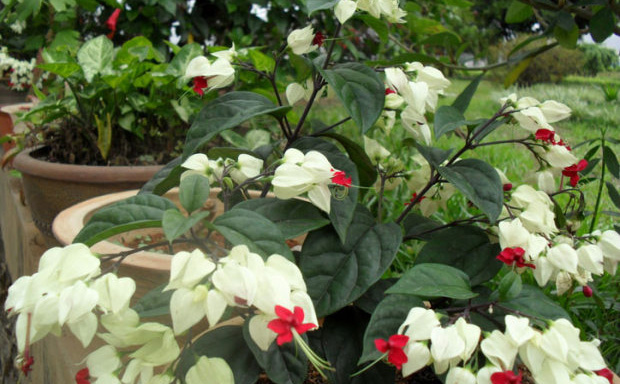
From the name of the bleeding heart vine alone, one can roughly tell that this flower must look very special when it blooms, and indeed that is the case: when the bleeding heart vine blooms, a dazzling little red flower emerges from the split at the tip of the flower, very striking and distinctive. It is a flower very suitable for greenhouse cultivation, but to cultivate an ideal bleeding heart vine, one must first understand its growth habits.
I. Growth Habits of Bleeding Heart Vine
It likes a warm, humid, semi-shaded environment with plenty of sunlight, and is not cold-tolerant. The overwintering temperature should be above 15°C, and it should be kept dry. Being below 10°C for a long time can cause leaf drop and even death. It is propagated by sowing or cuttings; the seeds have a short lifespan, so they should be sown immediately after collection.
The suitable growth temperature for bleeding heart vine is 18-24°C; from February to October it is 18-30°C, and from October to February of the following year it is 13-16°C. In winter the temperature should not be lower than 8°C; below 5°C the stems and leaves are prone to frost damage, with mild cases causing leaf drop and severe cases withering the tender stems. During the vegetative growth period the temperature can be higher; at high temperatures above 30°C, as long as water is supplied sufficiently, it can still grow normally. For reproductive growth, that is, the flowering period, the temperature should be lower, around 17°C.
Use fertile, loose, well-drained sandy loam soil. For potted plants, use a mixed soil of culture soil or peat soil and coarse sand.
II. Growing Methods for Bleeding Heart Vine
1. Planting
For potted bleeding heart vine, generally repot once every 1-2 years, and repotting can be done in early spring or after the flowers fade. When repotting, first cover the drainage hole with broken tile pieces, then add a small amount of bone meal as base fertilizer, then fill in new culture soil (4 parts leaf mold, 4 parts garden soil, 2 parts sandy soil), plant the plant well, and leave 2-3 cm of rim at the top for fertilizing and watering. After repotting, water thoroughly and place in a shaded spot for the plant to recover; after it has recovered, move it to a sunny spot for care.
2. Watering
Bleeding heart vine is relatively sensitive to moisture. During the stem and leaf growth period, the soil should be kept moist, but watering must not be excessive; too much water will cause it to grow only vines without flowering, and even cause leaves to turn yellow, wither and drop, and the roots to rot and die. During the high-temperature summer season, water thoroughly and shade appropriately. In winter, reduce watering to let it go dormant, so as to overwinter safely.
3. Light
Bleeding heart vine needs plenty of light in winter; when the weather is too hot in summer it should be shaded, otherwise the leaves will turn yellow. When light is insufficient, it will grow as vines and not bloom. Flower bud differentiation is not affected by photoperiod, but stronger light promotes flower bud differentiation and development. It should not be placed in darkness for too long; at temperatures above 21°C, exceeding 24 hours will cause flower drop.
4. Soil
Use fertile, loose, well-drained sandy loam soil.
5. Fertilizing
Fertilizing should not be excessive; during the flowering season, apply 1 application of well-rotted dilute cake fertilizer water every 7-10 days, and 3-4 consecutive applications are enough. If yellowing is found during the cultivation of bleeding heart vine, in combination with topdressing, apply 0.2% ferrous sulfate solution, which will gradually turn the leaves from yellow back to green.
Bleeding Heart Vine
III. Disease Control of Bleeding Heart Vine
Bleeding heart vine belongs to the Verbenaceae family and can develop leaf spot disease, which is caused by infection with imperfect fungi. At first there are only small brown spots; if not treated promptly, large black patches will form and the leaves will wither and die. Therefore, once the disease is found, immediately spray the leaves with 800-fold chlorothalonil solution, once every 7-8 days, for 2-3 consecutive times, and it can basically recover.
The main pests include scale insects and whiteflies, which can be sprayed with 1000-fold to 1500-fold 40% omethoate solution. For leaves that cannot unfold normally and lose green and turn yellow due to alkaline soil, water with 0.2% ferrous sulfate solution. For mosaic disease and fungal diseases, promptly remove fallen diseased leaves, strengthen ventilation, and keep the leaves dry to control the condition.
Occasionally growing some rare and exotic plants is actually quite an interesting thing. But no matter which flower or plant is cultivated, one must properly control watering, fertilizing, light exposure and pest control.
Key Points for the Cultivation and Management of Bleeding Heart Vine
The appearance of the bleeding heart vine is very special; it originates from western Africa and is now widely cultivated as a potted climbing flowering plant. The difficulty of artificially cultivating bleeding heart vine is not high, but it needs a suitable growing environment to make the bleeding heart vine more beautiful.
Bleeding Heart Vine
Bleeding heart vine is a flowering plant with a very long flowering period, and is suitable for fertile, well-drained, slightly acidic sandy loam soil. For potted bleeding heart vine, generally repot once every 1-2 years, and repotting can be done in early spring or after the flowers fade. When repotting, first cover the drainage hole with broken tile pieces, then add a small amount of bone meal as base fertilizer, then fill in new culture soil (4 parts leaf mold, 4 parts garden soil, 2 parts sandy soil), plant the plant well, and leave 2-3 cm of rim at the top for fertilizing and watering. After repotting, water thoroughly and place in a shaded spot for the plant to recover; after it has recovered, move it to a sunny spot for care.
Fertilizing bleeding heart vine should not be excessive; during the flowering season, apply 1 application of well-rotted dilute cake fertilizer water every 7-10 days, and 3-4 consecutive applications are enough. If yellowing is found during the cultivation of bleeding heart vine, in combination with topdressing, apply 0.2% ferrous sulfate solution, which will gradually turn the leaves from yellow back to green.