How to Grow Potted Small-Fruited Golden Finger Citron? A Detailed Guide to Care Techniques
First, pruning must be timely. When summer temperatures are high, humidity is great, and nutrition is abundant, the plant will produce large numbers of branches with slender internodes, unsubstantial tissue, and no flower buds. Summer shoots emerge after the plant is brought out of the greenhouse at "Grain Rain", and because they easily compete with spring fruit for nutrients and also affect the growth and development of autumn shoots, apart from a few shaping and nurturing branches, all the rest must be thinned out completely: cut away branchless flower shoots with more than 5 leaves, horizontal branches, clustered buds at the cut, diseased and pest-infested branches, etc., so that nutrients meet the needs of flower and fruit growth.
Second, fertilizing must be reasonable. After finger citron is potted in spring, if the potting soil used is nutrient soil with relatively high fertility, generally no further fertilizing is needed that year. If finger citron is grown in a substrate, then after the seedling is planted and watered, immediately place about 25 granules of imported compound fertilizer, and thereafter apply compound fertilizer once about every 15 days, scattering the fertilizer evenly on the substrate surface; it will seep into the substrate with drip irrigation water or watering.
In mid-to-late August, apply one more round of decomposed organic fertilizer. It begins to bear fruit in the third year, and fertilizing can then follow conventional management. Generally, the plant is brought outdoors around Grain Rain, and sufficient base fertilizer is applied along with repotting, mainly decomposed cake fertilizer residue plus a small amount of bone meal. After the plant has recovered from transplanting, place it outdoors in a sheltered, sunny spot, and apply dilute cake fertilizer water once every 10 to 15 days until flower buds appear, then stop.
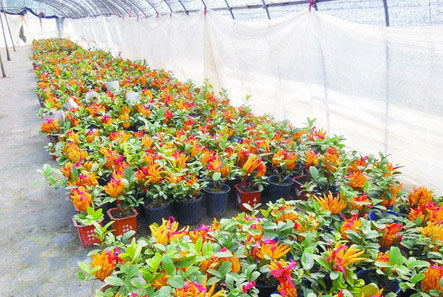
Third, pest damage must be prevented. With abundant rain in summer, small snails and wild slugs cause relatively serious damage; in mild cases they bite pits in new and old leaves, and in severe cases they damage the finger citron fruit, greatly affecting its marketability. For this reason, deep ditches can be dug around the greenhouse to prevent waterlogging, raise the dryness of the ground inside the greenhouse, and build a first line of defense. Second, spread slaked lime around the perimeter to build a second line of defense, disinfecting and contact-killing them. Third, hand-pick them, pinch them to death or throw them into the slaked lime; or use vegetable leaves as traps, scattering cabbage leaves or cabbage (kale) leaves on the seedbed in the evening to trap them, then checking and killing them in the early morning.
Care Techniques for Potted Small-Fruited Golden Finger Citron
Pruning:Timely bud removal and pinching, mainly by manual pruning with chemical bud control as a supplement, fully understanding the relationship between the growth and development of potted finger citron and its flowering and fruiting. By cutting away crossing, overlapping, overly dense, weak, and diseased or pest-infested branches, the goals of even distribution of fruit branches, short and thick branches, an open interior, and good ventilation are achieved. This brings out the delicate, compact beauty of the potted golden finger citron.
The spring shoots that emerge each year in March, apart from those kept to fill gaps and nurture neighboring fruit branches, can be cut away in good time if they are not used as fruiting mother branches.
When summer temperatures are high, humidity is great, and nutrition is abundant, the plant will produce large numbers of branches with slender internodes, unsubstantial tissue, and no flower buds. Summer shoots emerge after the plant is brought out of the greenhouse at "Grain Rain", and because they easily compete with spring fruit for nutrients and also affect the growth and development of autumn shoots, apart from a few shaping and nurturing branches, all the rest must be thinned out completely: cut away branchless flower shoots with more than 5 leaves, horizontal branches, clustered buds at the cut, diseased and pest-infested branches, etc., so that nutrients meet the needs of flower and fruit growth. For some branches or trees that have not fruited for many years, carry out one heavy pruning, keeping 3 to 4 buds at the base of the branch to encourage new branches to sprout and bear fruit.
Autumn shoots are rich in nutrients, grow thick and strong, have short internodes, and are substantial in tissue; the leaves on the shoots are small and plump, with strong leaves of deep green color, and they are the foundation for flowering and fruit set the following year. Apart from cutting away thin, weak shoots and overly dense shoots, they are generally not pruned, and basically all should be kept as next year's fruiting mother branches. Therefore, autumn shoots should be given strengthened care; this is the key to finger citron flowering more and bearing more fruit.
Fertilizing:
The key technique for growing finger citron well is reasonable fertilizing.
After young finger citron is potted in spring, if the potting soil used is nutrient soil with relatively high fertility, generally no further fertilizing is needed that year. If finger citron is grown in a substrate, then after the seedling is planted and watered, immediately place about 25 granules of imported compound fertilizer, and thereafter apply compound fertilizer once about every 15 days, scattering the fertilizer evenly on the substrate surface; it will seep into the substrate with drip irrigation water or watering.
In mid-to-late August, apply one more round of decomposed organic fertilizer. It begins to bear fruit in the third year, and fertilizing can then follow conventional management. Generally, the plant is brought outdoors around Grain Rain, and sufficient base fertilizer is applied along with repotting, mainly decomposed cake fertilizer residue plus a small amount of bone meal. After the plant has recovered from transplanting, place it outdoors in a sheltered, sunny spot, and apply dilute cake fertilizer water once every 10 to 15 days until flower buds appear, then stop.
During the flower bud stage, spray the leaf surface once or twice with 0.2% potassium dihydrogen phosphate solution. After fruit set, apply dilute chicken or duck manure water or cake fertilizer water once about every 10 days, for two or three consecutive applications. To prevent chlorosis, water once every 15 to 20 days with 0.2% ferrous sulfate water to keep the soil slightly acidic.
In the second year's spring, apply decomposed human manure, cake fertilizer water, etc. once every 15 to 20 days, for two or three consecutive applications.
Watering:
After the pot-in-pot transplanting is finished, watering is essential and must be thorough, so that the seedling roots and substrate bind tightly together. Because the substrate is light and has strong buoyancy, take care when watering: use a watering can to spray, and do not pour, otherwise the substrate will be washed out of the pot or pits will be washed into the substrate surface. At the same time, during the growth period the potting soil must be kept moderately moist, preferably in a state of about 60 percent moisture (more than half soil moisture). In summer, water generously, and frequently spray-wash the branches and leaves and sprinkle water on the ground around the flowerpot to lower temperature and raise humidity.
In the rainy season, keep it on the dry side to prevent excessive vegetative growth. In the early stage of fruit set, watering should be appropriately controlled to avoid fruit drop from too much water.
After the Start of Autumn, watering should be gradually reduced. In the north, move it indoors before Frost's Descent, place it in a sunny spot, keep the room temperature above 5°C, control watering, and watering once every 7 to 10 days is sufficient. Spray-wash the branches and leaves once a week with clean water close to room temperature to prevent dust from settling on the leaf surface and causing leaf drop.
If conditions permit, a drip irrigation system can be installed; the cost is not too high, and it can greatly reduce labor intensity. Watering times can be based on experience: when the soilless substrate feels 80 percent dry and the potted finger citron has become light in weight, it can be watered then. Soilless cultivation substrate has relatively strong water retention and air permeability, so too much water will not do much harm.
With abundant rain in summer, small snails and wild slugs cause relatively serious damage; in mild cases they bite pits in new and old leaves, and in severe cases they damage the finger citron fruit, greatly affecting its marketability. For this reason, deep ditches can be dug around the greenhouse to prevent waterlogging, raise the dryness of the ground inside the greenhouse, and build a first line of defense. Second, spread slaked lime around the perimeter to build a second line of defense, disinfecting and contact-killing them. Third, hand-pick them, pinch them to death or throw them into the slaked lime; or use vegetable leaves as traps, scattering cabbage leaves or cabbage (kale) leaves on the seedbed in the evening to trap them, then checking and killing them in the early morning.
In the early stage of damage, from March to April apply 6% Mesurol granules (250 grams per mu), or sprinkle tea-seed cake liquid on the soil ridges around the seedbed for contact-killing (boil 1 kg of tea-seed cake powder in 10 kg of water for half an hour, knead and sieve, take the clarified liquid, then mix evenly with 60 kg of water); 70 to 100 times diluted ammonia water can also be sprinkled near the plants in the evening; or spray with 800 to 1000 times diluted Miezhiling solution for control. For snail control, 8% Miewoling granules or 10% metaldehyde granules can also be used, at 1.5 grams per sq m.
How to Grow Kumquat
Kumquat, also known as golden kumquat, golden bullet, golden jujube, etc. An evergreen shrub or small tree of the Rutaceae family. Native to tropical regions of Asia and to Fujian, Taiwan, China, Guangdong, Guangxi and other places in China.
Ornamental cultivated species in the same genus include:
Golden Bullet: leaves thick and hard, fruit large and round, sweet taste with few seeds, excellent quality.
Golden Bean: fruit small like a bean. Plant form short and small, leaves also small, not edible.
Round Kumquat: fruit small and round, bright pure yellow.
Longevity Kumquat: also known as four-season kumquat, monthly orange. Fruit obovoid, with an inward-curving top and a slightly pointed base, pale yellow, fragrant.
Long-Leaf Kumquat: leaves long lanceolate, fruit round, thin skin, not cold-tolerant.
1. Morphological characteristics: much branched, usually spiny, branches slender. Leaves oblong, surface deep green and glossy, with scattered oil gland dots on the leaf underside. Flowers solitary or 2〜3 clustered in the leaf axils, white and fra grant. Fruit small, oblong or obovoid, golden yellow when ripe. Flowering period June〜August, fruiting period November to the following
February of the next year. In spring some fruits turn from yellow back to green and remain on the branch tips to continue growing.
Growth habits: prefers a warm, humid climate and conditions of ample sunlight. Has a certain cold tolerance; in the Yangtze River basin, under good microclimate conditions it can overwinter outdoors. Relatively drought-tolerant, slightly shade-tolerant, and prefers deep soil layers, well-drained, fertile, slightly acidic sandy loam.
Propagation method: kumquat is mostly propagated by grafting, with orange or trifoliate orange (bitter orange) commonly used as rootstock. Commonly used methods are approach grafting and cut grafting. This is often done in March〜April, with strong one-year-old branches selected as scions. After grafting, they survive in about 20-odd days; the key is to align the cambium, and after putting on a plastic bag, use a 5 cm shade net to provide shade when sunlight is strong.
Cultivation and care: for kumquat cultivation, focus on doing the following work well:
It is advisable to choose an unglazed clay pot with good drainage and good air permeability.
For the growing medium, use well-drained sandy loam mixed with about 20% rice husk ash or peat soil; the former needs to be aged material that has been leached with water.
For irrigation and fertilizing, refer to the requirements for finger citron.
In high-temperature seasons, provide appropriate shade and spray water; in winter, potted kumquat should be moved indoors to a sunny spot. Bring it outdoors after Pure Brightness.
—Generally the first pruning is done after bringing it outdoors, when all old branches should be heavily pruned, and all weak branches, diseased branches, and superfluous branches cut away. Combine pruning with overall shaping, generally keeping 3〜4 main trunks, extending evenly in all directions. The second is in May, when new branches grow to 15〜20 cm, carry out overall pinching to induce secondary branches to sprout. In early June, do the third pruning, pinching the secondary branches once more to encourage a third round of branches, so as to expand the crown and increase fruiting positions. After flowering, appropriately thin the flowers; after fruiting, keep 1〜2 fruits per branch, and promptly remove small fruits and diseased fruits. Branches that have not fruited should also be cut away.
In addition, potted kumquat should be repotted and the soil changed once every 1〜2 years, cutting away superfluous roots along the pot rim, to achieve rejuvenation of the root mass and improve the ventilation and air permeability of the potting soil.
For pest and disease control, refer to the section on finger citron.
Horticultural uses: the kumquat tree has an elegant posture, stays green all year round, its flowers are fragrant far and wide, and its golden fruits are brilliant; it has extremely high ornamental value and is a traditional Chinese fruiting ornamental plant for the Lantern Festival. It can also be used for courtyard landscaping. Its flowers can be used to make tea, fragrant and tasty. The fruit is edible and can be processed into candied fruit, jam, etc. The peel, seeds, and roots of the kumquat can all be used as medicine.