What are the common cultivated varieties of daylily?
Daylily is also called yellow flower vegetable. The flowers range from pale yellow to orange-yellow, in a broad funnel form, with a blooming period from May to September.
Those widely cultivated at present include:
1. Daylily (Hemerocallis fulva). Conical cymes, each scape bearing 6 to 12 flowers, flowers 7 to 11 cm long, petal edges wrinkled, orange-red to orange-yellow, with red-brown color patches on the lower part of the segments. When the flowers are fully open the petals curl backward, with a blooming period from May to August.
2. Double-flowered daylily. Also called thousand-grass daylily. Flowers large, up to 8 cm in diameter, pale yellow, inner petals orange-yellow. There are garden varieties in pure yellow, golden yellow and dark red, as well as those with carmine and purplish-red spots on the petals.
3. Lemon daylily. Also called yellow flower vegetable. Flowers pale lemon-yellow, with a faint fresh fragrance, blooming profusely. Blooming period from July to August. A single flower opens at dusk and closes before noon the next day.
4. Northern daylily. Also called yellow-flowered daylily. Flowers pale yellow or yellow, glossy, fragrant. Blooming period from May to July. A single flower opens at dusk and withers before noon the next day.
5. Small yellow daylily. Also called red daylily. The scape is short, the same length as the leaves. The corolla is deeply cleft, the inner and outer petals are the same size, golden yellow, fragrant, opening in the evening and closing before noon the next day. Blooming period from June to August.
6. Large-flowered daylily. Flowers 2 to 4, yellow, fragrant, the flower tube cylindrical, the pedicel extremely short, with large triangular bracts. Blooming period in July.
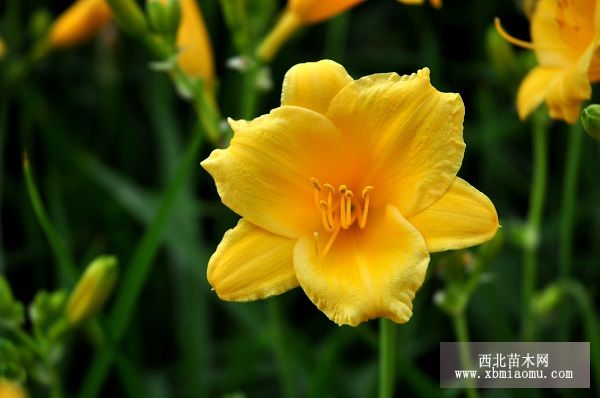
A perennial herbaceous perennial, with a short thick rhizome underground and a fleshy root system. The leaves are clustered and basal, in a strap-like lanceolate shape. The flower scape is about 1 m tall, with terminal cymes, each cyme bearing 6 to 12 flowers. The flowers are large, funnel-shaped, orange-red, and produce capsules. The garden varieties of daylily number more than ten thousand. According to their different colors, they are roughly divided into the white series, yellow series, peach-red series, red series, dark red series and purple series, etc. Among the same genus, those commonly cultivated include the large-flowered daylily, golden needle vegetable, yellow flower vegetable and small yellow daylily, etc.
(2) Ecological habits
It is distributed from southern Europe through northern Asia all the way to Japan, but it is mainly produced in the Yangtze River basin of our country. It has wide adaptability, likes moisture but also tolerates drought, likes sunlight but also tolerates partial shade, and can grow in ordinary soil, but sandy loam that drains well and is rich in humus is best.
New shoots sprout in early spring, the blooming period is from early June to mid-July, each flower opens for one day, the capsules ripen in mid-August, and very few seeds are set. The aboveground part withers in early December, and the perennial roots overwinter in the open ground.
(3) Propagation methods
Division propagation is the main method; seed propagation is used when breeding.
Division propagation is carried out after the leaves wither or before sprouting in early spring. Dig up the root clump, cut off the dead roots and excess fibrous roots, and divide it into separate plants. After one division, the plants can be divided again after 4 to 5 years, and the divided plants can bloom in the same year.
Seed propagation is best done by autumn sowing, and seedlings generally emerge about 4 weeks after sowing. If the seeds are sown immediately after being collected in summer and autumn, seedlings emerge in about 20 days. Seedlings grown from sowing bloom after 2 years of cultivation.
(4) Cultivation and management
Cultivation and management are simple and extensive. The plant and row spacing is about 0.5 × 1 m, with 3 to 5 plants per hole. Apply sufficient base fertilizer before planting. Because the daylily has strong adaptability, it can be planted almost anywhere and left to grow, and the clump can keep expanding year after year, but when arranging plantings in a garden, they should be matched according to plant height and flower color to improve the ornamental effect.