What are the common cultivated varieties of gladiolus?
Common cultivated gladioli include:
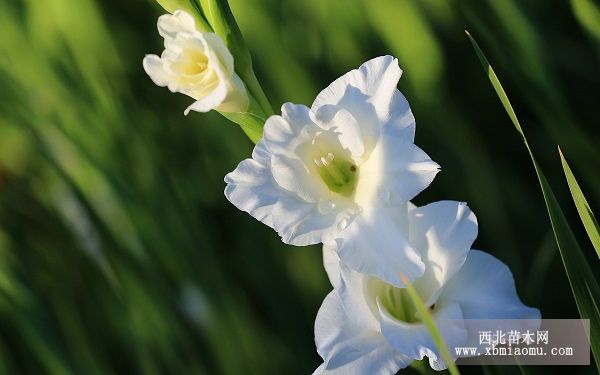
1. Gladiolus. Also known as "shiyangjin" (assorted brocade). It is a spring-planted bulbous flower. The flower stalk is thick and unbranched, the plant height is about 1 m, with a terminal spike inflorescence bearing 10-20 flowers. The flowers are usually arranged in two rows, mostly leaning to one side, opening successively from bottom to top. The corolla is funnel-shaped, slightly curved outward, with variable flower colors including white, yellow, pink, blue, purple, orange and others, as well as bicolors and spots or markings of different colors. Natural flowering period is summer.
2. Flesh-colored gladiolus. Plant height about 30 cm, 4 leaves, 3-10 flowers, pale pink or milky white, with red or purple spots, the flower tube red or purplish red.
3. Natal gladiolus. Plant height over 1 m, 10-12 flowers, the upper 3 lobes dark red, hood-shaped, the lower 3 lobes very small, mixed yellow and red.
4. Fragrant gladiolus. Plant height 15 cm, one leaf, produced after flowering, spirally curled, with yellow margins, 7-13 flowers, fragrant. Color variable, the corolla lobes often dark light purplish red with yellow edges, with a hood-shaped lobe in the upper middle.
5. Garden gladiolus. Many flowers, straight flower stalk, open corolla, flower color light purple or light reddish purple. Upper lobes hood-shaped, with diverse halos and blotches.
Sclerotinia disease: a fungal disease; when it occurs, the leaves turn yellow and then tea-colored, and in severe cases the aboveground part dies. Inspecting the affected stem, white mold and black sclerotia can be seen. You can spray 50% benomyl wettable powder at 1000-fold, or before planting apply 70% quintozene powder in furrows, 1.5-3 kg per mu, for soil disinfection.
Rust: a fungal disease. Diseased leaves show fine golden-yellow and brown spots, the epidermis ruptures, and rust-brown powder is released. In severe cases, plant growth is hindered, flowering is poor or absent, and new corms and seeds cannot be produced, and the plant may even die. You can spray 60% zineb wettable powder at 600-fold. When the disease is severe, remove and burn the diseased leaves.
Hardening disease: a soil-borne fungal disease. The pathogen can infect leaves and corms, first showing dark brown round spots, later turning black, with the inside of the spot discolored and sunken; affected plants stop growing and do not flower. The incidence is especially high in continuously cropped land. At the site of occurrence, spray plants and soil with 0.5 degree Bordeaux mixture for disinfection, and dig out and burn severely diseased plants.
Characteristics, cultivation and management of gladiolus
1. What characteristics does gladiolus have? What varieties are there?
Gladiolus, originally named changlan, malan, shiyangjin and so on. Gladiolus is the Japanese name for changlan, meaning Chinese calamus, and now it is customarily called gladiolus. Gladiolus originates from Africa and the Mediterranean coast, and is most widely distributed in the Cape of Good Hope in South Africa.
Gladiolus belongs to the Iridaceae family, genus Gladiolus, a perennial cormous herbaceous flower. The underground corm is flattened and round, about the size of a water chestnut or garlic bulb, wrapped in a membranous or fibrous brown outer skin. The leaves are sword-shaped, hard in texture, 7-8 leaves arranged in an overlapping manner; up to 60 cm long and 4-5 cm wide, with parallel, prominent veins. The cyme bears 12-24 flowers, arranged in two rows, leaning to one side, up to 30 cm long; the corolla is bilaterally symmetrical, funnel-shaped, slightly curved upward; the flower diameter reaches 12-16 cm. The flower stem is drawn out from the leaf cluster, and each flower is borne in each bract. Flower colors include white, yellow, light red, carmine, light purple, orange-red, sky blue and various striped colors; there are single-petaled and semi-double forms, with single-petaled being the majority. Flowering period is -September. Capsule.
There are as many as nearly ten thousand gladiolus varieties. According to different flowering periods, they can be divided into two major categories: spring-flowering types and summer-flowering types. Spring-flowering types are cultivated in autumn in warm regions and flower the following spring; summer-flowering types are planted in spring,
and flower in summer. Summer-flowering types can further be divided according to different growth periods into early-flowering, mid-flowering and late-flowering three types. Early-flowering types flower in 55-65 days; mid-flowering types flower in 75 days; late-flowering types flower in 85-95 days. According to different lobe forms, they can be divided into three types: flat-petaled, ruffled-petaled and waved-petaled.
In addition, gladiolus is very sensitive to the highly toxic gas hydrogen fluoride; when exposed to hydrogen fluoride gas, the leaves will turn yellow and wilt, so it can be used to monitor hydrogen fluoride pollution, which is why it is a very good environmental protection and landscaping flower. The corm of gladiolus is also a traditional Chinese medicine, with the effects of clearing heat and detoxifying, and dispersing blood stasis and reducing swelling.
2. How is gladiolus cultivated and managed?
Gladiolus prefers a warm and humid climate, dislikes high temperature, and is not cold-tolerant; the suitable growth temperature is 20-25 degrees. It likes a sunny, well-ventilated environment, fears waterlogging, and is suitable for fertile, well-drained, humus-rich sandy soil, with a pH of 5.6-6.5 being best. Before planting, the corms of gladiolus should be selected, choosing disease-free, spot-free flattened round small and medium corms with undamaged sprouting and rooting parts for cultivation.
After the corms are planted, water them thoroughly once, place them in a ventilated and sunny place, and keep the soil moist. After the flower spikes are drawn out in spring and summer, avoid water shortage and drought, but do not water too much either, so that water accumulates in the pot and causes waterlogging. Gladiolus does not like heavy fertilizer, otherwise it will cause excessive vegetative growth and lodging. During the growing period, generally applying thin topdressing 4 times is enough. The first time is when two leaves have grown; the second time is at bud stage; the third time is after the flower spike is fully drawn out; the fourth time is after the flowers fade. For topdressing, decomposed human manure and urine are best; at bud stage, phosphorus fertilizer should be added. During the flowering period, pay attention to shading the plants, and in hot and dry weather, spray water on the plants. The amount of fertilizer applied should be based on the actual growth of the plants; too much fertilizer will cause excessive growth and lodging; too little will cause leaf scorch and yellowing and flowers lacking luster.
Long-day conditions are favorable for flower bud differentiation in gladiolus; insufficient light will reduce flowering. However, after flower bud differentiation, short-day conditions can promote flower bud growth and early flowering.
3. How can gladiolus be made to flower all year round?
As introduced above, gladiolus can be divided into two major categories, spring-flowering types and summer-flowering types, and summer-flowering types can be divided into early-flowering, mid-flowering and late-flowering three types. If you want gladiolus to flower all year round, this goal can be achieved by selecting different varieties and planting them in stages. For example, if a batch is planted every half month from March to July, then they can flower continuously from mid-June to around National Day; if relatively low-temperature-tolerant varieties are selected and planted from August to September, and after autumn cools the room temperature can be kept at 15 degrees, then they can flower in November-December; if a batch is planted in the greenhouse from October to December, with room temperature above 15 degrees and ensuring 13 hours of light per day, then they can flower from New Year's Day to May Day.
4. How is gladiolus propagated?
Gladiolus can be propagated by division of corms and by sowing, and the division method is usually used more often, because this method of propagation helps maintain varietal characteristics.
Every year after autumn, after gladiolus withers, dig out the underground corms. Around the mother corm there are generally more than two new corms, and many cormels are attached to the new corms. We can separate them, remove the old corms, then classify them by size, put them in cloth bags, hang them in a ventilated place, dry them in the shade for later use. Propagating with new large corms can flower the same year; propagating with cormels can flower only the second year. If the number of corms in a year is small and you want to propagate more, you can use the method of cutting the corms for propagation. Two-year-old corms generally have 4-6 buds. Arranged in a straight line. When cutting the corm with a knife, make sure each part carries buds and a rooting part, so that after planting it can sprout and root and grow into a new plant.
Seed propagation is mostly used when carrying out hybrid breeding of new varieties. When gladiolus is in full bloom, select good male and female parents, remove the stamens of the female parent flower, and carry out artificial pollination hybridization. The pollination time should avoid summer, because gladiolus fears heat, so as to avoid infertility in pollination during hot weather. The capsule splits open by itself when mature, so seeds should be collected in time. After collection, seeds should be sown promptly; soaking the seeds in warm water for 5-6 hours before sowing makes germination easier. The plant can grow small corms underground in the same year; after autumn dig them out, dry them in the shade and store them, and after replanting the next year they can flower. Note that from these, keep the good and discard the inferior before replanting; after the second flowering, once again keep the good and discard the inferior; after the third flowering, their traits are basically stable, and a new variety has been bred.
5. How are gladiolus pests and diseases prevented and controlled?
Common diseases of gladiolus include corm rot, leaf blight and so on; common pests include thrips, slugs and so on.
Corm rot is a disease that often occurs during storage. After infection, yellow-brown slightly sunken lesions appear on the corm surface, with black ulcer-like areas around them; when air humidity is high, the lesions expand rapidly and a blue-green mold layer appears on the surface, causing the corm to shrink and become dry and hard. Preventive measures are to be careful when digging up the corms to avoid wounding them. After harvesting the corms, it is best to first soak them in cold water, then disinfect them with alcohol, dry them in the shade and store them, and keep the storage room ventilated and dry, maintaining a low temperature of 4-5 degrees.
Leaf blight mostly starts from the tips of the lower leaves of gladiolus, initially as faded green yellow spots, and later the lesions dry up and a dark brown mold layer appears; the disease is more severe from July to September. Preventive measures are to peel off the dried scales of the corms before planting. And soak the corms in 0.5% potassium permanganate for 15 minutes for disinfection. Or at the early stage of disease occurrence in the plants, spray once every 8-10 days with 1% equal-amount Bordeaux mixture or 50% zineb at 1000-fold.
Thrips: the adults and nymphs of this pest generally hide in the leaf axils during the day and harm the plants, and crawl onto the leaf surface to harm them on cloudy days or at night. They mainly feed on the leaves, stems and flowers of the plants, causing the leaves to discolor, leaving grayish-white dot-like feeding marks and egg-laying marks on the corolla, causing the petals to curl. You can spray 2.5% deltamethrin at 400-fold for control.
Slugs, commonly known as "nasal mucus worms," are a widely distributed pest with omnivorous feeding habits; their adults and nymphs mostly nibble the tender buds and leaves of plants, and where they crawl they often leave silvery-white traces. You can spray 3% lime water or 100-fold ammonia water for control.