How to care for potted geraniums? Detailed care methods and tips
Lately quite a few friends have asked me how to care for potted geraniums, so below I will share a few points from my own experience caring for potted geraniums:
1. Potting soil. Potted geraniums can use a growing mix made from leaf mold and peat moss plus 1/5 river sand and a small amount of cake fertilizer powder as a base fertilizer, or a mix of compost soil, leaf mold, garden soil and river sand at 1/4 each, plus a small amount of bone meal as the growing medium.
2. Light and temperature. It likes full sunlight and a cool climate, and fears intense summer heat and humidity, so in autumn, winter and spring it should all be grown in a spot with direct sunlight. In the hot summer season, once the temperature exceeds 35 degrees, it enters a semi-dormant state, and fertilization should stop and watering should be controlled. From the start of summer, move the pot to a cool, ventilated place or a north-facing windowsill or balcony, and also mist it frequently to lower the temperature.
3. Watering. It is fairly fond of fertilizer and somewhat tolerant of dryness, but fears waterlogging. Therefore, in the vigorous growing seasons of spring and autumn, it is best to apply a liquid fertilizer combining nitrogen and phosphorus once every half month. Normally, water just enough to keep the potting soil moist, and never let water accumulate in the pot. Otherwise it will cause root rot and even plant death.
It is not cold-tolerant, so in northern regions move it indoors before the early frost arrives in early to mid-October. In winter, the amount of watering depends on the room temperature. If the room temperature can only be maintained at 6~8 degrees, watering must be strictly controlled, and it is best to keep the potting soil slightly moist; if the room temperature can be kept above 12 degrees, water a little more generously, and at the same time apply a dilute liquid fertilizer once every half month so it can continue growing. Some varieties can even continue blooming without pause.
4. Repotting. Geraniums grow fast, so it is best to repot and change the soil once a year after the Start of Autumn. In the second year, move it outdoors in late April. In spring, do not water too much, otherwise it easily causes the plant to grow leggy or develop yellow leaves, affecting blooming.
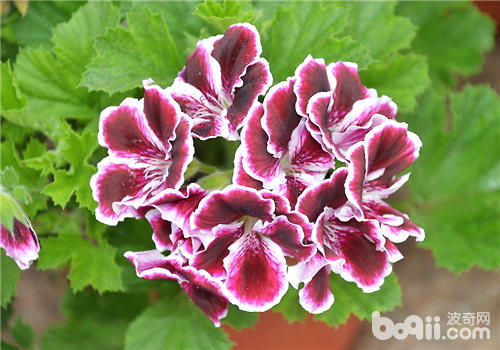
Geranium (detailed introduction)
1. Light:Geraniums are actually quite fond of light, especially in autumn, when you should find a way to give them full sunlight. Because of the balcony situation, my flower stand basically has to be moved once every season to follow the light. If conditions permit, in winter you should also give the maximum possible light, while in summer it should be placed in a spot with filtered light to avoid being scorched to death.
2. Temperature:The most suitable temperature for geraniums is 10--20 degrees Celsius, which means spring and autumn are the most suitable, while winter is too cold and summer too hot. So in summer you must prevent exposure to the scorching sun and put it in a shady place. In winter, the indoor temperature should not drop below 0°, otherwise it will suffer frost damage; if there is no heating equipment, turning on a 200° large light bulb in a small room also has a certain frost-prevention effect.
3. Planting pot:Although geraniums are not large plants, a pot that is too small will not do either, especially for trailing geraniums, where it is best to choose a taller pot and then keep the soil surface a bit higher from the pot rim, so as to avoid the plant breaking from being too heavy after it grows, effectively acting as a small support. For upright types, choose a pot of about 20 cm, while for Angel's Eye, if you want to grow it well, you need a pot of 30 cm or more.
4. Fertilizing:Applying too much fertilizer at once will cause dehydration in geraniums. If too much fertilizer is applied, for example too much nitrogen fertilizer, it will cause the plant to grow wildly without blooming. After over-fertilizing, watering diligently can alleviate the symptoms.
5. Growing soil:Geraniums are suited to growing in sandy soil. Mixing some sand into the soil bought at the flower market is more beneficial to the growth of geraniums.
6. Watering:Geraniums must never be overwatered. If you find the roots of a geranium rotting, it may be because of overwatering combined with rather muggy weather. Keep the watering frequency to once every two or three days, and each time water heavily, making sure to water thoroughly.
7. Weather effects:Strong winds will snap geraniums, while heavy rain will cause the roots of geraniums to be soaked in rainwater, resulting in a lack of oxygen for root respiration and thus rot.
Geranium propagation methods with pictures, and precautions for caring for potted geraniums
Geraniums are ornamental flowers commonly grown in homes, and because their flowering period is long and they can bloom during the Spring Festival, they have always been loved by people. So the propagation methods of geraniums are one of the flower-growing techniques we must master. Potted geraniums are generally propagated by two methods, sowing and cuttings, with the specific requirements described below:Geranium propagation methods
1. Propagation by sowing
This can be done in both spring and autumn, with indoor pot sowing in spring being preferable. The suitable germination temperature is 20~25°C. Geranium seeds are not large, so after sowing do not cover with soil too deeply; they germinate in about 2~5 days. If sown in autumn, they can bloom the following summer. From seedlings grown by sowing, excellent intermediate-type varieties can be selected and bred.
2. Propagation by cuttings
Except when geraniums are in a semi-dormant state in June~July, cuttings can be taken at any time. Spring and autumn are preferable. In the high summer heat, cuttings easily turn black and rot. Choose a cutting 10 cm long, with the tip portion being best, as it has strong growth vigor and roots quickly. After cutting the stem, let the cut dry for several days until a thin film forms, then insert it into a sand bed or a mixed medium of expanded perlite and peat, taking care not to damage the stem skin of the cutting, otherwise the wound easily rots. After inserting, place it in partial shade and keep the room temperature at 13~18°C; after insertion it roots in 14~21 days, and when the roots are 3~4 cm long it can be potted. During the cutting process, soaking the base of the cutting in a 0.01% indolebutyric acid solution for 2 seconds can increase the survival rate and rooting rate of the cuttings. Generally, geranium cuttings bloom after 6 months of cultivation, that is, cuttings taken in January bloom in June; cuttings taken in October bloom in February~March of the following year.Precautions for geranium care
For potted geraniums, the potting soil can be leaf mold mixed with an appropriate amount of sand and rice husk ash, plus a small amount of bone meal. The pot should be changed once a year, replacing it with fresh growing soil, to favor growth and blooming. Repotting is best done from mid-August to early September. Before repotting, first prune and shape the plant, and wait until the potting soil and the cut surfaces are dry before repotting. When repotting, appropriately trim away some of the longer and excessive fibrous roots. Every year in mid-to-late April, place it outdoors in a well-ventilated, sunny spot for care. To keep it blooming continuously, apply dilute decomposed cake fertilizer water frequently, generally once every 10 days. Ordinarily, watering does not need to be excessive. Otherwise it will cause the leaves to turn yellow and the plant to grow poorly, unable to form robust flower buds.
Control watering: generally water again when the leaf tips wilt, and when watering, water thoroughly. From late June to early August, the climate is hot and geraniums are in a semi-dormant state, so fertilization should stop and watering should be controlled. High temperatures, direct sunlight and water accumulating in the pot after rain will all affect the dormancy of geraniums, and can even cause root rot and death. Therefore, during the dormant period, place it on a shaded balcony, windowsill, or a spot in the yard that avoids light and is sheltered from rain. Doing so can also shorten the dormancy period.
Environmental requirements: adjust the environment for care according to the agricultural season and temperature. Generally, in spring and autumn place it outdoors for care; in summer, when high temperatures bring on the semi-dormant period, stop fertilizing and place it in a ventilated, partially shaded spot; if ventilation and shade cooling measures are used, you can get it to break dormancy early and grow and bloom earlier; outdoors, pay attention to preventing scorching sun exposure, hot and muggy humidity, and water accumulation in the pot from heavy rain; in winter, it is best to keep it indoors or in a greenhouse. In modern home life, an air conditioner can be used to adjust a suitable temperature, and as long as the light conditions are met, geraniums can bloom year-round.
Fertilizer and water management: as autumn arrives and the temperature drops, geranium plants begin to grow and enter the vigorous growth period. At this time, fertilizer and water management should be strengthened, applying a dilute nitrogen, phosphorus and potassium compound liquid fertilizer about once every 10 days; in early spring, autumn and winter, apply additional diluted phosphorus and potassium liquid fertilizer; the potting soil should be kept moist, and thick fertilizer and high humidity must be avoided.
Proper pruning: the leggy branches and the stems left after flowering of geraniums should be moderately cut back and reshaped to encourage new branches, and heavy pruning must be avoided; clear away old yellow leaves to keep the plant clean and the flowers abundant and attractive. Pruning branches and pinching is done to encourage a geranium with more branches to bloom more; the plant should be pinched several times to promote more branching and bud formation. After the flowers fade, promptly cut off the spent flowers and remove overly dense and weak branches, so as to avoid excessive consumption of nutrients, but in winter when it is cold, heavy pruning is not advisable.
If you want to learn more about care and management methods, you can refer to: Geranium growing methods and precautions.