How to grow Cymbidium orchids? These care essentials you need to master
How to grow Cymbidium orchids: care essentials for Cymbidium orchids: Cymbidium orchids, also known as tiger-head orchids and yellow cicada orchids, are an excellent tropical orchid species. They are famous for their abundant flower colors and varieties, large flowers with many blooms, and long flowering period; flowering can last from November until May of the following year. Cymbidium orchids have relatively high requirements for management and care work, and growers should treat them with care.
Temperature and light: Cymbidium orchids originate from low-latitude, high-altitude areas. The suitable growth temperature is 10°C to 25°C, and the overwintering temperature should not be too high; around 10°C at night is more suitable. Cymbidium orchids like light, and except during the high-temperature summer season, they can receive direct sunlight. During high temperatures, about 30% shading should be provided to promote flower bud formation while preventing the leaves from being scorched by the sun.
Watering and moisture retention: Cymbidium orchids have relatively high water requirements. During the growth period, the soil must not be allowed to dry out. In principle, water as soon as it dries, and water thoroughly when watering. In spring, autumn, and winter, water once every three or four days, and as temperatures rise, gradually increase the frequency of watering. In hot summer, water 2 to 3 times a day, and frequently spray water on the leaves, and increase air humidity to avoid the appearance of yellow leaves.
Reasonable fertilization: During the growth period, apply thin fertilizer frequently. A dilute chemical fertilizer or compound fertilizer can be applied as a top dressing. If more bone meal or rotted bean cake fertilizer is applied, the flowers can be larger and more numerous. Liquid fertilizer should be diluted at 1:1000 and applied once every 10 days. Before flowering, apply sufficient fertilizer; do not fertilize during the flowering period or in the hottest summer season.
Removing and wiping out leaf buds: The pseudobulbs of Cymbidium orchids generally contain more than 4 leaf buds. In order not to disperse nutrients, the newly emerging small buds and their growing points must be thoroughly removed and wiped out. This operation should begin after the flowering period ends, removing buds once a month, and stop before the new flowering period, so as to concentrate nutrients, strengthen the mother pseudobulb, and make the flowers bloom larger and more numerous.
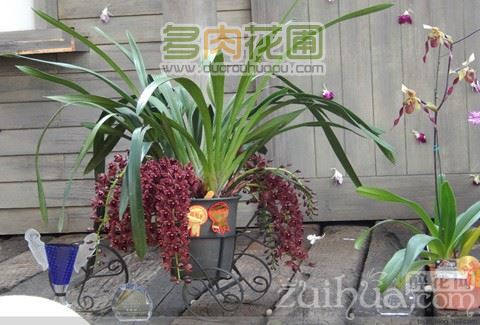
Growth habits and cultivation techniques of Cymbidium orchids
To grow Cymbidium orchids, first "know Cymbidium orchids." First of all, you must understand the ecological habits of Cymbidium orchids, which has important guiding significance for growing them well. To grow orchids well, environment comes first. If we create and set up a living environment corresponding to their native habitat according to the ecological habits of Cymbidium orchids, and strengthen management, Cymbidium orchids will certainly, like other orchids, survive, grow well, become strong, and bloom. Now, based on the main habits of Cymbidium orchids, let us discuss the key cultivation points for growing them:
1. Cymbidium orchids have the important habit of "liking sunlight and fearing shade."Most native habitats of Cymbidium orchids are on higher-altitude mountaintops or upper parts of mountains, with ample light. The ancients said: "Orchids grow in shade, Cymbidium orchids grow in sun." Therefore, when cultivating Cymbidium orchids at home, attention must be paid to solving the light problem and setting up a similar ecological environment for them. Place the orchid pot in a sunny position facing southeast, so that it can enjoy ample sunlight year-round. Except in summer and early autumn, when shade nets should be used to block the scorching sun around noon, in the other seasons sunlight can be allowed in full, to enhance photosynthesis, accelerate nutrient production, and promote plant growth. Practice has proven that more sunlight can strengthen the plants, promote root development, widen the leaves, thicken the veins, shorten the leaves, and increase flowering. With weak light, Cymbidium orchids will develop poorly. They easily decline and are not easy to bloom. Only with suitable light can the orchid plants grow verdant and spirited.
2. Cymbidium orchids have the habit of needing relatively more nutrients than other orchids.The pseudobulbs of Cymbidium orchids are small and store relatively few nutrients, while the leaves are numerous and long, so nutrient consumption is correspondingly greater. In addition, while Cymbidium orchids send up new shoots, the old shoots are still growing new leaves, consuming even more nutrients. Coarse planting material has poor water and fertilizer retention, so it is difficult to meet normal growth needs. In the natural environment, Cymbidium orchids rely on their well-developed root systems to absorb nutrients from the earth to meet their own growth needs. In nurseries and home orchid growing, restricted by flower pots, the advantages of the well-developed root system cannot be brought into play, and the favorable conditions of nature are completely gone, so more fertilizer must be applied to supplement nutrients. Potted Cymbidium orchids require more fertilizer than other orchid species. The amount of fertilizer applied should be twice as concentrated as that for Cymbidium goeringii. At the same time, various elements must be scientifically matched, and thin fertilizer should be applied frequently. Relying on their own thick, well-developed root systems, they absorb nutrients from the planting material, and in addition appropriate extra-root top dressing (foliar spraying) should be used. For example, in normal times a prepared fertilizer solution of monopotassium phosphate at 2/1000 can often be used to spray the leaves. A 2/1000 glucose solution can also be used and sprayed on the leaves and shoots as if it were clear water; it is quite effective. In 10 days, the leaf color will become glossy and the leaves will thicken and widen. If fertilization is done at the same level as for Cymbidium goeringii, Cymbidium orchids cannot be accelerated in propagation and grow robustly. Exceptions are old, weak, diseased seedlings and newly collected Cymbidium orchids that have not yet adapted to the pot; these should mainly be given light cultivation.
3. Cymbidium orchids have the characteristics of thick, long roots, tall plants, and high "foot armor."Therefore, potted Cymbidium orchids are suitable for large pots and deep pots, and should be cultivated by deep planting to meet the growth requirements of the orchid roots. Practice has proven that deep planting is better than shallow planting: the new shoots are stronger and it is easier to produce flowers.
4. Cymbidium orchids have a growth cycle longer than other orchid species. Newly collected Cymbidium orchids grow slowly. First, this is related to the relatively poor soil in their native habitat.Second, when orchid plants are dug up from the mountains, the roots are severely damaged. After being collected, the time from storage and transport to replanting is long, nutrients are greatly consumed, and vitality is severely damaged. They must go through a fairly long care cycle to recover their vitality. This is why newly collected Cymbidium orchids adapt to the pot relatively slowly and over a long period. Generally speaking, the new buds produced in pots take two to three years to become mature plants. Only after more than a year can Cymbidium orchids enter their best growth period, and some even take two to three years to adapt to the pot. Therefore, after planting Cymbidium orchids, it is advisable to repot less often. Because during repotting the root system is prone to short-term dehydration, and a relatively large number of roots will be damaged. The process of roots combining with the soil during adaptation to the pot also requires a relatively long process, so a relatively long recovery period will occur. Therefore, one must not be too impatient. One should wait until the new shoots of the orchid plant mature and new roots grow and adapt to the pot before repotting. Because the time for adapting to the pot and repotting is long, when repotting and replanting, new planting material must be replaced to ensure the fertilizer supply of the planting material.
5. Cymbidium orchids have stronger cold resistance than other orchid species.Cymbidium orchids grow on high mountains where the altitude is higher than for other orchids and the temperature is lower than for other orchids, generally around 1000 m. They often endure temperatures below 0°C and have an instinctive ability to resist cold. After being collected, they inherit cold-resistance genetic factors to a certain extent, and their cold resistance is much stronger than that of other orchid species. Therefore, in winter they can be brought indoors later; generally, when the temperature is below zero, they are brought into the orchid room for frost protection. In early spring, they can be moved out earlier than other orchids; once the temperature is above zero, they can be moved out, giving them cold-hardiness training. According to the cold-resistance characteristics of Cymbidium orchids, during the slow-growth period of leaf buds, which is the formation period of the flower primordium, strive to keep the temperature no higher than 23°C. During the growth dormancy period in winter and early spring, which is the flower bud growth and development period, strive to keep the temperature no higher than 15°C. When the orchid room temperature reaches above 15°C, all doors and windows of the orchid room need to be opened to facilitate ventilation and cooling and meet the temperature necessary for reproductive growth. In addition, I once conducted a cold-resistance experiment: I placed an ordinary pot of Cymbidium orchids outside the south balcony for the entire winter (avoiding the severe northwest wind of winter). The outdoor minimum temperature was about minus 50, and in early spring it sprouted and grew as usual and did not freeze to death (some old leaves had withered tips), which fully shows its strong cold resistance (climate of the Jiangsu and Zhejiang regions). This was an experiment; in severe winter it is still best to bring them indoors.
6. Cymbidium orchids have the habit of liking clustered growth.Because the pseudobulbs are small and store few nutrients, it is best to grow them in clusters of multiple plants. When repotting, dividing, and replanting, each pot must have no fewer than 3 connected shoots; more is better. It is not suitable to cultivate single plants. Single-plant cultivation easily causes the plants to decline; even if they survive, the new shoots they produce are still weak shoots. Practice has proven this: I tried cultivating one pot as a single plant. Although it survived, in the first year after survival it produced one small shoot, and in the second year it produced two branches that were still small shoots. The new leaves were only a bit more than 10 cm tall. Who knows in what year it could regain vigor and bloom?
7. Cymbidium orchids have a relatively high ventilation requirement.Because most native habitats of Cymbidium orchids are on higher-altitude mountain slopes where mountain winds blow fiercely, they have developed the habit of requiring more ventilation than other orchids. Therefore, when cultivating Cymbidium orchids, even more attention should be paid to ventilation than for other orchids. If placed indoors for cultivation, electric fans or exhaust fans can be installed to help exhaust air and ventilate. If conditions permit, it is best to place them on racks outside the window or cultivate them in a garden. The ancients said: ventilation is the first essential of orchid cultivation. This saying is even more important for Cymbidium orchids.
8. Cymbidium orchids have the habit of relatively lower air humidity requirements, drought tolerance, and relatively strong waterlogging resistance.Cymbidium orchids grow in places with higher altitude, relatively less rainfall, and stronger sunlight, where air humidity is very low. To adapt to the drier environment of their native habitat, Cymbidium orchid leaves have many vascular bundles, are dense, leathery, firm, and have little flesh. Their air humidity requirements are relatively low, and they are drought-tolerant and strongly waterlogging-resistant. Therefore, for potted Cymbidium orchids, the usual moisture level is best kept moist but on the dry side (slightly drier than for Cymbidium goeringii). Environmental humidity can be lower than for other orchid species without harm; air humidity should not be lower than 40%.
9. Others.① Because Cymbidium orchid leaves are firm, thick, and hard, with many dense vascular bundles, fertilization should emphasize the application of phosphorus and potassium fertilizers; ② The day-night temperature difference should be large. Strive to keep the day-night temperature difference at about 10 degrees, which is beneficial for storing nutrients and producing buds at the right time; ③ The placement of orchid pots should be stable; do not move them east and west; ④ The planting material should be coarser than for other orchid species (generally speaking: thick roots with coarse particles, fine roots with fine particles). This is greatly beneficial for strengthening Cymbidium orchid seedlings.
In summary: newly collected Cymbidium orchids have these characteristics: they like light and fear shade, like ventilation and fear being closed in, like looseness and fear compaction, like fertilization and fear strong concentration, like clustered growth and fear being divided singly, like being on the dry side and fear moisture, like temperature differences and fear muggy heat, like deep planting, and dislike frequent repotting. According to these habits, create a corresponding ecological environment for them, and cultivating Cymbidium orchids is not difficult. There is a saying: "Planting an orchid takes a few minutes, growing an orchid takes years of skill. As long as you understand its habits, the more you grow, the more successful you become." I hope orchid enthusiasts, in the process of cultivating Cymbidium orchids, will figure out their habits, increase their cultivation experience, and growing Cymbidium orchids will surely succeed.
Finally, one reminder: for introduced mature plants with flowers, as long-term domestication after collection continues and the environment changes, the habits of Cymbidium orchids will also change somewhat, adapting to the microclimate of the orchid garden and the home. The above mainly refers to newly collected Cymbidium orchids. Growers must proceed according to their own actual conditions and must not apply it rigidly; use it only as a reference.
The above is what I have learned today about the growth habits and propagation techniques of Cymbidium orchids. I hope flower enthusiasts will find this article helpful after reading it. For more knowledge about orchid family plants, please continue to follow our Succulent Flower Garden, and we will provide you with more related content as soon as possible!