When Does Gladiolus Bloom? Grow Potted Ones This Way If They Won't Flower, and Blossoms Will Fill the House in All Four Seasons
Gladiolus is a flowering plant that is very well suited to indoor growing. Previously we covered gladiolus growing methods and precautions and how to water-culture gladiolus; now let's look at when gladiolus blooms and what to do if it doesn't bloom. If grown well, the flowers it produces are absolutely more gorgeous than roses.
I. When Does Gladiolus Bloom? It Blooms in All Four Seasons
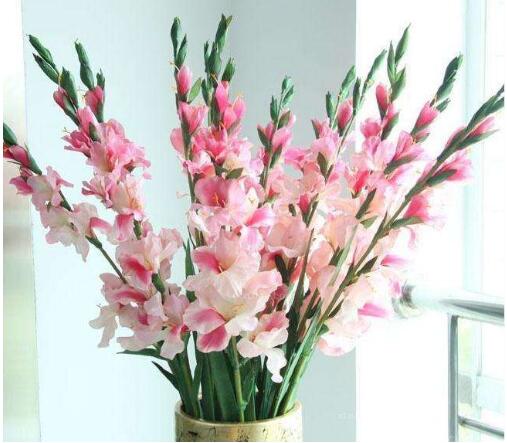
Gladiolus is a plant that greatly loves light. It fears the cold, and temperatures below 0°C can very likely freeze it to death, so sunlight and water are indispensable. Many people don't know when gladiolus blooms; in fact, potted gladiolus can bloom in all four seasons. They come in different varieties, and a well-grown gladiolus can produce flowers in 2 months.
Gladiolus flowering period: Gladiolus is divided into two varieties, spring-flowering and summer-flowering, and different varieties have different growth cycles. Early-maturing varieties bloom in 50~601 days, mid-maturing varieties in 65~80 days, and late-maturing varieties in 80~120 days. The flowering period is generally May to October, with May-June and October being the best for blooming. Because the planting season differs, the flowering season naturally differs too.
If you want flowers in January-February, plant in October-November. If planted in December, they will bloom in March-May. Generally, gladiolus takes 100-120 days from planting to flowering. Some bloom naturally in spring, some in summer, and it is relatively easy to keep alive. Now that we know when gladiolus blooms, let's understand what to do if potted gladiolus doesn't bloom.
II. What to Do If Potted Gladiolus Doesn't Bloom
1. Improper growing methods
If your gladiolus doesn't bloom, then your growing method must be improper - either not enough sunlight or not enough watering. First, before planting, the corms should be disinfected: remove the skin from the stored corms, soak them in clean water for 15 min, then soak in 500x diluted 50% carbendazim solution for 30 min, and in 500x diluted 50% thiram powder solution for 10 min, take them out, pile them up and cover with plastic film for 1 h, then spread them out to dry.
2. Planting
For summer flowers, plant in the open field in spring; for winter and spring flowers, grow in a greenhouse, and the growing period is more than 20~30 days longer than in summer. When planting, to prevent lodging and the growth of daughter corms, plant appropriately deep, and insert stakes around the planting bed and run ropes around them. The planting bed surface should be 5~10 cm high and 1 m wide; in dry areas, flat beds can be made.
3. Sunlight
Insufficient light during flower bud differentiation will reduce the number of flowers; after flower bud differentiation is complete, short-day conditions help with flower bud formation and earlier blooming. For potted gladiolus, use mainly phosphorus and potassium fertilizer, and apply light fertilizer more frequently.
III. What to Do After Gladiolus Blooms
After blooming in summer, promptly cut off the spent flowers and strengthen water and fertilizer management, so that the nutrients of the above-ground part move underground, promoting the swelling of the underground corms. After the corms mature in autumn, harvest and store them promptly: dig up the corms, remove clumps of soil and debris, cut off the dried stems and leaves, dry the corms, and store them in a cool, ventilated indoor space.
Generally, fully dried corms can be stored for 1 year at 1~3°C, and after winter passes they can still sprout normally. The above is the complete analysis of when gladiolus blooms and what to do if potted gladiolus doesn't bloom. Hope it can help everyone.
How to Make Gladiolus Bloom in All Four Seasons?
Gladiolus, also known as: Shiyangjin, jianlan, changlan, biqilian; Latin name: Vaniot Houtt; Iridaceae, Gladiolus genus, perennial herb. The corm is flat and round-spherical. Its original species comes from the Cape of Good Hope in South Africa, and it was formed through repeated interspecific hybridization; cultivated varieties are widely distributed around the world. The flower stem rises above the leaves, and the corolla tube is an enlarged funnel shape. Flower colors include red, yellow, purple, white, blue and other single or bicolor varieties. It is widely cultivated around the world. The main producing countries are the United States, the Netherlands, Israel and Japan, etc. Gladiolus is an important cut flower and can be used for flower baskets, bouquets, vase arrangements, etc. It can be used to arrange flower borders and specialized flower beds. Dwarf varieties can be grown in pots for ornamental display. It, together with cut roses, carnations and gerbera, is known as the "world's four great cut flowers." Varieties include Gladiolus tristis, Gladiolus gandavensis, etc. In addition, the stems and leaves can be used to extract vitamin C. We have already introduced that gladiolus can be divided into two major categories, spring-flowering and summer-flowering, and the summer-flowering type can be further divided into early-flowering, mid-flowering and late-flowering. If you want gladiolus to bloom in all four seasons, choosing different varieties and planting them in stages can achieve this goal.If a batch is planted every half month from March to July, then they can bloom continuously from mid-June to around National Day; if varieties relatively tolerant of low temperatures are chosen and planted in August-September, and after the autumn cool the room temperature can be kept at 15°C, then they can bloom in November-December; if a batch is planted in a greenhouse from October to December, with room temperature above 15°C and 13 hours of light guaranteed each day, then they can bloom from New Year's Day to May Day.
Methods and Specific Steps to Make Gladiolus Bloom in All Four Seasons
Many flower lovers may not be very familiar with this flower, gladiolus, but when jianlan is mentioned, some people will surely have a sudden realization. That's right, gladiolus is what we call jianlan. It is not only a very good potted plant, but can also be used as a cut flower. Today, I will take everyone through the methods to make gladiolus bloom in all four seasons.
Choosing varieties
Gladiolus is divided into two varieties, spring-flowering and summer-flowering, and different varieties have different growth cycles. Early-maturing varieties bloom in 50~601 days, mid-maturing varieties in 65~80 days, and late-maturing varieties in 80~120 days.
Controlling temperature
Gladiolus likes long-day conditions. In an environment with sufficient sunlight (more than 14 hours of light) and suitable temperature, it blooms earlier. Adjusting light duration and temperature can effectively regulate the flowering time of gladiolus.
Flowering regulation 1. Making it bloom earlier
Gladiolus has a dormancy period of 2~3 months each year, and even if the environment is suitable, it will not grow. To make it bloom earlier, its dormancy must be broken. Store the corms at 0~4°C for 30~50 days, or soak them in 39°C water for 2 weeks, to break dormancy. With methods like these, as long as the corms are made to enter dormancy earlier, after planting they will bloom earlier than ordinary corms.
2. Delaying flowering
Simple: to delay flowering, let the corms sleep a little longer and place them in a dry, low-temperature environment. Before the planned flowering time, raise the temperature and increase humidity to break dormancy. The rest is the same as the method for promoting flowering; just care for them normally.
Note that repeatedly messing with the corms will accelerate degeneration, so be careful to keep some for propagation. Also, promoting and delaying flowering can be used alternately to ensure healthy growth of the corms.
The above are the methods I have organized for making gladiolus bloom in all four seasons. I hope they can be helpful to the many flower lovers, and please continue to follow Duorou Huapu to learn more about flower care knowledge.