How to grow ginger lily? Introduction to and care for butterfly lily, garland flower, and ginger lily
Ginger lily (butterfly lily, garland flower, ginger lily)
Scientific name: hedychium coronarium
Aliases: wild ginger lily, butterfly ginger, garland flower, butterfly flower, white butterfly flower, fragrant snow flower, yehansu, ginger lily, turmeric
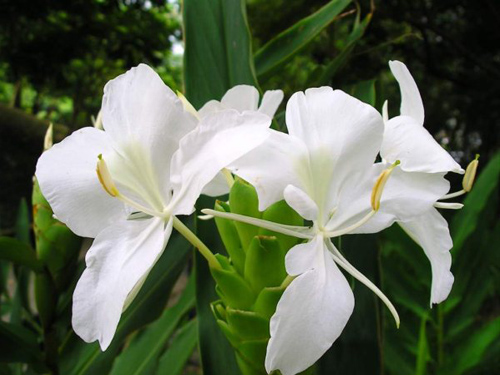
Morphological characteristics: underground stems tuberous, creeping horizontally and aromatic, shaped like ginger. Leaves long elliptic-lanceolate, sessile, parallel-veined, smooth on the surface, with long hairs on the underside. Terminal dense spike inflorescence, protected by large bracts, each inflorescence bears 10~15 flowers, flower colors include white, yellow, red, orange, etc.
Ecological habits: sun-loving, tolerant of partial shade, not cold-tolerant, prefers warm and humid climates. Grows well in slightly acidic fertile sandy loam; when winter temperatures drop below 10 degrees Celsius, the aboveground parts wither and the underground ginger tubers go dormant to overwinter.
Flowering period: May to November.
Flower language: trust, noble and elegant, simple and unsophisticated.
Landscape uses: cut flowers, mass planting beside roads, lawns, streams, rockeries and ponds.
Medicinal effects: rhizomes and fruits are used as medicine, with effects of warming the middle and strengthening the stomach, relieving the exterior, dispelling wind and scattering cold, warming meridians and relieving pain, and dispelling cold.
Ginger lily (butterfly lily, garland flower, ginger lily)
Scientific name: Hedychium coronarium
Aliases: wild ginger lily, butterfly ginger, garland flower, butterfly flower, white butterfly flower, fragrant snow flower, yehansu, ginger lily, turmeric
Morphological characteristics: underground stems tuberous, creeping horizontally and aromatic, shaped like ginger. Leaves long elliptic-lanceolate, sessile, parallel-veined, smooth on the surface, with long hairs on the underside. Terminal dense spike inflorescence, protected by large bracts, each inflorescence bears 10~15 flowers, flower colors include white, yellow, red, orange, etc.
Ecological habits: sun-loving, tolerant of partial shade, not cold-tolerant, prefers warm and humid climates. Grows well in slightly acidic fertile sandy loam; when winter temperatures drop below 10°C, the aboveground parts wither and the underground ginger tubers go dormant to overwinter.
Flowering period: May to November.
Flower language: trust, noble and elegant, simple and unsophisticated.
Landscape uses: cut flowers, mass planting beside roads, lawns, streams, rockeries and ponds.
Medicinal effects: rhizomes and fruits are used as medicine, with effects of warming the middle and strengthening the stomach, relieving the exterior, dispelling wind and scattering cold, warming meridians and relieving pain, and dispelling cold.