Crown Imperial (Fritillaria imperialis) Introduction and Cultivation Management Techniques
Crown Imperial (Fritillaria imperialis)
Scientific name: fritillaria imperialis
Family and genus: Liliaceae, Fritillaria genus
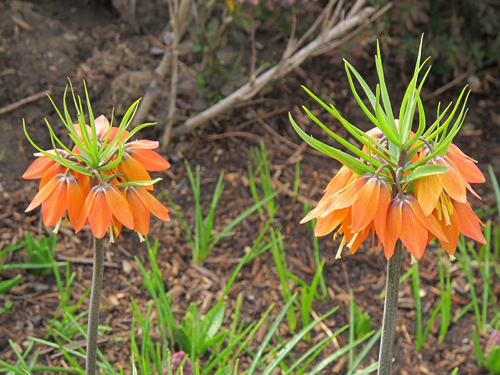
Morphological characteristics: Bulb large. Stem upright, leaves ovate-lanceolate to lanceolate, entire. Several flowers borne at the top of the plant, corolla bell-shaped, drooping beneath a cluster of leaf-like bracts. Flowers bright red, orange-yellow, yellow.
Ecological habits: Sun-loving, shade-tolerant, cold-hardy, requires cold treatment at 5-9°C for about 13-17 weeks, growing temperature 7-20°C. Soil should be moist, well-drained, dormant in summer, bulbs lifted and stored, storage temperature around 13°C, propagated by dividing bulbs in summer and autumn.
Cultivation management: Choose loose, fertile, organic-rich, well-drained sandy loam with pH 6.0-7.5. Apply ample base fertilizer before planting; decomposed organic fertilizer or fish and bone meal are both suitable. For container planting, use an equal mix of leaf mold, garden soil and sand. Autumn September-October is the suitable planting time; for ground planting, space plants about 30 cm apart, cover with 8 cm-12 cm of soil after planting. In cold climate regions, cover for winter protection. After new shoots emerge in early spring, apply a top dressing once promptly to promote stem and leaf growth. Keep soil moist normally; for late-spring blooming varieties, appropriate shading during the flowering period improves quality. After the above-ground parts wither in summer, the plant enters dormancy; bulbs may be left in the soil to overwinter, but the soil should not be too wet to avoid underground bulb rot, or they may be dug up and stored in a cool, ventilated environment to spend the summer. Bulb rot disease occasionally occurs; besides disinfecting the bulbs, regular spraying of Bordeaux mixture can also be used for control.
Pest and disease control: During the growing period, it is susceptible to leaf spot disease and lily black weevil. Spray 50% thiophanate-methyl wettable powder at 700-800 times dilution and 140% omethoate emulsifiable concentrate at 1000 times dilution respectively for control.
Flowering period: May.
Flower language: Majesty.
Garden uses: Courtyard planting, flower borders, foundation planting; dwarf varieties are suitable for containers.
Medicinal effects: Bulbs and flowers are used as medicine, to resolve phlegm and relieve cough, clear heat and dissipate nodules.
Crown Imperial (Fritillaria imperialis)
Scientific name: Fritillaria imperialis
Family and genus: Liliaceae, Fritillaria genus
Morphological characteristics: Bulb large. Stem upright, leaves ovate-lanceolate to lanceolate, entire. Several flowers borne at the top of the plant, corolla bell-shaped, drooping beneath a cluster of leaf-like bracts. Flowers bright red, orange-yellow, yellow.
Ecological habits: Sun-loving, shade-tolerant, cold-hardy, requires cold treatment at 5-9°C for about 13-17 weeks, growing temperature 7-20°C. Soil should be moist, well-drained, dormant in summer, bulbs lifted and stored, storage temperature around 13°C, propagated by dividing bulbs in summer and autumn.
Cultivation management: Choose loose, fertile, organic-rich, well-drained sandy loam with pH 6.0-7.5. Apply ample base fertilizer before planting; decomposed organic fertilizer or fish and bone meal are both suitable. For container planting, use an equal mix of leaf mold, garden soil and sand. Autumn September-October is the suitable planting time; for ground planting, space plants about 30 cm apart, cover with 8 cm-12 cm of soil after planting. In cold climate regions, cover for winter protection. After new shoots emerge in early spring, apply a top dressing once promptly to promote stem and leaf growth. Keep soil moist normally; for late-spring blooming varieties, appropriate shading during the flowering period improves quality. After the above-ground parts wither in summer, the plant enters dormancy; bulbs may be left in the soil to overwinter, but the soil should not be too wet to avoid underground bulb rot, or they may be dug up and stored in a cool, ventilated environment to spend the summer. Bulb rot disease occasionally occurs; besides disinfecting the bulbs, regular spraying of Bordeaux mixture can also be used for control.
Pest and disease control: During the growing period, it is susceptible to leaf spot disease and lily black weevil. Spray 50% thiophanate-methyl wettable powder at 700-800 times dilution and 140% omethoate emulsifiable concentrate at 1000 times dilution respectively for control.
Flowering period: May.
Flower language: Majesty.
Garden uses: Courtyard planting, flower borders, foundation planting; dwarf varieties are suitable for containers.
Medicinal effects: Bulbs and flowers are used as medicine, to resolve phlegm and relieve cough, clear heat and dissipate nodules.
Crown Imperial Fritillaria imperalis Crown Imperial guide: How to grow Crown Imperial / How to propagate Crown Imperial
Crown Imperial profileCrown Imperial Fritillaria imperalis
Aliases: Yingluo lily, Crown Imperial
Classification: Bulbous flower
Family and genus: Plantae, Angiosperms, Dicotyledoneae, Liliaceae, Fritillaria genus
Full bloom period: Spring and summer
Crown Imperial is a perennial bulbous flower, an autumn-planted bulb. Fresh bulbs are relatively large, plant height about 70 cm; stem upright, leaves ovate-lanceolate to lanceolate, entire. Flowers borne at the top of the plant, several clustered together, corolla bell-shaped, drooping beneath a cluster of leaf-like bracts. Flowers bright red, orange-yellow, yellow, flowering period March-June. To plant Crown Imperial, choose loose, fertile, organic-rich, well-drained sandy loam with pH 6.0-7.5. Apply ample base fertilizer before planting; decomposed organic fertilizer or fish and bone meal are both suitable. For container planting, use an equal mix of leaf mold, garden soil and sand. Plants of the Fritillaria genus have traditionally been cultivated in China mostly as medicinal materials. But...
Crown Imperial cultivation methods and precautions Crown Imperial introduction
Crown Imperial is a perennial bulbous flower, an autumn-planted bulb. Fresh bulbs are relatively large, plant height about 70 cm; stem upright, leaves ovate-lanceolate to lanceolate, entire. Flowers borne at the top of the plant, several clustered together, corolla bell-shaped, drooping beneath a cluster of leaf-like bracts. Flowers bright red, orange-yellow, yellow, flowering period March-June.
To plant Crown Imperial, choose loose, fertile, organic-rich, well-drained sandy loam with pH 6.0-7.5. Apply ample base fertilizer before planting; decomposed organic fertilizer or fish and bone meal are both suitable. For container planting, use an equal mix of leaf mold, garden soil and sand.
Plants of the Fritillaria genus have traditionally been cultivated in China mostly as medicinal materials. But worldwide, nearly a hundred species are cultivated as ornamental flowers. Crown Imperial is one of the most famous and most common species among them.
Morphological characteristics of Crown Imperial
Crown Imperial is a perennial bulbous flower, fresh bulbs are relatively large, plant height about 70 cm; stem upright, leaves ovate-lanceolate to lanceolate, entire. Flowers borne at the top of the plant, several clustered together, corolla bell-shaped, drooping beneath a cluster of leaf-like bracts.
Crown Imperial flowers are bright red, orange-yellow, yellow, flowering period May. There is also Fritillaria persica (F. persica) with a height of 80 cm, long flower spikes, blooming in early summer, which can be used in flower borders. Fritillaria michailovskyi, also known as Michailovsky's fritillary (F. michailovskyi), has a height of 20 cm, fine gray-green leaves; small flower spikes, bell-shaped flowers, drooping.
The bulb has 2-3 fleshy scales, diameter 1.5-4 cm. Leaves sessile, broadly linear, 3-4 leaves whorled or opposite, with tendril-like hooked tips. Raceme, bearing 1-6 flowers, borne in the leaf axils at the top of the stem, bell-shaped, pale yellow to yellow-green, with purple reticulate markings inside, nodding. Flowering period March-June.
Ecological habits of Crown Imperial
Crown Imperial is sun-loving, shade-tolerant, cold-hardy, requires cold treatment at 5-9°C for about 13-17 weeks, growing temperature 7-20°C. Soil should be moist, well-drained, dormant in summer, bulbs lifted and stored, storage temperature around 13°C, propagated by dividing bulbs in summer and autumn.
Cultivation techniques for Crown Imperial
To plant Crown Imperial, choose loose, fertile, organic-rich, well-drained sandy loam with pH 6.0-7.5. Apply ample base fertilizer before planting; decomposed organic fertilizer or fish and bone meal are both suitable. For container planting, use an equal mix of leaf mold, garden soil and sand. Autumn September-October is the suitable planting time; for ground planting, space plants about 30 cm apart, cover with 8 cm-12 cm of soil after planting.
In cold climate regions, cover for winter protection. After new shoots emerge in early spring, apply a top dressing once promptly to promote stem and leaf growth. Keep soil moist normally; for late-spring blooming varieties, appropriate shading during the flowering period improves quality. During the growing period, it is susceptible to leaf spot disease and lily black weevil. Spray 50% thiophanate-methyl wettable powder at 700-800 times dilution and 140% omethoate emulsifiable concentrate at 1000 times dilution respectively for control. After the above-ground parts wither in summer, the plant enters dormancy; bulbs may be left in the soil to overwinter, but the soil should not be too wet to avoid underground bulb rot, or they may be dug up and stored in a cool, ventilated environment to spend the summer. Bulb rot disease occasionally occurs; besides disinfecting the bulbs, regular spraying of Bordeaux mixture can also be used for control.
Propagation methods of Crown Imperial
Crown Imperial is propagated by dividing bulbs, usually done in summer and autumn, mainly by separating small daughter bulbs.
Disease control of Crown Imperial
Crown Imperial commonly suffers from rust disease, with many brown spore masses appearing on the underside of leaves, petioles and stem base; in severe cases the fritillary dies early. Control methods include strengthening field management, promptly removing above-ground debris, and spraying 1000 times dilution thiophanate-methyl plus New High Lipid Film before disease onset.
Gray mold
Water-soaked lesions appear on green leaves and leaf tips, later withering and dying. Spray 500 times dilution amobam plus New High Lipid Film for control.
Crown Imperial variety classification Main varieties
1. Aurora, flowers orange, leaf margins deep yellow;
2. Crown King, flowers in two whorls, orange-red;
3. Lutea Maxima, flowers deep yellow;
4. Premier, flowers orange-yellow with purple markings.
The Fritillaria genus has about 100 species, distributed in the Northern Hemisphere, especially the Mediterranean region, southwestern Asia, western North America, etc. Common species include Fritillaria thunbergii (F. thunbergii), Fritillaria cirrhosa (F. cirrhosa), Fritillaria ussuriensis (F. ussuriensis), Fritillaria camschatcensis (F. camtschatcensis), etc.
Distribution area of Crown Imperial
Crown Imperial is native to the temperate zones of Eurasia, from the Himalayan region to Iran and beyond. It has a long cultivation history of about 400 years, with many cultivated varieties in various flower colors such as yellow and red, as well as double-flowered types.
Functions and uses of Crown Imperial Ornamental value
Crown Imperial has many cultivated varieties, tall plants, and large, showy flowers. It is an excellent and unique flower material for flower borders and can also be planted in groups. It is suitable for courtyard planting, flower borders or foundation planting, while dwarf varieties are suitable for containers, with extremely strong ornamental appeal.
Dietary therapy or medicinal value of Crown Imperial
The medical information and health dietary therapy information on Hugarden website is for reference only and cannot be used as a basis for diagnosis or medical treatment. Any health issues should be consulted with professional medical staff, and treatment of any disease should follow doctor's orders.
Ultimate flower protection mission: Love yourself, start from reality, and follow doctor's orders. For illness, do not be careless, do not delay, do not give up hope, face it bravely, warm the silent world with love, and care for the flower field in your heart with your heart.
Medicinal value
Fritillaria is a commonly used medicine for resolving phlegm and relieving cough. It is the dried bulb of the Liliaceae plants Fritillaria cirrhosa and Fritillaria thunbergii. Fritillaria cirrhosa is mainly produced in Sichuan, Yunnan, Gansu and other places in China; Fritillaria thunbergii is mainly produced in Zhejiang, Jiangsu, Anhui and other places in China. Fritillaria cirrhosa tastes bitter and sweet, nature slightly cold; Fritillaria thunbergii tastes bitter, nature cold. It enters the lung and heart meridians. Effects: resolve phlegm and relieve cough, clear heat and dissipate nodules. It mainly treats heat-phlegm cough, externally-contracted cough, yin deficiency cough, scant phlegm with dry throat, yellow thick phlegm, lung abscess, breast abscess, sores and swellings, scrofula and other conditions. Modern pharmacological experiments have proven that fritillaria has antitussive, blood pressure-lowering, and blood sugar-elevating effects.
Some species of Fritillaria are precious medicinal materials; the bulbs and flowers are used as medicine to treat common and frequently occurring diseases such as cold cough and chronic bronchitis, especially Fritillaria thunbergii, Fritillaria cirrhosa and Fritillaria ussuriensis, which are all produced as specialized medicinal materials.
Extended reading
Fritillaria thunbergii
Fritillaria thunbergii tastes bitter and is cold in nature, entering the heart and lung meridians. Its functions are to clear heat and resolve phlegm, dissipate nodules and detoxify. Clinically it is often combined with Xuanshen, oyster shell, dandelion, trichosanthes root, forsythia, coix seed, houttuynia, fresh reed root, selfheal, seaweed, kelp, zedoary, etc. for the treatment of cough due to phlegm-heat obstructing the lungs, carbuncle toxin swellings and pain, and unruptured scrofula; combined with cuttlefish bone, calcined clam shell, bletilla, coptis, evodia, bamboo shavings, prepared pinellia, etc. it can treat stomach pain, acid reflux and heartburn. Modern pharmacological research has confirmed that Fritillaria thunbergii contains various alkaloids such as peimine. Peimine can relieve bronchial smooth muscle spasms, reduce bronchial mucosal secretion, dilate pupils, lower blood pressure, excite the uterus and have various other pharmacological effects.
Fritillaria cirrhosa
Slightly cold, sweet in taste, with a relatively strong effect of relieving cough and resolving phlegm, and also with a lung-moistening effect. It can be used whether there is much or little phlegm, and is especially suitable for cough caused by lung dryness or autumn dryness. Patients present with cough accompanied by scant, difficult-to-expectorate phlegm, or blood-streaked phlegm, dry mouth and nose, dry throat and thirst and other discomforts. At this time, stewed pear with Fritillaria cirrhosa can be chosen: take 9-10 grams of Fritillaria cirrhosa, soak in water, take 1 medium-sized ya pear, remove the core, put the soaked Fritillaria cirrhosa together with the water into the hollowed pear, steam in a pot for 1 hour, add an appropriate amount of rock sugar for seasoning and eat. In addition, 3-10 grams of Fritillaria cirrhosa can be taken, decocted in water, once a day. Taking Fritillaria cirrhosa ground into powder is also a good choice, once a day, 1-2 grams each time. There are currently reports of allergy from taking Fritillaria cirrhosa, so people with allergic constitutions should use it with caution.
Bolbostemma paniculatum
Cold in nature, bitter in taste, with relatively strong anti-inflammatory, antiviral and antitumor effects. It is often combined with other heat-clearing and detoxifying drugs to treat breast diseases, tuberculosis, skin swellings and sores and other diseases. In addition, it also has a certain spermicidal effect. Therefore, men who want to become fathers in the near future should be even more cautious in choosing it.
Garden uses of Crown Imperial
Crown Imperial is commonly used in gardens for flower borders and group planting.
Cultural background of Crown Imperial
The charm of Crown Imperial lies in the crown of flowers at the top, as well as the leaves (more precisely bracts) crowning the flower cluster. It is known as the representative flower of Isidore, Bishop of Seville in the 6th century. This bishop was very enthusiastic about education, and the most important quality of an educator is patience.
Flower language of Crown Imperial
Flower language of Crown Imperial: Patience. Because its flowers always hang their heads, the flower language of Crown Imperial is patience.
Another saying for the flower language of Crown Imperial: Splendid.
Crown Imperial pictures