A detailed guide to the main pests and diseases of Pentas lanceolata and their control methods
Whitefly
Symptoms: the young leaves of the plant fade and turn yellow, and eventually the whole plant wilts and dies.
Control:
(1) Use “insect-proof netting” to block the invasion of external pests.
(2) Before cultivation, thoroughly fumigate the cultivation site and clear weeds.
(3) Spray the whole plant with a 2500-3000 times dilution of 2.5% Kung Fu or a 2500 times dilution of 20% Mieshaoli.
Gray mold
Symptoms: mostly caused by the rainy season's high humidity or overwatering. Initially, water-soaked brown spots appear on the stems and leaf margins, gradually spreading until the branches and leaves rot. When air humidity is relatively high, gray mold often appears on the diseased parts.
Control:
(1) Keep the growing medium in a semi-dry state, do not overwater, and strengthen ventilation at the cultivation site.
(2) Thoroughly disinfect the growing medium.
(3) Before cultivation, disinfect the site with chlorothalonil smoke agent at a dose of 200 g/mu; after cultivation this must be continued, once every 10 days.
(4) When disease occurs, spray the whole plant with a 1500 times dilution of 50% iprodione or a 2000 times dilution of Ridomil.
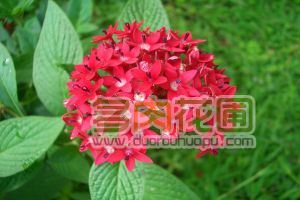
Diseases of Pentas lanceolata and their control methods
Gray mold
Gray mold mostly occurs in the relatively humid rainy season, or is caused by overwatering.
In the early stage, water-soaked brown patches appear on the stems and leaves of the plant; later the patches gradually spread, causing the leaves and stems to yellow and rot. When air humidity is relatively high, gray mold often appears on the diseased parts.
Control methods
During the cultivation of Pentas lanceolata, keep the growing medium in a semi-dry state at all times, do not overwater, and place the plant in a ventilated spot.
Frequently replace the medium in the pot, and disinfect the new potting soil with chlorothalonil; after cultivation, continue disinfecting the plant with chlorothalonil once every 10 days.
Once a Pentas lanceolata plant is found to be diseased, spray the whole plant with a 1500 times dilution of 50% iprodione or a 2000 times dilution of Ridomil; if the plant is seriously diseased, pull it out promptly and burn it.
Pests of Pentas lanceolata and their control methods
Whitefly
Whitefly adults are 1-1.5 mm long. The wings and the back of the thorax are covered with white powder. After laying eggs at the top of the plant, the eggs enter the leaf tissue and maintain a water balance with the plant, so they do not easily fall off.
After hatching, the nymphs pierce the leaf tissue with their mouthparts and suck nutrients from the plant, causing the leaves to fade and turn yellow, and eventually the whole plant dies.
Control methods
At the early stage of cultivation, insect-proof netting can be used to block the invasion of external pests.
Before cultivation, sterilize and disinfect the pot and soil to prevent the occurrence of pests.
If Pentas lanceolata is grown at home and whitefly adults are found, yellow boards can be used to trap the adults and coated with insect adhesive to kill them, but this cannot kill the eggs, so the pest is relatively likely to recur with this method.
Once a plant is found to be harmed by whitefly, spray the whole plant with a 2500-3000 times dilution of 2.5% Kung Fu or a 2500 times dilution of 20% Mieshaoli; seriously affected plants should be pulled out promptly.
Cultivation methods for potted Pentas lanceolata and key points for pest and disease control
Recently some flower enthusiasts have asked in the Huinong website backend: how do you grow Pentas lanceolata? Today we will briefly introduce how to cultivate and manage the beautiful potted Pentas lanceolata. Interested friends can also take a look.
1 Characteristics and traits
1.1 Morphological characteristics
Pentas lanceolata is an upright subshrub, with a plant height of 25-30 cm; the leaves are dark green, with a gradually narrowed base and short petioles. The cymes are borne at the top of the branches, and each inflorescence is composed of about 20 small flowers.
1.2 Growth habits
Pentas lanceolata prefers a warm, humid environment with sufficient light, and is heat-tolerant and drought-tolerant. It dislikes direct scorching sun and is slightly tolerant of semi-shade.
2 Propagation
Pentas lanceolata is mainly propagated by sowing, and can also be propagated by cuttings.
2.1 Sowing
2.1.1 Medium for sowing
The medium can be peat soil or a special sowing medium; mix in 50% carbendazim wettable powder at 0.10% of the medium weight for sterilization. While mixing in the carbendazim, water while stirring so that the water content of the medium reaches the point where it does not drip when squeezed by hand; leave it to air for 24 h before use.
2.1.2 Seedling containers
Use plug trays for seedling raising, using 105-cell plug trays. When using sowing boxes for seedling raising, the specification is best 80 cm x 50 cm x 10 cm; if the box is too large, it is inconvenient to carry, and if too small, the utilization rate is low.
2.1.3 Sowing time
Determine the sowing period according to the flowering time and potted plant specifications. A 10 cm potted plant needs 18-20 weeks of cultivation before it can be marketed; a 15 cm potted plant needs 20-22 weeks of cultivation.
2.1.4 Sowing method
① Plug tray seedling raising. Fill the disinfected medium into the seedling plug tray, then scrape it level, press a shallow hole in the center of each cell; because the seed germination rate is low (about 60%), sow 2 seeds per cell, noting that the seeds are photoblastic, so do not cover with soil; finally water thoroughly with a sprayer to ensure full contact between the seeds and the medium.
② Sowing box seedling raising. The sowing density is 2 000-4 000 seeds/m2. According to the area of the sowing box, divide the seeds evenly into several portions, with 1 portion per box. When sowing, fill the bottom of the sowing box with 4 cm of perlite and water thoroughly, which can retain water and allow air movement; then add the disinfected medium up to near the top of the sowing box, scrape the medium level, press it moderately, then evenly mix the seeds with 3-10 portions of fine sand and evenly broadcast them on the surface of the medium, without covering with soil; note that the four edges of the sowing box should not be sown, because after watering the medium in the box will shrink during the seedling-raising process and cracks will appear around the edges, which is not conducive to seed germination and seedling growth; finally water thoroughly with a sprayer to ensure full contact between the seeds and the medium. Because the seeds are tiny and germination is light-loving, do not cover the seeds after sowing. Therefore, a relatively high seedbed and air humidity should be maintained to ensure smooth germination. The suitable germination temperature is 23-25°C. Germination occurs about 2-3 weeks after sowing; after germination, a light medium passed through a fine sieve may be lightly covered. The sowing medium requires a pH of 6.50-6.80 and an EC of 0.75.
③ Post-sowing management. Place the sown plug trays or sowing boxes in an environment of about 28°C during the day and about 20°C at night, and spray water every day to keep the medium fully moist, with relative air humidity above 80%. Apply nitrogen fertilizer once a week at a concentration of 50×10-6 (equivalent to a 0.10% urea water solution), and apply 45% compound fertilizer 1-2 times in between at a concentration of 0.05%-0.08%. During the seedling stage, the medium EC should preferably be controlled at 1-1.50. Suitable light: 1 000 lux during germination, 10 000-30 000 lux after germination, and 50 000 lux for large seedlings.
④ Seedling-stage management. Pentas lanceolata begins to emerge about 15 d after sowing. When 80% of the seeds have germinated and emerged, lower the ambient temperature or move them to a lower-temperature greenhouse for cultivation, keep the maximum daytime temperature at 26°C and the minimum nighttime temperature at 15°C, gradually increase light, strengthen ventilation; the medium still needs to remain moist, but avoid excessive moisture to prevent seedling legginess; when the temperature is above 26°C and there is strong sunlight on clear days, cover with a shade net. After 2 pairs of true leaves have grown, spray a 0.10% Peter's 20-10-20 solution together with watering, spraying once every 7-10 d; after the first fertilization, also apply a protective fungicide once to prevent damping-off. When true leaves have grown and the seedlings begin to grow rapidly, keep the medium moisture at 50%-70%, and let the medium dry slightly before watering. Try to water in the morning and let it dry by evening. Through the above fine management, strong seedlings with a vigorous, thick root system and no pests or diseases can be cultivated.
2.2 Cuttings can use plug tray cuttings or sowing box cuttings.
2.2.1 Medium
The medium only needs to remain breathable; peat and perlite can be mixed evenly at a ratio of 3:1, and 50% carbendazim wettable powder is mixed in at 0.10% of the medium weight for sterilization. While mixing in the carbendazim, water while stirring so that the water content of the medium reaches the point where it does not drip when squeezed by hand; after airing for 24 h it can be used; then fill it into plug trays, press gently and level, scrape off excess medium; or add medium up to near the top of the sowing box, scrape the medium level, and press moderately.
2.2.2 Preparation of cuttings
Select robust mother plants and cut current-year young shoots from the mother plants; such cuttings have the highest endogenous auxin content and the strongest cell division capacity. Cut the collected young shoots into small segments of about 7 cm, remove the lower leaves, and cut off part of the upper leaves; after cutting, soak them in clean water and keep them moist for later use.
2.2.3 Inserting into the medium
Insert the cuttings into plug trays or sowing boxes; for plug trays, 1 stem per cell; for sowing boxes, insert the stems so that the leaves do not cover each other and do not affect photosynthesis. The cutting depth is 2 cm; do not insert too deep, so as not to affect rooting. After inserting, press the medium surface gently with your hands.
2.2.4 Management after cutting
After cutting, place the plug trays or sowing boxes under a shade net with a shading rate of 70% and in an environment at about 25°C. Proceed according to the weather: on clear days spray water on the medium surface every 2 h; on cloudy or rainy days spray less or not at all, keeping air humidity at about 80%; at the same time, the medium must not become waterlogged. About 30 d after cutting, new roots grow; gradually reduce the frequency of spraying. After the root system reaches 3 cm, transplanting or potting can be carried out and normal management begins. Rooting is slower at low temperatures.
3 Management after potting
3.1 Potting
When the third pair of true leaves has grown on sown seedlings, or when the root system of cutting seedlings reaches 3 cm, they can be transplanted and potted. The potting medium can be peat and perlite mixed evenly at a ratio of 4:1; the disinfection method is the same as for the sowing medium.
3.2 Light management
Pentas lanceolata prefers an environment with sufficient sunlight; the more sufficient the light, the more compact and sturdy the plant. Therefore, in winter with weak light and short days, attention should be paid to supplementary lighting. Proper supplementary lighting can shorten the cultivation time by 2-3 weeks; if light is insufficient, the flower stems will become leggy. For greenhouse cultivation, shading is not needed in winter; in spring, summer and autumn, shade 30%. Growth in a semi-shady environment is also relatively ideal.
3.3 Temperature management
Warmth and sufficient sunlight help the growth of Pentas lanceolata. During the growth period, the night temperature should preferably be kept above 17-18°C and the day temperature above 22-24°C; a temperature below 10°C will cause the plant to flower unevenly and delay or hinder flower opening.
3.4 Water and fertilizer management
Pentas lanceolata is relatively drought-tolerant but not waterlogging-tolerant. During the growth period, do not overwater, and at the same time avoid waterlogging in the growing medium, so as to avoid inducing root rot. Watering should follow the rule of not watering until dry, and watering thoroughly when watering. When watering, the water temperature should not be too low. Overwatering often makes the plant yellow and slows flower growth. For fertilization, the water-soluble fertilizer Peter's 20-10-20 can be used; the fertilization concentration in the first month after potting is 0.20%, and after the second month the concentration is 0.30%, applied once every 7-10 d.
3.5 Plant shape management
In order to obtain an ideal plant shape, it is generally necessary to pinch once at 3-4 pairs of true leaves, leaving 2 pairs of true leaves after pinching. After flowering, the spent flowers should be cut off immediately and fertilizer and water should be strengthened, which can promote the sprouting of new branches and continued flowering. When the lower branches and leaves of old plants are sparse, the ornamental value of the plant decreases, and a heavier pruning should be carried out to promote branching at the lower part of the plant and form a better plant shape.
4 Pest and disease control
Common pests and diseases of Pentas lanceolata include damping-off, gray mold, whitefly, etc.
4.1 Damping-off
Damping-off is prone to occur at the seedling stage. Diseased seedlings suddenly lodge and die, affecting the survival rate of seedling raising, and may even destroy all seedlings. The disease mainly occurs after the seedlings emerge, with the base of the young stem infected by pathogens. At first, the diseased part shows small water-soaked spots, then turns light brown to brown and becomes sunken and constricted. The diseased part rapidly develops around the stem for 1 full circle, causing the young leaves, while still emerald green, to lodge and die from the base, hence the name damping-off. Finally the diseased seedlings rot or dry up. After sowing, infection can also occur from seed germination to before emergence, causing bud rot and seed rot, and resulting in missing seedlings and broken rows on the seedbed. When the medium humidity is high, a layer of white cottony mycelium can often be seen on the diseased seedlings and the nearby soil surface. Damping-off is mainly caused by Pythium. The pathogen overwinters in the soil or on diseased plant residues, has strong saprophytic ability, and can survive in the soil for a long time, and is called a soil inhabitant fungus. The pathogen spreads through irrigation water and rainwater, and can also spread through contaminated compost, seeds, etc. High soil humidity in the seedbed and sowing box, improper watering, overly dense sowing, unsuitable temperature, and weak seedling growth all favor the occurrence of damping-off; continuous-cropping seedbeds or flower nurseries are severely affected because of the relatively high accumulation of soil-borne pathogens. Damping-off is a typical soil-borne disease.
Control methods: ① Improve seedling-raising measures. Choose high, dry, well-drained land as the seedbed; apply fully decomposed fertilizer or use high-quality culture soil; control the amount of irrigation at the seedling stage, and the soil should not be too wet; sow at the proper time so that seedlings are not affected by unsuitable temperatures; sowing should not be too dense, and thin out and transplant seedlings in time so that the seedbed remains well ventilated; avoid continuous cropping in flower nurseries with severe disease, or disinfect the soil before sowing; implement excellent seedling-raising measures and cultivate strong seedlings to enhance disease resistance and reduce the harm of damping-off. ② Soil treatment. Because the damping-off pathogen can survive in the soil for a long time, directly eliminating the pathogen in the soil is of great significance for controlling the disease. Mix in 50% carbendazim wettable powder at 0.10% of the medium weight for medium sterilization. ③ Chemical control. Spraying fungicides in time at the early stage of disease can effectively control the spread of the disease. Commonly used fungicides include a 500 times dilution of 50% carbendazim wettable powder, an 800 times dilution of 25% metalaxyl (Ridomil) wettable powder, a 200-400 times dilution of 40% fosetyl-aluminum (Aliette) wettable powder, and a 600 times dilution of 75% chlorothalonil wettable powder, etc. Be careful to spray the young stems of the seedlings and the central diseased plants and the diseased soil near them. Apply once every 7-10 d, alternating the chemicals, spraying continuously 2-3 times, or as determined by the condition of the disease. Generally, apply the chemical once each at the seedling stage and the early stage of potted management for prevention.
4.2 Gray mold
Gray mold can harm leaves, stems, flowers and fruits. The symptoms are relatively complex, including leaf spots, cankers, seedling damping-off, and organ rot; under humid conditions the gray mold layer is prominent, and in severe cases the whole plant dies. When humidity is high, gray mold grows on the diseased parts; this disease recurs very easily, so the control of gray mold must be persistent. In maintenance and management, increase ventilation, control watering on cloudy days, apply less nitrogen fertilizer, and remove diseased flowers and leaves in time; for chemical control, a 2 000 times dilution of 50% procymidone wettable powder or a 1 000 times dilution of 70% thiophanate-methyl wettable powder can be used, applying once every 7-10 d, alternating the chemicals, spraying continuously 2-3 times, or as determined by the condition of the disease.
4.3 Whitefly is small, white, and not strong in flying. Adults and larvae suck plant sap, causing damaged leaves to yellow and fall off; the honeydew secreted by the adults can cause sooty mold. Control methods: use yellow sticky traps for trapping and killing; yellow sticky traps can be placed in the greenhouse, and the flowers can be shaken manually to trap and kill the startled whiteflies that fly away; a 1 000 times dilution of 40% omethoate, or a 2 000 times dilution of 2.50% deltamethrin emulsion, or a 2 000 times dilution of 10% buprofezin can be sprayed once every 10 d, continuously 3-4 times, which can achieve obvious results.
The above are all the cultivation key points for potted Pentas lanceolata. Flower growers are welcome to download the Huinong website APP to learn at any time every day, and interested flower enthusiasts are also welcome to refer to this site!