Four-season care methods for potted peace lilies: water is important
The peace lily not only has a beautiful meaning, but also has upright and graceful flower stems, fresh and pleasing to the eye, making it an excellent potted plant. The flowering period of the peace lily is generally from May to August, but with careful care, it may also be possible to keep it blooming all year round. So how do you care for a potted peace lily? Below are the four-season care methods for peace lilies carefully compiled by the editor. Friends who want the flowers to keep blooming should definitely take a look~
I. How to care for a potted peace lily
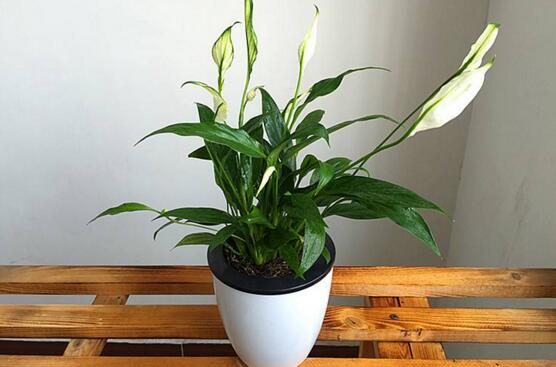
In the cultivation methods for peace lilies, we have already introduced the peace lily's requirements for soil, water, light, and so on quite comprehensively, so if you want it to bloom beautifully and remain unbeaten all year round, it is very simple: just follow the requirements. As for how to care for a peace lily, the specifics are as follows:
1. Soil: should be loose, with good drainage and aeration
2. Light: avoid direct strong light; maintaining 60% scattered light is best
3. Temperature: keep it between 20-28°C
4. Water: keep the potting soil moist, and also sprinkle water near the pot
5. Fertilizing: apply organic fertilizer about once a week during the growing season
6. Repotting: repot once every year in early spring before a large number of new buds appear
How to care for a potted peace lily does not require paying attention to too many things. Do the above 6 points well, and your peace lily will bloom beautiful flowers and remain unbeaten all year round~ When that time comes, using it as a potted plant to decorate the living room or study will make people feel fresh and natural, and very comfortable. Of course, care methods differ by season. Below are the four-season care methods for peace lilies. Keep reading.
II. Four-season care methods for peace lilies
1. Spring care
Spring is the peak season for new leaf growth in peace lilies. At this time, appropriate morning and evening light should be ensured. In spring, the peace lily can be placed by a windowsill with morning and evening light for cultivation, and attention should be paid to water and fertilizer supply. Under normal circumstances, indoor air humidity is relatively low and cannot meet the peace lily's requirement for high air humidity, so it should be misted and sprinkled with water several times a day around it.
Peace lilies like shady and humid environments. After the new leaves have grown, they can be placed year-round indoors in bright light for viewing. Repotting is generally carried out in spring (when the temperature stabilizes above 15°C), but as long as conditions are suitable, peace lilies can be repotted in all four seasons.
2. Summer care
In summer, the peace lily should be placed in a bright indoor spot. When the weather is hot, increase the frequency of watering and misting, and pay attention to indoor ventilation. If an air conditioner is used in the room, be careful not to let the air conditioning wind blow directly on the leaves. Because it likes warmth, the peace lily grows quickly in summer and has a large amount of growth, so it needs sufficient fertilizer, but fertilizing should be done in appropriate amounts.
3. Autumn care
After the autumn temperature becomes cool, morning and evening light can be appropriately increased. When the temperature drops in late autumn, attention should be paid to maintaining indoor temperature, gradually moving the peace lily to a floor-to-ceiling window with light for cultivation, appropriately reducing the frequency of watering, and stopping fertilizing.
4. Winter management
Peace lilies are not cold-tolerant. When the winter temperature is kept at around 10°C, they can overwinter safely. At this time, the peace lily grows slowly, so the potting soil should be kept on the dry side. On sunny days at noon when the temperature is relatively high, mist and sprinkle water around it several times. When the temperature is around 10°C, the peace lily still has ornamental value. Mature peace lily plants should be placed in such a temperature environment.
If the indoor minimum temperature is kept above 15°C, the peace lily can grow normally. Young plants are suitable for placement under such temperature conditions, and the potting soil can be kept moist with appropriate fertilizing. If an air conditioner is used in the room, be careful not to let the air conditioning wind blow directly on the leaves, and at the same time increase the frequency of misting and sprinkling water around it.
How to grow a potted peace lily / Peace lily cultivation methods
█ Strawberry geranium cultivation >> Summary of potted strawberry geranium cultivation and care methods
█ Amaryllis cultivation >> Is amaryllis toxic / Summary of amaryllis cultivation methods
█ Umbrella tree cultivation >> Summary of umbrella tree cultivation methods and precautions
When people mention "peace lily," they often think of the idiom "smooth sailing" and forget about the plant peace lily. In fact, it is also very famous and important among plants and flowers worldwide. It is a very fresh and elegant ornamental flower and is very effective at purifying exhaust gas and dealing with harmful gases, so it is widely planted in many places. However, most people still do not know how to grow peace lilies and the cultivation methods for peace lilies, so let's take a look below.
¤ Cultivation methods for peace lilies
The peace lily is jade-green and dripping with freshness. It is an extremely fresh and elegant ornamental flower with strong vitality and is relatively easy to grow. So how do you grow a peace lily? Usually people grow peace lilies as potted plants, so how do you grow a potted peace lily? The specific cultivation methods are as follows:
1. Soil: Peace lilies do not have high requirements for soil; generally, fertile loam rich in humus is sufficient. For potted cultivation, a mix of leaf mold, peat soil, and coarse sand can be used, and adding a small amount of calcium phosphate appropriately is even better.
2. Light: Although it originates from the tropics, the peace lily is very afraid of strong sunlight and does not need much light. When growing it in a pot, it is best to place it in a semi-shady environment, especially in summer, when the shading rate should reach about 60% to 70%. However, long-term insufficient light is also unfavorable for the plant's flowering and growth, so appropriate light is enough.
3. Temperature: The peace lily is native to tropical America and greatly loves high-temperature environments, while its cold tolerance is naturally very weak. The suitable temperature for its growth is generally 22 to 28°C, of which from March to September it is about 24 to 30°C, while from September to March of the following year it is 18 to 21°C. In winter, the cultivation temperature cannot be lower than 14°C. If it is lower than 10°C, the plant is very likely to suffer cold damage.
4. Watering: Peace lilies are very sensitive to humidity and like moist and warm environments. Therefore, during cultivation, the soil must be kept moist at all times, especially in summer and autumn, when more water should be sprayed to maintain the humidity of the air around the plant. At the same time, note that watering should not be excessive, otherwise it may cause root rot or disease.
5. Fertilizing: Peace lilies do not have a great demand for fertilizer. Usually, fertilizing once every half month is sufficient. When fertilizing, "Huiyou" 20-20-20 general-purpose fertilizer can be used.
¤ Precautions for growing peace lilies
In daily cultivation, when growing peace lilies, pay more attention to watering, light, and temperature maintenance, especially in terms of watering and temperature. Too much watering can easily cause root rot and disease in the plant, while too low a temperature can easily cause root rot and yellowing and withering of the aboveground parts, so in daily cultivation, pay more attention and do not overdo it.
At the same time, growing peace lilies also requires attention to pest and disease control. Its common pests and diseases are generally bacterial leaf spot, brown spot, and anthracnose. Once these diseases appear, timely treatment is needed. In the daily cultivation process, preventive work also needs to be done well. You can spray the leaf surface with a 500-fold dilution of 50% carbendazim wettable powder.
Summary:The cultivation methods for peace lilies are actually quite simple. The main thing is people's carefulness and persistence. As long as people carefully care for it, the peace lily will surely grow smoothly and produce astonishingly elegant beauty.
How to grow a potted peace lily? Cultivation methods and precautions for peace lilies
[Common questions]How do you grow a potted peace lily?
[Expert answer]The peace lily is a perennial herbaceous plant of the genus Spathiphyllum in the Araceae family. Its leaves are green and dripping with emerald color, and its flowers are pure white and elegant. It also has the beautiful meaning of smooth sailing and everything going well, so it is deeply welcomed and very suitable for potting to decorate the home environment. So how should a potted peace lily be grown? The cultivation methods and precautions for peace lilies are introduced below.
Image: Peace lily
I. Cultivation methods for peace lilies
1. Soil:Potted peace lilies require loose soil with good drainage and aeration. Heavy clay soil must not be used. Fertile loam rich in humus is best. Generally, leaf mold and peat soil mixed with a small amount of perlite can be prepared as a substrate, and a small amount of organic fertilizer can be added as a base fertilizer when planting.
2. Light:Peace lilies are relatively shade-tolerant, so they are suitable for growing in a semi-shady environment. Direct sunlight must be avoided. About 60% scattered light can meet the growth needs of peace lilies, so they can be kept year-round indoors in bright scattered light. If it is placed under strong light, the leaf surface will turn yellow and may even be directly sunburned.
3. Temperature:Peace lilies like high temperatures and are especially afraid of cold. The most suitable growth temperature is 20-28°C. Once winter arrives, they must be brought indoors. The lowest temperature they can withstand is 10°C, so attention must be paid in winter. Therefore, relatively speaking, cultivation conditions in the north are too poor. Being kept under low temperatures for a long time will cause root rot, leaf drop, or scorched yellow leaves, and in severe cases may even lead to death.
4. Watering:Peace lilies have a relatively high demand for water and must often be kept in moist potting soil, but excessive watering must also be avoided. Once watered too much, a large amount of water accumulates in the pot, which can easily cause root rot and yellowing and withering of the plant. In addition, note that in summer and during drought, water should often be sprayed on the leaf surface and ground to increase air humidity, which is beneficial to its growth.
5. Fertilizing:When fertilizing peace lilies, do not apply concentrated fertilizer or raw fertilizer, and after applying solid fertilizer, water once with clear water. It is best to use dilute fertilizer water instead of clear water for irrigation. In this way, fertilizer damage generally will not occur, and the peace lily will grow very lushly.
6. Pests and diseases:During the growth period, peace lilies are most favored by pests, so acaricides specifically for mites should be sprayed regularly for prevention and control, such as dicofol, hexythiazox, and pyridaben. Common bacterial leaf spot, brown spot, and anthracnose harm the leaves and can be sprayed with a 500-fold dilution of 50% carbendazim wettable powder.
7. Repotting:Peace lilies have strong tillering ability. Repot once every 1-2 years. When repotting, pay attention to trimming the roots and cutting off withered leaves. After dividing overly dense plants, pot them separately, remove some old roots and overly long root systems, pick out the old soil, and replace it with new culture soil to help the peace lily bloom.
Image: Peace lily
II. Precautions for growing peace lilies
1. Repot once every 1-2 years, and repotting should be done in spring. When repotting, place an appropriate amount of cake fertilizer at the bottom of the pot as base fertilizer. Peace lilies have fleshy roots and a relatively developed root system. The potting soil should be a culture soil mixed with 5 parts leaf mold, 3 parts sandy soil, 2 parts sawdust, and an appropriate amount of organic fertilizer. When planting, use 1 plant per pot.
2. Always keep the potting soil moist, but not overly wet. If the potting soil is too wet, it will affect root development and may even cause root rot. In winter, water less; water again when the surface of the potting soil turns white, and warm water should be used. In addition to meeting the potting soil's water requirements, water should also often be sprayed on the leaves to increase air humidity.
3. Peace lilies grow quickly and have a large amount of growth, so they need sufficient fertilizer, but fertilizing should be done in appropriate amounts. Summer's high temperature and high humidity are suitable for peace lily growth and are its vigorous growth period. During this period, apply 0.1%-0.3% urea water along with watering, once every 7-10 days, and at the same time spray 0.2% monopotassium phosphate to promote broad and glossy leaves. It is also possible to apply a mixed topdressing of 0.2% urea fertilizer water plus 0.2% monopotassium phosphate fertilizer water every 7-10 days. When the winter temperature exceeds 20°C, apply a small amount of nitrogen fertilizer and an appropriate amount of phosphorus and potassium fertilizer to cultivate the root system. A mixed topdressing of 0.1% urea water plus 0.1% monopotassium phosphate fertilizer water can be used, once every 15-20 days. When the winter temperature is below 20°C, topdressing should be stopped. Do not fertilize peace lilies too much. When too much fertilizer is applied, the leaves turn yellow and wrinkled, and in severe cases it can cause root rot and even death.
4. The suitable growth temperature for peace lilies is 20-30°C. When the summer temperature exceeds 30°C, water should be sprayed to cool it down, but water must never be poured into the leaf center, otherwise it will cause rot. In winter, the growth temperature should be kept above 15°C. Long-term low temperatures or cold wind will cause the leaves to lose green color, turn yellow, and scorch.
5. During the growth period of peace lilies, direct sunlight should be avoided. They can be placed in a shady spot or under a shade shed for care. After direct sunlight, the leaves are prone to wrinkling and scorched leaves. In winter, it is best to appropriately increase light to meet the needs of photosynthesis.
Image: Peace lily
[Editor's concluding remarks]Peace lilies like high-temperature and humid environments, and special attention is needed during care. The cultivation methods and precautions for peace lilies have been introduced above, and I hope they can be helpful to everyone!