A detailed guide to the propagation methods of the three-colored cordyline, easy to learn at a glance
The three-colored cordyline, also known as the three-colored ti plant, is an evergreen shrub in the Agavaceae family. It prefers a warm, humid and semi-shaded environment and fears direct strong light. Its optimum growth temperature is 20-25°C. It is not cold-tolerant and fears waterlogging. It is suited to loose, fertile, well-drained, slightly acidic sandy loam.
The three-colored cordyline is commonly propagated by cuttings. Cuttings are best taken in late spring or early summer. Cut 3 stem nodes from a mature growing tip, remove the lower leaves (the cut surface must be smooth), insert into plain sand or vermiculite, and cover with a plastic film cover to help retain warmth and moisture. After inserting, place in a shaded spot and keep the medium moist. At 25-30°C, roots and shoots will form after 1 month. If water-propagated in a wide-mouthed bottle in May-June, roots will form in about 3 weeks.
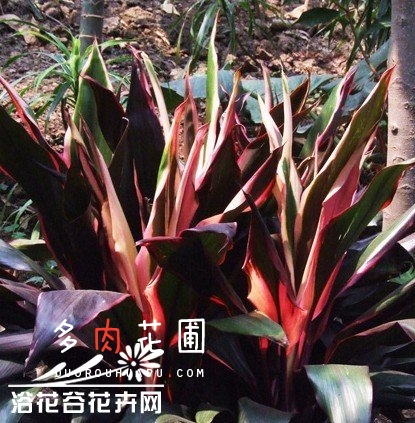
For pot cultivation, choose a growing medium mixed evenly from 5 parts brown peat soil and 5 parts garden soil and river sand. During the growing season, keep the potting soil moist at all times. In summer, watering must be sufficient, and the leaves should be misted frequently, which helps keep the leaf color vibrant, bright and glossy. When growing the three-colored cordyline, note that only when relatively high air humidity is maintained do the leaves look moist and vivid; if the air is too dry, the leaf tips easily turn brown, and the leaves may even drop off. During the peak growing season, apply a compound fertilizer once every half month on average. Do not apply too much nitrogen fertilizer alone, otherwise the colored patterns on the leaves will disappear.
For indoor cultivation, it can be placed in a spot with bright light. In summer, prevent direct strong light, otherwise the leaves are easily scorched. The three-colored cordyline is not cold-tolerant. In winter, the room temperature must be kept above 10°C. At this time, watering should be controlled, and it is best to keep the potting soil slightly dry. To make the plant short and sturdy, when the plant grows to 50-60 cm tall it needs to be pinched back to encourage branching and make the plant form fuller.
How to grow the three-colored cordyline
The three-colored cordyline is an evergreen shrub with a single stem. The stem is club-shaped. Because it resembles the dragon tree, it is easily confused with it and is also called the three-colored dragon tree. The leaves are arranged in a loose rosette. As time goes by, the lower leaves gradually wither and fall off, leaving a bare stem. The leaves are narrow and long, arching, and have no petioles. The leaves are initially green and gradually develop various colored patterns. The three-colored cordyline has leaves with green, yellow and red stripes.Growth habits:
It prefers semi-shade, avoids direct light, and should be kept out of the wind. It needs relatively high air humidity (relative humidity 50%-60%). Dry and strongly ventilated environments very easily turn the leaf tips brown and even cause the leaves to drop. It is not cold-tolerant, and the wintering temperature should not be lower than 10-13°C.
Propagation and cultivation:
Sowing, division and cuttings are all possible; cuttings are the simplest. In spring or early summer, cut a 10-20 cm long stem tip or base for propagation. Insert the cuttings into a moist growing medium mixed with equal parts peat, coarse sand or perlite, cover with a plastic bag, and place in a warm room with bright diffused light. They will root after 4-6 weeks. After 4-5 months, move them into pots with a diameter of 10-15 cm.
Sometimes, because the lower stem of the cordyline has fallen off and looks rather unattractive, you can use the old stem cutting method: cut off the old stem and plant it into the growing medium. It is fine for the stem to have no leaves, but it must have at least one growth bud; 5 cm is enough.