Will Mimosa pudica die if touched repeatedly? Full picture gallery of types
Everyone is certainly familiar with Mimosa pudica; it is a very magical plant. As soon as a person touches it, its leaves immediately fold up, which looks very interesting. Because of this characteristic of Mimosa pudica, many people touch it, and quite a few mimosas die as a result, which makes people curious: can Mimosa pudica be shy itself to death? Here, we will answer this question for you.
1. Why does Mimosa pudica fold its leaves at the slightest touch
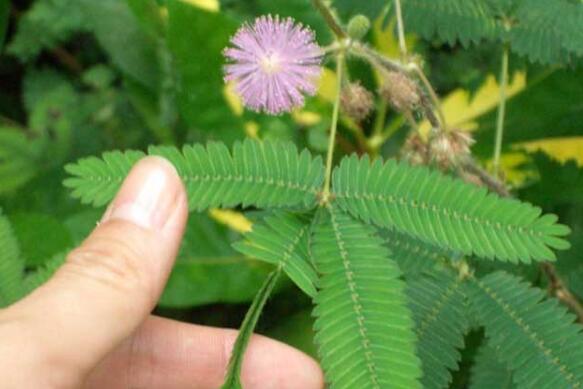
Before answering whether Mimosa pudica can be shy itself to death, let us first look at why it folds its leaves at the slightest touch. According to research, Mimosa pudica has a special organ, the "pulvinus," and the water inside it supports the leaflets. Once it is stimulated, the water in the pulvinus flows elsewhere, causing the leaves of Mimosa pudica to close. Of course, this is a simple explanation; the specific reason is described in detail in Why Does Mimosa pudica Feel Shy, so we will not say more here.
2. Can Mimosa pudica be shy itself to death? Yes
Returning to the question of whether Mimosa pudica can be shy itself to death: when stimulated, the water in the pulvinus of Mimosa pudica must flow elsewhere and then recover. If it is stimulated continuously without interruption, not only is a large amount of ATPase consumed, but the normal transport of water and nutrients is also affected. How could it not die?
In daily life, the behavior of Mimosa pudica moving as soon as it is touched makes many people find it interesting, so scenes like the animation above appear. We remind everyone here that you must not do this, because with frequent touching, Mimosa pudica keeps responding, and the result is that it will die! This also gives rise to the question "Can Mimosa pudica be shy itself to death?" In fact, it does not die of shyness, but is killed by us!
2. Full picture gallery of Mimosa pudica types
As Mimosa pudica gradually becomes better known, many people grow it in pots at home. However, we should remind you that there are mainly four types of Mimosa pudica, among which there is also a thorny Mimosa pudica, and it is not good if it pricks people. The following are 4 varieties of Mimosa pudica:
1. Thorny Mimosa pudica
As the name suggests, it is a Mimosa pudica that grows thorns. Its neck has some small white fine hairs, slightly stiff, and there are tiny thorns at the forks of the branches and leaves.
2. Thornless Mimosa pudica
This kind of Mimosa pudica is often grown in pots at home. Its stem is smooth, without fine hairs, and there are no thorns at the forks of the branches and leaves.
3. Mimosa pigra
A member of the Mimosa pudica varieties, it also blooms, and the flowers are very dense, looking very beautiful like snowflakes. It is understood that Mimosa pigra has strong adaptability and grows rapidly, and has now become an uncontrollable invasive species.
[Mimosa pudica] Mimosa pudica pictures, complete information on Mimosa pudica
♠
The scientific name of Mimosa pudica is Mimosa pudica Linn. It is a perennial herbaceous or subshrub plant of the Fabaceae family. Because the leaves of this plant react to heat and light and close immediately when touched by external force, it is named Mimosa pudica. The shape of Mimosa pudica is like a pom-pom. After flowering, it produces pods, and the fruit is oblate. The leaves of Mimosa pudica are feathery compound leaves, alternate and arranged in a palmate pattern. It usually blooms after midsummer, and each pod segment has 1 seed that falls off when mature. Its flowering period is from March to October, and its fruiting period is from May to November. It likes a warm and humid growing environment and has no special requirements for soil.
♠ Mimosa pudica picture appreciation 1
♠ Information on Mimosa pudica -- management and care
The flowers, leaves, and pods of Mimosa pudica all have good ornamental value, and it is relatively easy to keep alive. It is suitable for cultivation in places such as balconies and indoor potted flowers, and can also be planted at home or in courtyards. What makes Mimosa pudica different from ordinary plants is that when touched by people, its petiole droops and its leaflets quickly close. Therefore, people say it is very shy, and it is also called the sensitive plant, huhan grass, zhixiu grass, and paichou grass. This plant is native to the tropical regions of South America.
♠ Mimosa pudica picture appreciation 2
♠ Information on Mimosa pudica -- sensory characteristics
1. The difference between animals and plants is that plants do not have a nervous system or muscles and do not perceive external stimuli, while animals do. Although Mimosa pudica is a plant, it is an exception. When it receives an external touch, it quickly droops and closes its leaves. People interpret this action as "shyness," so Mimosa pudica is also called zhixiu grass and paichou grass.
2. The cells of Mimosa pudica are composed of small mesh-like protein actin. When it produces closing movement, the phosphate of actin falls off. Therefore, as long as Mimosa pudica absorbs a chemical substance and this substance is not allowed to fall off, even if it is touched with something, Mimosa pudica will not change. When the actin bundles disperse, the cells are destroyed, water escapes, and closing movement occurs. This kind of muscle movement exists in Mimosa pudica and can be said to be quite rare.
3. Plant movement is usually caused by changes in intracellular turgor pressure, and most mature plant cells have a large vacuole. When the vacuole is full of water, it presses on the surrounding cytoplasm and makes it press tightly against the cell wall, giving the cell wall a kind of pressure that makes the cell stiff and swollen, similar to a fully inflated balloon. The concentration of organic and inorganic substances contained in the vacuole determines the level of osmotic pressure. This process can only cause slow movement, such as the opening and closing of stomata.
♠ Mimosa pudica picture appreciation 3
♠ Information on Mimosa pudica -- ornamental value
The plant shape of Mimosa pudica is loose, and its feathery leaves are slender and elegant, and its leaves close as soon as they are touched. The flowers of Mimosa pudica are numerous and delicate, looking lovely and giving a delicate and elegant impression. This kind of flower can be planted in the corner of a courtyard, or placed as a potted plant on a windowsill. When giving it as a gift, gently cover the potted plant with pink gauze and tie a pink ribbon bow, which is especially interesting. It is now mostly grown as an ornamental plant in the home.
♠ Mimosa pudica picture appreciation 4
Conclusion:With its unique plant cells and muscle tension, Mimosa pudica is very sensitive when people touch it, and its leaves droop and immediately close. This is a relatively rare phenomenon among plant species. The above is the information introduction and picture appreciation about Mimosa pudica brought to you by us. We hope it can help friends who like Mimosa pudica.
Why does Mimosa pudica feel shy? Analysis of the reasons for Mimosa pudica feeling shy / a normal physiological phenomenon
In nature, there are countless beautiful and magical plants, but few are unforgettable once seen, and among them is Mimosa pudica, a plant whose leaves fold up after being touched. Some people say that Mimosa pudica folds its leaves because it feels shy after being touched, but why does Mimosa pudica feel shy? According to our research, the reason Mimosa pudica feels shy is actually a normal physiological phenomenon!
1. Why does Mimosa pudica feel shy? A normal physiological phenomenon
Everyone has certainly heard of Mimosa pudica and knows that it is a plant that feels shy and folds its leaves, but do you know why Mimosa pudica feels shy? It turns out that this is not shyness, but a natural physiological response of Mimosa pudica after being stimulated. It is said that once Mimosa pudica is stimulated, it begins to respond within 0.1s and completes the response within a few seconds, as shown in the picture above.
2. The reason Mimosa pudica feels shy: the pulvinus is key
Now that we know why Mimosa pudica feels shy and that it is a natural physiological response, we will explain the reason below. In fact, the key to Mimosa pudica folding its leaves is that it has a special organ, the "pulvinus." It is understood that this organ is unique to grasses and grows on the outer side of the junction of the leaf blade and leaf sheath, with a slightly lighter-colored band-like structure.
According to research, there are many parenchyma cells in the pulvinus of Mimosa pudica, and these cells are very sensitive to external stimuli. Once we touch its leaves, the stimulus is transmitted to the pulvinus within 0.1s. At this time, the cell sap in the parenchyma cells flows into the intercellular spaces, causing the cells' ability to swell to decrease. Once they shrivel, they gather inward, and externally this appears as the leaves closing and the petiole drooping.
Simply put, when Mimosa pudica is stimulated, the turgor pressure in its pulvinus increases, causing contraction. This is the reason Mimosa pudica feels shy. It is understood that 1-2 minutes after the stimulus feedback, the cell sap gradually flows back into the pulvinus, and then the leaves return to their original appearance. So why does Mimosa pudica feel shy? It is only a normal physiological phenomenon.
Mimosa pudica feeling shy is related to its growing environment
Why Mimosa pudica feels shy is inevitably connected with its growing environment. According to our research, Mimosa pudica is native to tropical regions, where violent storms and rain frequently occur. When storm winds move the leaflets of Mimosa pudica, in order to survive, it immediately closes its leaves, thereby protecting the leaves from being damaged by storms, and thus gradually formed this physiological phenomenon.
Mimosa pudica also closes its leaves at night
It is worth mentioning that Mimosa pudica also closes its leaflets at night and its petiole droops, which is also caused by external stimuli. Because in the cultivation methods of Mimosa pudica, we introduced that Mimosa pudica likes a warm environment, and growth is affected when the temperature is below 10 degrees. Therefore, when the temperature is low at night, Mimosa pudica closes its leaflets to protect them.
Fun trivia: Mimosa pudica can predict the weather
Besides feeling shy, Mimosa pudica can actually also predict the weather. If you touch Mimosa pudica with your hand, its leaves close quickly and open very slowly, this indicates that the weather will clear up; if after touching, the leaves of Mimosa pudica shrink slowly and droop slowly, or even close slightly and then reopen, this indicates that the weather will turn from clear to overcast or that it is about to rain.