How to water a potted Clivia? The correct method is to water thoroughly in one go
In the Clivia growing methods and precautions, we have already explained that watering is crucial. Once you overwater Clivia and cause water to accumulate in the pot, it will lead to root rot and yellowing leaves. So we need to grasp the principle: do not water until the soil is completely dry, and when you do water, water thoroughly. But how exactly should you do it? Below is the correct method for watering Clivia. Follow along with the editor and take a look.
1. How to water Clivia: not too much, not too little
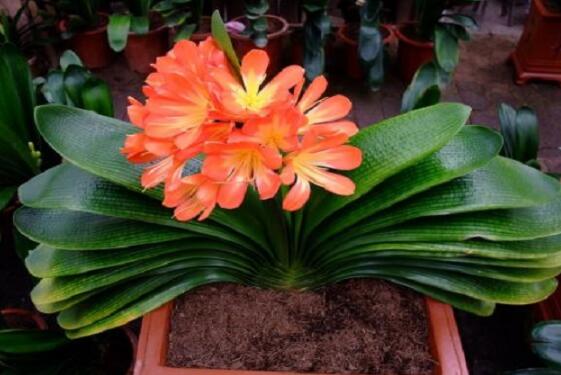
Watering is a skill, especially when watering Clivia, which allows no carelessness. In daily life, not knowing how to water can be said to be one of the important reasons many orchid growers fail to grow Clivia well. Overwatering causes root rot and yellow leaves, while underwatering causes yellow leaf tips and a wilted, listless appearance. Therefore, mastering the correct method of watering Clivia is crucial.
2. How to tell whether Clivia needs watering: 3 clever tricks
Before learning the correct method of watering Clivia, the editor will first introduce how to tell whether Clivia needs watering. In different environments, the frequency and amount of watering are all different. This requires us to judge for ourselves. Below are 3 methods for judging whether Clivia should be watered. The specific steps are as follows:
1. Tap the pot
The simplest way to tell whether Clivia needs watering is to tap the pot. Specific method: tap lightly with your finger at one-third of the way up the flower pot. A relatively crisp sound indicates there is plenty of moisture in the potting soil, while a dull sound indicates the pot is dry, and at this point it needs watering.
2. Weigh by hand
If you are very sensitive to weight, before watering Clivia you can pick up the flower pot and feel its weight. If it feels light, then it is time to water. Of course, this weighing by hand also requires a learning process, otherwise mistakes are easy to make.
3. Probe the soil
How to tell whether Clivia needs watering? Besides the two methods above, the simplest and most direct way is to probe the soil. Specific method: growers can insert a finger one-third of the way into the potting soil and feel it. If it is moist, do not water; if it is dry, or you cannot even push your finger in, then it is time to water!
3. The correct method of watering Clivia: watering through the four seasons
Now that you know how to tell whether Clivia needs watering, let us look at the correct method of watering Clivia. Simply put, watering Clivia should be “thorough” but not “leaking”, to prevent nutrient loss. Below are the four-season watering methods for Clivia. Keep reading.
(1) Watering Clivia in spring: once every 2-3 days
In spring, the earth warms up and temperatures gradually rise, so Clivia should be watered more at this time. Generally speaking, water Clivia once every 2-3 days in spring, with watering done between 9 and 10 a.m. If the weather is dry, you can also mist the leaves.
(2) Watering Clivia in summer: once a day
In summer, temperatures continue to rise, and water evaporation is high at this time, so the frequency of watering Clivia should be increased. It is best to water once every morning, though of course this also depends on the weather and how dry or moist the potting soil is.
The principle for watering Clivia in summer: do not water until the soil is completely dry, and when you do water, water thoroughly. Do not let the potting soil stay neither wet nor dry, otherwise the leaves will grow thin and weak.
Precautions: For watering Clivia, stored rainwater is best. Tap water should be left to settle for 24 hours before use, to prevent the soil from deteriorating. If there is continuous rain, promptly tilt the pot to drain the water or move it indoors. If the potting soil drains poorly and water accumulates for a long time, its fleshy roots are prone to rotting.
(3) Watering Clivia in autumn: once every 2-3 days
In autumn, the weather gradually turns cooler. At this time, watering Clivia is basically the same as in spring, about once every 2-3 days, preferably between 9 and 10 a.m., and the potting soil should still be kept slightly on the dry side. Water for watering: rainwater is relatively good, river water and tap water are next, and well water is best not used.
(4) How to water Clivia in winter: once every 7 days
Among the correct methods of watering Clivia, winter watering is what growers need to pay the most attention to. In winter, when temperatures drop, if the room temperature is below ten degrees, Clivia will enter a dormant state. At this time it needs little water, and watering Clivia can be extended to about once every 7 days, watering when the weather is good.
Precautions: Do not use cold water when watering Clivia in winter. The water temperature should be close to room temperature. No heating is needed; just leave the water indoors for a while. In winter, if Clivia is already in the flower-stem-shooting stage, do not spray water with a spray bottle, because the water droplets sprayed out are hard to control, and this prevents the flower center from staying moist for a long time and rotting.
How to grow potted Clivia: Clivia growing methods and precautions / water must not be excessive
When it comes to Clivia, I believe every flower grower is familiar with it. Although it does not have the beauty of a peony, nor the emerald green of Dieffenbachia, its broad, thick green leaves and fiery red flowers, with red and green enhancing each other, make it an ideal potted flower for beautifying the environment. In daily life, many people choose to grow Clivia, so how do you grow potted Clivia? Below is a carefully compiled guide to Clivia growing methods and precautions. If you want to grow it, you should not miss it~
1. How to grow potted Clivia: watering is key
Growing Clivia at home is the first choice of many flower growers, but some people report that their Clivia just dies while being grown. What is going on? Actually, this may be because it was overwatered, because in the Clivia growing methods and precautions, watering is very crucial. How to grow potted Clivia? Let us continue reading for the specific methods and precautions.
2. Clivia growing methods and precautions
1. Potting soil
How to grow Clivia? Potting soil is the first thing to consider. Although many friends just buy it directly from a flower shop, you will always need to repot and change the soil, so the potting soil requirements for Clivia are also something we need to understand.
Regarding the flower pot: Clivia is a famous flower, but the pot is not better the more exquisite it is; breathability is the most important thing.
Regarding the soil: it is best to line the bottom of the chosen flower pot with tile shards, which helps drain away accumulated water. For the soil, you can use leaf mold, garden soil plus a small amount of river sand mixed evenly. Reference soil mix: leaf mold 50%, coarse sand 15%, charcoal and tile fragments 20%, rotted fertilizer 15%.
Precautions: Flower pot: old flower pots used for many years have poor breathability, so they should be soaked and cleaned, then sun-dried before use; Soil: avoid clayey soil and alkaline soil, otherwise it will cause poor growth and yellowing leaf color.
2. Watering: accumulated water must not be excessive
No matter what kind of flower you grow, watering is essential, and this is exactly what needs the most attention in Clivia growing methods and precautions. Clivia roots are fleshy, and water accumulating in the flower pot easily causes root rot, so watering must not be excessive. Grasp the principle: do not water until the soil is completely dry, and when you do water, water thoroughly.
Precautions: When watering Clivia, be sure not to pour water on the leaves, to prevent the leaves from rotting. When you find dust on the leaves, gently wipe the leaf surface with a soft cloth; do not wash it with large amounts of water. During the flowering period, use the method of watering the roots, but the flower pot absolutely must not retain water.
3. Fertilizing: apply thin fertilizer frequently
In Clivia growing methods, fertilizing is also very important. Clivia likes fertilizer, but too much fertilizer will also cause problems for Clivia, so watering and fertilizing are best done at the same time. During the vigorous growth period, this can be done every 15-20 days. There are mainly three types of fertilizer: dry fertilizer, water fertilizer and solid fertilizer.
Precautions: For fertilizing Clivia, in spring and autumn apply fermented solid fertilizer once a month, and apply liquid fertilizer once a week, mainly nitrogen fertilizer. In winter and summer, it is best not to apply additional fertilizer, or in winter apply solid fertilizer once to Clivia, with less nitrogen fertilizer and more phosphorus and potassium fertilizer. Just remember one principle: apply thin fertilizer frequently.
4. Light: must not be too strong
In Clivia growing methods and precautions, although light is indispensable, the requirements are not strict. It is understood that Clivia likes semi-shade and fears direct light. If exposed to strong light, transpiration will be greatly increased. At this time, if watering is improper, the leaf color will become dull and scorched yellow, or even wilt.
Precautions: Because summer air temperature and soil temperature are relatively high, it is easy for the root system to become disordered, leading to unbalanced nutrient absorption and causing phenomena such as neck stretching and leaf bolting. So when the light is strong, Clivia should be moved to a shaded place, along with a bit more watering.
5. Temperature: must not be too high
How to grow potted Clivia? Suitable temperature is key. Clivia avoids high temperatures in summer. If the temperature exceeds 30°C, or it is exposed to blazing sun, cooling measures should be taken, placing Clivia in a cool, low-temperature, ventilated semi-shaded place.
Precautions: Although Clivia avoids high temperatures, it is also not cold-tolerant. If the temperature is too low, it will stop growing or even die. So in winter, when sunlight is soft, it should be placed indoors in a spot with ample light. A room temperature above 10°C is enough for it to overwinter safely.
3. Clivia growing precautions
Although there are already quite a few precautions in the Clivia growing methods above, to grow Clivia well there are still a few points we need to pay attention to, such as repotting and pruning. The Clivia growing precautions are specifically as follows:
1. Pruning
In summer, be sure to cut off excess flower stems of Clivia. The normal flowering period of Clivia is from New Year's Day to Spring Festival. Flower stems produced in summer cannot produce good flowers, and if not cut off in time, they will consume nutrients and affect normal growth and flowering in winter and spring.
2. Repotting
In Clivia growing precautions, repotting is also very important. In the second year, growers should switch to a 15 cm clay pot, and afterward switch to a clay pot one size larger every 2 years. Repotting is best done in spring and autumn, with a temperature of around 20°C being most suitable.
How to grow potted Clivia: Clivia potting methods
Clivia is also called arrow-leaf stone garlic and large-leaf stone garlic, in the Amaryllidaceae family, Clivia genus, a perennial herb. It likes a warm, humid, semi-shaded environment, fears heat, is not cold-tolerant, and avoids direct sunlight in summer. The suitable growth temperature is 16-25 degrees; below 5 degrees it stops growing and enters dormancy, and above 30 degrees the plant is also in a semi-dormant state. Home potting is a good way to grow Clivia, so do you know how to grow potted Clivia and what the Clivia potting methods are?
How to grow potted Clivia
1. Temperature: The suitable temperature for Clivia growth is 15-25°C. When the temperature exceeds 30°C for a long time in summer, growth is inhibited. At this time, if the air humidity is below 60%, Clivia leaves will become lighter and yellow and even wilt; if the humidity is above 90%, the stems and leaves will grow excessively. To prevent these undesirable phenomena, appropriately lower the temperature, pay attention to ventilation and light transmission, and control humidity. When the temperature drops below 5C, Clivia basically stops growing. If the temperature drops to around 0C, frost damage may occur, causing the leaf tips and leaf margins to fade green and turn yellow, and even appear yellow-white necrotic spots. Therefore, in winter, good warmth protection should be done for Clivia to prevent frost damage.
2. Light: Clivia is a semi-sun-loving flower and likes scattered light. Too strong light is unfavorable to its growth and easily causes sunscald. However, if the placement location is too dark and light is insufficient for a long time, the leaves will also lose their luster, old leaves will become dark green, and new leaves will become thinner and yellow or yellow-green. Some people call this yellow-leaf phenomenon shade yellowing. At this time, Clivia should be moved to a place with slightly stronger light. If it is not suitable to move it, supplementary lighting can be used.
3. Soil and fertilizer: Clivia likes loose, fertile sandy loam. Soil compaction and insufficient fertilizer supply will cause leaves to turn yellow and affect flowering. At this time, apply additional thin liquid fertilizer and pay attention to loosening the soil.
4. Moisture: Clivia likes moisture. If the potting soil is too dry for a long time and the temperature is also high, the leaves easily turn yellow. But long-term overwatering easily leads to disease. Therefore, in Clivia cultivation, in spring and autumn the soil should be kept moist, in the winter dormant period slightly on the dry side, and in summer the potting soil should not be too warm. You can appropriately spray clear water on the leaf surfaces and surrounding ground every morning or evening to maintain a cool environment.
5. Ventilation: If Clivia is placed too densely and the surrounding environment is enclosed, it will hinder air circulation and make the plant weak, yellow and thin. So indoor ventilation should be strengthened, and crowded placement should be avoided.
The above is the article on how to grow potted Clivia and Clivia potting methods. Clivia is suitable for growing in loose, fertile soil rich in humus and slightly acidic, and absolutely must not have water accumulation. In winter, place it indoors, and a room temperature above 5 degrees is enough for it to overwinter safely. Common Clivia varieties include large-flowered Clivia and nodding Clivia. The flowering period is from April to June, and propagation is mainly by division and sowing.