How to grow Impatiens balsamina (Chinese impatiens)? Detailed planting method
There are two common types of impatiens: Chinese impatiens (Impatiens balsamina) and African impatiens. Chinese impatiens is also commonly known as henna flower, tochugrass, etc. The flowers come in white, pink, orange-red, copper-red, etc., and the flower forms include single-petaled and double-petaled types. It is suitable for pot cultivation. This article starts from sowing to explain how to grow Chinese impatiens, for the reference of flower lovers.
1. Care
Why talk about care first? Because some flower lovers may have already planted Chinese impatiens by the time they read this article, so we will start with the care of Chinese impatiens. In fact, Chinese impatiens is very easy to grow. During care, you must ensure there is light, no water shortage, and good soil drainage. If drainage is good, the seedlings may wilt from sun exposure at noon in summer, so appropriate shading is needed. There is nothing else particularly noteworthy.
Seedling-stage care: During the cotyledon stage, keep the substrate moist, not dry, but also not overly waterlogged, to avoid the occurrence of "damping-off". During the true-leaf stage, water must be controlled; water only when the surface of the substrate looks dry. Once the first true leaves unfold, they can be transplanted. Of course, if you are planting only a small amount, you can sow directly without transplanting, which is better for strong roots.
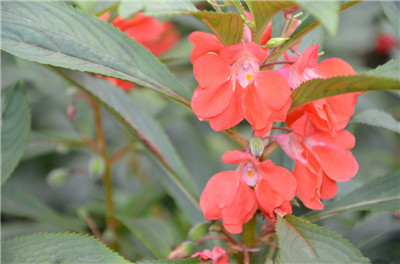
Grown-seedling care: Water thoroughly before transplanting, then transplant with the soil ball. When transplanting, the planting depth should preferably be the original depth or slightly deeper. Water thoroughly immediately. When planting in summer, provide appropriate shade for a few days; after one week, normal care can resume. No watering is needed unless the soil looks dry. After 2 more true leaves grow, a small amount of fertilized water can be applied to promote growth. Fertilization should preferably be comprehensive in nutrients, which can produce more and larger flowers.
Impatiens is very easy to grow. As long as it receives sufficient light, is neither drought-stressed nor waterlogged, and is fertilized in small amounts but frequently, it will be fine.
Impatiens seed collection: Because the fruit of impatiens bursts open and flings the seeds in all directions, it relies on mechanical seed dispersal. So if flower lovers want to collect seeds, they can look at the bottom of the pot or around it, or harvest the seeds before the fruit bursts.
2. Sowing
The sowing time is generally spring and autumn. Choose conditions with an ambient temperature of 22-26°C and humidity between 50-85%. Sow when there is sufficient light, but first prepare the substrate well. There must be no large clods of soil; level it flat and fine to avoid "seed burial". Water the seedbed substrate thoroughly. After the water has completely drained down, scatter the seeds evenly, then cover with fine sandy soil or vermiculite at a thickness of 0.5-0.8 cm. Sprouts will appear in 5-6 days.
How to grow Chinese impatiens
There are two common types of impatiens: Chinese impatiens (Impatiens balsamina) and African impatiens. Chinese impatiens is also commonly known as henna flower, tochugrass, etc. The flowers come in white, pink, orange-red, copper-red, etc., and the flower forms include single-petaled and double-petaled types. It is suitable for pot cultivation. This article starts from sowing to explain how to grow Chinese impatiens, for the reference of flower lovers.1. Care
Why talk about care first? Because some flower lovers may have already planted Chinese impatiens by the time they read this article, so we will start with the care of Chinese impatiens. In fact, Chinese impatiens is very easy to grow. During care, you must ensure there is light, no water shortage, and good soil drainage. If drainage is good, the seedlings may wilt from sun exposure at noon in summer, so appropriate shading is needed. There is nothing else particularly noteworthy.
Seedling-stage care: During the cotyledon stage, keep the substrate moist, not dry, but also not overly waterlogged, to avoid the occurrence of "damping-off". During the true-leaf stage, water must be controlled; water only when the surface of the substrate looks dry. Once the first true leaves unfold, they can be transplanted. Of course, if you are planting only a small amount, you can sow directly without transplanting, which is better for strong roots.
Grown-seedling care: Water thoroughly before transplanting, then transplant with the soil ball. When transplanting, the planting depth should preferably be the original depth or slightly deeper. Water thoroughly immediately. When planting in summer, provide appropriate shade for a few days; after one week, normal care can resume. No watering is needed unless the soil looks dry. After 2 more true leaves grow, a small amount of fertilized water can be applied to promote growth. Fertilization should preferably be comprehensive in nutrients, which can produce more and larger flowers.
Impatiens is very easy to grow. As long as it receives sufficient light, is neither drought-stressed nor waterlogged, and is fertilized in small amounts but frequently, it will be fine.
Impatiens seed collection: Because the fruit of impatiens bursts open and flings the seeds in all directions, it relies on mechanical seed dispersal. So if flower lovers want to collect seeds, they can look at the bottom of the pot or around it, or harvest the seeds before the fruit bursts.
2. Sowing
The sowing time is generally spring and autumn. Choose conditions with an ambient temperature of 22-26°C and humidity between 50-85%. Sow when there is sufficient light, but first prepare the substrate well. There must be no large clods of soil; level it flat and fine to avoid "seed burial". Water the seedbed substrate thoroughly. After the water has completely drained down, scatter the seeds evenly, then cover with fine sandy soil or vermiculite at a thickness of 0.5-0.8 cm. Sprouts will appear in 5-6 days.
How to grow Chinese impatiens: cultivation tips and precautions for Chinese impatiens
Impatiens has been praised by many poets since ancient times. The appearance of Chinese impatiens is very lovely. Below, let us learn specifically about Chinese impatiens and find out how best to grow it.
How to grow Chinese impatiens1. When does Chinese impatiens bloom?
Chinese impatiens can bloom between June and August each year, after which it produces fruit roughly similar in shape to a peach. After that, Chinese impatiens produces seeds for reproduction, so seed collection needs to be timed well.
2. How to grow Chinese impatiens——sowing
The suitable temperature for growing Chinese impatiens is around 22 degrees, and humidity needs to be controlled at around 50 percent. Sufficient light is a prerequisite. Level the soil and sow the seeds; seedlings can be grown in about 5 days.
3. How to grow Chinese impatiens——seedling-stage care
Chinese impatiens seedlings need moisture protection; they cannot be too dry, and at the same time they cannot be too moist. During the seedling growth stage, impatiens needs water control. After the leaves unfold, if the planting amount is not large, there is no need to move the pot; otherwise, after moving the pot, water control treatment should also be carried out at the same time.
4. How to grow Chinese impatiens——grown-seedling care
Before moving the pot, water thoroughly, then transplant together with the pot soil. A somewhat deeper transplanting depth is better. After that, water sufficiently again. Wait until the seedling grows new leaves, then apply a small amount of fertilized water to promote growth.