How Are Wintersweet Bonsai? Advantages and Disadvantages Explained at Once
Wintersweet (Chimonanthus praecox) generally blooms during the cold winter months, that is, from December each year to March of the following year. Its flower colors are mainly red, yellow and white, and its fragrance has a solid, rich quality. Wintersweet bonsai is usually grown both outdoors and indoors, thanks to the plant's tenacious ability to survive.
How to Grow Wintersweet: Water and Fertilizer Management
There is a saying about wintersweet: "A wintersweet will not die of drought," which fully shows that wintersweet's drought tolerance is extremely strong, so wintersweet bonsai is not sensitive to water needs. Generally, in spring and autumn, do not water unless the potting soil is dry; in summer, water once in the morning and once in the evening. During the wintersweet flowering period, do not water too much or too often, otherwise it will cause the wintersweet flowers to drop.
Wintersweet likes fertilizer, but do not apply it too concentrated. Fertilizing is generally done once a month with liquid fertilizer from April to November, and one additional fertilizing can be added in late June to prepare nutrients for flower bud differentiation.
How to Grow Wintersweet: Shaping and Pruning
To ensure that a wintersweet bonsai has good ornamental value, the branches need to be pruned. The pruning method for wintersweet bonsai depends on the tree shape decided in advance. Taking the pruning method for a tree-like form as an example, during the wintersweet seedling stage, select one thick, strong branch to develop into the trunk. After the trunk grows to the desired height, pinch it (pinching, also called topping, is the work of treating reserved trunk branches, basic branches or side branches) to form the crown.
How to Grow Wintersweet: Pest and Disease Management
Wintersweet has relatively few pests and diseases. If any occur, you can use the wintersweet's dormant period to cut off the pest-infested branches and burn them.
After enjoying so many wintersweet pictures and also learning how to grow wintersweet along the way, start planting now, and next winter you will be able to see a wintersweet bonsai in full bloom.
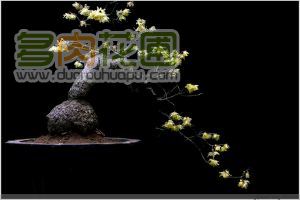
Potting Process
Pot selection: Plum (Prunus mume) is best grown in a zisha clay pot or a glazed clay pot, and generally the pot should not be too shallow. For the slanting-trunk style and curved-trunk style, medium-deep trough pots, round pots, square pots, hexagonal pots, etc. are mostly used; for the cliff-hanging style, tall cylindrical pots are mostly used.
Soil: Plum has no strict requirements for soil, but loose, well-drained soil rich in humus is best. For pot cultivation, pond mud that has been frozen and crumbled and mixed with 30-40% rice-hull ash is commonly used as the growing medium.
Planting: It is best to do this from November to December, and it can also be done after flowering. Generally, slanting planting is preferable, as it makes it easier to create a dynamic form when styling. Before planting, shaping and pruning can be carried out once. When potting, base fertilizer can be placed at the bottom of the pot.
Shaping Techniques
Processing: Plum styling mostly uses "rough bending and fine pruning." Once the trunk reaches 1 cm in diameter, it can be bent and tied, and side branches can also be roughly bent. Palm fiber or metal wire can both be used, and all the rest is shaped by pruning. For the new flowering branches that grow each year, according to styling needs, they can also be bent and tied with palm fiber. Processing of the trunk and large branches is best done in winter, while processing of new branches is best done in September in autumn. Be careful not to bruise the buds.
Tree form: Generally speaking, for Chinese plum bonsai, the trunk should be slanting or horizontal, and the branches and leaves should spread out, but it should not be sparse all the way through. It should be sparse within dense, with proper sparseness and density, to be rich in painterly quality. Among the bonsai schools of our country, there are many traditional plum bonsai styles, and the following are several common ones:
Roaming Dragon Style
This is a traditional style of Hui-style bonsai, that is, the trunk forms several S-shaped bends from the base to the top, like a roaming dragon. The side branches all emerge from the convex bends of the trunk and are also bent to a certain degree, symmetrical left and right, with the upper and lower parts on the same plane, very full of interest
Three-Tier Style
This is also a traditional Hui-style style. The trunk has 2-3 bends, and the upper branches and leaves are divided into three sections, staggered in height with clear layers. Each section is made into a horizontal steamed-bun shape, dignified and steady.
Split-Trunk Style
A traditional style of Su-style bonsai, in which a thick but unshaped plum trunk is split open, part of the xylem is removed, and carving and processing are carried out to achieve the effect of "a withered tree meeting spring."
Knotted Style
A traditional style of Yang-style bonsai, in which during the plum seedling stage the trunk is tied into a knot or coiled into a circle, and over time it forms a knotted shape, appearing ancient and peculiar.
Downwind Style
This is also a traditional Yang-style style, that is, all the flowering branches of the plum are tied toward the same side, like the effect of wind blowing a flag
Weeping Branch Style
This is also a traditional Yang-style style, that is, all the side branches of the plum are tied into a drooping form, with a distinctive charm.
The above styles are for reference only. Nowadays, plum bonsai styling more often involves bending and pruning the plum into an unrestrained, natural feeling.
How to Make Wintersweet Bonsai: How to Grow Wintersweet Bonsai
Wintersweet (Chimonanthus praecox) bursts into bud in the deep winter when the hundred flowers have withered, braving the cold and defying the frost, expressing the Chinese nation's character of never yielding in the face of brutality, and giving people spiritual inspiration and enjoyment of beauty. This integrity of wintersweet has also made it favored by many flower-growing enthusiasts. Wintersweet bonsai has extremely high artistic and ornamental value. This article introduces in detail the production process of wintersweet bonsai for you.
Sourcing Materials and Cultivation
It is relatively common and also quick to produce results to use old wild wintersweet root stumps from mountain areas and cultivate them in the ground to make ancient wintersweet stumps. The method is: select old tree stumps that have sprouted after many years of cutting, dig them back, take care to protect the root system, and prune the branches. Choose a place with moderate light, loose soil and good drainage for "nurturing the stock," and after it survives, move it into a pot for cultivation. If it is an old stump of Gouying wintersweet, then a Suxin wintersweet can be selected for grafting, and after it survives it can be processed and styled as needed.
Potting Process
1. Pot selection: Wintersweet is best grown in a zisha clay pot, and a glazed clay pot can also be used. Generally, seedling wintersweet mostly uses round pots, square pots, hexagonal pots, etc.; old wintersweet stumps can use medium-deep trough pots or begonia pots; for the cliff-hanging style, tall cylindrical pots are mostly chosen. Dark purple or ochre red colors are better, to set off the wax-yellow flowers and increase their ornamental effect.
2. Soil: Wintersweet has no strict requirements for soil, but well-drained sandy loam is best. For pot cultivation, decomposed garden soil or leaf mold mixed with 20-30% rice-hull ash is commonly used as the growing medium.
3. Planting: Transplanting wintersweet is mostly done in early spring, and it is best around the time when the flower stems and new buds sprout in early March. Generally, slanting planting is preferable, as it makes it easier to create a dynamic form when styling. Before planting, shaping and pruning can be carried out once. When potting, sufficient base fertilizer can be applied at the bottom of the pot.
Shaping and Styling
Wintersweet shaping and styling mainly uses pruning and bud pinching, with bending and tying as a supplement. Xi Yaojia Village in Yanling County, Henan, has long been known as "Yanling wintersweet being the finest under heaven." Its traditional styling arts include "screen-fan plum," "knotted plum," "hanging-branch plum," etc., with screen-fan plum being the most popular. Its styling process: the time should be during March to April. Use the "rolling knife method" and "dragon knife method" to make the main branch twist and spiral upward. When the buds are just beginning to stir, make a slanted cut at the place to be bent, with the cut going in at an angle, to a depth reaching 2B3 of the branch diameter. Bend carefully, so that the upper section of the split xylem is supported on the lower section, use a vertical pole to support the newly bent main trunk, and tie it firmly with rope. Then make all the top tips of the branches point downward. The cut must be coated with mud within 1 month, and kept from falling off; if it falls off, replace it immediately. After the basic skeleton is formed, pay attention to pruning and pinch the buds in time to maintain the screen-fan shape.
Although wintersweet and plum do not belong to the same family, their flowering periods are close, and their flowers and fragrance are also similar. Wintersweet is delicate in color and rich in fragrance, no less than red plum, so the plum styling principles can be borrowed: "Plum is beautiful in its curves; straight, it has no grace. It is beautiful in its slant; upright, it has no scenery. It is beautiful in its sparseness; dense, it has no form," "Plum is valued for being sparse rather than abundant, valued for being old rather than young, valued for being thin rather than fat, valued for being contained rather than open," etc. Therefore, the trunk should be slanting or horizontal, the branches and leaves should spread out sparsely, and the old stump should show strength. In addition to the "screen-fan style," "knotted style," and "hanging-branch style" of Yanling, Henan, traditional styles also include "downwind style," "weeping branch style," "roaming dragon style," etc. In modern styling, the tree shapes are mostly based on the slanting-trunk style and the natural style.
All right, the above is the whole process of making wintersweet bonsai. Friends who are interested can try making a pot of wintersweet bonsai.