Cyclamen: A Beautiful Flower That Arrives with Grace
Cyclamen, also called root begonia, rabbit ear flower, rabbit flower, first-grade crown, bonfire flower, and rolled-petal lotus, is a perennial herbaceous plant of the genus Cyclamen in the family Primulaceae. Its leaves are thick and fleshy, its flowers are elegant, and its fragrance is rich. Moreover, cyclamen carries the meaning of “immortal guests arriving gracefully,” which makes it a flower suitable for indoor growing and very popular among people.
Morphological characteristics: The cyclamen tuber is flat-round spherical or spherical, and fleshy. Leaves grow from the top of the tuber and are heart-shaped, ovate, or kidney-shaped, with fine serrations along the leaf margins. The upper leaf surface is green with white or gray mottling, while the underside is green or dark red. The petioles are relatively long, reddish brown, and fleshy. Flowers are borne singly at the top of the flower stalk, nodding, with petals curled upward like rabbit ears, which is why it is called rabbit ear flower. Flowers come in white, pink, rose red, bright red, purple red, snow blue, and other colors, often with dark red spots at the base. Petal margins vary and may be entire, notched, wrinkled, or wavy. Flowers usually have five petals, and the flowering period is from October to April of the following year.
Growth habits: Cyclamen prefers a cool, humid, and sunny environment. The optimum temperature for growth and flower bud differentiation is 15—20 degrees Celsius, with humidity of 70%-75%. During the winter flowering period, the temperature must not be lower than 10 degrees Celsius; if the temperature is too low, the flower color becomes dull and the flowers easily fall off. If the summer temperature reaches 28—30 degrees Celsius, the plant goes dormant; if it reaches above 35 degrees Celsius, the tuber easily rots. Seedlings are slightly more heat-tolerant than older plants. It is a long-day plant. It requires loose, fertile, humus-rich, well-drained, slightly acidic sandy loam soil.
Variety classification: There are more than 20 cyclamen varieties. Common types include:
(1) Large-flowered type: large flowers, petals entire, flat-spreading, reflexed, with single, double, fragrant, and other varieties.
(2) Flat-petaled type: petals flat-spreading and reflexed, margins with fine notches and wavy wrinkles, buds relatively pointed, petals relatively narrow.
(3) Rococo type: flowers half-open and nodding; petals not reflexed, relatively wide, margins with wavy wrinkles and fine notches. Bud tips rounded, flowers fragrant. Leaf margins with prominent serrations.
(4) Frilled-edge type: large flowers, petal margins with fine notches and wavy wrinkles, petals reflexed.
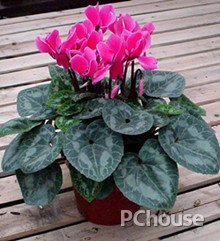
We usually hear a lot about rabbit flower, but did you know that the scientific name of rabbit flower is cyclamen, and it carries the meaning of “immortal guests arriving gracefully”?
1. It is the king of potted flowers. Cyclamen is also called rabbit ear flower, first-grade crown, root begonia, and so on. It originated in the Mediterranean region. Because horticulturists have continuously improved its varieties, this beautiful begonia flower has become a worldwide ornamental flower and is highly praised by many flower lovers. Its tuber is flat-round spherical or spherical and fleshy; the upper leaf surface is green with white or gray mottling, the underside is green or dark red, and the petioles are relatively long, reddish brown, and fleshy. Leaves grow from the top of the tuber and are ovate, kidney-shaped, or heart-shaped, with fine serrations along the leaf margins. Flowers come in white, pink, rose red, bright red, purple red, snow blue, and other colors, often with dark red spots at the base; petal margins vary and may be notched, entire, wavy, or wrinkled. Its heart-stirring appearance has made it the king of potted flowers, the city flower of Qingzhou City, Shandong Province, the national flower of San Marino, and the mascot of the 43rd World Table Tennis Championships held in Tianjin in 1995.
2. It has more than 20 varieties. According to flower shape, cyclamen horticultural varieties can be divided into four types. First, the large-flowered type: large flowers, petals entire, flat-spreading, reflexed, with single, double, fragrant, and other varieties; second, the flat-petaled type: petals flat-spreading and reflexed, margins with fine notches and wavy wrinkles, buds relatively pointed, petals relatively narrow; third, the Rococo type: flowers half-open and nodding; petals not reflexed, relatively wide, margins with wavy wrinkles and fine notches. Bud tips rounded, flowers fragrant. Leaf margins with prominent serrations; fourth, the frilled-edge type: large flowers, petal margins with fine notches and wavy wrinkles, petals reflexed.
3. Its living environment. Cyclamen prefers a cool, humid, and sunny environment. The optimum temperature for growth and flower bud differentiation is 15—20°C, with humidity of 70%-75%; during the winter flowering period, the temperature must not be lower than 10°C. If the temperature is too low, the flower color becomes dull and the flowers easily fall off. It is also not tolerant of high temperatures; above 30°C the plant stops growing and enters dormancy, and above 35°C it easily rots and dies. Seedlings are slightly more heat-tolerant than older plants. It avoids direct sunlight and needs to be cultivated in a shaded place; at home, it is best to place it on an east-facing balcony. After flowering, it can be placed indoors in a bright spot for display and viewing. It requires loose, fertile, humus-rich, well-drained, slightly acidic sandy loam soil.
Cyclamen can be said to be beautiful and distinctive, deeply favored by people. As someone who enjoys flowers, how could you miss it?