What to Do When Plumbago Leaves Turn Yellow? Solve the Problem by Replenishing Water
Plumbago (Ceratostigma plumbaginoides) is a flower species with a rather fresh and elegant appearance, and it has great ornamental value. Of course, no matter how beautiful a flower is, if its leaves turn yellow, it will greatly affect its beauty. As for what to do when plumbago leaves turn yellow, you need to know what is causing it. Long-term exposure to strong sun, insect pests, lack of water and so on are all among the causes of plumbago leaves turning yellow. Once you find the problem, it is relatively easy to deal with it in a targeted way. Below, the editor will walk you through it.
I. What to Do When Plumbago Leaves Turn Yellow / Replenish Water / Remove Pests
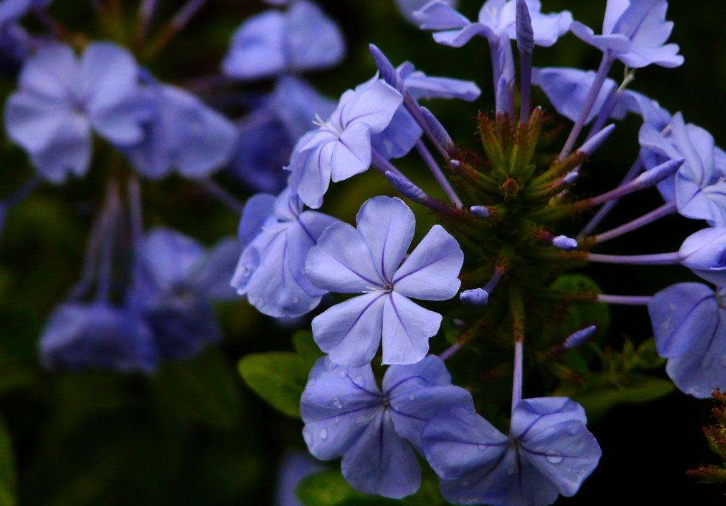
There are many reasons that cause plumbago leaves to turn yellow; exposure to strong sun, lack of water and insect pests can all cause this kind of problem. Among them, if it is due to insect pests, you can refer to the article on pest and disease control for plumbago, in which you can find the answer you want, so the editor will not go into too much detail here.
1. Long-term exposure to strong sun
Although plumbago is a plant that is relatively tolerant of high temperatures, this is only relative. The suitable growing temperature for plumbago is generally between 20-25°, and when the weather is rather hot in summer, being exposed to strong sun outdoors for a long time may cause plumbago leaves to turn yellow. Everyone should pay attention to this.
Note: During the hotter periods in summer, such as around noon, it is best to move the plumbago to a semi-shaded spot indoors. This way it will not be in a state of strong sun exposure, yet it can still absorb sunlight.
2. Lack of water
Water is a very important nutrient for plants, and plumbago is no exception. Lack of water is also one of the reasons that cause plumbago leaves to turn yellow. Some people buy a plant and then leave it in one place without caring for it for a long time, which eventually causes the leaves to turn yellow and even die. This kind of behavior is very inadvisable; plants still need careful cultivation to bloom with beautiful flowers.
Note: When watering plumbago, pay attention to the appropriate amount. In summer, a rather hot season, you can choose to water more, while in winter you should reduce the amount of watering. Everyone must pay attention to this point.
II. Plumbago Flower Language / Coldness, Melancholy
The Legend of the Plumbago Flower Language
This is a love story that originated in ancient times, and the specific events are now very difficult to verify. It is said that at that time a warrior fell in love with a princess of a fallen kingdom, and the two lived a happy life. However, war is cruel, and in the end the warrior still went to the battlefield and died in battle. Yet it was not the enemy who killed him, but a black bear. Because of the warrior's death, the princess of the fallen kingdom also chose to die for love. However, where she died there was a patch of plumbago, and in the legend at that time plumbago was the most magical thing in the world, possessing an unexpected magic that could make the person one longs for share life and death together. This longing is melancholy, so the plumbago flower language also represents “coldness, melancholy”.
This article mainly tells everyone what to do when plumbago leaves turn yellow. I believe that after reading the above content everyone has gained a certain understanding, and I hope it can be of help to everyone. As for the part about the plumbago flower language, it is meant to let everyone better understand the story of the plant you are growing, so it counts as a bonus.
How to Grow Plumbago? Plumbago Care Methods
Plumbago, also known as blue flower leadwort, blue snow leadwort, blue flower jisong and blue jasmine, is a perennial evergreen shrub. When planted in the ground, the plant height is 1-2 m, and when potted it is 35-50 cm. When young, the branches are upright, and later they become pendulous. Plumbago mainly has two varieties: one is Taiwan plumbago, with a loose and tall plant and propagated by cuttings; the other is an extraordinary seed-grown variety with a compact plant shape that can be planted in wall-mounted pots. Today, taking Taiwan plumbago as an example, the editor will talk about its key care points for everyone's reference and study.
Substrate:Peat is better for growing it; growing it in garden soil is noticeably slower. Just mix in some perlite. It can also be made by mixing grass peat and vermiculite in a certain proportion, with a pH value of 5.8-6.2 and an EC value of less than 0.75 mS/cm;
Flower pot:A wider pot is better, and it does not need to be too deep. Plumbago belongs to the shrub group and will send out new branches laterally from roots spreading underground. Choose a large flower pot; it grows rapidly and needs a large amount of water and fertilizer, while a small flower pot restricts growth. Generally speaking, seedlings I took cuttings of in autumn are planted in an Alice No. 10 round pot by the summer of the following year.
Fertilizer:Plumbago likes fertilizer. For base fertilizer, long-acting slow-release fertilizers such as Osmocote and hoof-and-horn can be used. There is not much particularity in ordinary topdressing; basically anything can be used. I am used to using Flower Duoduo for root drenching, and for solid topdressing fertilizer I use Leili Haifusheng. Foliar spraying of fertilizer has a very good effect, with Flower Duoduo plus seaweed extract.
Water:It likes a relatively moist substrate. If it lacks water and you replenish it immediately, it can recover. If it lacks water for a long time, the leaves easily turn yellow and the plant weakens. In summer, for the ones I grow in No. 14 pots, at least twice a day with water, and often I still need to add another watering at noon.
Pests and diseases:The main pest and disease problem of plumbago is the larvae of noctuid moths, small green fleshy worms. Use abamectin or Leili 609, or Xiangshan Plant Insecticide King. White powder on the back of the leaves is a normal phenomenon, and curling of old leaves is not a disease either.
Pruning:Plumbago is not afraid of pruning. After flowering, cut off the spent flowers, and it can bloom again in about 20-30 days. Old branches must not be more than two years old. I generally do hard pruning each autumn when I move it indoors, cutting off black branches and keeping only the thick green branches newly grown that year.
Propagation:Plumbago is mostly propagated by cuttings and division, and can also be propagated by sowing. Sowing is suitable in spring, and cuttings can be taken in spring, early summer or late summer. For summer cuttings, choose tender shoots or semi-mature branches. The best rooting temperature is 20-25℃, and after insertion they can root in about 20-30 d.
Others:If it encounters rain during the full flowering period, the flowers are easily damaged, which affects the ornamental value. It likes strong sun, and the flower quantity is still decent in semi-shade. In winter, low temperature and cutting off water can force dormancy, but a certain amount of light must be ensured. According to my experience, the low-temperature limit is about zero degrees. Some flower friends in Shanghai have successfully overwintered it outdoors, only needing it to regrow branches. There are two varieties: one is Taiwan plumbago, with a loose and tall plant and propagated by cuttings; the other is an extraordinary seed-grown variety with a compact plant shape that can be planted in wall-mounted pots.
Summary: The above are the key care points for plumbago. I hope it is helpful to friends who grow plumbago.
Plumbago Ceratostigma plumbaginoides Plumbago Illustrated Guide: How to Grow Plumbago / How to Propagate Plumbago
Plumbago ProfilePlumbago Ceratostigma plumbaginoides
Plumbago Cultivation Methods and Precautions Introduction to Plumbago
Plumbago is also known as blue snow leadwort, blue flower jisong, blue jasmine and so on. It is a plant of the family Plumbaginaceae and the genus Ceratostigma, native to South Africa, and is a perennial evergreen shrub. When planted in the ground, the plant height is 1-2 m, and when potted it is 35-50 cm. When young, the branches are upright, and later they become pendulous. The leaves are simple and alternate, thin, and entire. The spike inflorescences are terminal or axillary, the corolla is salver-shaped, light blue or white, the flowering period is June-September, and the fruit is a capsule.
The upper part of plumbago is vine-like or very spreading, about 1 meter tall or taller. The leaves are thin, usually rhombic-ovate to narrowly long-ovate. The spike inflorescence contains about 18-30 flowers; the peduncle is short; the bracts are linear narrowly long-ovate, the corolla is pale blue to blue-white, the limb is broad, the lobes are obovate with rounded tips; the ovary is nearly pear-shaped with 5 angles.
Plumbago likes warmth, tolerates heat, likes light, is slightly shade-tolerant, and is moderately drought-tolerant. There are 85 seeds per gram. It can be propagated by sowing, and also by cuttings and division. Cuttings are generally taken in May-June, the suitable rooting temperature is 20℃-25℃, and after insertion they root in about 20-28 days.
The flowering period of plumbago is June-September.
It is often cultivated in South China, East China, Southwest China and Beijing in China. It is native to southern South Africa and has been widely introduced by various countries as an ornamental plant.
The Morphological Characteristics of Plumbago
Plumbago is a perennial evergreen shrub of the family Plumbaginaceae and the genus Ceratostigma. When planted in the ground, the plant height is 1-2 m, and when potted it is 35-50 cm. When young, the branches are upright, and later they become pendulous. The leaves are simple and alternate, thin, and entire.
The branches of plumbago have angled grooves, are upright when young, and become trailing after growing. The leaves are thin, simple and alternate, entire, short-rounded or oblong-spatulate, with an obtuse tip and a small protruding point, and a wedge-shaped base. The spike inflorescences are terminal and axillary, the bracts are shorter than the calyx, the calyx has sticky glandular hairs and fine soft hairs, the corolla is pale blue, salver-shaped, with a narrow and long tube and 5 lobes at the top.
The upper part of plumbago is vine-like or very spreading, about 1 meter tall or taller, hairless except for the inflorescence, and covered with fine calcareous granules.
The spike inflorescences of plumbago are terminal or axillary, the corolla is salver-shaped, light blue or white, the flowering period is June-September, and the fruit is a capsule. Plumbago likes warmth, tolerates heat, likes light, is slightly shade-tolerant, and is moderately drought-tolerant. There are 85 seeds per gram. It can be propagated by sowing, and also by cuttings and division. Cuttings are generally taken in May-June, the suitable rooting temperature is 20℃-25℃, and after insertion they root in about 20-28 days.
The leaves of plumbago are thin, usually rhombic-ovate to narrowly long-ovate, sometimes (not fully developed) elliptic or long-obovate, (1) 3-6 (7) cm long and (0.5) 1.5-2 (2.5) cm wide, with a suddenly pointed tip and a small short point, rarely obtuse or slightly concave, with a wedge-shaped base gradually narrowing downward into a stalk; the base of the petiole of the upper leaves often has small semicircular to oblong auricles.
The spike inflorescence of plumbago contains about 18-30 flowers, the peduncle is short, usually 2-12 mm long, the rachis (including the fruiting period) is 2-5 (8) cm long, and it is densely covered with gray-white to pale yellow-brown short down together with the peduncle and the stem of the 1-2 nodes below it.
The bracts are 4-10 mm long and about 1-2 mm wide, linear narrowly long-ovate, with a shortly acuminate tip. The bracteoles are about 2-6 mm long and about 1-2 mm wide, narrowly ovate or long-ovate, with an acute or short-pointed tip.
The calyx is 11-13.5 mm long, the middle of the calyx tube is about 1-1.2 mm in diameter, and the tip has 5 short small lobes that are long-ovate-triangular. The outside of the lobes is covered with even fine pubescence, and the upper half or upper part of the calyx tube and the green parts of the lobes bear stalked glands; the corolla is pale blue to blue-white, the corolla tube is 3.2-3.4 cm long, the middle diameter is 0.5-1 mm, the limb is broad, usually 2.5-3.2 cm in diameter, the lobes are about 1.2-1.4 cm long and about 1 cm wide, obovate, with rounded tips; the stamens are slightly exposed beyond the throat, the anthers are about 1.7 mm long and blue; the ovary is nearly pear-shaped with 5 angles, and the angles widen and protrude into horns on the upper part of the ovary; the style is hairless and the stigma is included.
Plumbago has emerald-green leaves and elegantly colored flowers, giving a cool feeling in the hot summer. It can be potted to decorate rooms and balconies. Mature plants have pendulous branches, making them even more suitable for large combined container planting. The flowering period is June-September, and the fruit is a membranous capsule; the fruit has not been seen.
The Ecological Habits of Plumbago
Plumbago likes warmth, tolerates heat, likes light, is slightly shade-tolerant, likes light and is also shade-tolerant, and is suitable for a warm environment and well-drained sandy soil. It is moderately drought-tolerant; under outdoor temperatures continuously above 35c in Chongqing, it still grows well, with bright flower colors and a long flowering period. It likes loose and fertile soil, but can also grow well in soil with relatively high clay content. When potted in early June, flowers can be seen in early July, and the flowering period lasts relatively long, about 2 months.
Plumbago grows on the foothills of low mountains and on flat ground. It likes warmth and is not cold-tolerant. In North China and other temperate regions, it is cultivated as a greenhouse flower. The suitable growth temperature is 25℃. It likes light and is slightly shade-tolerant, and should not be exposed to strong sun. It requires a moist environment; dryness is unfavorable to its growth, and it is not drought-tolerant. It is suitable for growing in humus-rich, well-drained sandy loam.
Plumbago likes a warm, humid and sunlight-abundant environment. It is not cold-tolerant, is relatively shade-tolerant, and fears strong light exposure. It is suitable for growing in fertile, slightly acidic soil, and the winter temperature should not be lower than 10℃. During the growth period, it needs frequent application of dilute liquid fertilizer, and in the spring and summer growing seasons it should be fertilized once a week. After the weather warms and it is moved out of the greenhouse, it should be placed in semi-shade or in a shade shed, and watered reasonably according to the plant's needs. In high temperatures it should be shaded, and water should be sprinkled around the pot soil at the right time. Spraying Xinguozhimo preserves fertilizer and moisture, and spraying Duoduo Zhuangdiling at the bud stage can promote strong buds, plump petals, vivid flower color, rich fragrance and a longer flowering period.
In North China and other temperate regions, plumbago is cultivated as a greenhouse flower.
Plumbago Cultivation Techniques and Key Cultivation Points
Substrate
Peat is better for growing plumbago; growing it in garden soil is noticeably slower. Just mix in some perlite.
Flower pot
A wider pot is better for plumbago, and it does not need to be too deep. Plumbago belongs to the shrub group and will send out new branches laterally from roots spreading underground. Choose a large flower pot; it grows rapidly and needs a large amount of water and fertilizer, while a small flower pot restricts growth. Generally speaking, seedlings I took cuttings of in autumn are planted in an Alice No. 10 round pot by the summer of the following year.
Fertilizer
Plumbago likes fertilizer. For base fertilizer, long-acting slow-release fertilizers such as Osmocote and hoof-and-horn can be used. There is not much particularity in ordinary topdressing; basically anything can be used. I am used to using Flower Duoduo for root drenching, and for solid topdressing fertilizer I use Leili Haifusheng. Foliar spraying of fertilizer has a very good effect, with Flower Duoduo plus seaweed extract.
Water
Plumbago likes a relatively moist substrate. If it lacks water and you replenish it immediately, it can recover. If it lacks water for a long time, the leaves easily turn yellow and the plant weakens. In summer, for the ones I grow in No. 14 pots, at least twice a day with water, and often I still need to add another watering at noon.
Pests and diseases
The main pest and disease problem of plumbago is the larvae of noctuid moths, small green fleshy worms. Use abamectin or Leili 609, or Xiangshan Plant Insecticide King. White powder on the back of the leaves is a normal phenomenon, and curling of old leaves is not a disease either.
Pruning
Plumbago is not afraid of pruning. After flowering, cut off the spent flowers, and it can bloom again in about 20-30 days. Old branches must not be more than two years old. I generally do hard pruning each autumn when I move it indoors, cutting off black branches and keeping only the thick green branches newly grown that year.
Others
If it encounters rain during the full flowering period, the flowers are easily damaged, which affects the ornamental value. It likes strong sun, and the flower quantity is still decent in semi-shade. In winter, low temperature and cutting off water can force dormancy, but a certain amount of light must be ensured. According to my experience, the low-temperature limit is about zero degrees. Some flower friends in Shanghai have successfully overwintered it outdoors, only needing it to regrow branches.
Potted Flower Management
The medium pH value is 5.5-6.0. The planting depth is based on the pot soil just covering the top of the plug seedling soil ball. A small amount of fertilizer can be added to the medium.
Temperature: the suitable growth temperature is 17℃-26℃, and it can tolerate up to 35℃. Strong light and relatively high temperatures favor branching.
Fertilizer: apply a complete-element compound fertilizer at 200-300 ppm at least once a week.
Water: keep the medium surface dry in daily care. When watering, make sure to water thoroughly to prevent the EC value from being too high and soil salinization.
Management: during the process of growing to a finished seedling, pinching is needed 2-3 times, and pinching can delay the flowering period by about 2 weeks.
Plumbago Pests and Diseases: The roots are easily damaged by root-knot nematodes. Attention should be paid to disinfecting the soil before use. During the disease period, a diluted solution of 80% dibromochloropropane emulsifiable concentrate can be sprayed on the soil surface. For the pest mealybugs, use 25% phosmet emulsifiable concentrate at 1000 times dilution for spray control.
Time from sowing to flowering for plumbago: 14-18 weeks in a 10 cm pot.
Repotting
Repot every spring, generally using a 15-20 cm pot, and large containers can also be used for cultivation. When repotting, prune appropriately and take care to protect new shoots. For plants more than 3 years old, hard pruning should be done, and after pruning apply a wound healing and antiseptic film to the wounds so that they heal quickly.
Plumbago Cultivation Methods
Plumbago cultivation is relatively simple, and management is also relatively extensive. It is a flower that tolerates heat and high temperature and high humidity. In the hot summer, plumbago gives people a cool feeling, and it also has relatively few pests and diseases. Although its cultivation is relatively simple, a certain amount of effort is still needed when growing it, so that better plumbago can bloom. So, what are the cultivation and management methods for plumbago?
1、Temperature and Light
Plumbago likes warmth and is not cold-tolerant. The suitable growth temperature is 25℃, and it can tolerate up to 35℃. Strong light and relatively high temperatures favor branching. The minimum winter temperature should be above 7℃. The plant likes light and can also tolerate shade. It should be placed in a bright place and receive several hours of direct sunlight each day, but do not expose it to strong sun. During overwintering, it is best to let it receive a little more sunlight.
2、Fertilizing
During the growth period, plumbago needs frequent application of liquid fertilizer, and in the spring and summer growing seasons it should be fertilized once a week.
3、Watering
During the vigorous growth period, plumbago needs a large amount of watering, and the environment around the plant should be kept moist. You can spray water on it or place the flower pot on wet stones. In winter, reduce the amount of watering; it is enough that the pot soil does not dry out completely.
4、Propagation
Plumbago is propagated by cuttings. In spring or summer, select 8-10 cm branches as cuttings, insert them in culture soil, cover with plastic film, and place in a bright place. After roots grow, remove the plastic film and begin cultivation.
5、Cultivation and Repotting
Plumbago should be planted in well-drained soil. Repot in spring. If repotting is not necessary, the plant should be taken out, pruned appropriately, and then replanted back into the original pot with fresh culture soil.
6、Management
During the process of growing plumbago to a finished seedling, pinching is needed 2-3 times, and pinching can delay the flowering period by about 2 weeks.
7、Pests and diseases
The roots are easily damaged by root-knot nematodes. Attention should be paid to disinfecting the soil before use. During the disease period, a diluted solution of 80% dibromochloropropane emulsifiable concentrate can be sprayed on the soil surface. For the pest mealybugs, use 25% phosmet emulsifiable concentrate at 1000 times dilution for spray control.
Warm Tips
Only the branches that grow out in the current year can bloom for plumbago. Therefore, every spring it should be pruned, cutting off the weak and thin branches and the 213 main stems. New branches growing from the old stems will bloom before long.
Plumbago Propagation Methods
For plumbago propagation methods, cuttings and division are mostly used, and sowing propagation can also be used.
Cutting Propagation
Plumbago cuttings can be taken in spring, early summer or late summer. Every spring, this is done together with repotting and pruning. For summer cuttings, choose robust and full biennial tender shoots or semi-mature branches 10-15 cm long, insert them in a sand bed, and the best rooting temperature is 20-25℃. After insertion, spray Xinguozhimo and they can root in about 20-30 days. After 3 weeks they can be potted for cultivation. The best rooting temperature is 20-25℃, and after insertion they can root in about 20-30 d.
Sowing Propagation
Plumbago is very easy to sow, and it can bloom in the same year. Plant some little sky flowers; they not only are not prone to getting insects, but also have a long flowering period.
1. Plug specifications: 288, 200, 128 or 72 plugs
2. Medium: choose a light medium free of pests and diseases with good drainage. It can be made by mixing grass peat and vermiculite in a certain proportion, with a pH value of 5.8-6.2 and an EC value of less than 0.75 mS/cm
3. After sowing, cover with coarse vermiculite. The suitable germination temperature is 22-23℃, and the suitable growth temperature at the seedling stage is 18℃-21℃
4. Germination days: 4-6 days
5. Light: light is not needed during the germination stage, but timely supplementary light after germination can effectively shorten the growing cycle
6. Water: keep the medium moist during the seedling-raising period to avoid seedling wilting
7. Fertilizer: after the cotyledons emerge, start applying 100 ppm fertilizer 1-2 times a week. Later, increase the nitrogen fertilizer concentration to 150-175 ppm, and alternate fertilizers with an N-P-K ratio of 13-2-13 or 14-0-14 and 20-10-20.
8. Growth regulators: not needed at the plug seedling stage
9. Plug seedling raising days: 6-8 weeks (288 plugs)
Plumbago Disease Control
Plumbago has strong growth, tolerates heat, is relatively tolerant of high temperature and high humidity, has few pests and diseases, is simple to manage, and has a long ornamental period.
During the growth period, plumbago commonly suffers from root-knot nematode disease damaging the roots. A diluted solution of 80% dibromochloropropane emulsifiable concentrate can be sprayed on the soil surface.
The roots are easily damaged by root-knot nematodes. Attention should be paid to disinfecting the soil before use. During the disease period, a diluted solution of 80% dibromochloropropane emulsifiable concentrate can be sprayed on the soil surface. For the pest mealybugs, use 25% phosmet emulsifiable concentrate at 1000 times dilution plus Xinguozhimo, and spray for control, greatly improving the utilization rate of the active ingredients of the pesticide, and spray together to kill them.
Variety Classification of Blue Plumbago
Blue plumbago mainly has two varieties: one is Taiwan blue plumbago, a tall, sprawling plant propagated from cuttings; the other is an outstanding seed-grown variety with a compact habit that can be planted in wall-mounted pots.
Species in the Same Genus
Purple plumbago P. indica
Erect or climbing shrub, 0.5-1.5 m tall. Inflorescence axis glabrous, calyx cylindrical, red, with glandular hairs on the apical lobes, corolla red. Native to tropical Asia. Now semi-wild or cultivated in other tropical regions of the world.
It is also cultivated in Guangdong and Yunnan, China. White plumbago P. zeylanica, a climbing subshrub, 1-3 m tall. Leaves ovate to oblong-ovate, apex acute to acuminate, petiole base enlarged and stem-clasping. Spike terminal and axillary, inflorescence axis glandular, corolla salverform, white. Distributed in Yunnan, Sichuan, Guizhou, Guangdong, Guangxi, Fujian and Taiwan, China.
It also occurs in other tropical regions of the world. The root can be used medicinally.
Small blue plumbago P. micrantha
Annual herb, 20-50 cm tall, the whole plant tinged red. Leaf base auriculate and stem-clasping. Flowers in fascicles of 3-5, corolla pale blue-purple, narrowly campanulate. Capsule light blackish-brown, circumscissile.
Related Species
White plumbago (form) Plumbago auriculata Lam. form. alba (Pasq.) Peng
Blue plumbago, blue-flowered plumbago (nominate form) Plumbago auriculata Lam. form. auriculata
Blue plumbago, Guizhou white plumbago (doubtful species) Plumbago esquirolii Levl.
Blue plumbago, purple-flowered plumbago Plumbago indica L.
Blue plumbago, white plumbago Plumbago zeylanica L.
Blue plumbago, sharp-petaled white plumbago (variety) Plumbago zeylanica L. var. oxypetala Boiss.
Blue plumbago, white plumbago (nominate variety) Plumbago zeylanica L. var. zeylanica L.
Distribution Range of Blue Plumbago
Blue plumbago is native to South Africa, now cultivated in various places, and has been widely introduced by many countries as an ornamental plant; the type specimen was collected from a plant cultivated in India.
In China, blue plumbago is often cultivated in South China, East China, Southwest China and Beijing, mainly distributed within Henan (Jigongshan, Funiushan, Taihangshan), extending north along the Taihang Mountains (Shanxi) to Beijing, and east to Jiangsu (Xuzhou), Shanghai and the Zhoushan Islands of Zhejiang (Qushan).
Blue plumbago is cultivated in various parts of China; in many places in southern China it is grown in the open ground, while in the north it needs to be cultivated in a greenhouse.
Medicinal or Dietary Value of Blue Plumbago
The medical information and health dietary information on Huahua.net are for reference only and cannot be used as a basis for diagnosis or medical treatment. For any health problem, consult professional medical personnel, and for the treatment of any disease, follow doctor's advice.
Ultimate flower-care mission: love yourself, start from reality, and strictly follow doctor's advice. Toward illness, do not be careless, do not delay, do not give up hope; face it bravely, warm the silent world with love, and care for the flower field within your heart.
Medicinal Value
The root of the blue plumbago plant is used in India to treat warts.
Uses and Ornamental Value of Blue Plumbago
Native to southern South Africa, it has been widely introduced by many countries as an ornamental plant.
Blue plumbago grows vigorously, tolerates heat, is relatively tolerant of high temperature and high humidity, has few pests and diseases, is simple to manage, and has a long ornamental period. The leaves are emerald green and the flowers are elegantly colored, giving a cool feeling in the hot summer; it can be potted to accent rooms and balconies.
Landscape Uses of Blue Plumbago
The branches of mature blue plumbago plants trail downward, making it more suitable for large mixed container plantings; during the Olympic Games it could be used for environmental decoration around venues and along major routes such as roads and overpasses, and it can also be planted in the ground at forest edges or to accent lawns; it is one of the new superior flowering ornamentals used to decorate Beijing's environment during the Olympic Games.
Cultural Background and Legend of Blue Plumbago
Legend says that in ancient times a warrior fell in love with a princess of a fallen kingdom. For love, and to be together forever, the warrior decided to flee his own country with this princess of a fallen kingdom; the two went to live in seclusion. But the warrior was ruthless, and his fate was to be held on the battlefield, so even though they left their country, the warrior ultimately died in battle. However, it was not the enemy who defeated this warrior, but a black bear. In the end, the princess of the fallen kingdom also hanged herself with a blue cloth strip. At the foot of where she died was a patch of blue plumbago, so it is said that blue plumbago is the most magical and powerful thing under heaven, able to make the person you long for share life and death with you; however, this longing is melancholy, so its flower language is: coldness, melancholy.
Research
Blue plumbago can bloom year-round under suitable conditions, with two peak flowering periods, winter-spring (April-December) and summer-autumn (June-September). Judging from the specimens studied, the style is short and the glands on the inner side of the stigma are dense and short, consistent with the short-styled type of the heterostyly reported for this species by O. Dahlgren (in Svensk Bot. Tidskr 12: 363-367. 1918); specimens with mature fruit have not yet been seen in China, which may be related to this. In addition, the following form is also cultivated in China.
Flower Language of Blue Plumbago
Flower language of blue plumbago: coldness, melancholy.
Legend says that blue plumbago is the most magical and powerful thing under heaven, able to make the person you long for share life and death with you; however, this longing is melancholy.
Blue Plumbago Pictures