How to Grow and Care for Bromeliads: Fertilizing Matters Most
For bromeliads, I believe every flower enthusiast is familiar with them. They mainly fall into two categories: one that doesn't look great but can produce pineapples, called edible pineapple; the other that looks beautiful and can bloom but doesn't bear fruit, called ornamental bromeliad, which is the bromeliad we commonly grow indoors. So how do you grow bromeliads? Below is a carefully compiled guide to bromeliad growing methods and precautions by the editor. Friends who want to grow them shouldn't miss it~
I. How to Grow Bromeliads: Grow Them with Care
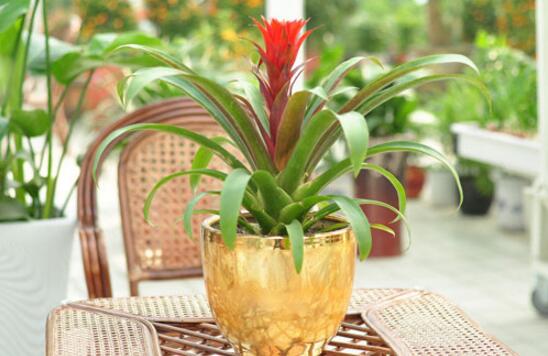
Growing plants indoors is different from outdoors. Soil, light and water all need to be provided by us, so how do you grow bromeliads? Meet all their growing needs, then just be a bit careful. Below are the bromeliad growing methods and precautions, mainly covering 5 points: soil, light, temperature, watering and fertilizing. Read on.
II. Bromeliad Growing Methods and Precautions
1. Soil: Good Air Permeability
In the bromeliad growing methods and precautions, the first thing to choose is naturally the soil. It is said that bromeliads like loose, fertile, breathable, well-draining, slightly acidic soil. So flower enthusiasts should choose loose peat soil, humus soil, and tree fern debris mixed into the growing medium.
Precautions: To ensure bromeliads absorb water well, choosing the right soil is key. If growing at home, flower enthusiasts had best choose leaf mold soil plus a small amount of garden soil, or mix half peat soil and half perlite.
2. Light
For growing bromeliads, light is especially important. It is said that bromeliads were originally an understory plant in tropical rainforests, so they like semi-shade but cannot do without light. Therefore, in our daily growing we should prevent exposure to scorching sun. To ensure light duration, you can place them in a semi-shaded spot or a window with brightness.
Precautions: Bromeliads need light, but not much. Once exposed to too much sun, some of their leaves will show yellowing symptoms. After that, the flower tips may also become somewhat dry, and similar problems may appear.
4. Temperature
No matter what plant it is, temperature must be paid attention to when growing it, so in the bromeliad growing methods and precautions, temperature is also something we need to watch. To grow bromeliads well, it's best to keep them in an environment of 20-30°C; too high or too low won't do.
Precautions: The temperature must be suitable; too high or too low will both affect bromeliad growth. Best to ensure: at the highest, the temperature should not exceed 35 degrees; at the lowest, it should not drop below about 10 degrees.
5. Fertilizing
For growing bromeliads, fertilizing is also extremely important, because an appropriate amount of fertilizer can make bromeliads grow well. During the growing season, apply nitrogen fertilizer to bromeliads once a week. Before flowering, appropriately increase phosphorus and potassium fertilizer to promote larger flowers and brighter colors.
Precautions: Do not fertilize too much, as this will cause fertilizer burn, leading to root rot in bromeliads. Normally, flower enthusiasts can spray both sides of the leaves with a solution of 0.1% urea plus 0.2% monopotassium phosphate. In addition, you can also pour some very dilute liquid fertilizer into the leaf cups, which benefits bromeliad growth.
III. Bromeliad Growing Precautions
Although there are already quite a few precautions in the bromeliad growing methods above, to grow bromeliads well and let them produce beautiful flowers, there are still a few points we need to note, such as humidity and water quality. The bromeliad growing precautions are specifically as follows:
1. Air humidity: In daily care, besides watering, flower enthusiasts should also maintain air humidity, preferably 50%-75%. So when you feel the air is dry, you can spray water around the bromeliad.
2. Water quality: The water quality used for watering is also one of the bromeliad growing precautions. It is said that bromeliads like to grow in acidic soil and require water to also be weakly acidic. They dislike salts, especially calcium salts and sodium salts.
Bromeliad Growing Methods Bromeliad Growing Methods and Precautions How to Grow Bromeliads
If you have seen a bromeliad, you must know how its name came about. Just as you have seen, its petals and pineapple leaves are very similar, and its flowers are gorgeous with intricate patterns that are fascinating. Aside from its appearance, it can also purify indoor air, filling the home with green vitality while also fulfilling its flower language - perfection. Such a good flower is of course also easy to grow. Below we will introduce the bromeliad growing methods.
Key Point of Bromeliad Growing - Water
Water is the source of life and the key to development. The water bromeliads like best has a pH of preferably 5.5-6.5, which is most beneficial for nutrient absorption and can also reduce the pressure the roots bear from the outside environment. So the ideal irrigation is rainwater. If not available, lake water and surface water are also good for irrigation. If conditions permit, you can buy a spray bottle, which not only helps prevent water accumulation at the bottom of the pot, but also lowers the indoor temperature.
Key Point of Bromeliad Growing - Light
Bromeliads are indoor plants that like shade and are not suited to direct sunlight, but they also need sunlight. According to traditional growing experience, 3 hours a day is best. Spring and autumn need no mention, but it is worth noting that in summer there must be no direct sunlight, and in winter the temperature must be above 10° and below 20°, which benefits the plant's rest and will not affect the next year's growth.
Key Point of Bromeliad Growing - Fertilizing
Bromeliads were originally epiphytic plants. Their root system is not very developed, with no main root, only weak fibrous roots, so do not add too much fertilizer to the pot. This is also the main reason many people report yellowing leaves and root rot during growing. Here the editor suggests using a small pot and shallow pot for planting, letting some of the roots contact air. As for the soil, leaf mold plus a bit of garden soil, or half peat and half perlite mixed together, will do.
Summary: Actually, the bromeliad growing methods are just this simple. As long as you do these few things, you can grow lovely flowers planted with your own hands. They are not only beautiful but can also purify indoor air. Try it together.
[Related Articles]
?Pink Rose Pictures ?Curtain Pairing ?Forget-Me-Not Flowers ?Rainbow Cross-Stitch
?Orange Jessamine Bonsai ?Eucalyptus Growing ?Artificial Flower Vines ?Poppy Growing
?Masson Pine Pictures ?Pine Bonsai ?Winter Daphne ?Marigold Growing
?Chinese Rose Pictures ?Dawn Redwood Bonsai ?Poppy Growing ?Mimosa Information
How to Grow Bromeliads_Bromeliad Growing Methods and Precautions
Bromeliads are also called pineapple flowers or ornamental bromeliads. They are a flowering plant belonging to the genus Billbergia in the Bromeliaceae family, native to the jungles from Mexico to southern Brazil and northern Argentina. There are more than fifty species, most of them terrestrial plants. Their leaves are sickle-shaped, with the upper part sloping downward. They usually consist of 5-8 leaves arranged in a tube shape, forming a rosette-shaped leaf cluster, and have very good ornamental value. Many people very much like to grow bromeliads at home. Below let's take a look at how to grow bromeliads, as well as the bromeliad growing methods and precautions.
[Morphological Characteristics of Bromeliads]
Bromeliads are ornamental plants with very strong foliage and floral appeal. Especially when used as home garden ornamentals, they have very good ornamental value and are often grown indoors by people. Their leaves are rosette-shaped and basal, leathery, and strap-like outward-curving. The leaves have dark green horizontal stripes. Some leaves are brown with green water-vein patterns on them, and some leaves have dark green spots. In some varieties, the leaves in the central part are bright dark red or pink, while in others the leaves are dark red, and some have dark red front edges with relatively fine sharp-toothed leaf margins. The leaf tips have spines. The blooming flowers are generally sky blue and light purple, with very good ornamental value.
[Growth Habits of Bromeliads]
Bromeliads like to grow in a relatively warm and humid environment, and need sufficient light, which is more beneficial to their growth. In winter, the humidity of the growing environment should be appropriately increased, and in summer appropriate shading should be done to avoid direct sunlight; growing in a semi-shaded environment is most suitable. The growing season of bromeliads is spring and autumn. In these two seasons, increase the amount of watering and maintain soil moisture. Also fertilize appropriately to ensure bromeliads can get sufficient nutrients, which is more beneficial to the growth of bromeliad leaves and flowers. Bromeliads like to grow in loose, fertile, well-draining sandy soil, which is more beneficial for improving the ornamental value of bromeliads.
[How to Grow Bromeliads]
The growing methods for bromeliads are relatively simple, and their requirements for the growing environment are not especially strict. Bromeliads are shade-loving plants, generally grown indoors, and the growing environment should be kept cool, without direct strong light, otherwise it will cause harm to the bromeliads. When the climate is relatively dry, increase the amount of watering, and avoid water accumulation in the pot soil, otherwise it will cause root rot. During the growing season, bromeliads should be fertilized more, and appropriately pruned, with weeds removed, which is more beneficial for improving the ornamental value of bromeliads.
[Bromeliad Growing Methods and Precautions]
Bromeliads are epiphytic plants, native to the tropical rainforest regions of Central America. They like to grow in semi-shaded environments and must avoid direct sunlight. The suitable light intensity for bromeliad growth is about 18000lux, the suitable humidity is 68-75%, and the suitable temperature is about 22-28°C. At night, keeping the temperature at 20-21°C is more beneficial to bromeliad growth. Bromeliads are plants that are very sensitive to humidity. If they grow in an environment with relatively strong light or relatively dry conditions, and if the humidity of the growing environment is below 50%, the leaves will naturally curl inward and cannot fully extend. Bromeliads like to grow in semi-shaded and humid environments, but in summer, when encountering a hot and humid season, insufficient ventilation may occur, causing bromeliads to suffer from pests and diseases, thereby affecting their growth trend. Bromeliads need to be propagated in a ventilated and cool environment. If the climate is relatively dry, bromeliad leaves will also wither, the colors of the flowers produced will be relatively pale, and the flowering period will be relatively short. More attention should be paid to humidity and climate issues.
More related information: German Iris Flower Language How to Grow Epiphyllum How to Grow Red Water Lily How to Grow Cymbidium Flower Language of Hymenocallis