Can Guzmania (Vriesea splendens) be grown hydroponically? Hydroponic growing methods and water-change key points
Keeping a pot of Guzmania at home is the first choice of many flower lovers today, because it is not only beautiful but also carries an extremely auspicious meaning, able to bring people good luck. However, compared with soil growing, the vast majority of people prefer water growing, because that way it is more beautiful and looks more important. Can Guzmania be grown hydroponically? The answer is yes. Below, let the editor introduce the hydroponic growing methods for Guzmania. Let's take a look together!
1. Can Guzmania be grown hydroponically? Yes, it can.
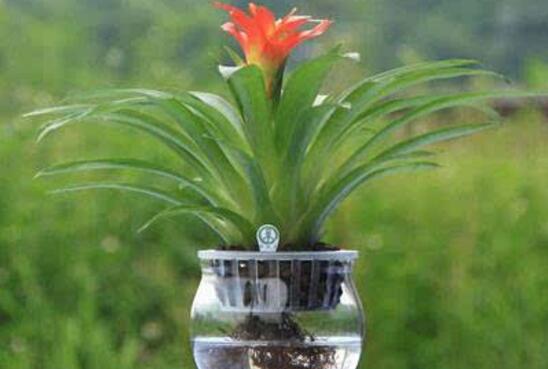
In the growing methods and precautions for Guzmania, we learned that Guzmania likes a moist environment, and its leaves can also be watered directly, so can Guzmania be grown hydroponically? The answer is obvious: yes, it can. Of course, there are many points that need attention when growing it hydroponically. The following are the hydroponic growing methods for Guzmania. Let's read on.
2. Hydroponic growing methods for Guzmania
Glass bottle, clean water, nutrients
1. Water amount and water quality
Since it is hydroponic Guzmania, the most important thing is naturally water, which is mainly reflected in the water amount and water quality. Water amount: when adding water to a glass bottle, do not add too much; just submerge half or 1/3 of the Guzmania roots.
Water quality: it must not be too poor; it should be very clean water, otherwise the plant may die. In addition, pouring some water into the Guzmania leaf cup is also necessary, and it must be clean. It is best to keep the leaf cup from lacking water; when the water decreases, add more.
2. Light
Sufficient light is a necessary condition for soil-grown Guzmania, and this is also true for hydroponic growing. In summer, when the sunlight is relatively strong, while ensuring sufficient light, shade it as much as possible, but do not shade it completely, otherwise growth will also be adversely affected. Everyone should judge this according to the situation.
3. Humidity
Although it is water-grown, the humidity in the air also affects Guzmania. Once the humidity is insufficient, the tips of its leaves and flowers will dry out. Therefore, during the hydroponic growing process of Guzmania, flower lovers should often spray some water near it to increase humidity.
4. Changing the water
Soil growing requires changing the soil, and hydroponic Guzmania naturally also requires changing the water. It is worth mentioning that when flower lovers change the water for Guzmania, they also need to clean off the attachments on its roots, scrub the bottle, and then add new water and nutrients.
3. Daily care of hydroponic Guzmania
1. Change the water frequently
In the hydroponic growing methods for Guzmania, changing the water is very important. Once the water quality deteriorates, the Guzmania root system will rot. Therefore, in daily care, flower lovers can change the water once every 5-7 days in spring and autumn, every 3-5 days in summer, and every 10-15 days in winter. The best practice is to replace 2/3 of the original bottle water each time.
2. Add nutrient solution
Soil growing requires fertilizing, and water-grown Guzmania naturally requires applying nutrient solution. After each water change, drip nutrient solution into the bottle (ratio: six drops of nutrient solution per liter of water), then gently shake it to make the nutrients even and at the same time increase the oxygen content in the water, which is beneficial to root growth.
3. Indoor ventilation
When growing Guzmania hydroponically indoors, it is best to place it in a sunny and ventilated environment, which is beneficial to its photosynthesis and thereby reduces leggy growth and yellow leaves. In winter, it is best to move Guzmania outdoors at 10 a.m. and let it bask in the sun for one hour.
4. Precautions for hydroponic Guzmania
1. Adding water
During the growth period of Guzmania (late spring and early autumn), the water amount can be appropriately increased, and more clean water can also be added to its leaf cup. Water changes should be frequent, preferably once every half month, otherwise the water easily becomes smelly and deteriorates.
2. Pruning
When Guzmania begins to bloom, do not add water to its leaf cup. At this time, place it in a lightless area, which can extend the flowering period of Guzmania. After the Guzmania flowers wither, cut off its flower stalk to save nutrients.
Can Guzmania be grown hydroponically? Can Guzmania survive without roots?
Guzmania has a very auspicious name, and its slender, emerald-green leaves surround bright red flowers. The color combination is very beautiful and eye-catching, with extremely high ornamental value. It is one of everyone's favorite green plants for giving as gifts or growing at home. However, some people prefer hydroponic plants because they look cleaner and fresher, so can Guzmania be grown hydroponically?
Can Guzmania be grown hydroponically?
Guzmania can be grown hydroponically. Guzmania is a perennial evergreen herb. The leaves are broad and strap-shaped, curved outward, and dark green. The spike inflorescence is conical, with densely growing bracts, bright red, with yellow tips.
Can Guzmania survive without roots?
It can survive. At 10 cm it is just right for division. Use a sharp knife to gently cut from the connection between the shoot and the mother plant, peel off the lowest leaves of the shoot, let the wound dry slightly, then plant it with growing soil, water thoroughly to settle the roots, and keep the pot soil slightly dry. For cuttings, use clean river sand; after rooting, transplant into slightly acidic fertile soil. For cuttings, use clean river sand; after rooting, transplant into slightly acidic fertile soil.
If the rooting situation is not particularly good, you can add an appropriate amount of Fujinmen root-promoting water-soluble fertilizer, which can effectively improve the rooting effect of the crop and the absorption and utilization rate of nutrients.
Precautions for hydroponic Guzmania
1. When growing hydroponically, the water level should not be deep. Do not soak all the roots in water; just 1/3 to 1/2 in water is enough.
2. The water used for hydroponics must be clean. Clean here does not mean purified water, but unpolluted water. Nutrient solution can be added to the water to strengthen its growth. In addition, besides water in the bottle, water should often be added to the "leaf cup", preferably clear clean water. When the water amount in the leaf cup is low, it must be refilled; it must not lack water. This is the key to caring well for bromeliads.
3. Regarding light, from May to October, shade as much as possible; the shading varies slightly due to different light intensity. Of course, it must not be too shady either.
4. Regarding air humidity, even for hydroponic growers, if the air is relatively dry, the plant will likewise grow poorly, mainly shown on the inflorescence and leaves. The leaf tips are especially sensitive; easy drying of the tips is a warning sign! It is necessary to frequently spray water on the plant or humidify the surrounding environment.
5. In addition, when changing the water in hydroponics, rinse off the mucus on the roots, wash the bottle, and then pour in new water and nutrient solution.
Guzmania growing environment
Guzmania likes a warm and humid environment. The suitable growing temperature is 21-28°C during the day and 18-21°C at night, and the maximum temperature must not exceed 35°C. High temperatures are unfavorable to growth, but being in a 10°C environment for a long time easily causes slow plant growth, and the leaves or bracts may lose color by turning red or white. If the temperature continues to drop, it will cause the plant to die.
Air humidity should be high, generally 75-85% is best. When it is below 50%, the plant will show phenomena such as leaf shrinkage and curling. Light is best at 18000-**** lux. When the light is too strong, the leaves are easily sunburned; when it is too weak, growth will also be poor. Ventilation is also extremely important. When the temperature is not high, the effect is not obvious, but in high-temperature seasons it is especially prominent. Ventilation not only makes the plant grow robustly but also reduces infection by diseases.
When watering, it is best to use clean water that has been left to stand for 2-3 days, and when watering, pour it into the plant's "cup" shape, not directly into the pot's substrate. Even if the substrate in the pot is somewhat dry, if there is water in the leaf cup, the plant will still grow well. But if only the pot soil has high moisture and the leaf cup has no water, the plant will lack vitality and show adverse reactions such as easily yellowing leaves.
No fertilizing is needed during the flowering period. After flowering, promptly cut off the flowers and supplement fertilizer. Fully water-soluble fertilizer can also be poured into the leaf cup along with watering, but other fertilizers such as cake fertilizer and granular chemical fertilizers should not be applied in the leaf cup. After small plants grow out, you can use a sharp knife to cut them off from the mother plant and plant them separately. Generally, old plants will not bloom again and can later be used as mother plants to propagate new plants.
As long as the care location has suitable light and watering is done properly, under normal circumstances Guzmania is very easy to grow.
As mentioned above, there are many types of Guzmania. Bright red is a particularly common one, and there are also pink, golden yellow, and others. They are all very beautiful and are a particularly easy-to-grow flowering plant, deeply loved and sought after by everyone.
How to grow Guzmania? Growing methods and precautions for Guzmania
Guzmania is a common landscaping seedling, and many people grow it in real life. So have you encountered growing problems during the cultivation process? Below is a summary by the editor of the growing methods and precautions for Guzmania. If you grow it at home, you can check whether it is correct.
1. Introduction to Guzmania
Guzmania is a flowering plant in the Bromeliaceae family. Because the flower center is bright red, it is called Guzmania. Guzmania is a perennial evergreen herb. The leaves are broad and strap-shaped, curved outward, and dark green. The spike inflorescence is conical, with densely growing bracts, bright red, with yellow tips.
2. Environmental requirements for Guzmania growth
1. Soil: Guzmania is suitable for growing in loose, fertile, humus soil. Friends planning to grow it at home can choose 2 parts peat soil mixed with 1 part fine sand to prepare growing soil.
2. Light: most Guzmania need a light intensity of about 20,000 lux, with daily light duration greater than 12 hours and less than 16 hours. If the light intensity is increased to 30,000-40,000 lux, together with high humidity and good ventilation conditions, growth will be faster and better, the plant will be short, plump, and sturdy, the leaves will be broad, short, and stiff, and the flower colors will be bright and beautiful.
3. Temperature: the suitable temperature for Guzmania is 15°C to 22°C. In winter, the minimum temperature must not be lower than 10°C, otherwise the plant will suffer cold damage, the leaf color will turn yellow, and robust growth will be affected.
3. Watering methods for Guzmania
Guzmania likes a humid environment. On ordinary days, keeping the pot soil moist is enough, and generally do not water on cloudy and rainy days. For household cultivation, it is best to use purified water that has been left to stand; do not directly water with tap water. Guzmania is a flowering plant that can be enjoyed both for its flowers and its leaves. It is best to spray clean water on the leaf surface once a day to remove dust, make the leaf color bright, and at the same time help photosynthesis and promote robust plant growth. (Tip: although Guzmania likes a high-humidity environment, this does not mean watering heavily; spraying water on the leaf surface is enough.)
4. Fertilizing methods for Guzmania
In the growing season, generally apply liquid fertilizer once every 10-20 days, usually using fermented cake fertilizer or chemical fertilizer. Chemical fertilizer usually uses nitrogen, phosphorus, and potassium (1:1:1), with a concentration of 0.1%-2.3%. It can be applied to the pot soil or sprayed on the leaf surface. When fertilizing, never apply fertilizer into the leaf tube at the center of the plant, so as to avoid harm. Fertilizing should be stopped during the flowering period, dormancy period, and summer.
5. Propagation methods for Guzmania
1. Division propagation: after the Guzmania plant blooms, 1 to several tiller shoots will grow from the base of the mother plant. When the tiller shoots grow to 1/3-1/2 the size of the mother plant, use a small knife to cut them off from the base of the shoots, remove the lower leaves, dry the cut, and insert them into a pot mixed with equal parts leaf mold soil and plain sand. Under conditions of slightly dry pot soil, a temperature of 25-28°C, and a ventilated, humid environment, they will root in about 12-15 days. After new leaves begin to grow, normal cultivation management can be carried out. With division propagation, generally 1-3 years of cultivation can lead to flowering.
2. Seed propagation: Guzmania must undergo artificial assisted pollination when flowering in order to set seed, and the seeds are very small. When using seed propagation, it is generally required that the temperature be stable above 16°C before sowing, and acidic pot soil is suitable. After sowing, cover with chopped moss or plastic film to retain moisture. At a temperature of 25-30°C, seedlings can emerge 20-25 days after sowing. When the seedlings grow to about 4 cm, they can be divided into shallow trays, then divided and transplanted as the seedlings grow, and finally planted into flower pots. With seed propagation, it generally takes 3-4 years to bloom.
6. Repotting and changing soil for Guzmania
For repotting Guzmania, the cultivation method for epiphytic orchids is often used for potting. That is, use potting materials such as moss, fern roots, and bark chunks. Fill the bottom of the pot with granular crushed bricks and other materials to facilitate drainage. This plant has no obvious dormancy period, so it can be repotted at any time. After repotting, of course, press firm and water thoroughly, place it in half shade and half sun, and after a week it can be returned to normal care. After that, apply liquid fertilizer once every 1-2 weeks. Keep the pot soil moist, and often spray water on the leaves and pour clean water into the leaf tube. Sunlight can be about 70%, making the flower color more brilliant and the leaves more oily green. The most suitable temperature is 22-25°C, and in winter it must not be lower than 10°C, with watering appropriately reduced.
7. Causes of yellowing Guzmania leaves and rescue methods
1. Water-yellowing. Caused by overly frequent watering. Its characteristic is that old leaves show no obvious change while young leaves turn yellow; water control should be implemented immediately.
2. Drought-yellowing. Caused by lack of water and drought. Its characteristic is that old leaves turn yellow first from the bottom upward. If the lack of water lasts a little longer, the whole plant's leaves will turn yellow, or it may even die. Water should be given in time.
3. Fertilizer-yellowing. Caused by overly frequent fertilizing or too high concentration. Its characteristic is that young leaves are thick, glossy, and uneven; fertilizer should be controlled, and intertillage and watering should be carried out.
4. Starvation-yellowing. Caused by insufficient fertilizer, low fertilization concentration, and too long intervals between fertilizing. Its characteristic is that young leaves and tender stems turn yellow first. If this phenomenon is seen and fertilizer is not applied in time, it can also cause the whole plant's leaves to turn yellow or even die. For flowers lacking fertilizer, never apply a large amount of concentrated fertilizer at one time, so as to avoid burning the roots.
5. Iron-deficiency yellow leaves. Due to large changes in soil fertility conditions, yellow leaves often appear. Its characteristic is that young leaves are obviously affected, old leaves are less affected, the leaf flesh is yellow, and the veins are green. It can be solved by applying ferrous sulfate aqueous solution. The method is: mix 7 parts cake fertilizer, 5 parts ferrous sulfate, and 200 parts water into a diluted solution for irrigation.
8. Pest and disease control for Guzmania
1. The main disease is Fusarium. It can be controlled with 75% chlorothalonil 500-fold solution or 50% carbendazim 500-fold solution.
2. The main pests are scale insects, red spiders, and others. For scale insects, spray a mixed solution of trichlorfon and dimethoate at 1:2 diluted 1500-2000 times, once every 7 days, for 3 consecutive sprays; for red spiders, use dicofol 800-1000-fold solution, once every 10-15 days.
9. Hydroponic methods for Guzmania
1. The water level should not be deep. Do not soak all the roots in water; just 1/3-1/2 in water is enough.
2. The water quality must be clean. Clean here does not mean purified water, but unpolluted water. Nutrient solution can be added to the water to strengthen its growth. In addition, besides water in the bottle, water should often be added to the "leaf cup", preferably clear clean water. When the water amount in the leaf cup is low, it must be refilled; it must not lack water. This is the key to caring well for bromeliads.
3. Regarding light, in the current season direct sunlight is acceptable, but from May to October shade as much as possible; the shading varies slightly due to different light intensity. Of course, it must not be too shady either.
4. Regarding air humidity, even for hydroponic growers, if the air is relatively dry, the plant will likewise grow poorly, mainly shown on the inflorescence and leaves. The leaf tips are especially sensitive; easy drying of the tips is a warning sign! It is necessary to frequently spray water on the plant or humidify the surrounding environment.
In addition, when changing the water in hydroponics, rinse off the mucus on the roots, wash the bottle, and then pour in new water and nutrient solution.
10. Placement location for Guzmania
Guzmania is suitable for placement in the living room, carrying the meaning of gathering wealth and bringing good fortune. In addition, it also likes an environment with relatively high moisture, so it can be placed in the bathroom to absorb foul air. Of course, if the bathroom is both spacious and bright and has air conditioning, using a gorgeous plant like Guzmania can decorate the bathroom like a mini garden, making people enjoy it. However, Guzmania can also be placed on the balcony, appropriately letting it absorb some sunlight.
11. Four-season care for Guzmania
Guzmania requires attention to different care throughout the four seasons. In winter and spring, pay attention to temperature changes. Once the temperature is below 10°C, promptly cover it with a transparent plastic bag to reduce the stimulation of cold, and remove the plastic bag promptly when the temperature rises. In summer, when the sun is fierce, the ornamental bromeliad should avoid direct sunlight to prevent sunburn. In autumn, the sunshine duration shortens, but the sunlight is still strong, so maintaining half shade and avoiding direct sunlight is still necessary. After autumn cools, more sunlight can be given, while keeping air humidity above 50%.
Guzmania is a potted plant with a very good meaning and is very popular in daily life. If you like flowers, you can cultivate it according to the methods shared by the editor.