What to do when geranium leaves turn yellow? Learn pruning and shaping to cut off dead branches and rotten leaves
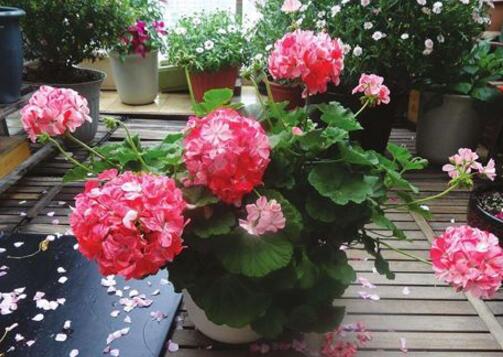
Geranium is a highly ornamental plant, loved by many people because its flowers are so brightly colored. However, even the most beautiful flower will have its overall beauty affected if it turns yellow. As for what to do when geranium leaves turn yellow, the most direct method is pruning. As for how to prune and shape geraniums, there is a detailed description below that everyone can take a look at.
I. What to do when geranium leaves turn yellow / pay attention to care
There are many possible causes of geranium leaves turning yellow. Improper care in daily maintenance as well as the appearance of pests and diseases can both lead to this kind of problem. If it is caused by pests and diseases, you can refer to the article on pest and disease control for geraniums, which contains detailed control methods, so I will not go into too much detail here.
II. How to prune and shape geraniums
1. Choose pruning tools
Regarding how to prune and shape geraniums, pruning tools are key. It is recommended to choose a sharper tool when selecting one, so that the pruning looks neat and natural. If you choose one that is too blunt, it is very easy to crush the plant, which is something to pay attention to when pruning.
2. Prune according to the variety
Before pruning geraniums, you should also pay attention to the variety, because different varieties require different pruning methods. For example, hybrid geraniums have rather messy natural branching, so when pinching, the effect will not be as obvious compared with other varieties.
3. Pruning method
Regarding how to prune and shape geraniums, mastering the method well is very important. Generally, pruning is done according to its growth vigor. Usually you can keep 3-5 main branches, and other branches that grow too densely, too long, or are weak can be pruned directly from the base.
Then shorten and prune the main branches and side branches of the geranium. For each side branch, you only need to keep the robust-growing side branches. In this way, the distribution of the entire branches will appear even and compact, and the plant shape will also appear full and short and sturdy.
What is going on with clivia leaves turning yellow and rotting, and what to do
Clivia has a beautiful and upright appearance and is easy to grow, but sometimes its leaves turn yellow and rot. There are many reasons for this situation. Today I will briefly introduce these situations.
Reasons for clivia leaves turning yellow and rotting
1. Temperature reasons
Clivia has its own suitable growing temperature, roughly between 15 and 25 degrees. In addition, it is best to ensure that the temperature difference between day and night is controlled between 8 and 12 degrees, as this is most favorable for clivia growth. In summer, if it exceeds 30 degrees, clivia will enter a semi-dormant stage. Add to that humidity below 60%, and clivia leaves will turn yellow and rot.
2. Soil reasons
Clivia is a plant that likes loose and fertile sandy soil. If the soil used for growing it does not contain enough fertilizer, clivia leaves will turn yellow and rot, thereby affecting clivia's flowering period.
3. Light reasons
Clivia relatively prefers weaker scattered light, and therefore cannot withstand strong light. Under long-term strong light exposure, clivia leaves are prone to turning yellow, and the plant may become dehydrated and dry up.
What to do about clivia yellow leaves and rotten leaves
For the yellowing and rotting caused by the above three reasons, what solutions are there? Below is a brief introduction to the solutions.
1. Adopt the method of cooling and ventilation.
We can adopt the method of ventilation and cooling to lower the temperature around the clivia to a suitable range. However, if it is winter and the indoor temperature is relatively low, we should pay attention to raising the temperature to prevent the clivia from being damaged by freezing.
2. Adopt the method of frequently changing the soil and fertilizing reasonably.
As for clivia's fertilizer requirements, it generally needs to be fertilized in the two seasons of spring and autumn, so as to maintain clivia's nutrient needs. In addition, clivia needs its soil changed once a year, as only then can the freshness of the soil be maintained, which helps clivia's growth.
The above is a brief introduction to the reasons for clivia leaves turning yellow and rotting as well as some solutions, and I hope it can help some friends who grow clivia at home.
How to prune and fertilize lilacs, pay attention to dilution before fertilizing / pay attention to pruning dead branches
In the process of growing lilacs, there are many aspects that need attention, such as pruning and fertilizing, which are two relatively important ones. Lilac is a highly ornamental plant. Proper pruning during cultivation can make it more ornamental, and maintaining sufficient fertilizer will also make it grow more vigorously. So how do you prune and fertilize lilacs? Below I will take everyone through it.
How to prune and fertilize lilacs
Regarding the question of how to prune and fertilize lilacs, there are actually many points that need attention. These two points are introduced in detail below, and interested friends can take a look.
1. How to prune lilacs
a: Thinning
Thinning lilacs is mainly to allow lilacs to grow better. This pruning method is generally carried out after leaf fall, mainly cutting off some dead branches and rotten leaves as well as some small side branches. Cutting them off in time is not only beneficial to growth in the second year, but also has a certain beautifying effect on the appearance.
b: Light pruning
Regarding the question of how to prune lilacs, light pruning is a very important aspect, mainly pruning off some branches that grow too densely. This can increase the light transmittance of the lilac and also reduce the nutrients consumed when flowering. If overly dense branches are not pruned in time, it is very easy to affect the flowering rate of the lilac, so everyone must remember this point.
2. How to fertilize lilacs
a: Fertilizer selection
When fertilizing lilacs, we can generally choose phosphorus and potassium fertilizer. Of course, we can also choose fertilizer specially made for flowering plants. However, before fertilizing, it must first be diluted, otherwise it is very easy to burn the plant. Everyone should remember this point.
b: Fertilizing method
Regarding how to fertilize lilacs, the method is actually very simple. First, we need to mix the fertilizer with water to dilute it, and then fertilize. The fertilizer is generally applied into the soil, and then let the lilac gradually absorb it. Never apply it on the plant, as this will cause the plant to turn yellow and die.