Methods and Technical Points for Regulating the Blooming Period of Baby's Breath
If baby's breath is grown in a greenhouse, its blooming period can be regulated even more effectively, aiming to bring it to market before the Spring Festival.
The growth and flowering characteristics of perennial baby's breath are its growth and development characteristics. Apart from the two misleading characteristics - flowering under long-day conditions and the rapid elongation of the flower stems after the flower buds of baby's breath form - there are three more points: namely, plants that have already formed a rosette in autumn break the rosette after receiving low temperatures, and their growth activity increases. After the activity increases, they grow slowly even under the relatively low temperatures of early spring; once baby's breath has grown to a certain extent, if the temperature rises, flower buds form under long-day conditions, and at the same time the flower stems elongate rapidly and the plant blooms. If it encounters high summer temperatures, its growth activity decreases, and under the cool autumn and short-day conditions it enters winter in a rosette state. If a rosette state forms, the growth activity of perennial baby's breath in autumn and winter is extremely low, and it is in a state where flowering is difficult. High temperature and long-day treatment can be used to prevent the formation of a rosette.
Specific methods for regulating the blooming period of baby's breath: grow at a temperature of 15-25°C with more than 16 hours of daylight (night lighting is best), and cut flowers can be obtained in autumn, winter or early spring; alternatively, starting in mid-July, cold-store the plants at 2-3°C until mid-September for planting out, then grow them under long-day conditions at a temperature above 8°C, and they will bloom in December; rosette formation can also be prevented with hormones - when a rosette is about to form, spray with aminopurine (300×10-6), or spray with gibberellin (300×10-6), both of which can significantly promote the elongation and flowering of perennial baby's breath.
After pinching, keep 4-6 branches per plant, and ultimately more than 5 stems of flowers can be produced. Because the selling price per stem is several times higher than that of other cut flowers, most flower vendors divide large stems into small stems and sell them at prices based on quality, and sometimes baby's breath is in short supply.
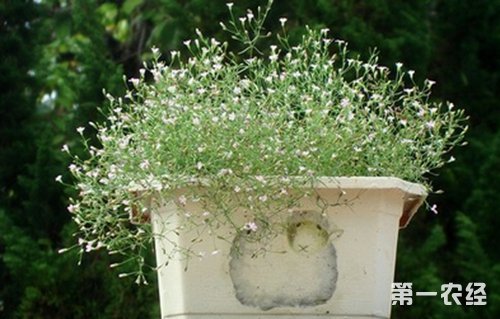
Specific methods:Grow at a temperature of 15-25°C, with supplemental lighting in winter to a minimum of 12 hours, 16 hours being optimal (night lighting is best), and cut flowers can be obtained in autumn, winter or early spring; alternatively, starting in mid-July, cold-store the plants at 2-3°C until mid-September for planting out, then grow them under long-day conditions at a temperature above 8°C, and they will bloom in December; rosette formation can also be prevented with hormones - when a rosette is about to form, spray with aminopurine (300×10-6), or spray with gibberellin (300×10-6), both of which can significantly promote the elongation and flowering of perennial baby's breath.
After pinching, keep 4-6 branches per plant, and ultimately more than 5 stems of flowers can be produced. Because the selling price per stem is several times higher than that of other cut flowers, most flower vendors divide large stems into small stems and sell them at prices based on quality, and sometimes baby's breath is in short supply.
[Editor's Commentary] The blooming period of baby's breath is generally June-August, but some people have seen baby's breath blooming during the Spring Festival. What is going on? In fact, this is simply regulating the blooming period of baby's breath. The specific methods have been introduced in detail above by the editor of First Agricultural Economics. We hope this is helpful to you, and thank you for your attention and support!