Narcissus bulb selection methods and tips
To grow narcissus well, you must choose good narcissus bulbs. The quality of the narcissus bulb determines how many flowers bloom and whether the fragrance is rich. When choosing narcissus bulbs, you can do it from four aspects: looking at the shape, observing the color, pressing, and asking about the "zhuang" (packing grade).
(1) Looking at the shape: High-quality narcissus bulbs are generally large, flat in shape, and hard in texture, with relatively wide spacing between the vertical vein stripes on the surface, a very taut middle membrane, bright skin color, a broad and thick root plate, and symmetrical small bulbs growing beside the main bulb. The main bulb's shape is required to be flat and round, that is, the left-right diameter is greater than the front-back diameter. This is because the flower buds inside the narcissus bulb basically grow in parallel rows; when the size is the same, a flat-round flower head contains more flower buds than a perfectly round or oblong flower head. Under the condition that the soil around the roots has been removed, those that feel heavy are better, and those that feel light are inferior. The small bulbs on both sides of the main bulb must not be too many or too small, so as to avoid dispersing nutrients and affecting the growth of the main bulb. Generally, 1 to 3 on each side is suitable.
(2) Observing the color: From the outside, bulbs that are dark brown, with intact outer membranes, bright luster, and no traces of rot or pest damage are top grade.
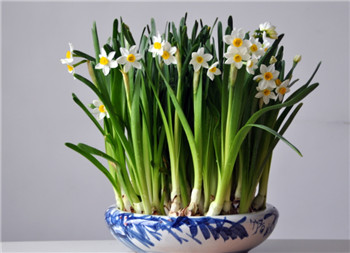
(3) Pressing: Pressing is the main method for selecting and identifying how many flower scapes a narcissus has. You can pinch the bulb with your thumb and index finger and press slightly with force. If it feels columnar in outline, elastic, and relatively firm, it is a flower scape; if it feels soft and loose, flat in outline, and slightly less elastic, it is mostly a leaf bud. The bulb should be firm and elastic. If it is soft and has no elasticity, it indicates severe dehydration; after growing in water, its growth will be poor, the flowers will be small and few, and the fragrance will be faint.
(4) Asking about "zhuang": The so-called "asking about zhuang" refers to how many narcissus flower heads can be packed into a bamboo basket with a size of 31 cm, an inner diameter of 28 cm at the □, and an inner diameter of 27.5 cm at the bottom. The larger the narcissus flower heads, the fewer can be packed in one basket, the smaller the "zhuang number," the more flowers each individual narcissus flower head will produce, and the higher the price.
Usually, narcissus are packaged in bamboo baskets of the same size. There are four packaging specifications: 20, 30, 40, and 50 bulbs per basket, commonly known as 20 zhuang, 30 zhuang, 40 zhuang, and 50 zhuang. The fewer the number packed per basket, the larger the individual bulbs. For example, for 20 zhuang bulbs with 20 per basket, each bulb can reach 12 cm in diameter, making it first-grade; for 30 zhuang, the individual bulbs are slightly smaller than those of 20 zhuang. For the above two types of narcissus bulbs, generally each bulb can produce more than 4-7 scapes of flowers, making them top grade. The bulbs of 40 zhuang and 50 zhuang are much smaller, and generally can only produce 1-3 scapes of flowers. When selecting, be sure to choose bulbs with a smaller zhuang number.
How to choose narcissus bulbs How to prevent narcissus "blind flowers"
In the April days of the human world, clear and elegantly it comes across the water, graceful and charming, clear and light, fluttering as it arrives, making you smile fully. The curling music lightens the mood of the past, and the curved moon that gently taps the window lattice still has a smile like a flower. White clouds play the dance music of the soul, and the blue sky lifts up a pure dream. So, do you know how to grow narcissus? Below, the editor will introduce it to you.
1. To grow a good pot of narcissus, you must start by choosing good narcissus bulbs.
When choosing narcissus bulbs, you can do it from four aspects: looking at the shape, observing the color, pressing, and asking about the "zhuang" (packing grade).
(1) Looking at the shape:High-quality narcissus bulbs are generally large, flat in shape, and hard in texture, with relatively wide spacing between the vertical vein stripes on the surface, a very taut middle membrane, bright skin color, a broad and thick root plate, and symmetrical small bulbs growing beside the main bulb.
(2) Observing the color:From the outside, bulbs that are dark brown, with intact outer membranes, bright luster, and no traces of rot or pest damage are top grade.
(3) Pressing:Pressing is the main method for selecting and identifying how many flower scapes a narcissus has. You can pinch the bulb with your thumb and index finger and press slightly with force. If it feels columnar in outline, elastic, and relatively firm, it is a flower scape; if it feels soft and loose, flat in outline, and slightly less elastic, it is mostly a leaf bud.
(4) Asking about "zhuang":Narcissus are generally packaged in bamboo baskets of the same size. There are four packaging specifications: 20, 30, 40, and 50 bulbs per basket, commonly known as 20 zhuang, 30 zhuang, 40 zhuang, and 50 zhuang. The fewer the number packed per basket, the larger the individual bulbs.
2. Sprouting dormant bulbs
① Peeling:That is, peeling off the layer of brown skin on the outside of the bulb.
② Cutting the bulb:At the left and right 1/3 positions of the upper half of the bulb, cut horizontally downward, then cut horizontally upward to remove 2-3 layers of scales. At the same time, make a vertical cut downward in the exact center on both the left and right sides of the bud, reaching as deep as the middle of the bulb. During operation, avoid injuring the tender buds, and carefully remove the old roots and soil at the bottom.
③ Soaking the bulb:Soak the cut bulb in clean water for 1-2 days, then rinse off the glue-like liquid flowing out from inside the bulb.
④ Sprouting:The soaked bulb should be placed in the sun to be exposed, preferably put into a container and covered with a layer of rice husk. Water once a day to keep the rice husk maintaining temperature and humidity. At this time, pay attention to preventing cold and excessive light, and appropriate covering may be used. After one week, new buds sprout, and then they can be fully exposed to sunlight. After about 50 days, the flower head emerges, and then the narcissus bulb can be taken out, rinsed clean, and transplanted into a water basin for cultivation.
3. Preventing "blind flowers"
To prevent "blind flowers," first choose high-quality three-year-old bulbs for water cultivation. For water cultivation, it is best to use rainwater or pond water; if using tap water, it should be stored for one day before use. Next, ensure that the narcissus being grown receives sufficient light, no less than 6 hours per day, and also pay attention to indoor ventilation. Keeping the temperature at 12-15 degrees is most favorable for narcissus growth. In the north, where the weather is dry, spray water on the narcissus plant every day.
Generally, narcissus bulbs under normal water cultivation can bloom on schedule after 45-50 days. So-called normal water cultivation means ensuring that after the narcissus is grown in water, it has 6 hours of light per day, and the room temperature is kept at around 10-15 degrees. If the weather is abnormal, with insufficient light and too low (or too high) temperature, then measures must be taken so that the narcissus can bloom on schedule.
The above is all the content I have learned today about narcissus. I hope flower lovers will find it helpful after reading this article. If you want to learn more about narcissus, please continue to follow our Succulent Flower Garden to learn more.
How to choose narcissus? What is the cultivation method for narcissus?
Narcissus is beautiful. It has a faint fresh fragrance, pure white petals, and green leaves. Looking at it makes people feel cheerful. Just having it is enough. So how do you choose narcissus, and how do you grow it well?
1. Choosing seed bulbs
The quality of the narcissus bulb determines how many flowers bloom and whether the fragrance is rich. To grow a good pot of narcissus, you must start by choosing good narcissus bulbs.
When choosing narcissus bulbs, you can do it from four aspects: looking at the shape, observing the color, pressing, and asking about the "zhuang" (packing grade).
(1) Looking at the shape:High-quality narcissus bulbs are generally large, flat in shape, and hard in texture, with relatively wide spacing between the vertical vein stripes on the surface, a very taut middle membrane, bright skin color, a broad and thick root plate, and symmetrical small bulbs growing beside the main bulb.
(2) Observing the color:From the outside, bulbs that are dark brown, with intact outer membranes, bright luster, and no traces of rot or pest damage are top grade.
(3) Pressing: Pressing is the main method for selecting and identifying how many flower scapes a narcissus has. You can pinch the bulb with your thumb and index finger and press slightly with force. If it feels columnar in outline, elastic, and relatively firm, it is a flower scape; if it feels soft and loose, flat in outline, and slightly less elastic, it is mostly a leaf bud.
(4) Asking about "zhuang":Narcissus are generally packaged in bamboo baskets of the same size. There are four packaging specifications: 20, 30, 40, and 50 bulbs per basket, commonly known as 20 zhuang, 30 zhuang, 40 zhuang, and 50 zhuang. The fewer the number packed per basket, the larger the individual bulbs. For example, for 20 zhuang bulbs with 20 per basket, each bulb can reach a diameter of
2. Sprouting dormant bulbs
① Peeling:That is, peeling off the layer of brown skin on the outside of the bulb.
② Cutting the bulb: At the left and right 1/3 positions of the upper half of the bulb, cut horizontally downward, then cut horizontally upward to remove 2-3 layers of scales. At the same time, make a vertical cut downward in the exact center on both the left and right sides of the bud, reaching as deep as the middle of the bulb. *During operation, avoid injuring the tender buds, and carefully remove the old roots and soil at the bottom. ③ Soaking the bulb: Soak the cut bulb in clean water for 1-2 days, then rinse off the glue-like liquid flowing out from inside the bulb.
④ Sprouting:The soaked bulb should be placed in the sun to be exposed, preferably put into a container and covered with a layer of rice husk. Water once a day to keep the rice husk maintaining temperature and humidity. At this time, pay attention to preventing cold and excessive light, and appropriate covering may be used. After one week, new buds sprout, and then they can be fully exposed to sunlight. After about 50 days, the flower head emerges, and then the narcissus bulb can be taken out, rinsed clean, and transplanted into a water basin for cultivation.
3. Cultivation methods
Narcissus likes sunlight and warmth, requires high air humidity, is not very cold-tolerant, and fears heat. During the vegetative growth period, it needs moist but not waterlogged sandy soil. Unlike other perennial herbaceous flowers, narcissus has the characteristics of beginning growth in autumn, blooming in winter, storing nutrients in spring, and going dormant in summer.
There are two methods for cultivating narcissus: water culture and soil culture.
Water culture means growing it by soaking in a shallow basin of water. Place the sprout-treated narcissus upright into a shallow narcissus basin, and add water until it covers one third of the bulb. Quartz sand, pebbles, and the like can be used in the basin to fix the bulb.
During the day, the narcissus basin should be placed in a place with sufficient sunlight, and at night it should be moved indoors, and the water in the basin should be poured out to control leaf spindling. The next morning, add clean water again, and be careful not to change the direction of the bulb. Just after potting, the narcissus can have its water changed once a day, then once every 2-3 days, and after the flower buds form, once a week. Narcissus grows well in a 10-15 degree environment and can bloom in about 45 days, with the flowering period lasting more than a month.
During the water cultivation period of narcissus, especially sufficient light must be given. During the day, place it in a sunny spot, and at night it can be placed under lamplight. This can prevent the stems and leaves of the narcissus from spindling, making the narcissus leaves short, broad, and thick, sturdy, with deep green leaf color, and the flowers bloom with a rich fragrance. For narcissus grown in water, fertilization is generally not needed. If conditions permit, applying a little quick-acting phosphorus fertilizer during the flowering period can make the flowers bloom better.
Growing narcissus requires no flower fertilizer at all; only clean water is needed. To make the narcissus grow robustly, it should be taken to the balcony to bask in the sun during the day. If you want to delay the flowering period, you can adopt the method of lowering the water temperature, or pour out all the water in the basin in the evening and add clean water again the next morning. In addition, if full flower buds cannot be seen 10 days before the festival, the method of warming the water can be used to force flowering, and the water temperature should preferably be close to body temperature.
As long as you master the conditions for narcissus care, you can "make the flowers bloom as you wish"; otherwise, flowering will be delayed, or it will even only grow leaves and not bloom. The soil culture method is less commonly used by households, that is, using the cultivation method for most moisture-loving flowers to cultivate narcissus. In mid-to-late October, use fertile sandy soil to plant large bulbs into a small flowerpot with holes, planting half and leaving half exposed. A little fine sand should be placed under the bulb in advance to facilitate drainage. Place the flowerpot in an indoor place with sufficient sunlight and suitable temperature. 4 to 12°C is best; if the temperature is too low, frost damage is likely to occur, and if the temperature is too high and there is insufficient light, it is likely to spindly grow, with weak plants and a short flowering time, reducing ornamental value. In management, if the light and temperature requirements are met, the leaves will be thick and large and the flower stalks sturdy, thus making the flowers bloom larger and the fragrance lasting. For soil-cultured narcissus, apply liquid fertilizer two to three times before flowering.
Because of limited climatic conditions, narcissus cannot reproduce on its own. When cultivating narcissus, if there is no pest or disease damage, there is no need to spray chemicals. For winter water culture of narcissus, temperature, light, and water supply are the three key elements determining whether the narcissus can bloom. Narcissus growth requires sufficient sunlight; a suitable temperature of
The above is all the content I have learned about narcissus. I hope flower lovers will find it helpful after reading this article. If you want to learn more about aquatic flowers, please continue to follow Succulent Flower Garden, and we will provide you with more related knowledge!