Management Methods and Key Points for Cyclamen During Full Bloom
Cyclamen in full bloom is highly favored by people and is a premium potted flower for decorating living rooms, desks, and public places such as shops and restaurants in winter. The full bloom period of cyclamen is from November to March, and management after the full bloom period should be done well.
Generally, newly propagated cyclamen seedlings bloom earlier, while seedlings whose corms have overwintered through summer bloom slightly later. If during the bud stage they are moved to a warmer place (temperature not exceeding 18°C) and a certain humidity is maintained, flowering can be advanced. Also, if after the flower buds have formed and the pedicels are still short, a 0.01% gibberellin solution can be sprayed on the pedicels to promote growth and accelerate flowering. If you want to breed new varieties, select excellent parents, carry out artificial pollination, and before the anthers mature, first emasculate with tweezers, bag them, and then carry out hybridization; it is possible to breed new varieties in this way.
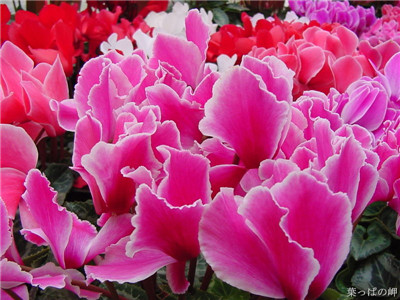
From May to August, the temperature gradually rises and the flowers wither and decrease. If you want it to grow and bloom normally, it is best to repot it into a larger pot, add an appropriate amount of humus soil, and place it on a balcony or another well-ventilated and shady place. Frequently spray water on the leaves to supplement the evaporated water and increase air humidity. Every half month, spray once with a 0.1% KH2PO4 foliar fertilizer, and apply once a soil fertilizer with N:P:K=1:0.7:2 at a concentration of 0.1%. This can keep it blooming continuously. After September, the weather turns cooler, which is exactly when cyclamen is actively growing. New leaves slowly unfurl and grow larger, and some old leaves begin to turn yellow and shrivel; the yellow leaves can be removed. Every 10 days, water once with a mixed liquid fertilizer of N:P:K=10:15:20 at a concentration of 0.1%, to prepare for it to bloom again later. Do not forget that fungicide should also be sprayed regularly at the same time.
In summer, when the temperature exceeds 35°C, it is prone to rot. In winter, when the temperature is below 5°C, the corm is prone to frost damage. When the temperature is above 30°C, the corm goes dormant. At that time, cyclamen can be placed outdoors in a cool, rain-sheltered place, and watering should be reduced. The potting soil is better kept on the dry side, but be careful not to let it become too dry, to prevent the corm from shriveling or from sprouting and blooming too late, so that it can safely enter dormancy. After the Beginning of Autumn, when the temperature is around 25°C, begin watering a small amount to keep the potting soil moist, but not overly wet, to prevent rot. In late September, when cyclamen is about to sprout and grow, carry out one repotting and soil change. Use sandy soil rich in humus for the potting soil; it is best to sterilize it at high temperature for half an hour (steam it over water or directly scald it with boiling water). While exposing one third of the corm above the soil surface, remove the yellow leaves.
Cyclamen Pollination Methods and Post-Bloom Management
Cyclamen
Cyclamen, with its rich flower colors and fresh green leaves, generally blooms around the Spring Festival. When in full bloom, it gives people a feeling of vibrant energy and is very eye-catching. However, its main method of propagation is sowing-based propagation. Importantly, the source of its seeds can only be obtained through artificial pollination. So below, let us introduce artificial pollination and post-bloom management of cyclamen!
I. Plant Selection and Timing Determination
The varieties to be pollinated must be selected from healthy plants with various excellent traits such as robust growth, no disease infection, and an ideal flowering period. Pollination should preferably be carried out during the full bloom period in January. If too late, such as in March or April, which is the late stage of growth and flowering, the plant begins to age, and the seeds cannot mature, or they mature but are not ideal, and it will also affect the plant's overwintering through summer.
II. Pollination
Choose flowers that have been open for less than three days as the pollination targets; at this time there is sticky fluid on the stigma and the pollen is orange-yellow. The method is: after ten o'clock in the morning on a sunny day, gently pinch the flower with the right thumb and index finger, and shake the pollen onto the left thumbnail, then gently dip the stigma of the pistil of the flower to be pollinated onto the pollen. To ensure success, a second pollination can be carried out one or two days after the first pollination. Before proceeding, hands should be strictly washed to avoid carrying bacteria. It is best to use sterilized small metal tools, such as medical tweezers, for the operation.
III. Care of Plants After Pollination
Five to six days after pollination, the petals fall off, the ovary begins to swell, and the pedicel bends downward, indicating that pollination was successful. To ensure the nutrients needed for seed development, all flowers other than the successfully pollinated ones should be removed. Generally, a plant in an 18 cm pot can support 20-30 fruits, and a plant in a 15 cm pot can support 15-20 fruits. At the same time, strengthen the management of pollinated plants, and apply bone meal once to benefit fruit development and full seeds. After April, the fruits gradually mature, and they are harvested when they are about to split open.
Cyclamen
IV. Post-Bloom Management of Cyclamen
After cyclamen blooms, as the temperature rises, the aboveground part will gradually wither and enter a summer dormancy state. During summer dormancy, place it together with the flowerpot in a cool, ventilated north-facing balcony or room, and manage it as usual. When watering, still water thoroughly to keep the corm firm; during dormancy, not much fertilizer is needed, so do not apply additional fertilizer. When the weather turns cool and autumn arrives, it will send out new shoots again and enter the next growth season.
In late September, when cyclamen is about to sprout and grow, carry out one repotting and soil change. Use sandy soil rich in humus for the potting soil; it is best to sterilize it at high temperature for half an hour (steam it over water or directly scald it with boiling water). While exposing one third of the corm above the soil surface, remove the yellow leaves.
During the development period, apply a dilute liquid fertilizer mainly based on phosphorus once every 10 days (in daily care, watering and fertilizing should not submerge the top of the corm, nor should they be poured on the flower buds and tender leaves, otherwise it is easy to cause rot), and gradually increase exposure to sunlight so that the petioles do not grow too long. When the pedicels emerge and the buds are about to open, apply bone meal once additionally. During the flowering period, some water-soluble high-efficiency nutrient solution can be applied.
Because cyclamen is a plant that likes moisture and fears waterlogging, it should not be watered too much during care, otherwise problems such as root rot, stem rot, and even death are likely to occur, ultimately affecting not only the ornamental value of cyclamen but also its propagation rate. Therefore, in ordinary care, it is enough to ensure that the soil in the pot remains moist and to prevent pests and diseases.
Should Cyclamen Be Watered During Dormancy, and Cyclamen Management and Care
Flower and Bonsai Network Introduction: Today Flower and Bonsai Network shares with you an article about whether cyclamen should be watered during dormancy and cyclamen management and care. Let us take a look.
Toxicity of Cyclamen
This plant is somewhat toxic, especially the root and stem parts. Accidental ingestion may cause symptoms such as diarrhea and vomiting; skin contact may cause redness, swelling, and itching. If these symptoms appear, please consult a doctor for guidance, and do not let animals or children accidentally ingest this plant or its roots and stems.
Cyclamen (scientific name: Cyclamen persicum), also known by the aliases radish begonia, rabbit ear flower, rabbit flower, yipin crown, bonfire flower, and fan-petal lotus, is a perennial herbaceous plant in the genus Cyclamen of the family Primulaceae. Cyclamen is a commonly cultivated flower, suitable for growing in indoor flowerpots, and in winter it needs greenhouse cultivation. Some cultivated varieties of cyclamen have a rich fragrance, while some have a light or no fragrance. The word "xiankelai" comes from a transliteration of the scientific name Cyclamen. Because the transliteration is clever, the flower name carries the meaning of "immortal guests arriving gracefully." Cyclamen is the city flower of Qingzhou City, Shandong Province, and was also the mascot of the 43rd World Table Tennis Championships held in Tianjin in 1995.
This flower is also called begonia, but it belongs to the family Primulaceae.
Chinese name: Cyclamen, national flower of San Marino
Latin scientific name: Cyclamen persicum Mill.
English names: Florist's Cyclamen, Persian Cyclamen, sowbread, persian violet, primrose
Chinese aliases: rabbit flower, rabbit ear flower, yipin crown, radish begonia. Bu begonia, rabbit flower, bonfire flower, fan-petal lotus.
Cyclamen Cultivation Methods
Greenhouse Selection
Choose a solar greenhouse facing south, with heating and wet curtain cooling facilities inside. In winter, cover the greenhouse film with straw curtains for insulation, and keep the temperature above 10°C-12°C, with relative humidity at 60%-100%. In summer, set up 75%-90% shade netting, keep the temperature at 12°C-18°C, and control light intensity at 25000-35000 lux.
Early Seedling Stage
When the cotyledons have fully grown and 2-3 true leaves have appeared, the small seedlings sown in 288-cell trays should be moved into 72-cell or 50-cell trays. The key management points at this stage are high humidity (80%-85%), alternating temperature (18°C-20°C during the day, 15°C-16°C at night), medium light (15000-25000 lux), and fertilizer adjustment (after the cotyledons have fully expanded and the first true leaf has appeared, use 75-100 mg per liter of ammoniacal nitrogen fertilizer or calcium sulfate alternately, each for 7-10 days). During the hardening-off period, water should be appropriately controlled (humidity 70%-80%), temperature should be controlled (18°C-20°C during the day, 15°C-16°C at night), light should be strengthened (35000 lux), and fertilization should be reasonable (a compound fertilizer with nitrogen:phosphorus:potassium of 20:20:20 at 100 mg per liter, once a week).
Cyclamen Transplanting Management
After the plug seedlings have 4-5 true leaves, they should be transplanted in time. Flowerpots generally use 15-18 cm high-quality plastic flowerpots with a mesh structure at the bottom. For the substrate, choose a substrate ratio rich in organic matter and humic acid, with strong water retention and relatively large porosity (leaf mold, cow dung, perlite at 2:1:1) as the ideal substrate for cyclamen cultivation in the northwest region. When transplanting seedlings, expose 1/2-1/3 of the corm, place the seedling in the center of the pot, leave 1 cm of watering space from the pot rim, and promptly spray thiophanate-methyl (800-1000 times) and agricultural streptomycin after potting to prevent pathogens from invading through wounds; root drenching 1-2 times gives better results. The carrying capacity of a solar greenhouse is preferably 8-12 pots per square meter. Within one week after transplanting, shade the plants, then gradually increase light to a maximum of 30000 lux. Due to the phototropism of plants, turn the pots once every 15-20 days after potting. Control humidity at 60%-70% during the day and 80%-85% at night; control temperature at 23°C-26°C during the day and 15°C-17°C at night; for fertilization, alternately use compound fertilizers with nitrogen:phosphorus:potassium=1:0.7:2 and nitrogen:phosphorus:potassium=2:1:2, gradually increasing the concentration from 200 mg per liter to 500 mg per liter. Applying more phosphorus and potassium fertilizer during the seedling stage benefits corm development, makes leaves thicker, and improves resistance; for summer management, shade the plants (preferably 25000-30000 lux), cool them (install wet curtains in the solar greenhouse, preferably keeping the temperature below 28°C), ventilate (install fans), and prevent disease (spray with 4000-5000 times agricultural streptomycin plus thiophanate-methyl at 800-**** times, alternately use agricultural streptomycin and copper preparations for root drenching, but these two pesticides cannot be used at the same time).
Cultivation Management
When cultivating, the soil should be loose. A culture soil mixed with 2 parts leaf mold, 1 part garden soil, and a small amount of superphosphate can be used. Dried and crushed river mud can also be used, or a culture soil mixed with 2 parts peat and 1 part perlite. The culture soil needs fumigation and disinfection. When repotting, gradually increase the pot size according to the size of the plant; it is not suitable to directly use a large pot to cultivate small seedlings. When planting, shallow planting is preferable. When potting or repotting large seedlings, make 2/3-1/2 of the corm sit above the soil surface, to prevent the corm from rotting from moisture in the soil. Avoid applying concentrated fertilizer, as concentrated fertilizer easily damages the roots. Topdressing can be done about 3 times per month. Before fertilizing, loosen the soil, choose a sunny day for topdressing, do not apply fertilizer from the top of the plant, and apply it to the side instead; after fertilizing, spray water to wash it off.
Cyclamen care and management can be roughly divided into 5 stages:
1. Seedling Stage
When the first leaf has fully grown and true leaves first appear, transplanting should be done. When the seedlings have 3-4 leaves, they can be planted in flowerpots with a diameter of 10 cm. Later, as the plants grow larger, repot them into larger flowerpots. The latest repotting time must not exceed June. If the seedlings are small, they can be left in small flowerpots to pass the summer. Seedlings need shading. In hot weather, frequently loosen the soil, weed, water, and fertilize.
2. Summer Seedling Maintenance Stage
Summer temperatures are high, which is extremely unfavorable for cyclamen growth. Cooling equipment should be used to lower the environmental temperature so that it can pass the summer safely. To avoid high temperatures, use two layers of shade netting for shading, control watering, and stop fertilizing.
3. First-Year Flowering Stage
After autumn, growth resumes, and the amount of watering can be gradually increased and dilute fertilizer applied. In mid-October, place it in a sunny place. The greenhouse air should be humid. Fertilize 2-3 times per month. From mid-December to early February, fertilization is generally not needed, but in a warmer environment, fertilization does not have to stop. Generally, flowering begins in November.
4. Summer Corm Dormancy Stage
After May, the leaves gradually turn yellow, and watering should be gradually stopped to let it go dormant. After the leaves have completely withered, place it in a low-temperature, ventilated environment so that the corm can pass the summer safely. Generally, place the pot in a cool, rain-sheltered place.
5. Second-Year Flowering Stage
After the hot summer passes, water slightly to revive the corm and promote sprouting. After sprouting, repot with fresh culture soil and remove the rotten root system. Care for it in a greenhouse, and it can bloom around December. After blooming, it again enters the summer corm dormancy period. Newly propagated seedlings generally begin to bloom in November. If during the bud stage the temperature is kept at 15°C-20°C and 100 mg/L gibberellin is sprayed on the buds and pedicels, it can promote pedicel elongation and accelerate flowering.
Cyclamen Care and Management
Watering should keep it moist but not waterlogged; fertilizing should be light rather than concentrated; light should be warm rather than scorching.
Watering should keep it moist but not waterlogged: keep the soil moist frequently, and do not let water accumulate at the roots.
Cyclamen is somewhat contradictory in water absorption. It very much likes a moist environment, but it is also afraid of too much water. Therefore, when we water it, we should water an appropriate amount once a day to maintain the moisture of the potting soil. At the same time, we must also control the amount of watering, and water must not accumulate on the potting soil, to avoid excessive water corroding its roots. In summer, spray water on it frequently to ensure a normal amount of water absorption.
Fertilizing should be light rather than heavy: apply light fertilizer once every ten days during the growing period, and apply little or no nitrogen fertilizer during the flowering period.
Cyclamen is a plant that relatively likes fertilizer, but what it likes is light fertilizer. Especially during its growing period, we should apply light fertilizer once about every ten days. When cyclamen is forming buds, apply liquid fertilizer once more as topdressing. During the flowering period, apply as little fertilizer as possible; even if fertilizing, apply light fertilizer only occasionally, and do not apply nitrogen fertilizer. When fertilizing, be especially careful not to pour the fertilizer water directly onto the flowers and leaves, otherwise they are easily corroded.
Light should be warm rather than scorching: sunlight exposure should be warm and mild. In summer, avoid direct sunlight and provide shading.
When the sunlight is relatively warm and not glaring, let cyclamen receive plenty of sunlight. Sufficient sunlight helps promote flowering. In summer, try to place cyclamen in a place with scattered light, and shade it when necessary, to avoid being sunburned by the scorching sunlight.
Ventilation conditions: the cultivation site for cyclamen must also have good ventilation conditions.When the weather is too stuffy and hot and the surrounding environment is not ventilated, cyclamen can easily go dormant. In addition, a suitable temperature is also very important for cyclamen growth. During the day, try to maintain 20°C. When it is too hot in summer, be sure to do a good job of cooling and shading. In winter, the indoor temperature should try not to be lower than 10°C, otherwise it will affect the normal growth of cyclamen.
Precautions
Repot at the right time. Generally, in mid-September the dormant corm begins to sprout, so repot immediately, and do not cover the corm with the potting soil. When the newly repotted cyclamen corm sends out new roots, do not water too much, to prevent corm rot; the potting soil is better kept slightly dry.
Pay attention to ventilation and shading. During the growing period, always pay attention to indoor ventilation and shading. When the leaves are lush, widen the spacing between pots, to avoid yellowing and rotting of leaves caused by crowding. Around the Spring Festival, cyclamen enters the full bloom period. On sunny days, ventilation should be adjusted, to avoid excessive indoor humidity, which causes flowers to wither and pedicels to develop water-soaked rot. The fruiting period coincides with rising temperatures, and the amount of watering increases accordingly. Strictly prevent excessively high indoor temperature and humidity, and pay attention to ventilation adjustment, to avoid rotting of flower stems and moldy fruits. In mid-June, the leaves begin to turn yellow and fall off, and the corm enters the dormancy period. Place the dormant corm in a well-ventilated, cool place and maintain a certain humidity. If too wet, the corm easily rots; if too dry, sprouting and flowering are delayed.
Strengthen fertilizer and water management. During the growth and development period of cyclamen, fertilize once every ten days, and gradually increase sunlight exposure so that the petioles do not grow too long and affect the appearance. When the pedicels emerge and the buds are about to open, apply bone meal or superphosphate once additionally. In the middle and lower reaches of the Yangtze River, it can bloom around New Year's Day. During the flowering period, stop applying nitrogen fertilizer and control watering. Especially on rainy and snowy days, water must not be poured on the flower buds and tender leaves, otherwise they easily rot and affect normal flowering. After flowering, apply bone meal once more to benefit fruit development and seed maturation. Around May, the fruits begin to mature. After harvesting, peel open the fruit skin to take out the seeds, dry them in a ventilated place, and store them. In the early growth stage of cyclamen, a 20-20-20 general fertilizer can be used, that is, nitrogen content (N) 20%, phosphorus content (P2O5) 20%, and potassium content (K2O) 20%. During the flowering period, a special fertilizer for potted flowers, 15-15-20 water-soluble high-efficiency nutrient solution, can be used.
(Cyclamen image)
Cyclamen Management and Care
When cultivating cyclamen, the soil should be loose. A culture soil mixed with 2 parts leaf mold, 1 part garden soil, and a small amount of superphosphate can be used. Dried and crushed river mud can also be used, or a culture soil mixed with 2 parts peat and 1 part perlite. The culture soil needs fumigation and disinfection. When repotting, gradually increase the pot size according to the size of the plant; it is not suitable to directly use a large pot to cultivate small seedlings. When planting, shallow planting is preferable. When potting or repotting large seedlings, make 2/3-1/2 of the corm sit above the soil surface, to prevent the corm from rotting from moisture in the soil. Avoid applying concentrated fertilizer, as concentrated fertilizer easily damages the roots. Topdressing can be done about 3 times per month. Before fertilizing, loosen the soil, choose a sunny day for topdressing, do not apply fertilizer from the top of the plant, and apply it to the side instead; after fertilizing, spray water to wash it off.
Cyclamen care and management can be roughly divided into 5 stages:
1. Seedling Stage
When the first leaf has fully grown and true leaves first appear, transplanting should be done. When the seedlings have 3-4 leaves, they can be planted in flowerpots with a diameter of 10 cm. Later, as the plants grow larger, repot them into larger flowerpots. The latest repotting time must not exceed June. If the seedlings are small, they can be left in small flowerpots to pass the summer. Seedlings need shading. In hot weather, frequently loosen the soil, weed, water, and fertilize.
2. Summer Seedling Maintenance Stage
Summer temperatures are high, which is extremely unfavorable for cyclamen growth. Cooling equipment should be used to lower the environmental temperature so that it can pass the summer safely. To avoid high temperatures, use two layers of shade netting for shading, control watering, and stop fertilizing.
3. First-Year Flowering Stage
After autumn, growth resumes, and the amount of watering can be gradually increased and dilute fertilizer applied. In mid-October, place it in a sunny place. The greenhouse air should be humid. Fertilize 2-3 times per month. From mid-December to early February, fertilization is generally not needed, but in a warmer environment, fertilization does not have to stop. Generally, flowering begins in November.
4. Summer Corm Dormancy Stage
After May, the leaves gradually turn yellow, and watering should be gradually stopped to let it go dormant. After the leaves have completely withered, place it in a low-temperature, ventilated environment so that the corm can pass the summer safely. Generally, place the pot in a cool, rain-sheltered place.
5. Second-Year Flowering Stage
After the hot summer passes, water slightly to revive the corm and promote sprouting. After sprouting, repot with fresh culture soil and remove the rotten root system. Care for it in a greenhouse, and it can bloom around December. After blooming, it again enters the summer corm dormancy period. Newly propagated seedlings generally begin to bloom in November. If during the bud stage the temperature is kept at 15°C-20°C and 100 mg/L gibberellin is sprayed on the buds and pedicels, it can promote pedicel elongation and accelerate flowering.