How to Propagate Wax Begonia from Cuttings with a High Survival Rate? Detailed Methods and Steps
Wax begonia (Begonia semperflorens) has delicate, glossy leaves, clustered flowers with vivid colors, and blooms in all four seasons, making it an excellent houseplant.
The cuttings of wax begonia do not need to be too long; generally, it is recommended to keep them under 10 cm. Cuttings that are too long can lead to difficulty in water transport, difficulty in supporting the branch, and easy rotting. Besides soil propagation, water propagation is also possible (placing the branch in a water bottle). The most important cultivation point for wax begonia is that it must not be too wet; being a bit dry is actually fine. In addition, its ability to resist intense sun exposure is also very strong, so there is no need for shading.
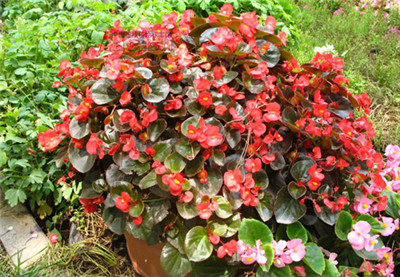
For wax begonia cutting propagation, the following aspects should be mastered:
1. Cutting time. Wax begonia roots very easily, but cutting in summer is not recommended. During high temperatures, it often enters semi-dormancy, so cuttings are less likely to survive and the cuttings tend to rot. It is best to take cuttings in spring and autumn, when the survival rate is very high. Generally, no special treatment is needed; it is very simple. For home propagation, it is best done between April and May, when the temperature rises above 20 degrees Celsius. At this time, air humidity is high, the temperature is warm, management is simple, and it is suitable for the rapid rooting of wax begonia.
2. Cutting selection. For the cuttings, generally choose healthy, disease-free shoot tips about 5—6 cm long, that is, with 3-4 nodes, and each cutting should carry at least 2 buds. Cut 1 cm below the node at the base of the cutting stem. After cutting, the leaves near the base can be removed. If there are flower buds, remove them, then cut the top into a flat shape and the bottom into a horseshoe shape to enlarge the contact surface with the sand and promote rooting before inserting for propagation.
3. Cutting medium. Wash river sand, dry it in the sun, and place it in a pot. River sand that has been washed and then dried in the sun basically achieves the purpose of disinfection, and the dried river sand helps raise the temperature under sunlight during the day, promoting healing and rooting of the cut surface of the cutting.
4. Cutting and management. Insert into the sand pot at a plant-to-row spacing of 3 cm × 4 cm. Before inserting, first use a bamboo stick of the same thickness as the cutting to make holes in the pot sand, then insert the wax begonia branch. Within 2 days after insertion, do not water, so as to help the cut surface form a healing callus. On the 5th day, spray-water with water at about the same temperature as the sand, until water is seen flowing out from the bottom of the pot. Place it in a cool place, and generally do not water again. After about 10 days, roots 3~4 cm long can grow. At this time, place the pot in sunlight and water according to weather conditions. After another 6~7 days, it can be potted for final planting.