What to do when Ixora leaves turn yellow and dry up? Control water, adjust temperature and fertilize in time
As for Ixora, those who have seen it should remember it; its emerald green leaves and beautiful flowers are both very popular. However, to achieve this, flower lovers must take good care of it, because once operations are improper, or there is even a slight negligence, it will cause the symptoms of yellow leaves. So what should be done when Ixora leaves turn yellow and dry up? The following are several causes of yellowing Ixora leaves and their solutions; let us take a look together.
I. What to do when Ixora leaves turn yellow and dry up: find the cause
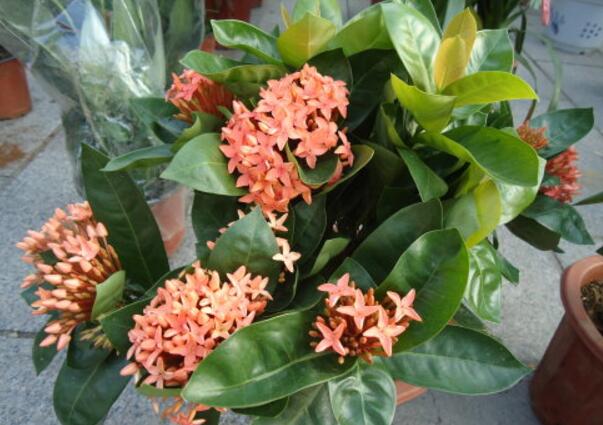
In the cultivation methods for Ixora, we introduced Ixora's requirements for light, water and fertilizer, and fertilization, and once we cannot meet these requirements, its leaves will turn yellow. As for what to do when Ixora leaves turn yellow and dry up, we must first find out what is causing it, and then solve it accordingly. The following are 5 causes of yellowing Ixora leaves summarized by the editor, with solutions attached; let us continue reading.
II. Causes of yellowing Ixora leaves and solutions
1. Sudden environmental change
No matter what plant it is, even one with extremely strong adaptability like Agave, once the growing environment changes too much, its leaves will also turn yellow. So if everyone bought Ixora online, it may fail to adapt because the growing environment changed greatly all at once, and after being kept for a period of time, symptoms of yellowing and drying leaves will appear.
Solution: What to do when Ixora leaves turn yellow and dry up? At this time, everyone should communicate with the seller to learn about Ixora's previous growing environment, strive to keep it unchanged at home, and then change it gradually until it adapts. After a period of time, the flower lovers' Ixora will recover its health.
2. Temperature too low
Ixora likes a warm environment and cannot tolerate low temperatures; its optimal growing temperature is 20-30°C. After being brought indoors in winter, the indoor temperature should be kept between 12-18°C. Once it is below 0°C, it is prone to cold damage, thereby causing the phenomenon of yellowing and drying Ixora leaves.
Solution: After being brought indoors in winter, the temperature must be controlled, and the air conditioner should be turned on when necessary; if the yellowing is caused by being frozen, it should immediately be moved to a warm environment, with appropriate light and a small amount of watering. After a period of careful care, your Ixora will recover its health.
3. Light too strong
There are many causes of yellowing and drying Ixora leaves. If it is summer, everyone should first consider the light issue. Ixora likes light, but dislikes direct strong light, so if you place Ixora in a place with too strong light, it will be burned, and its manifestation is dry and yellow leaf tips.
Solution: In summer when the light is strong, we should properly shade it; if the yellowing leaves are caused by too strong light, we should move it to a ventilated and sunny indoor place, and water it appropriately, and after a period of time it will recover.
4. Too much or too little watering
Although Ixora likes moisture, it is also afraid of water accumulation. Once watered too much, it is easy to cause water accumulation in the pot, leading to root rot, thereby affecting plant growth, and its manifestation is yellowing leaves; however, watering too little is also not good, because then the leaves cannot absorb water and will also dry up and turn yellow.
Solution: When watering too much, stop watering immediately and loosen the soil more to let the water evaporate; when watering too little, to prevent water loss, immediately place the Ixora in partial shade and water it a little, not too much at once. At the same time, loosen the cracks on the pot wall so that water can drain out through the gaps.
5. Too much or too little fertilization
During Ixora's growth process, proper fertilization is very important. Once we do not fertilize for a long time, or do not fertilize at all, Ixora will turn yellow because it lacks the necessary nutrients; however, too much fertilization is also not good, as this will cause fertilizer damage, leading to root rot, and thus yellowing leaves.
Solution: What to do when Ixora leaves turn yellow and dry up? If it is a lack of fertilizer, we should fertilize Ixora appropriately; when there is too much fertilizer, finally replace the potting soil inside so that the Ixora becomes dry and fresh again.
Overall, Ixora is very easy to grow, and when grown well, its ornamental effect is quite good~ But during the cultivation process, if one is slightly careless, its leaves will turn yellow, thereby seriously affecting its ornamental value, so everyone must not be careless for even a moment. Regarding yellowing and drying Ixora leaves, the editor will introduce it here, hoping to bring help to everyone.
What to do when Ixora leaves dry up
What is the cause of this phenomenon
We should first understand what causes the withering, so that we can handle it better.
Light too strong
The first cause may be that the plant is placed directly facing the sun, and the light the plant receives is too strong, so the plant's leaves are burned. Note that the phenomenon corresponding to this cause should be dry leaf tips.
Too much water
The second possible cause is too much water; being drenched by heavy rain during the rainy season or being watered too much by people can both cause the above phenomenon. However, the symptom of this cause is different from the first one: it is the plant's young leaves that dry up.
Pathogens
The third cause may be the presence of plant pathogens; the plant has contracted some kind of leaf-related disease that causes the drying phenomenon to appear.
Corresponding treatment measures
For the first cause, light should be adjusted appropriately. Undoubtedly, no light is not acceptable; Ixora's growth and flowering also need a sunny environment. But be very careful: in summer when the light is especially strong, appropriate measures must be taken to shade the plant, otherwise it will cause the leaves to lose water and dry up, and may even affect the flowers.
If it is the second cause - too much watering - then watering should be done reasonably. This plant generally still likes moisture and cannot lack water; the pot soil should be kept moist. However, long-term overly wet conditions are not acceptable, and may simultaneously cause the two consequences of leaf withering and root rot. So slightly moist pot soil is enough, and when overly wet conditions are observed, drainage should be done in time.
The third cause is rather easy to handle; just spray some sterilizing liquid.
How to grow Ixora in winter: watering and light matters
How to grow Ixora in winter 1. Winter light requirementsWinter sunlight is not especially strong, so even at noon light, no special shading measures are needed; let the plant receive as much light as possible.
Generally, flower lovers can place the plant in places that can receive sunlight, such as a balcony or windowsill.
2. Winter watering requirementsIxora should not be watered too much in winter, except that when the soil is found to be already very dry, a little can be added. In addition, Ixora will bloom in winter, so after Ixora blooms, it still needs some watering to replenish moisture.
3. Winter temperature controlAlthough Ixora can tolerate a low temperature of 0°C in winter, when winter comes, it is still recommended that flower lovers move Ixora indoors for care. Generally, Ixora's growth will become slow when the ambient temperature is below 10°C. It is recommended that when caring for Ixora in winter, the temperature of the care environment be controlled at 13°C to 18°C.
4. Winter fertilization requirementsIxora is a flowering plant that likes fertilizer, but dislikes concentrated fertilizer and raw fertilizer. During the growing period, fully decomposed organic fertilizer can be applied once every half month, so in winter nutrients should also be replenished in time.