Lily of the Valley Growing Methods and Precautions, Suitable for Care in Semi-Shade
Lily of the valley is a plant with a very elegant temperament and high ornamental value, and it is also a plant that many growing enthusiasts quite like. How to grow lily of the valley is also a question many people care about. Below are the growing methods and precautions for lily of the valley; those interested can take a look.
I. How to Grow Lily of the Valley / The Method Matters
When it comes to how to grow lily of the valley, aspects such as the environment, season and watering method all need attention. Understanding these aspects will also be very helpful for the process of growing lily of the valley. In short, growing any plant is the same: mastering the method well will make your growing process smoother. The methods are as follows; let us continue reading.
II. Growing Methods and Precautions for Lily of the Valley
1. Environment Selection
Lily of the valley is a plant suited to growing in a cool, shaded environment. Its demand for sunlight is not very strong, and it is generally best placed in a semi-shaded spot indoors. Lily of the valley grown in such an environment will also be more robust.
2. Growing Season
When it comes to how to grow lily of the valley, choosing the season is very important. The season most favorable for the growth of lily of the valley is spring each year, and spring is also the best period for growing lily of the valley. So if you want to grow a lily of the valley at home, it is best to choose spring.
3. Water Frequently
In the process of growing lily of the valley, the watering method is also something that needs attention. This plant is naturally fond of moisture and is not very drought-tolerant, so when growing it you must remember to water frequently, and when watering you must water thoroughly. But remember not to cause waterlogging, or root rot may occur.
4. Plant Spacing Control
If you are planting lily of the valley in outdoor soil, plant spacing also needs attention. It is best not to plant them too densely; generally a spacing of 15cm between each plant is optimal, which will also be more favorable for the growth of the cymbidium.
What to Do When Lily of the Valley Leaves Turn Yellow: Grow in a Semi-Shaded Spot Indoors / Deal with Pests and Diseases Promptly
Lily of the valley is a white flower that gives people a feeling of pure, spotless beauty and has extremely high ornamental value. Precisely because it looks so immaculate, yellowing would ruin its overall beauty. As for what to do when lily of the valley leaves turn yellow, this is actually related to many aspects; as long as you find the root of the problem, dealing with it is relatively simple.
I. What to Do When Lily of the Valley Leaves Turn Yellow / Pay Attention to Light
Regarding yellowing leaves on lily of the valley, this phenomenon can occur for many reasons. For example, improper watering, too much or too little light and other aspects can all cause this. So how should we avoid this phenomenon? Below is a detailed introduction to this topic; let us read on together.
II. Ways to Prevent Lily of the Valley Leaves from Turning Yellow
1. Caused by Improper Watering
When watering lily of the valley, there are many aspects that need attention. If you water too much, it may cause waterlogging in the potting soil, leading to root rot in the lily of the valley. Of course, watering too little is also no good, because then the lily of the valley cannot absorb nutrients, and its leaves will lose their luster and turn yellow.
Prevention method: To avoid this situation, you need to find the correct watering method. Lily of the valley is a plant that relatively likes moisture; generally, watering until the potting soil is moist is enough, so it can absorb sufficient nutrients. Remember that moist is enough; do not let water accumulate.
2. Caused by Improper Fertilizing
Many people, when growing lily of the valley, keep applying fertilizer in order to make it grow better. This method is incorrect. Although lily of the valley needs fertilizer very much, a limit must still be observed; too much will directly affect the plant's roots and cause the leaves to turn yellow.
Prevention method: During the vigorous growth period of lily of the valley, we can appropriately choose to fertilize more. About 15 days before its flowering period, fertilizer can be applied once; during the flowering period no fertilizer is needed, and after the flowers fade, applying fertilizer 1-2 times is enough.
3. Caused by Improper Light
Among the causes of yellowing leaves on lily of the valley, light is one of the relatively main reasons. Lily of the valley differs from many plants in that it does not need too much sunlight during its growing process, though of course it cannot be without sunlight either; too much or too little sunlight can both cause its leaves to turn yellow.
Prevention method: During the growing process of lily of the valley, it is best to place it in a semi-shaded spot indoors for cultivation, and the environment should be ventilated. In this way it can not only absorb nutrients from sunlight but also avoid yellowing caused by too much sunlight. This is a point that needs relatively more attention.
4. Caused by Pests and Diseases
During the process of growing lily of the valley, if the improper operations above occur, pests and diseases are very likely to arise. Pests and diseases are also one of the main causes of yellowing leaves on lily of the valley; in severe cases they will not only make the leaves yellow but even cause the whole plant to die.
Prevention method: If lily of the valley develops pests or diseases, they need to be controlled promptly. The specific methods for this are recorded in detail in the article on pest and disease control for lily of the valley; you can go and take a look. I will not introduce too much here.
As long as everyone pays attention to the issues mentioned above and follows the correct methods for cultivation, your lily of the valley will surely grow robustly and will not develop yellowing. That is all for the introduction on yellowing lily of the valley leaves; I hope it can help everyone.
Lily of the Valley Convallaria majalis L Lily of the Valley Illustrated Guide: How to Grow Lily of the Valley / How to Propagate Lily of the Valley
Lily of the Valley ProfileLily of the Valley Convallaria majalis L
Growing Methods and Precautions for Lily of the Valley Introduction to Lily of the Valley
Lily of the valley (scientific name: Convallaria majalis), also known as Junying grass, lily of the valley, and bellflower, is the only species in the genus Convallaria. It is native to the temperate Northern Hemisphere, with wild distribution in Europe, Asia, North America, and the Northeast and North China regions of China at altitudes of 850-2500. There is also a Japanese drama named after lily of the valley, and some anime, games, and light novels also feature characters named after lily of the valley.
Exchanging lily of the valley is something French people must do on May 1, because the French believe that lily of the valley brings good luck. Lily of the valley is also common at weddings, where it is given to the bride to wish the couple "the arrival of happiness." The original species of lily of the valley is distributed across Asia, Europe, and North America, especially at higher latitudes; wild populations exist in China's Northeast forest regions and the Qinling Mountains in Shaanxi. It mostly grows in deep mountain valleys and in grass along forest edges. Lily of the valley is a precious aromatic plant, and its flowers can be used to extract high-grade aromatic essential oil.
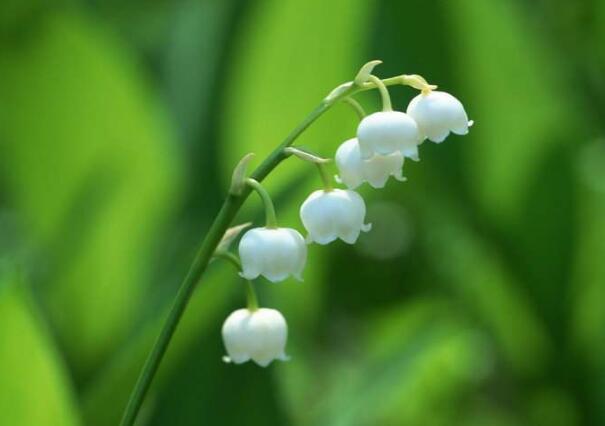
The flowers of lily of the valley are small bell-shaped flowers, borne at the top of the flower stem in a raceme that leans to one side. The flowers are milky white and hang like strings of bells; one stem generally bears 6-10 flowers, crystal clear and noble, exquisitely elegant. The fragrance is rich, softly floating, subtly refreshing to the heart, and intoxicating.
The fallen flowers of lily of the valley dancing in the wind look like snow falling, so the grasslands of lily of the valley are also called "silver-white heaven."
Morphological Characteristics of Lily of the Valley
Lily of the valley is a short plant, a perennial herb about 20 cm tall, with a much-branched, creeping, flat-lying rhizome underground.
In spring, 2-3 leaves grow from the terminal bud at the tip of the rhizome; they are ovate or narrowly ovate with arcuate veins, 13-15 cm long and 7-7.5 cm wide, acute at the apex, slightly narrowed at the base, with several sheath-like leaves clasping at the base. The leaves are narrowly ovate or broadly lanceolate with arcuate veins, 2-3 in number, basal, clasped at the base by several sheath-like membranous scale leaves, and glossy. The petiole is about 16 cm long, sheath-like and clasping each other, with several sheath-like membranous scales at the base.
The flowers are bell-shaped, nodding, in a raceme, bearing 6-10 flowers, about 7 mm long and about 1 cm wide, milky white; the scape extends from the axil of the scales; the raceme leans to one side; the bracts are lanceolate, membranous; the perianth is 6-lobed at the apex, with ovate-triangular lobes; stamens 6; the style is shorter than the perianth.
In autumn it bears round, dark red berries that are toxic, containing 4-6 elliptical, flattened seeds. It is an excellent potted ornamental plant, usually used in flower beds and small cut flowers, and can also be used as a groundcover plant; its leaves are often used as material for flower arrangements. The flowering period is generally in early summer from April to May, and the fruiting period is from June to July.
Lily of the valley is 20-30 cm tall. Underground it has a horizontal, branched rhizome, with a enlarged underground bud at the stem tip. Leaves 2-3, clasping each other at the base into a sheath, ovate or narrowly ovate, with arcuate veins, glossy. The raceme leans to one side, 15-20 cm high; in summer it blooms with bell-shaped white flowers, about 10 small flowers, about 8 mm in diameter, nodding and fragrant. The fruit is 5-7 mm in diameter and contains several relatively large pale white or pale brown seeds; the seeds are dry, bead-like, clear and semi-transparent. Leaves are narrow or broad with arcuate veins. Flowers bell-shaped, nodding, in a raceme, bearing 6-10 flowers, about 7 mm long and about 1 cm wide, milky white; the scape extends from the axil of the scales; the raceme leans to one side; the bracts are lanceolate, membranous; the perianth is 6-lobed at the apex, with ovate-triangular lobes; stamens 6; the style is shorter than the perianth. In autumn it bears round, toxic berries containing elliptical, flattened seeds. It is an ornamental plant, usually used in flower beds and small [cut flowers], and its leaves are often used. It likes cool, moist, and semi-shaded environments, and in the south it needs to be planted in higher places without severe summer heat. It likes sandy loam rich in humus, moist but well-drained, and avoids drought. It likes slightly [acidic soil], and can also grow normally in neutral and slightly alkaline soil. It is dormant in summer. In autumn and spring, cut and divide the rhizome or sprouts into sections for separate cultivation, that is, division propagation. The planting site is best with deep plowing and fertility. After 3-4 years, change the site and replant, or rotate with other flowers. Planting row spacing is 25-30 cm, with 2-3 buds per clump, and soil covering depth of 5-6 cm. During the growing period, the soil should always be kept loose and moist, and in early spring and late autumn apply a fully fermented topdressing once each. Place indoors at 2-3°C, undergo low-temperature treatment for 2-3 weeks, take out and pot in a leeward and shaded place, move into a 12-14°C greenhouse 5 weeks before the desired flowering period, water appropriately and place in a dark place, after 10-15 days gradually move toward the light. Spray with wettable powder at 700 times dilution. It is best planted in deeply plowed, fertile soil. It can also be done from after autumn to early March of the following spring by dividing the rhizome into several sections.
Ecological Habits of Lily of the Valley
It grows in wet, shaded mountain forest understories or shrubs at forest edges, and has red fruits and white bell-shaped flowers.
It likes cool, moist, and semi-shaded environments. Under lower temperature conditions, it can also grow and bloom in direct sunlight. It is extremely cold-tolerant and avoids heat and dryness. When the temperature is above 30°C, the plant's leaves will yellow and wither prematurely. In the south it needs to be planted at higher altitudes without severe summer heat. It likes sandy loam rich in humus, moist but well-drained, and avoids drought. It likes slightly acidic soil and can also grow normally in neutral and slightly alkaline soil. It is dormant in summer.
The lily of the valley plant is short and likes cool, moist, and semi-shaded environments. It is cold-tolerant and avoids heat and dryness. It likes fertile, well-drained sandy loam, and is dormant in summer. It can be propagated by division or sowing; division can be done in both spring and autumn. If the buds are plump and strong, they can bloom in the following spring. Sowing is generally done in autumn. It is often done in spring and autumn by cutting and dividing the rhizome or sprouts into sections for separate cultivation, that is, division propagation. The planting site is best with deep plowing and fertility. After 3-4 years, change the site and replant, or rotate with other flowers. Planting row spacing is 25-30 cm, with 2-3 buds per clump, and soil covering depth of 5-6 cm. During the growing period, the soil should always be kept loose and moist, and in early spring and late autumn apply a fully fermented topdressing once each. Before flowering there should be appropriate sunlight, and after flowering it is relatively shade-tolerant. After leaf fall in late autumn, for forcing cultivation, cut the root crown, place indoors at 2-3°C, undergo low-temperature treatment for 2-3 weeks, take out and pot in a leeward and shaded place, move into a 12-14°C greenhouse 5 weeks before the desired flowering period, water appropriately and place in a dark place, after 10-15 days gradually move toward the light, raise the room temperature to 20°C, bottom temperature 22°C, and increase watering and topdressing; after 3 weeks it can bloom. Forcing cultivation often does not sprout, or although it sprouts, the scape and leaves [are irregular]. It can be sown directly in an open-field seedbed and sprout in the following spring. Carry out division propagation once every 2 to 3 years; in late autumn, the flower buds are bluntly conical and plump and short, and can bloom in the following year; the leaf buds are long conical and thin, and can bloom only in the third year. For the first division, it is best to keep buds, among which there are both flower buds and leaf buds. It is best planted in deeply plowed, fertile soil. It can also be done from after autumn to early March of the following spring by dividing the rhizome into several sections and covering with about 5 cm of soil. If breeding or introducing from distant places, seed propagation can be used; sow in autumn and sprout in the following spring. The planting site is best with deep plowing and fertility. After 3-4 years, change the site and replant, or with other flowers. Planting row spacing is 25-30 cm, with 2-3 buds per clump, and soil covering depth of 5-6 cm. During the growing period, the soil should always be kept loose and moist, and in early spring and late autumn apply a fully fermented topdressing once each. Before flowering there should be appropriate sunlight, and after flowering it is relatively shade-tolerant. After leaf fall in late autumn, for forcing cultivation, water appropriately and place in a dark place, after 10-15 days gradually move toward the light.
Cultivation Techniques for Lily of the Valley
Lily of the valley likes semi-shade, moist, and cool environments, is cold-tolerant, and avoids heat. As long as there are appropriate cool and shaded conditions, it will multiply rapidly by spreading rhizomes. Shade and moist, fertile soil are important conditions for successful planting. Soil containing humus and sand is ideal; this kind of soil is both fertile and well-drained. In modern factory greenhouse commercial production, pollution-free cultivation is adopted to improve flower quality and yield, avoid excessive application of nitrogen fertilizer, and use less ammonium nitrogen fertilizer. This is worth noting and emphasizing.
It is often done in spring and autumn by cutting and dividing the rhizome or sprouts into sections for separate cultivation, that is, division propagation. The planting site is best with deep plowing and fertility. After 3-4 years, change the site and replant, or rotate with other flowers. Planting row spacing is 25-30 cm, with 2-3 buds per clump, and soil covering depth of 5-6 cm. During the growing period, the soil should always be kept loose and moist, and in early spring and late autumn apply a fully fermented topdressing once each. After 10-15 days gradually move toward the light, raise the room temperature to 20°C, bottom temperature 22°C, and increase watering and topdressing; after 3 weeks it can bloom. If forcing cultivation is not given low temperature and darkness, it often does not sprout, or although it sprouts, the scape and leaves grow unevenly, which hinders viewing.
When planting, cover with more than 5 cm of soil, and water thoroughly after planting. After sprouting in spring, topdress once every 15 days; pay attention to watering in dry weather; stop fertilizing after the flower stem emerges; after the flowers fade, promptly cut off the flower stalk and topdress 1-2 more times. After the aboveground part withers in late autumn, cover with leaf mold and cow dung to protect the rhizome and its dormant buds for overwintering in the open field. For ground planting, divide and replant once every 3-4 years. For potting, mostly choose plump and large rhizome buds, with 4-5 buds per pot, and repot once every year. Forcing cultivation: plant the low-temperature-treated rhizome, maintain the temperature at around 18-20°C throughout the cultivation period, pay attention to fertilizer and water management, keep the soil moist, and it can bloom in about one month. There is damage from brown spot disease; spray with 75% chlorothalonil wettable powder at 700 times dilution.
Carry out division propagation once every 2 to 3 years; in late autumn, after the aboveground part of the plant withers, dig up the young buds at the ends of the rhizome for division planting. After division, large young buds bloom in the following spring, while small ones bloom after an interval of one year. The top of the underground rhizome of lily of the valley has flower buds and leaf buds. For the first division, it is best to keep 4-6 buds, among which there are both flower buds and leaves, with each section carrying 4-6 buds each. Apply some plant ash or sulfur powder to the wound, and cover the hole with about 5 cm of soil. If breeding or introducing from distant places, seed propagation can be used; sow in autumn and sprout in the following spring.
To manage lily of the valley, apply sufficient base fertilizer. After sprouting in spring, water with diluted decomposed cake fertilizer once every 7-10 days; when flower stalks appear, after flowers fade, and after autumn, apply liquid fertilizer once each. After flowering, it is best to cut off the stems and branches early so that nutrients are concentrated and supplied to the rhizome. For overwintering in the open field, cover the ground with grass or fine soil to prevent cold and freezing.
If potted, in November dig out rhizomes with buds and store them at 3°C-5°C for 14-21 days, then take them out and plant them in pots, but do not let them see light; keep the temperature at 12-14°C, and only let them see light after the young buds emerge, at which time control the temperature between 20-22°C. Then water and topdress appropriately. If cultivated properly, they can bloom afterward. If low temperature and dark treatment are not given in advance, the leaves often grow unevenly and the flower stems fail to sprout.
Lily of the valley is naturally robust and easy to manage. If decomposed cake fertilizer is often applied after sprouting in spring, it will bloom abundantly. Stop fertilizing after the scape emerges, and resume fertilizing 1-2 times after the flowers fade to promote new tillers from the rhizome. Generally, division of the rhizome is used for propagation. In autumn, cut the mother plant's bud-bearing rhizome into sections and plant them, and with careful care they will survive. The sprouts growing from the base can also be cut off for separate planting, but the propagation rate is relatively low.
Water and Fertilizer Management
After the divided seedlings are planted, water thoroughly. In winter, cover the surface with compost or straw curtains to prevent cold. After the buds sprout in early spring, remove the covering and weed and loosen the soil. During the growing period, keep the soil moist and apply dilute cake fertilizer water once every 2 weeks; pause fertilizing after the flower stalk emerges. After the flowers fade, if the fruit is not to be viewed, promptly cut off the flower branches and apply liquid fertilizer once to promote the growth of dormant buds. For open-field planting, apply heavy fertilizer once before winter, so that it will grow vigorously in the following spring. After 3 years of planting, lily of the valley needs to be rotated to another site.
Collection Management
1. It grows on the shady side of mountain slopes, under forests, and in grasslands at forest edges.
2. Choose shady mountain slopes and forest areas and grasslands with relatively thick humus. Make strips along contour lines or across the mountain, with a strip width of 1.5 m, strip spacing of 2 m, and row-hole spacing of 50x20 cm. Dig holes, break up the soil, compact it, and shape it like a steamed bun.
3. Use seeds or rhizomes for propagation. In autumn, sow the seeds in rows in the holes, cover with soil, compact, and cover with leaves. Or in spring, cut the rhizome into sections, plant them in the holes, compact, and cover with leaves.
4. After the seedlings emerge in the following spring, thin them so that each hole has 2-3 plants. Remove the leaves, ventilate, let in light, and pull out diseased and weak plants.
5. Collect after the fruits mature; harvest the whole plant, remove the soil, and dry in the sun.
Disease Control of Lily of the Valley
Propagation is generally done by division; in autumn, it can be cut with a sharp knife together with the rhizome. Wild species in their native habitat often grow in groups and are rarely attacked by pests or diseases. Greenhouse cultivation is prone to pest and disease damage; commonly seen are fungal diseases such as stem rot, anthracnose, and leaf spot. Usually, copper-based fungicides should be used regularly for control, and it is strictly forbidden to collect seeds from diseased plants for propagation. Once diseased plants are found, they must be immediately destroyed and removed to prevent spread.
Pests and diseases: If there is brown spot disease, spray with 75% chlorothalonil wettable powder at 700 times dilution.
Propagation Methods of Lily of the Valley
Propagate by dividing the rhizome and the small bulbs at the end of the rhizome; this can be done in spring or autumn, and November is best.
Its rhizome has young buds of various sizes. After the aboveground part withers in autumn, dig up the rhizome, cut off each terminal bud with a section of rhizome, and plant it, and it can become a new plant.
After division, plump buds can bloom in the following spring, while small ones need an interval of 1 year before blooming.
In autumn, wash the seeds out of the red, ripe berries and sow them directly in an open-field seedbed; they will sprout in the following spring.
Distribution Range of Lily of the Valley
It is also very common from Korea and Japan to Europe and North America. Those distributed in Eurasia have a white midvein on the flowers. Those distributed in the United States have a light green midvein on the flowers.
[Domestic distribution] Heilongjiang, Jilin, Liaoning, Inner Mongolia, Hebei, Shanxi, Shandong, Henan, Shaanxi, Gansu, Ningxia, Zhejiang, and Hunan.
[Foreign distribution] It is also very common from Korea and Japan to Europe and North America. Those distributed in Eurasia have a white midvein on the flowers. Those distributed in the United States have a light green midvein on the flowers.
[Altitude] 800-2500 m
Variety Classification of Lily of the Valley
Besides the common white-flowered form, there are varieties such as large-flowered lily of the valley and red-flowered lily of the valley.
In particular, large-flowered lily of the valley in April extends gracefully curved flower stalks from a pair of dark green, long elliptical leaves and opens fragrant, pure white flowers; besides single-petaled forms, there are also double-flowered lily of the valley varieties; some horticultural hybrids show variegated leaves and are called variegated lily of the valley.
Medicinal or Dietary Value of Lily of the Valley
The medical information and health dietary information on Huahua Network is for reference only and cannot be used as a basis for diagnosis or medical treatment. For any health problem, consult professional medical personnel, and for the treatment of any disease, follow doctor's advice.
Ultimate flower-protecting mission: to love yourself, start from reality, and strictly follow doctor's advice. For illness, do not be careless, do not delay, do not give up hope; face it bravely, warm the silent world with love, and care for the flower field in your heart with your heart.
Medicinal Value
The whole plant of lily of the valley is used as medicine. After the fruits mature in summer, harvest the whole plant, remove the soil, and dry in the sun.
Lily of the valley can not only purify the air but also inhibit the growth and reproduction of tuberculosis bacteria, pneumococci, and staphylococci.
[Nature, flavor, and meridian entry]: Bitter, warm. Toxic.
[Source]: "Northeast Medicinal Plant Record"
[Traditional Chinese medicine chemical components]: The whole plant contains convallatoxin, convallatoxol, convallatoxigenin, deglucocheirotoxin, 3β,5β,11α,14β-tetrahydroxy-carden-20(22)-olide-3α-L-rhamnoside, periplogenin-3-o-α-L-rhamnoside, convallarin flavonoid glycoside, 3',4',5,7-tetrahydroxyflavonol-3-β-D-galactoside, 3',4',5,7-tetrahydroxyflavanol, as well as rhodeasapogenin and isorhodeasapogenin.
The flowers contain convallatoxin 0.02%, convallatoxol, convallarin A, convallarin B, glucoconvallarin A, glucoconvallarin B, convallarin C, convallarin D, deglucocheirotoxin, and chelidonic acid. The leaves contain convallatoxin 0.037%.
[Functions and indications]: Strengthen the heart and promote diuresis. Used for congestive heart failure, atrial fibrillation, and left heart failure caused by hypertension and nephritis.
[Usage and dosage]: 0.3 grams of the whole plant each time, 1.0 gram per day, taken mixed with water.
[Additional prescriptions]:
① To treat erysipelas: 50 grams of lily of the valley. Decoct in water and wash.
② To treat purpura: an appropriate amount of lily of the valley; burn to ash, grind into powder, and apply mixed with rapeseed oil.
③ To treat traumatic injuries: 15 grams of lily of the valley, 10 grams of red notoginseng, five fen of red and white two pills, 25 grams of Sikuaiwa. Decoct in water and take, with yellow rice wine as the guiding agent.
④ To treat abnormal uterine bleeding and leukorrhea: 15 grams each of lily of the valley and motherwort. 10 grams each of red and white cockscomb and Hongmaoqi, 7.5 grams of safflower, and 5 grams of Shizelan. Decoct in water and take, with yellow rice wine as the guiding agent. (Selected prescriptions from "Shaanxi Chinese Herbal Medicine")
⑤ To treat congestive heart failure: take 10% lily of the valley tincture orally, 1 milliliter each time, 4 times a day; after continuous use for 3 days, change to a maintenance dose of 1 milliliter per day.
Toxicity Characteristics
[Toxicity]: Level 6
[Characteristics]: All parts are toxic, especially the leaves; even the water in which fresh flowers are kept can be toxic.
[Poisoning symptoms]: Facial flushing, tension and irritability, headache, hallucinations, erythema, dilated pupils, vomiting, stomach pain, nausea, slowed heartbeat, heart failure, coma, death.
[Onset time]: Immediately
[Antidote]: Gastric lavage, take cardiac sedatives.
[Caution]: It looks very much like garlic on the market and is even sold publicly as an ornamental plant!
Landscape Uses of Lily of the Valley
It is the best semi-shade-loving groundcover plant for under deciduous forests, at forest edges, in forest clearings, and on the back sides of buildings. It can also be arranged with other flowers in flower beds and flower borders.
The lily of the valley plant is short, elegant and fresh, and pleasantly fragrant; it is an excellent groundcover and potted plant. There are milky white, pink, and variegated-leaf varieties. In autumn the red fruits are delicate and charming, very attractive.
Lily of the valley is a very ideal flower for potting, flower beds, flower borders, and lawns, and can also be used for cut flower cultivation and as a groundcover plant.
Key points:
Because all the flowers open downward, when used as cut flowers they should be specially treated with fine wire and transparent tape to make the flowers look more visible.
Uses and Functions of Lily of the Valley Improving the Environment
1. Lily of the valley can kill germs in the home. Like roses, dianthus, lemons, and other plants, lily of the valley is also a fragrant flower with a rich aroma, and the volatile oils it produces have an obvious bactericidal effect. Placing it at home, the fragrance it gives off has an inhibitory effect on the growth and reproduction of tuberculosis bacilli, pneumococci, and staphylococci, and has a protective effect on both adults and children at home.
2. It has the effect of an air purifier. When we place some flowers and plants at home, besides beautifying the home, there are many benefits; many plants have the function of an air purifier, and lily of the valley is one of them. Although it does not have as strong a toxin-absorbing ability as spider plants or aloe, it can also absorb carbon dioxide, release oxygen, and increase negative ions in indoor air. Its fragrance in particular can make the air fresh and healthy; with a pot of lily of the valley nearby, you will have better spirits whether working or living. Moreover, many flowering plants have a dust-removal effect, and lily of the valley flowers can also intercept and absorb floating particles and smoke dust in the air, reducing the impact of dust on home cleanliness. [7]
3. Lily of the valley can help people relax. Fresh flowers are not only beautiful but can also improve people's physical condition. Like lily of the valley, when it gives off fragrance during a meeting, and a breeze blows through, waves of intoxicating scent fill the room, allowing people to relax, and their spirits become pleasant. Living in such an environment often can also give good sleep and improve one's work efficiency.
Cultural Background of Lily of the Valley Folklore
Legend says that on the land where the forest guardian Saint Leonard died, white and fragrant lily of the valley bloomed. The lily of the valley blooming on that cold land is the incarnation of Saint Leonard... Clusters of densely growing small flowers make one wonder: does she have a strong will to grasp happiness?!
In an old Sussex legend, the warrior Saint Leonard (St. Leonard) was determined to rid the people of a scourge. He fought a vicious dragon in the forest and finally, exhausted, perished together with the dragon. On the land where he died grew fragrant lily of the valley with small white flowers like jade bells. The lily of the valley blooming alone on that cold land is the incarnation of Saint Leonard, condensing his blood and spirit. According to this legend, if you give lily of the valley to relatives and friends, the god of happiness will descend upon the recipient.
There is a beautiful legend in Ukraine that says long ago a beautiful girl waited faithfully for her lover who had gone off to war, and the tears of longing that fell from her onto the forest grass turned into the fragrant lily of the valley.
Others say that lily of the valley is the pearls that scattered when Snow White's pearl necklace broke, and still others say they are the little lanterns of the 7 dwarfs.
There is also a legend about a youth named "Landysh" (the Russian word for lily of the valley), who was heartbroken because his beloved "Vesna" (the Russian word for spring) left him, and the youth's tears turned into white flowers, while the blood flowing from his shattered heart turned into the bright red berries of lily of the valley.
Lily of the valley is the flower of the goddess of sunrise in ancient Nordic mythology, a fresh flower offered to the goddess of sunrise.
Lily of the valley is also the sacred flower of the Native Americans of North America.
The romantic French even have a special "Lily of the Valley Festival." On the "Lily of the Valley Festival" in May, French people give each other small lily of the valley flowers, symbolising good fortune and good luck.
The flower meaning of lily of the valley is the return of happiness
If you cannot catch the faint fragrance of lily of the valley, light as a star's sigh, from the night wind, how can you follow the scent to the valley where lily of the valley blooms? If you do not guard it with all your heart, how can you happen to reach its side just when the lily of the valley's moment comes? The waiting of lily of the valley is only for the most attentive person, and the music of lily of the valley lightly tapped by the wind can only be heard by the one who loves it most. In order to obtain true love, lily of the valley waits in the lonely valley for its own spring to arrive...
Lily of the valley blooms only with the spring breeze of May, and its flower meaning is the return of happiness (return of happiness).
Purity and happiness
The lily of the valley plant is small and delicate, with a pleasant floral fragrance, and its flowers are small bell-shaped blooms. In France, lily of the valley is a symbol of purity and happiness. Every year on May 1, it is the Lily of the Valley Festival in France, and on this day romantic French people give each other lily of the valley flowers to wish each other a year of happiness. The recipient usually hangs this small white flower in a room to keep for the whole year, symbolising that happiness will stay forever.
Lily of the valley can often be seen at French weddings. Giving this flower to the bride is to congratulate the newlyweds on the arrival of happiness. This is probably because this small flower, shaped like a little bell, makes people think of a little bell that summons happiness.
In addition, because the growing region of lily of the valley is not large, it is also called "lily of the valley," giving people a feeling of "purity and freshness." In friendships, lily of the valley has always expressed the pride of "happiness, purity, virginity," and beautiful wishes such as "happiness bestowed upon a pure-hearted maiden."
Just like the sorrowful legend of the birth of lily of the valley, the happiness of lily of the valley comes especially hard, and is accompanied by a faint sorrow of fate. The waiting of lily of the valley is the sigh of stars in the wind, faint and barely there, vast and quiet, and only the attentive can sense it; the temperament of lily of the valley is as pure and clear as the faithful, gentle love belief of a woman in the wind, and only by concentrating can one begin to taste it.
Flowers incompatible with lily of the valley
Lily of the valley and lilac cannot be placed together, otherwise the lilac flowers will quickly wilt; even at a distance of 20 cm, if the lily of the valley is moved away, the lilac will return to its original state; lily of the valley also cannot be placed together with narcissus, otherwise both will suffer.
Lily of the valley pictures