How do you care for a small crown of thorns (Euphorbia milii)? Growing methods and precautions, sunlight must be sufficient
Crown of thorns is a plant native to Africa that was later introduced to our country, and today it is also a fairly common plant in our country, with many people wanting to grow it. So how do you care for a small crown of thorns? Regarding the growing methods and precautions for crown of thorns, let us walk you through them below.
I. How to care for a small crown of thorns / Sufficient sunlight
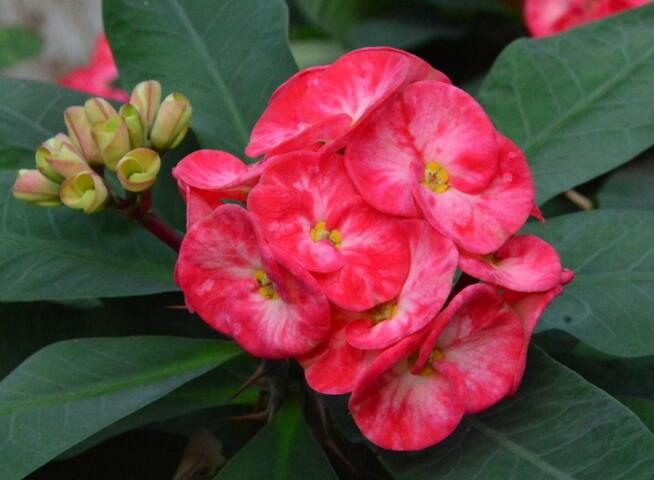
The question of how to care for a small crown of thorns cannot be summed up in a single sentence, because many aspects need attention during growing, such as light and the amount of watering. Below is a detailed explanation of the growing methods and precautions for crown of thorns; interested friends can take a look.
II. Growing methods and precautions for crown of thorns
1. Soil selection
When growing crown of thorns, soil selection is the first step and also one that requires some attention. When choosing soil, it is best to choose sandy soil, as this type of soil has better drainage and allows the crown of thorns to absorb nutrients better.
2. Fertilization requirements
Although fertilizer is one of the main nutrients for crown of thorns, you should still follow the principle of less rather than more. Generally, we can choose to fertilize about once a month, and remember to dilute the fertilizer before applying it, otherwise it cannot be absorbed.
3. Watering requirements
Crown of thorns is a fairly drought-tolerant plant, so when watering it you should follow the principle of watering when dry. Never water too frequently, otherwise root rot easily occurs, so everyone must pay attention to this point.
4. Light requirements
In the process of growing plants, light is indispensable, and crown of thorns is no exception. It is best to grow it in a place with direct sunlight, so that it can carry out photosynthesis better and thus produce beautiful flowers.
5. Pay attention to repotting
After growing crown of thorns for about 2 years, it needs to be repotted. The best season for repotting is generally spring, and during repotting you can also prune some dead branches and rotten leaves of the crown of thorns.
How do you raise pufferfish?
Because in recent years quite a few diners have started eating pufferfish, and Japan is a major country for eating pufferfish, farmers in coastal areas have taken advantage of regional advantages to farm pufferfish, mainly for export to Japan. Regarding how to raise pufferfish, let me give a simple and comprehensive introduction!
How do you raise pufferfish?
Cage farming of pufferfish has the advantages of being mobile, flexible, simple, adaptable to a wide range of waters, and easy to operate.
Farming waters
Choose waters that are sheltered from the wind and face the sun, with a quiet environment, fresh water quality, no pollutants, no obstacles, a broad water surface, and good sunlight conditions as the cage farming waters. Shipping lanes, areas in front of dams, sluice gates, main river channels, and waters with a flow speed exceeding 0.1 m per second are all unsuitable for setting up cages. The bottom of the cage must be more than 0.5 m above the water bottom to prevent the cage from running aground. Waters where cages are set up generally have a year-round water depth of 3-6 m and a dissolved oxygen content above 4 mg per liter.
Cage setup
When pufferfish are about 3 cm in body length, the cage mesh is 6 mesh per square cm; when pufferfish are over 8 cm in body length, the mesh diameter is 1.5 cm. The cage size is 5 m × 8 m × 2.5 m, with the upper opening 30 cm above the water surface. In relatively open water, cages should be arranged in a pinwheel shape, plum-blossom shape or herringbone shape, with a distance of 15-30 m between cages; if limited by water conditions and the cages must be arranged in a straight line, every 2 cages should be grouped together, with a spacing of more than 50 m between groups. The area of feeding cages generally accounts for about 4% of the water surface where they are set up.
Fry stocking
10-15 days before stocking the fry, the cages should be tested for water suitability. The fry are required to have intact body surfaces, be free of disease and injury, be robust, and be uniform in size. Before pufferfish fry enter the cage, first place the oxygen bag containing the fry into the cage to acclimatize for 15 minutes, and release the fry once the water temperature inside the bag is roughly the same as the water temperature in the cage. About 12 fish are stocked per square meter of cage. To prevent excessive growth of algae in the cage, a small number of plant-eating fish should also be stocked together in the cage.
Bait feeding
Feeding should be done at fixed times, fixed locations, with fixed quality, and fixed quantity. An appropriate amount of water peanut and other aquatic plants should be stocked in the cage, with the aquatic plants covering about 20% of the water surface. One week before stocking the pufferfish, first splash soybean milk and scatter soybean residue in the cage to cultivate early bait for the pufferfish. After the pufferfish enter the cage, start feeding a bait mixed from crushed fish meat paste and wheat flour at a ratio of 3:1, with the feeding amount being 10% of the fish body weight. The bait is placed on feeding platforms, fed twice a day at 9 a.m. and 4 p.m.
Daily management
Daily management mainly includes one diligence, two grasps, and three preventions.
One diligence means diligent inspection. Before the cage is put into the water, check whether the netting is damaged; after it is put into the water, check whether the cage body maintains its box shape, and promptly wash the cage. Every day in the morning, noon and evening, check whether the cage is intact. Diligently observe the fish conditions and water conditions.
Two grasps: first, grasp timely cage washing. Cleaning cages usually uses a cage-washing machine to wash off attachments on the netting. Careful operation is required to avoid injuring the fish. Never wash the cage too frequently. Second, grasp timely cage moving. The cage should be moved at the appropriate time according to water conditions and changes in water quality. When the cage position sinks or just before flood season, the cage must be promptly moved to safe waters with a suitable water level.
Three preventions: first, prevent fish diseases. Before stocking the fry, first soak them in 3%-5% salt water for 10 minutes; choose disease-free bait, and before feeding or before storage soak the bait in 3%-5% salt water for about 15 minutes; splash quicklime water once a month. Regularly check the fish bodies, because they like to swim near the cage edges and easily scrape their bodies. Generally, every 10 days scoop up all the fish and soak them in 2%-3% salt water for 15 minutes to prevent parasites and bacteria from attaching, and regularly mix furazolidone and sulfa drugs into the feed. Second, prevent strong winds and floods. Keep timely track of weather conditions and move the cages before strong winds and floods arrive. Third, prevent cage loss. Special personnel should be assigned to guard the cages day and night to prevent loss. At the same time, also prevent rats, otters, water birds and other animals from harming the pufferfish.
Taking fish out of the cage
When the fry reach the size for sorting and transfer to another cage, or reach the standard for growing into commercial fish, they should be taken out of the cage in a timely manner. The method for taking fish out of the cage is: row two work boats to either side of the cage, first lift the bottom net at the two corners of the cage, then insert bamboo poles into the bottom of the net to block it off, slowly drive the fish to one end of the cage, then rest the bamboo poles on the floating frame, with one corner of the floating frame resting on the bow of the boat and tied with rope, untie the cage opening, and use a scoop to reach into the cage and scoop out the fish. Put the fry that meet the conditions for separate rearing into fry cages or adult fish cages, and the small fry left behind are still put back into the original cage for rearing. If the number of small fry left behind is not large, the small fry from several cages can be merged into one cage for rearing.
Morphological characteristics of pufferfish
Pufferfish, commonly known as "he tun", is the collective name for fish of the family Tetraodontidae in the class Osteichthyes. The pufferfish body is cylindrical, has an air sac, and inhales air to swell when in danger, generally with a body length of 25-35 cm! The upper and lower jawbones and teeth are fused into 4 large tooth plates, with 1 dorsal fin and no ventral fins. It has no scales or has small spines. The whole body is oval, with the front part blunt and round and the tail gradually tapering. The snout is short and bluntly round; the mouth is small, terminal, and transversely split. The upper and lower jaws each have 2 plate-like incisors, with a clear median suture. The lips are well developed, and the two ends of the lower lip curve upward on the outer side of the upper lip. The eyes are small, and the gill opening is small, forming an arc-shaped slit located in front of the pectoral fins, with the body surface densely covered in small spines.
The dorsal fin is positioned very far back, opposite the anal fin; there are no ventral fins; the posterior end of the caudal fin is flat and truncated. The back is grayish brown, the sides are slightly yellowish brown, and the belly is white; the markings on the back and sides vary by species. There are many species, most living in the sea, but they can also be found in freshwater and where seawater and freshwater meet. They stir the water and air in the water, making the mud and sand fly up, and then prey on organisms hiding in the sand. Their teeth and jawbones are very hard and can bite through extremely hard shells.
Distribution of pufferfish
Pufferfish resources in our country are extremely rich, with 54 species produced along the China coast, with an annual output of about 3 to 4 million tons, and they can be caught almost year-round along the coast. In the Yangtze River and Pearl River, flood seasons appear between spring and summer, making them one of the main fishery targets in coastal areas and the middle and lower reaches of rivers. In our country, more than 30 species of pufferfish live along the coast from Liaoning to Guangdong, among which the dark-colored obscure puffer enters the middle and lower reaches of water systems such as the Yangtze River and Pearl River.
Living habits of pufferfish
Pufferfish are larger in body shape than dolphins, and they can grow to 3 m long. Unlike dolphins, their heads can rotate 90 degrees, which gives them an advantage in complex river channels. Sometimes they also chase fish schools collectively like dolphins to improve feeding efficiency. Their jaws have sensitive hairs, said to be tactile organs for preying on crustaceans in the mud. They have broad pectoral fins, which improve their flexibility in narrow river channels; relying on their caudal fins, their speed can also reach 23 km/h in a short time.
Overall, the toxicity of farmed pufferfish is still weaker than that of wild ones, so if domestic diners want to eat pufferfish, it is best to choose farmed pufferfish. Farmed pufferfish are also relatively cheaper, easier to prepare, and thus safer to eat.