How to grow potted Mandevilla? Growing methods and precautions, temperature should be moderate
Mandevilla, native to tropical America, is loved by many people in China for its fragrant blooms and brilliant flower colors. However, compared with other plants, Mandevilla is not an easy plant to grow well. You need to understand the growing methods and precautions for Mandevilla to enjoy its fresh, pleasant fragrance. Today we will explain how to grow potted Mandevilla.
How to grow potted Mandevilla
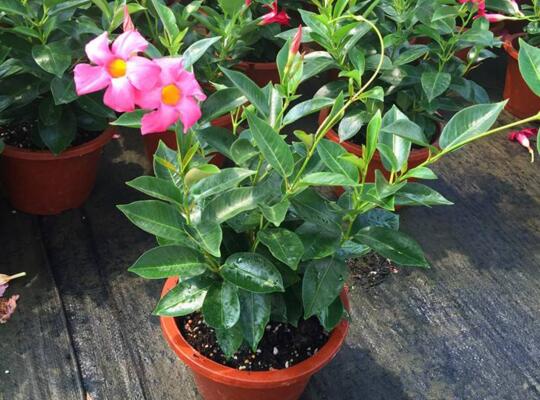
Since Mandevilla has certain requirements for light, water and fertilizer, temperature, soil and so on, in the growing methods and precautions for Mandevilla we will introduce these aspects in detail. In addition, one point to understand is that potted Mandevilla is divided into indoor and outdoor growing, because the light conditions differ between the two. Below we will explain in detail how to grow potted Mandevilla.
1. Light requirements for potted Mandevilla
The most suitable growing environment for Mandevilla is a warm, humid place with plenty of sunlight. Therefore, to let it grow healthily, you must ensure sufficient light. Partial sun or full sun are both acceptable, and it can also be maintained in certain specific shady places.
Precautions: In summer, temperatures are relatively high, so how should potted Mandevilla be grown at this time? The answer is that it needs partial shading. In the afternoon when the sunlight is rather scorching, give it partial shade to avoid leaf scorch caused by too-rapid water evaporation. In other seasons such as spring, autumn and winter, Mandevilla can be exposed directly to sunlight.
2. Water and fertilizer requirements
Mandevilla is not strict about water and fertilizer, but you still need to follow the growing methods and precautions for Mandevilla. Generally, water according to the principle of not watering until dry, and watering thoroughly when you do. A compound fertilizer is fine as the fertilizer choice.
Precautions: When watering, take care not to let the plant become waterlogged or too dry, as this will cause poor growth. The timing of fertilization should be during Mandevilla's growing period, and fertilizing once every half a month or once a month is sufficient.
3. Temperature requirements
The most suitable temperature for Mandevilla growth is 20-30 degrees. The maximum should not exceed 30 degrees, and the minimum should not be lower than 10 degrees. Therefore, in winter you need to pay attention to how to grow potted Mandevilla. Later we will introduce in detail how to grow Mandevilla in winter.
Precautions: To make Mandevilla grow more lush, temperature control is very important. When summer temperatures are too high, you can use shading or ventilation to lower the ambient temperature appropriately, while in winter it is exactly the opposite.
4. Soil requirements
Mandevilla is very adaptable. Therefore, in the growing methods and precautions for Mandevilla, its requirements for soil are not high; any normal soil is suitable for Mandevilla growth.
Precautions: Although there are no special requirements for soil, it is best if you can use a well-drained sandy soil containing humus, because this kind of soil will be more favorable for Mandevilla growth.
Summary: This article has introduced in detail the growing methods and precautions for Mandevilla. Generally speaking, we need to pay attention to the care of Mandevilla in summer and winter, because in summer the temperature is high and the light is strong, so the potting soil is relatively prone to drying out completely. Therefore, you need to observe promptly and take reasonable countermeasures.
Tree Peony Paeonia suffruticosa Tree Peony illustrated guide: how to grow tree peony / how to propagate tree peony
Tree Peony profileTree Peony Paeonia suffruticosa
Growing methods and precautions for tree peony Introduction to tree peony
Tree peony is native to the mountainous areas around the Qinling Mountains and Daba Mountains in western China. It is a perennial deciduous small shrub that grows slowly and has a small plant form. Tree peony is a precious woody flowering plant unique to China and is China's national flower, with thousands of years of natural growth and more than two thousand years of artificial cultivation history. Tree peony has long been known by the laudatory titles "national beauty and heavenly fragrance" and "king of flowers."
Among cultivated types, it can be divided into over a hundred varieties mainly according to flower color. "Tree peony has many varieties and also many colors. Yellow, green, flesh red, deep red and silver red are considered superior, with yellow and green especially precious. Tree peony flowers are large and fragrant, hence the title 'national beauty and heavenly fragrance.'"
In the Tang Dynasty, Liu Yuxi described the tree peonies of the capital Chang'an: "The herbaceous peony in the courtyard is bewitching but lacks dignity; the lotus on the pond is pure but short on feeling. Only the tree peony is truly of national beauty; when it blooms, the whole capital is stirred." In the late Qing Dynasty, the tree peony was once regarded as China's national flower. In May 1985, the tree peony was rated second among China's top ten famous flowers. It is a precious woody flowering plant unique to China, with thousands of years of natural growth and more than 1500 years of artificial cultivation history. It is widely cultivated in China and was long ago introduced around the world. The tree peony flower is hailed as the king of flowers, and there are abundant cultural and painting works about it.
Overview of the morphological characteristics of tree peony
Deciduous shrub. Stems up to 2 m tall; branches short and thick. Leaves usually bipinnately compound with three leaflets per division, occasionally the leaves near the branch tip with 3 leaflets; terminal leaflets broadly ovate, 7-8 cm long, 5.5-7 cm wide, 3-lobed to the middle, the lobes unlobed or 2-3 shallowly lobed, surface green, hairless, abaxial surface pale green, sometimes with white powder, sparsely short pubescent or nearly hairless along the veins, petiolules 1.2-3 cm long; lateral leaflets narrowly ovate or oblong-ovate, 4.5-6.5 cm long, 2.5-4 cm wide, unequally 2-lobed to 3-shallowly lobed or unlobed, nearly sessile; petioles 5-11 cm long, hairless along with the rachis. Flowers solitary at the branch tips, 10-17 cm in diameter; pedicels 4-6 cm long; bracts 5, oblong, of unequal size; sepals 5, green, broadly ovate, of unequal size; petals 5, or double, rose-colored, purplish red, pink to white, usually highly variable, obovate, 5-8 cm long, 4.2-6 cm wide, apex irregularly wavy; stamens 1-1.7 cm long, filaments purplish red, pink, upper part white, about 1.3 cm long, anthers oblong, 4 mm long; disc leathery, cup-shaped, purplish red, apex with several sharp teeth or lobes, completely enclosing the carpels, dehiscing when the carpels mature; carpels 5, rarely more, densely pubescent. Follicles oblong, densely covered with yellow-brown stiff hairs.
Plant form
Because tree peony varieties differ, tree peony plants may be tall or short, clustered or single-stemmed, straight or slanting, gathered or spreading, each with its own differences. Generally speaking, according to their shape they are divided into five types:
Upright type: branches upright and tall, compactly distributed, with a small spreading angle; the angle between branches and the vertical line is mostly within 30 degrees. Internodes are relatively long; annual growth of new branches is 10-15 cm; generally a five-year-old plant is 40-50 cm tall, and taller ones reach more than 1 m. Examples include 'Shouan Hong', 'Zi Er Qiao', 'Yao Huang' and others.
Spreading type: branches mostly spreading and curving outward in all directions, with plant width greater than plant height, forming a low, spreading plant shape; when branches spread, the angle with the vertical line is mostly above 45 degrees, and new branches are long and relatively soft. Examples include 'Zhao Fen', 'Shou Zhong Hong', 'Shan Hua Lan Man', 'Qing Long Wo Mo Chi' and others.
Open type: branches grow robustly and upright, slanting outward in all directions, with the angle between the previous two types; the plant shape is full and upright, with moderate height; annual growth of new branches is 6-8 cm; generally a five-year-old plant is 30-40 cm tall. Examples include 'Zhuang Yuan Hong', 'Yin Hong Qiao Dui', 'Jin Yu Jiao Zhang' and others.
Dwarf type: branches grow slowly, internodes are short and leaves dense, branches are compact and short; annual new branch growth is 2-4 cm; generally a five-year-old plant is about 15 cm tall. Representative examples include 'Mei Ren Hong', 'Luo Han Hong', 'Hai Yun Zi' and others.
Single-trunk type: mostly artificially cultivated artistic forms, with an obvious main trunk, the trunk height varying, generally 20-80 cm. The upper part of the trunk divides into several branches forming a crown (some have no crown), with an antique form much like a bonsai, growing relatively slowly; generally it takes more than 8 years to take shape. Examples include 'Shi Ba Hao' and others.
Roots
Tree peony has a well-developed root system, with many deep-rooted fleshy main roots and lateral roots. Newly born roots are initially white, gradually turning yellow to brown; the fleshy part is white, occasionally red, and the center of the fleshy part becomes lignified, commonly called the "wooden core." The fleshy part stores a large amount of nutrients and water for plant growth. Generally speaking, plants with deep roots have luxuriant branches and leaves and are taller, while shallow roots mean short branches and a short plant form. Because tree peony varieties differ, their root types and quantities also differ, but they can broadly be divided into three categories:
Taproot type: this type has deep roots (the roots of a four-year-old tree peony can enter the soil more than 80 cm), but the roots are sparse, with no obvious main root, only a few dozen evenly thick "noodle roots," smooth with white skin, and very few small roots branching from the roots; the roots (called "dan pi" after processing) have high yield and good quality. Examples include 'Feng Dan', 'Zhao Fen', 'Er Qiao', 'Mo Kui' and others. These tree peonies are mostly dual-purpose varieties for medicinal and ornamental use.
Slope-root type: this type has roots of varying thickness and length, with many lateral roots branching and growing crosswise, commonly called "chicken-claw roots," most entering the soil relatively shallowly and at a large slant angle. Varieties include 'Qing Shan Guan Xue', 'Bai Yu', 'Huang Hua Kui' and others. The quality and yield of dan pi from these tree peonies are lower than those of the taproot type, and they are not suitable for medicinal cultivation.
Intermediate type: this type has moderately sparse roots, with no obvious main root, producing many "noodle roots" of even thickness and smooth root skin, with an average soil depth of 70-80 cm, such as 'Zhong Sheng Hei', 'Yao Huang' and others, which can be used both ornamentally and medicinally.
Petioles
Tree peony petioles also differ in thickness, hardness and length; the longest can reach 40 cm, while the shortest is no more than 10 cm; the concave parts of the petioles are mostly dark purple, purplish red, gray-brown, yellow-green and other different colors. The length of the petiole, especially the size of the angle between the petiole and the branch, varies greatly among varieties and also greatly affects the ornamental value of the flower. When the angle between petiole and branch is large, the leaf surface is flat or drooping, and the leaves are relatively sparse; for example, in 'Mo Kui', the flowers all sit above the leaf cluster, forming a beauty of flowers and elegant leaves that complement each other. Conversely, when the petiole is shorter and the angle between petiole and branch is smaller, because the branches and leaves are dense, the flowers are often hidden in the leaf cluster, causing the phenomenon of "flowers hidden in leaves," greatly reducing ornamental value.
Buds
Tree peony buds are enclosed by 6-8 scales, so tree peony buds are also called "scaly buds." Tree peony overwinters by means of scaly buds. According to function and degree of differentiation, tree peony buds are divided into four kinds: flower buds, leaf buds, latent buds and adventitious buds.
Flower buds: tree peony flower buds are mixed buds that can send out branches, grow leaves and bloom. Those borne at the tips of branches are called "terminal flower buds"; on a branch that has flowered once, the flower stem dries up and retracts a section by itself. Flower buds borne in the leaf axils below the dried flower stem are called "axillary flower buds" or "lateral flower buds." Flower buds are generally relatively plump and full; after peeling off the scales, the "flower embryo" (that is, the young small flower bud inside the scaly bud) can be seen.
Leaf buds: leaf buds only send out branches and grow leaves. Most are borne in the leaf axils below the flower buds, and some are borne at the tips of branches. They are thinner and smaller than flower buds and develop into branches after sprouting.
Latent buds: latent buds are borne at the lowest part of new branches, shrunken and small in shape, like millet grains, commonly called "dog turtles." They normally do not sprout, and can only sprout after flower buds, leaf buds or branches are injured. Their lifespan is relatively long, able to last 10-15 years.
Adventitious buds: buds borne at the rhizome are called "adventitious buds." After emerging from the soil they grow into sprout tillers, commonly called "soil buds." Adventitious buds have especially strong sprouting ability and are the main source of scions, renewed old branches (stocks) and additional new stocks. Adventitious buds do not bloom in the same year; in vigorous ones, flower buds can develop and differentiate at the top in the same year and bloom the following year.
Tree peony buds differ among varieties in shape, color and other aspects, with countless forms and each with its own characteristics. Broadly there are conical, pearl-shaped, oblate, long conical, hawk-beak-shaped and others; among the shapes there are also differences in size, number of scales, and whether the bud quality is shrunken or plump, hollow or solid; colors also include blue-green, yellow-green, earth red, earth yellow, silver gray, brown and varying degrees of purplish red; in addition there are flower colors and mixed colors, which are the main basis for distinguishing varieties in autumn. Therefore, it is very difficult to identify tree peony varieties solely by bud shape, color and so on; only through long-term patient and detailed observation can one master the characteristics of each variety's scaly buds.
Branching
Because the internode length on the current-year effective branches differs, the number of buds borne and the sprouting strength of new branches also differ, and the branching habits also show obvious differences. But branches have the following types:
Single-branch type: current-year new branches have long internodes and bear relatively few buds, with buds only on the 1-2 basal nodes or on the 1st-3rd nodes, and among these new buds only one sprouts in the same year to become a current-year new branch. This type generally has tall plants and sparse branches, such as 'Yao Huang' and others.
Dense-branch type: current-year new branches have short internodes and bear relatively many new buds, generally 3-5, and the new buds have strong branching ability; each new bud can send out a short branch in the same year, and the branches are many, relatively dense and clustered. Plants of this type are generally relatively short with dense branching. Examples include 'Ying Luo Bao Zhu', 'Dan Lu Hong', 'Zhi Hong' and others.
Leaves
Tree peony leaves are alternate and composed of leaf blades and petioles. Leaf shape, size, color, texture and so on vary by variety and can be divided into the following categories:
Large round-leaf type: the whole leaf is large and round, more than 40 cm long and more than 25 cm wide; leaflets broad and large, round and blunt and thick, broadly ovate or ovate; lateral leaflets lack marginal notches; leaf surface mostly flat. Examples include 'Wang Hong', 'Da Hu Hong', 'Mo Kui', 'Shouan Hong' and others.
Large long-leaf type: the whole leaf is the same size as the previous, but the leaflets are relatively narrow and long, oblong, relatively thin in texture, with few and pointed marginal notches, and the leaves are relatively sparse and flat or drooping, such as 'Yin Fen Jin Lin', 'Bing Ling Zhao Hong Shi' and others.
Small round-leaf type: the whole leaf is relatively small, about 20-30 cm long; leaflets short and thick, with few and round blunt marginal notches. Examples include 'Ge Jin Zi', 'Lan Tian Yu', 'Mei Ren Hong' and others.
Small long-leaf type: the whole leaf is the same size as above, but the leaflets are relatively narrow, with pointed and upward-curling marginal notches. Examples include 'Zhi Hong', 'Yan Long Zi' and others.
Medium-leaf type: the whole leaf is medium-sized, about 30-40 cm long; leaflets oblong, with many relatively pointed and upward-curling marginal notches, and leaves mostly slanting. Examples include 'Jia Ge Jin Zi', 'Zhuang Yuan Hong', 'Da Zong Zi' and others.
In addition, there are special leaf shapes. For example, 'San Qi Ji Sheng' has only three irregular round leaflets on each petiole, two-thirds fewer than ordinary varieties, and is a bipinnate compound leaf with one emergence; another example is 'Rou Fu Rong' and 'Da Zong Zi', each petiole bearing three groups of leaflets, divided into five at the top and six behind, for a total of eleven leaflets, two more than ordinary varieties.
The colors of tree peony leaves are mainly green and yellow-green; individual varieties have purple halos of varying depth on the leaves; some leaf surfaces are also dotted with purple or yellow spots; the abaxial leaf surface is mostly gray-green and light gray, and individual varieties (such as 'He Bai') have especially abundant fine hairs.
Petals
Tree peony flowers are large and brilliantly colored, with many varieties. Some varieties have complete floral organs, with sepals, stamens and pistils developing normally, such as 'Si He Lian', 'Feng Dan Bai' and others; but some varieties have stamens and pistils transformed into petals or degenerated, forming varied and beautiful flower forms and colorful blossoms.
According to the number of petal layers, flowers are traditionally divided into: single-petal (layer) type, double-petal (layer) type and thousand-petal (layer) type. Within these three major categories, according to the morphological characteristics of the flower they are further divided into six flower forms: sunflower type, lotus type, rose type, hemisphere type, crown type and hydrangea type (traditionally the crown type and hydrangea type are called "raised towers"). This classification method relatively intuitively reflects the various changing forms of the flowers.
Relevant tree peony experts and scholars, together with scientific researchers from production areas, combined traditional classification methods with many years of field observation and research and anatomical observation of tree peony flowers. After clarifying the evolution rules of flower form and flower structure, they proposed a new flower-form classification, namely dividing tree peony flower forms into single-petal type, lotus type, chrysanthemum type, rose type, thousand-layer terrace type, osmanthus type, golden-ring type, crown type, hydrangea type and tower terrace type.
Single-petal type: petals in 2-3 whorls, 10-15 pieces, broad and flat, stamens 200-300, pistils 4-6, stamens and pistils developing normally, with strong seed-setting ability. Representative varieties of this flower type include 'Ya Pian Zi', 'Shi Liu Hong', 'Feng Dan Bai' and others.
Lotus type: petals in 4-5 whorls, 20-25 pieces, petals broad and large, similar in shape and size, clearly arranged, pistils developing normally, with strong seed-setting ability, but individual varieties occasionally show transformation of stamens or pistil stigmas into petals. Representative varieties of this flower type include 'Si He Lian', 'Jin Yun Hong', 'Yu Ban Bai' and others.
Crown type: outer petals in 2-5 whorls, broad and flat; most or all stamens are transformed into finely broken, curled and wrinkled petals, and the petal cluster is dense and towering, shaped like a crown. Inner petals are irregularly arranged, often mixed among the petals with normal stamens or degenerating stamens, and anthers often remain among the petals; pistils degenerate or transform into petals, and occasionally set seed. Representative varieties of this flower type include 'Lan Tian Yu', 'Hu Hong', 'Yao Huang', 'Shouan Hong' and others.
Hydrangea type: stamens fully transformed into petals, inner and outer petals similar in shape and size, crowded and raised, spherical; pistils basically or entirely degenerated or transformed into petals, with no seed-setting ability. Representative varieties of this flower type include 'Dou Lu', 'Lu Xiang Qiu', 'Xue Ying Zhao Xia' and others.
Chrysanthemum type: petals in more than 6 whorls, petal shapes similar, neatly arranged, with distinct layers, gradually becoming smaller from outside inward, and occasionally transformed into petals; pistils 5-11, growing normally or degenerated and smaller. In some varieties the stigmas show transformation into petals, and seed-setting ability is relatively poor. Representative varieties of this flower type include 'Mei Gui Hong', 'Cong Zhong Xiao', 'Yin Hong Qiao Dui', 'Jin Pao Hong' and others.
Rose type: petals in many whorls, gradually becoming smaller from outside inward; some stamens are transformed into normal petals, and pistils degenerate and become smaller or transform into petals, with poor seed-setting ability. Representative varieties of this flower type include 'Zi Er Qiao', 'Wu Jin Yao Hui', 'Hong Xia Zheng Hui' and others.
Golden-ring type: outer petals in 2-3 whorls, broad and flat; in the center of the flower some stamens are transformed into narrow, long, upright large petals, and between the central petals and the outer whorl petals there is a ring of normal stamens forming a golden ring; pistils normal or slightly transformed into petals, with poor seed-setting ability. This flower type is extremely rare, represented by varieties such as 'Bai Tian E', 'Jun Yan Hong', 'Fen Mian Tao Hua', 'Yu Mei Ren'.
Osmanthus type: outer petals in 2-5 whorls, broad and neat; some stamens are transformed into slender petals, with anthers or anther traces often remaining at the petal tips, and normal stamens mixed among the petals, irregularly arranged and sparse; pistils normal or slightly transformed into petals, with seed-setting ability. Representative varieties of this flower type include 'Shu Nü Zhuang', 'Jiao Hong', 'Xian E', 'San Bian Sai Yu' and others.
Tower terrace type: the lower flower's stamens are relatively fully transformed into petals, similar in shape to normal petals, and the pistils are transformed into normal petals or colored petals; the upper flower's petals are slightly larger and fewer in number, and the stamens are basically all transformed into petals or degenerated; the pistils are transformed into normal petals or colored petals, and in some varieties they degenerate and disappear. Representative varieties of this flower type include 'Chi Long Huan Cai', 'Sheng Dan Lu', 'Yu Lou Dian Cui', 'Zi Chong Lou' and others.
Thousand-layer terrace type: the lower petals are in more than 4 whorls, neatly arranged, similar in shape, with no stamens or degenerated stamens mixed among the petals. Stamens normal but few in number, or occasionally transformed into petals; pistils degenerated and smaller or transformed into petals; the upper petals are few in number, flat or upright, stamens few and smaller, pistils degenerated and smaller or transformed into petals. Representative varieties of this flower type include 'Ling Hua Zhan Lu', 'Zhi Hong', 'Shou Xing Hong' and others.
Fruit and seeds
Single-petal flowers bear five-angled follicles, each fruit angle setting 7-13 seeds, the seeds roundish. The outer fruit skin is initially green and hairy, becoming crab-yellow when mature; the seeds are yellow-green, and when overripe the fruit angles split open and the seeds become black-brown; each kilogram may contain 2400-3000 dried seeds. Double-petal flowers generally set 1-5 angles, but only some of the seeds are filled, or none are filled at all; thousand-petal types set no fruit or seeds.
Differences between tree peony and herbaceous peony:
The most fundamental difference: tree peony is a woody plant that can grow up to 2 m tall, while herbaceous peony is a (perennial tuberous-root) herbaceous plant no taller than 1 m.
Tree peony blooms earlier than herbaceous peony. Tree peony generally blooms in mid-to-late April, while herbaceous peony blooms in early-to-mid May. The difference in flowering period between the two is about 15 days.
Tree peony leaves are broad, with the upper surface green and slightly yellowish, while herbaceous peony leaves are narrow, with both surfaces dark green.
Tree peony flowers are borne at the tips of flowering branches, mostly solitary, with flower diameter generally about 20 cm; while herbaceous peony flowers are mostly clustered at the branch tips, with flower diameter about 15 cm.
Tree peony is called the king of flowers. Herbaceous peony is called the minister of flowers.
Tree peony leaves tend to be gray-green, while herbaceous peony leaves are more glossy.
Tree peony has richer flower colors than herbaceous peony.
Ecological habits of tree peony
Tree peony prefers a warm, cool, dry, sunny environment. It likes sunlight and also tolerates partial shade; it is cold-tolerant, drought-tolerant and tolerant of mild alkalinity; it dislikes waterlogging and fears heat and direct scorching sun. It is suitable for growing in loose, deep, fertile, high and dry, well-drained neutral sandy loam. It grows poorly in acidic or heavy clay soil.
Abundant sunlight is relatively favorable for tree peony growth, but it does not tolerate summer scorching sun; when the temperature is above 25°C the plant will enter a dormant state. The suitable temperature for flowering is 17-20°C, but before flowering it must undergo low-temperature treatment at 1-10°C for 2-3 months. It can withstand low temperatures down to -30°C, but in cold northern regions appropriate cold protection measures are needed in winter to avoid freeze damage. The hot, humid weather of the south is extremely unfavorable for tree peony growth. Therefore, cultivating tree peony in the south requires giving it specific environmental conditions before one can admire its wondrously beautiful flowers.
Cultivation techniques for tree peony
Tree peony has fleshy roots, prefers dryness and avoids dampness, likes high, open, sunny places, and also benefits from unilateral (side) shade. In view of these growth characteristics of tree peony, pay attention to the following issues when planting:
When planting tree peony, adapt to local conditions. The planting site should be chosen in a high, dry, sunny place; in shady places the plant grows thin and weak and cannot bloom. It grows best with side shade. The soil should be chosen as loose, fertile, deep and well-drained sandy loam or loam, with a soil pH value preferably neutral; slightly acidic or slightly alkaline is also acceptable.
For ornamental tree peony planting, pay attention to the combination of varieties, flower colors and flowering periods. Before planting, appropriately prune the roots, cutting off diseased roots and broken roots, then soak half the roots in 0.1% copper sulfate solution or 5% lime water for half an hour to disinfect, then take them out, rinse with clean water and plant. The planting depth should preferably have the junction of root and stem level with the soil surface. The planting time is preferably from mid-September to mid-to-late October. Northern regions may plant a little earlier, and southern regions a little later. With suitable planting time, the wounds heal easily after planting and roots form easily, which is beneficial to growth and flowering in the following years.
1. Planting
Choose a sunny place that does not accumulate water, preferably a sunny slope, with fertile soil and well-drained sandy loam. Before planting, deeply plow the land. The planting hole should be appropriately large. When the tree peony roots are placed in the hole they should spread vertically and not be curled. Do not plant too deeply; it is best to just bury the roots. Generally, container growing is relatively uncommon.
2. Light and temperature
Abundant sunlight is relatively favorable for its growth, but it does not tolerate summer scorching sun; when the temperature is above 25°C the plant will enter a dormant state. The suitable temperature for flowering is 17-20°C, but before flowering it must undergo low-temperature treatment at 1-10°C for 2-3 months. It can withstand low temperatures down to -30°C, but in cold northern regions appropriate cold protection measures are needed in winter to avoid freeze damage. The hot, humid weather of the south is extremely unfavorable for tree peony growth. Therefore, cultivating tree peony in the south requires giving it specific environmental conditions before one can admire its wondrously beautiful flowers.
3. Watering and fertilizing
Before planting, water thoroughly twice. Before winter, irrigate once to ensure it overwinters safely. After spring begins, supply water according to the dry or wet condition of the soil, but do not water excessively. Generally fertilize 3 times a year: the 1st is pre-flowering fertilizer, applying a quick-acting fertilizer to promote large, good blooms. The 2nd is post-flowering fertilizer, applying an organic liquid fertilizer once. The 3rd is autumn-winter fertilizer, mainly base fertilizer, to promote growth the following spring. In addition, pay attention to cultivating and weeding; when there are no weeds, shallow cultivation to loosen the soil is fine.
4. Shaping and pruning
After flowers fade, promptly remove flowers and prune branches. Cut according to the tree's natural growth vigor combined with the tree shape you desire, and at the same time apply a wound-healing antiseptic film to the pruning cuts to protect the wounds and prevent pathogen invasion and infection. If you want a low plant with dense flower clusters, then shorten more heavily to inhibit branch expansion and root-sucker formation; generally it is suitable to retain 5-6 branches per plant.
5. Flowering period control
Potted tree peony can bloom at Spring Festival through winter forcing treatment. The method is to select robust tree peony varieties with plump scaly buds 60 days before Spring Festival (such as Zhao Fen, Luoyang Hong, Sheng Dan Lu, Ge Jin Zi, Zhu Sha Lei, Da Zi Hu Hong, Mo Kui, Wu Long Peng Sheng and others), lift them with soil, injuring the roots as little as possible, air-dry them in a cool place for 12-13 days, then pot them, and carry out shaping and pruning, leaving 10 branches with plump terminal buds per plant, keeping the terminal buds and removing the rest. When potting, the pot size should match the plant to achieve a satisfactory plant shape. After watering thoroughly, manage normally. 50-60 days before Spring Festival, move them into a greenhouse at about 10°C and spray water 2-3 times a day, keeping the potting soil moist. When the scaly buds swell, gradually raise the temperature to 25-30°C, with night temperature not lower than 15°C; in this way flowers can be seen at Spring Festival.
Growing methods for tree peony
Commonly propagated by division and grafting, and also by sowing and cuttings. The suitable time for transplanting is late September to early October; do not do it too early or too late. It likes fertilizer, and should be fertilized at least three times a year, namely "flower fertilizer," "bud fertilizer" and "winter fertilizer." After 2-3 years of cultivation, pruning and shaping should be carried out. For varieties with vigorous growth and strong branching ability, only cut off thin and weak branches, retaining all strong branches, and promptly remove basal sprouts to maintain a beautiful plant shape. Bud removal is also an extremely important task. To make the plant bloom profusely and brilliantly and keep the plant robust, control the number of flowers according to the plant's age. In the early bud stage, select and retain a certain number of well-developed flower buds and remove excess and weak buds as early as possible. Generally, for a 5-6 year old plant, retain 3-5 flower buds. For newly planted plants, all flower buds should be removed in the following spring, not allowing them to bloom, so as to concentrate nutrients and promote plant development.
Tree peony is a deep-rooted deciduous shrub flower. It likes sunlight, is cold-tolerant, loves a cool environment and avoids high temperature and stuffiness, and is suitable for growing in semi-dry, semi-moist, loose, fertile, well-drained sandy soil. Therefore, the potting soil for generally cultivated tree peony should use a mixture of sandy soil and cake fertilizer, or a culture soil thoroughly mixed with fully rotted barnyard manure, garden soil and coarse sand in a 1:1:1 ratio. If there is too much water in the cultivation soil, its fleshy roots easily rot. Therefore, during continuous rainy weather, drain promptly and never let water accumulate at the roots. Tree peony does not tolerate high temperatures; when the weather is hot in summer, take cooling measures promptly. It is best to set up a shade shed to shade it. Cover with grass curtains or reeds before noon and remove them in the evening. If this measure is done promptly, leaf drop can be prevented; if it is allowed to suffer heat and drop leaves, later flowering will be seriously affected. Because tree peony has relatively long fibrous roots and a relatively large plant, it is suitable for ground planting. If you want to grow it in a pot, choose a large, well-permeable clay pot, with a pot depth of more than 30 cm. It is best to use a clay jar 60-70 cm deep. Tree peony can be propagated by sowing, division and grafting.
Tree peony disease control Leaf spot disease
Leaf spot disease: also called red spot disease. This disease is caused by a fungus of the genus Pestalotiopsis. The pathogen mainly infects leaves and also infects new branches. The initial onset is generally about 15 days after flowering, and from mid-July, as temperatures rise, it becomes increasingly severe. In the early stage there are brown spots the size of grains of rice on the abaxial leaf surface, with slightly darker edges, forming irregular concentric ring-patterned blighted spots that are dense outside and pale in the middle, merging with each other until the leaves scorch and fall. When petioles are affected, a dark green downy layer is produced; when stems and petioles are infected, raised lesions are produced; the pathogen overwinters in the stems and leaves of diseased plants and in the soil.
Control methods:
Around early November (Start of Winter), sweep the dead leaves in the field clean and burn them in a centralized way to eliminate the pathogen;
Before onset (May), spray 1:1:160 Bordeaux mixture once every 10-15 days until the end of July;
In the early stage of disease, spray 500-800 times thiophanate-methyl or carbendazim once every 7-10 days, for 3-4 consecutive times.
Purple root rot
It is a fungal disease. It is spread by soil. It occurs at the root collar and roots, and is more commonly seen at the root collar. The affected area has purple or white cottony mycelium, initially yellow-brown, later black-brown, commonly called "black lump head." In mild cases, dotted and patchy spots form, no new roots grow, branches wither and thin, leaves yellow, and scaly buds shrink; in severe cases, the entire root collar and root system rot and the plant dies. This disease mostly occurs in the high-temperature, rainy season from June to August. After September, as temperatures drop and rainfall decreases, the lesions stop spreading.
Control methods:
Choose high, dry plots with good drainage for planting;
Cultivate the soil promptly during the rainy season to reduce soil moisture;
Rotate crops once every 4-5 years;
Breed disease-resistant varieties;
When planting separately, apply 500 times quintozene solution to the affected area before planting, or pour 5% amobam 1000 times solution on the roots; ⑥ disinfect around affected diseased plants with lime or sulfur.
Sclerotinia disease
Also known as stem rot. The pathogen is Sclerotinia sclerotiorum. When the disease occurs, water-soaked spots appear on the stem near the ground, gradually expanding and rotting, with white cotton-like growth appearing. It may also infect leaves and flower buds.
Control methods: choose well-drained, high, dry plots for planting; promptly dig out and remove diseased plants and disinfect the soil; rotate crops once every 4-5 years.
Also commonly seen are anthracnose and rust. Anthracnose produces circular or irregular light brown sunken lesions on the leaf surface, with purplish-brown margins after expansion; rust produces yellow spore masses on the underside of leaves, causing chlorosis, and in the later stage columnar hair-like structures form on diseased leaves. Control methods are the same as for leaf spot.
Yellow leaf disease
Diagnosis and treatment of yellow leaf disease in tree peony? When tree peony is deficient in phosphorus, the plant grows slowly and is short and stunted, thin and weak, with small leaves that drop easily, and the color is generally dark green or grayish-green, lacking luster. It starts from the old leaves at the base of the stem and gradually spreads upward.
Deficiency of trace elements such as magnesium, manganese, boron and copper can also cause yellowing, necrosis, leaf tip scorch and other symptoms on leaves, so potassium dihydrogen phosphate and micronutrient fertilizers should be sprayed after the flowering period in combination with pesticide application to supplement nutrition. When tree peony develops pathological changes, the leaves may also show mottling of uneven color depth, alternating yellow and green, namely "mosaic". This is the most common symptom of viral disease and needs to be distinguished.
Tree peony cultivation sites are mostly fields with many years of continuous cropping or successive cropping, where there are many pathogens, especially the fungus Fusarium, which causes rot of the roots and stem base of tree peony, thereby weakening water and nutrient uptake, causing the lower leaves to gradually turn yellow, drop or scorch upward, while the new shoot tips and new leaves of the tree peony still remain normal in color. This is the yellow leaf symptom shown by root rot in tree peony during drought.
Cultivar classification of tree peony
China is the birthplace of the world's tree peony and the world's kingdom of tree peonies. According to differences in cultivation regions and wild ancestral species, Chinese tree peony horticultural cultivars can be divided into 4 cultivar groups, namely the Central Plains cultivar group, the Northwest cultivar group, the Jiangnan cultivar group and the Southwest cultivar group.
I. Central Plains tree peony cultivar group
1. Historical evolution
The Central Plains cultivar group has the longest cultivation history. The main cultivation center of Chinese tree peony has always been located in the Central Plains (middle and lower reaches of the Yellow River) region. This became the main line in the formation of the Chinese tree peony horticultural cultivar system. The Central Plains is the birthplace of Chinese tree peony horticultural cultivars.
2. Cultivation distribution
Mainly distributed in the middle and lower reaches of the Yellow River, including Henan, Shandong, Hebei, Shanxi and other provinces. The distribution center is in Heze, Shandong, Luoyang, Henan, and Beijing. In fact, the cultivation distribution of Central Plains tree peony cultivars extends southward to Shanghai and Hangzhou; eastward to Qingdao and Yantai; westward to Lanzhou, Gansu; and northward to areas south of the Great Wall, where they can all flower normally. Now, with cold protection for overwintering, they can also be cultivated in the open field and flower normally in Harbin, Daqing, Mudanjiang, Shangzhi in Heilongjiang and as far as Xining, Qinghai; with a little cold protection they can overwinter safely. It can be seen that the Central Plains cultivar group has very strong environmental adaptability. Abroad, it has already been introduced and planted in Japan, the Netherlands, the United Kingdom, France, Germany, the United States, Australia, Italy, Singapore and other countries.
3. Wild ancestral species
The main wild ancestral species is Paeomia spontanea, such as Paeonia rockii (P.rockii); in recent years, Paeonia ostii (P.ostii) has also participated in the formation of Central Plains tree peony cultivars.
4. Main characteristics
(1) Plants of this cultivar group vary in height; under normal circumstances, they are shorter than those of other cultivar groups. However, a small number of cultivars with Paeonia ostii ancestry have taller plant types. This cultivar group has relatively varied leaf shapes.
(2) Some cultivars in this group have dark spots or dark halos at the base of the petals, indicating blood relationship with Paeonia rockii. Among the 3 wild ancestral species forming the Central Plains cultivar group, only Paeonia rockii has a large ink-purple patch at the base of the petals, while Paeonia spontanea and Paeonia ostii have only a slight light purple halo at the base of the petals.
(3) The most complete range of flower types.
(4) Rich and varied flower colors. There are white, pink, red, purple, ink purple, green, pale yellow, snow blue and other colors and bicolors, with rich variation in color intensity, the most abundant flower colors among the 4 cultivar groups.
(5) There are as many as more than 500 cultivars, the largest number among the 4 cultivar groups.
II. Northwest tree peony cultivar group
1. Historical evolution
The ornamental cultivation of Northwest tree peony began approximately in the Tang Dynasty. Tree peony cultivation already existed in the Tianshui area of Gansu. During the Ming and Qing dynasties, cultivation of Northwest tree peony flourished increasingly. For example, the cultivation center Linfu was then known as "Little Luoyang".
2. Cultivation distribution
Distributed in Tianshui, Gangu, Wushan, Longxi and Jingning in the middle and upper reaches of the Wei River in Gansu; Xiahe, Linxia and Hezheng in the middle and lower reaches of the Daxia River; Lintao and Kangle in the lower reaches of the Tao River, as well as Lanzhou, Yuzhong and other places; Pingliang in eastern Gansu also has considerable cultivation. In addition, it is also distributed in Xining, Qinghai and areas to its east, Xi'an, Shaanxi and areas to its west, and the Guyuan area of Ningxia. The cultivation centers are Lanzhou, Linxia, Lintao and other places.
3. Wild ancestral species
The wild distribution areas of Paeonia rockii and Paeonia spontanea are mainly in the Loess Plateau and the Yellow River basin. From the main trait expression of Northwest tree peony cultivars, it can be proved that the main wild ancestral species of the Northwest tree peony cultivar group is Paeonia rockii, but it also carries the bloodline of Paeonia spontanea.
4. Main characteristics
(1) Plants are tall and large. Annual growth is relatively large, leaf shape variation is relatively small, and the total petiole is long.
(2) The base of the petals has a large ink-purple or purplish-red patch. Petals are thick and the floral fragrance is rich.
(3) The degree of flower type evolution is lower than that of the Central Plains cultivar group. The number of terrace-flowered cultivars is relatively small.
(4) The number of cultivars is relatively large. There are about more than 100 cultivars. The flowering period is long.
(5) Cold-resistant, drought-resistant, alkali-resistant, vigorous in growth, with few pests and diseases, and can be planted in the vast cold and arid Northwest region.
III. Jiangnan tree peony cultivar group
1. Historical evolution
Since the Song Dynasty there have already been dozens of cultivars with excellent traits. The shifts of its cultivation centers through the dynasties are as follows: Hangzhou (Song Dynasty) -> Jiyang (Ming Dynasty, present-day Jiangyin, Jiangsu; one theory says Zhuji, Zhejiang) -> Tongling, Ningguo, Hangzhou, Shanghai (Qing Dynasty) -> Tongling, Ningguo, Hangzhou, Shanghai (present).
2. Cultivation distribution
Distributed in Anhui, Jiangsu, Zhejiang and other provinces. Tongling, Ningguo, Hangzhou, Shanghai and other places are cultivation centers. The main cultivation sites include Yancheng (Jiangsu), Lechang (Guangdong), Nanchang (Jiangxi) and others.
3. Wild ancestral species
The main ancestral species is Paeonia ostii.
4. Main characteristics
(1) Plants are tall and large. Annual branches are long, with few soil buds, strong branching ability, and many flowers, presenting a magnificent sight.
(2) Early flowering; the local flowering period is from early to late April.
(3) Historically there were numerous cultivars. For example, Ji Nan's "Peony Manual" (1890) collected 103 cultivars, and the tree peonies around Jiaxing were renowned for a time.
(4) The root system is shallow and tolerant of damp heat, suitable for promotion and planting in the vast southern regions of our country.
IV. Southwest tree peony cultivar group
1. Historical evolution
Tianpeng (present-day Pengzhou City, Sichuan Province) tree peony began to be cultivated in the Tang Dynasty, with the main production area at Danjing Mountain, where many tree peonies were planted. By the Song Dynasty, Luoyang cultivars were introduced and cultivation flourished greatly. Lu You's "Tianpeng Peony Manual" (1178) records: "Generally there are nearly a hundred flower varieties, of which forty are notable." By the late Qing Dynasty, Tianpeng tree peony declined, and now it has recovered and developed again.
2. Cultivation distribution
Distributed in Sichuan, Yunnan, Guizhou, Tibet and other places. With Pengzhou and Chengdu as cultivation centers, it is mainly cultivated in Dali, Lijiang, Zhaotong, Wuding, Guiyang, Lhasa and other places.
3. Wild ancestral species
Tianpeng tree peony was mainly formed after the introduction of Central Plains tree peony and Northwest tree peony, with those cultivars adapted to the local ecological environment remaining, and after cultivation and selection over successive generations together with local original cultivars. From this it can be seen that the wild ancestral species of Tianpeng tree peony should mainly be Paeonia rockii and Paeonia spontanea, or may have the bloodline of Paeonia ostii.
4. Main characteristics
(1) Plants are tall and large. Leaves are large, flower stalks are long, and the base of the petals has purple patches or red halos. Branches and leaves are stout and relatively sparse. Lijiang cultivars have narrow, long leaves, shallow terminal lobes, few notches, and many basal buds.
(2) The root system is shallow and the growth vigor is strong.
(3) The degree of flower type evolution is high, with many terrace-flowered cultivars.
(4) Flower diameter is large, flower quantity is relatively small, and the flowering period is relatively long.
In summary: from the perspective of historical development, the Chinese tree peony horticultural cultivar system evolved and developed from one main line and several secondary lines. The main line of development is the Central Plains cultivar group, and the secondary lines include the Northwest cultivar group, the Jiangnan cultivar group and the Southwest cultivar group.
From the perspective of historical evolution, the various cultivar groups have been able to exchange and blend with one another. However, due to differences in the natural conditions and main wild ancestral species of the locations of each cultivar group, cultivar groups with distinctive characteristics have still formed. Therefore, in areas where the cultivar groups are close to one another, there is often an obvious phenomenon of exchange between cultivar groups. For example, Yan'an tree peony cultivars show an obvious blending phenomenon of the Central Plains cultivar group and the Northwest cultivar group.
Cultivar classification
(1) The 3 major classes of tree peony: 1. single-petal class; 2. thousand-layer class; 3. tower class.
(2) The 11 types of tree peony:
1. The single-petal class is divided into: single-petal type;
2. The thousand-layer class is divided into: lotus type, chrysanthemum type, rose type, terrace type;
3. The tower class is divided into: golden stamen type, gui-supported type, golden ring type, crown type, hydrangea type, terrace type.
Main cultivars
At present there are more than 300 cultivars produced throughout China with different flower colors (such as red, purple, purplish-red, pink, white, blue, green, yellow, black and bicolors, etc.), different flower types (such as single-petal type, lotus type, crown type, tower type, hydrangea type, etc.) and with characteristics such as drought resistance, cold resistance, heat resistance and moisture resistance, which can be planted in temperate, cold-hot and subtropical regions, as well as more than 100 cultivars from Japan, the United States and France. Native to China.
I. Tree peonies with rich flower color cultivars
(1) Bicolor class: Shiyangjin, Jiaorong Sanbian, Douyan, Erqiao Sanbian Saiyu, Agate Lotus, Caidie, Hua Hudie
(2) Green class
Lüxiangqiu, Chunshui Lübo, Dou Lü, Lü Yu
(3) Yellow class
Yao Huang, Jingui Piaoxiang, Yuxi Yingyue, Huang Huakui, Jinyu Jiaozhang, Yuyi Huang
(4) Ink purple class
Guanshi Moyu, Yanrong Zi, Qinglong Wo Mochi, Molou Zhenghui, Wujin Yaohui, Hei Huakui.
(5) Pink class
Zhao Fen, Lu Fen, Fen Zhongguan, Taohua Feixue, Guifei Chacui, Xueying Taohua,
Ruanyu Wenxiang, Shunü Zhuang, Fenhe Piaojiang, Yinlin Bizhu, Shengdan Lu, Qinglong Wo Fenchi
(6) White class
Yeguang Bai, Jing Yu, Xiang Yu, Jinxing Xuelang, Liuli Guanzhu, Xue Ta, Bai Yu, Xue Gui, Kunshan Yeguang, Yulou Diancui, Yuban Bai, Xuelian, Shuijing Bai, Baihe Yu, Fengdan Bai, Shuijing Qiu, Fengdan Bai, Yuban Bai, Qingxiang Bai
(7) Pink-blue (purple) class
Lantian Yu, Zilan Kui, Lanshi Bao, Linghua Zhanlu, Chuitou Lan, Zhusha Lei, Xiu Taohua, Yuhou Fengguang, Caihui, Daduo Lan, Sihe Lian, Lan Furong, Luhe Hong
(8) Purple class
Sheng Gejin, Wei Zi, Zhao Zi, Gejin Zi, Xiao Wei Zi, Zi Kui, Shen Hei Zi
(9) Purplish-red class
Hongxia Zhenghui, Hongxia Yingri, Jinpao Hong, Wulong Pengsheng, Cangzhi Hong, Baiyuan Hongxia, Yingjin Hong, Dazong Zi, Shou'an Hong, Zhuangyuan Hong, Panzhong Quguo, Jinxiu Qiu, Luoyang Hong
(10) Red class
Shanhu Tai, Congzhong Xiao, Chen Hong, Huolian Jindan, Jiaohong, Pingshi Yan, Jinzhang Furong, Yingri Hong, Shiba Hao, Nihong Huancai, Hongbaoshi, Hongtu, Shanhua Lanman, Zhihong, Mingxing, Chunhong Jiaoyan, Rou Furong, Yuji Yanzhuang, Feiyan Hongzhuang, Yinhong Qiaodui, Hu Hong, Hongzhu Nü, Yingluo Baozhu.
II. Northwest purple-patch tree peonies with tall plants and extremely strong cold and drought resistance
(1) White class
Shusheng Pengmo, Ziban Bai, Yuhu Bingxin, Yipian Danxin, Juhua Bai, Yu Die, Zhongchuan Yu, Xiao Xue, Guanyin Dou, Heyu Bai, Yunzhong He, Honghai Weibo
(2) Yellow-green class
Huang Yun, Chufeng Huichao, Fotou Qing
(3) Red class
San Zhuan, Hongguan Yuzhu, Dahongpao, Zui Yanzhi
(4) Black class
Heirong Lian, Yeguang Bei, Hei Fengdie, Ziguan Yudai
(5) Purplish-red
Chatou Feng, Zidie Yingfeng, Jiuzhou Da Zi, Hong Lian, Ning'an Hong, Yingxiong Hong, Chongban Hong, Yulan Zi, Xiqing, Hong Qiangwei, Gucheng Xianghui, Jinhua Zhuangyuan
(6) Pink class
Sufen Ling, Jincheng Fen, Heping Erqiao, Ziban Fen, Hong Yun, Fen Tianxiang, Fen Qilin, Fenmo Dengchang
(7) Purple-blue class
Longyuan Zhuangshi, Hua Heshang, Dahan Fengyun, Hui He, Lan He, Heping Lan, Landie Yingchun, Lanhai Yinbo.
Paeonia rockii is a plant unique to China and a precious flower germplasm resource; propagation trials should now be actively carried out and cultivation promoted.
III. Foreign tree peonies with unusual flower colors
Fangji, Riyue Jin, Taiyang, Xin Qifu Shen, Hua Wang
Rimu, Baqian Dai Chun, Wu Dazhou, Lian He, Riben Dao Jin
American Princess, Jin Ge, Huayuan Zhubao, Jin Dao, Zhengwu (Hai Huang)
Jin Huang, Hua Dachen, Hei Guangsi, Chu Wu
The dietary therapeutic or medicinal value of tree peony
The medical information and health dietary therapy information on Hugarden is for reference only and cannot be used as a basis for diagnosis or medical treatment. Any health problem should be consulted with professional medical personnel, and treatment of any disease should follow a doctor's advice.
Ultimate flower-protecting mission: love yourself, start from reality, and strictly follow a doctor's advice. For illness, do not be careless, do not delay, do not give up hope, face it bravely, use love to warm the silent world, and use your heart to care for the flower field within.
Tree peony not only has ornamental value, but also has very high medicinal value. Processing the root of tree peony into "danpi" makes a precious Chinese herbal medicine. Its nature is slightly cold, its taste is pungent, and it is non-toxic; it enters the heart, liver and kidney three meridians, and has the effects of dispersing blood stasis, clearing blood, harmonizing blood, relieving pain and promoting menstruation, as well as the effects of lowering blood pressure and antibacterial and anti-inflammatory action; taken over a long period it can benefit the body and prolong life. It nourishes blood and harmonizes the liver, disperses stagnation and removes blood stasis, and is suitable for facial chloasma and skin aging; regular drinking activates qi and blood and moistens the lungs, gives a rosy complexion, improves menstrual disorders, dysmenorrhea, and stops deficiency sweating and night sweats.
Chinese medicines related to tree peony
Shan Mudan (alias: Geteng, Dieda Wang, Teng Xuduan, Bai Niu Teng, Baimian Shuiji, Baibei Teng, Xuanhua Teng, Huang Teng)
Medicinal material base source: the root bark or whole plant of the Convolvulaceae plant Argyreia acuta of the dicotyledonous medicinal plants.
Chou Mudan (alias: Dahongpao, Chou Babao, Ai Tongzi, Da Honghua, Ye Zhutong, Chou Fengcao, Chou Zhutong, Ai Tong, Fengxiancao, Chou Dengtong, Chou Shu, Chou Cao, Chou Huanggen, Chou Moli, Chou Furong, Chou Wutong)
Medicinal material base source: the stems and leaves of the Verbenaceae plant Clerodendrum bungei of the dicotyledonous medicinal plants.
Clerodendrum bungei root (alias: Choufeng root)
Medicinal source: the root of Clerodendrum bungei, a dicotyledonous plant of the Verbenaceae family.
Melastoma (alias: Zhumucao, Shanshiliu, Diqie, Baoyalangmu, Huoxuedan, Gaojiao Shanluosu, Tunkouba, Zhanzigan, Maozugan)
Medicinal source: the whole plant of Melastoma, a plant of the Melastomataceae family.
Melastoma root (alias: WangbuliU, Lijiguan)
Medicinal source: the root of Melastoma, a plant of the Melastomataceae family.
Rusty-leaved Melastoma (alias: Daye Jinshiliu)
Medicinal source: the leaves of Melastoma, a plant of the Melastomataceae family.
Fine-leaved Melastoma (alias: Pudi Ren, Shangongliu, Shuishe Yemudan)
Medicinal source: the whole plant of the fine-leaved Melastoma, a plant of the Melastomataceae family.
Moutan cortex
Medicinal source: the root bark of the peony, a plant of the Paeoniaceae family.
Bleeding heart root
Medicinal source: the rhizome of the bleeding heart, a plant of the Papaveraceae family.
Distribution range of the peony: distribution in China
Main domestic producing areas:
Heze, Shandong
Known as Caozhou in ancient times, it has long been called the "mighty and illustrious prefecture," and is the "center of the world" in Sima Qian's writings. It is the hometown of the famous military strategists Sun Bin and Wu Qi, and of Bo Le, the master at recognizing talent. Peony cultivation in Caozhou has a history of several hundred years. In the Song dynasty, Luoyang had the most peonies, and from the Ming dynasty onward the cultivation center shifted to Caozhou. Pu Songling wrote in his Strange Tales from a Chinese Studio that "Caozhou peonies rank first in Qilu." Heze peonies are characterized by upright, well-arranged branches, luxuriant and graceful leaves, and opulent, magnificent flowers, and are praised as the finest of ornamental peonies.
Heze is the world's largest production base, research base, export base and ornamental base for peonies, with the greatest number of varieties. It currently has a cultivation area of more than 120,000 mu, nine major color series, and 1,237 varieties. At the 1999 Kunming World Horticultural Exposition it alone won 81 awards.
Scientific research on Heze peonies has produced abundant results. As early as the first National Flower and Grass Exposition, three research achievements from Heze - breeding of new peony varieties, research on field forcing techniques for peonies, and new peony varieties - won the National Science and Technology Progress Award, the highest number of peony research awards in the country. On January 14, 1997, Heze's peony research achievements passed national appraisal for the fourth time. In that single instance, seven achievements passed appraisal: cultivation of new peony varieties, soilless cultivation of tabletop peonies, screening of heat-tolerant peony varieties, application of grafted ornamental peonies from Fengdan seedlings in commercial production, research on peony bonsai, screening of cut-flower herbaceous peony varieties, and breeding of new peony varieties - the largest number of peony research achievements ever appraised at one time.
In 2000, Heze was named "Home of Chinese Peonies" by the China Flower Association. In 2006, Heze was rated a "Chinese Peony City." The famous calligrapher Shu Tong once wrote for Heze peonies the inscription "Caozhou peonies rank first under heaven." Mr. Pu Jie also left behind for Heze peonies the calligraphic work "Finest fragrance under heaven." On March 16, 2012, the China Flower Association officially named Heze the "Capital of Chinese Peonies," giving Heze peonies a better platform for development. According to the Measures for the Administration of Naming and Awarding by the China Flower Association, following an application by the Heze Municipal People's Government and expert inspection and review organized by the China Flower Association, it was decided to name Heze the "Capital of Chinese Peonies." The news documentary North and South of Mount Tai praised it greatly: "Heze peonies rank first under heaven; the world's peonies come from Heze." Every year in mid-April, when the peonies bloom, Heze holds the "Heze International Peony Festival."
Luoyang, Henan
Luoyang peonies are rooted in the land of the Yellow River and the Luo River; they began in the Sui dynasty, flourished in the Tang dynasty, and ranked first under heaven in the Song dynasty. Legend has it that on the first day of the twelfth lunar month in the second year of Tianshou, heavy snow fell in Chang'an, the western capital. Wu Zetian drank wine and composed poetry, and in high spirits, with a drunken brush, wrote an edict: "Tomorrow I shall tour the imperial garden; quickly inform spring, the flowers must bloom overnight, do not wait for the morning wind to blow." The hundred flowers, overawed by this command, bloomed overnight; only the peony did not defy the season and kept its buds closed. In a great rage, Wu Zetian banished the peony from Chang'an, exiled it to Luoyang, and subjected it to fire. After this ordeal the peony's body was like charcoal, yet its roots and branches did not scatter, and it stood firm in the bitter cold; when the spring wind blew strongly the following year, its flowers bloomed even more brilliantly, and it was praised as the "scorched-bone peony." Luoyang peonies thus became famous throughout the world and were called the "chief" of flowers, and the people of Luoyang increasingly made a custom of cultivating and viewing peonies.
Emperor Xuanzong and the imperial consort both praised it greatly with admiration, and immediately had Li Guinian set it to music for the musicians of the Pear Garden to sing. A fine day, beautiful scenery, joy in the heart - such pleasures belonged only to the season when the peonies bloomed. The Tang poets Liu Yuxi and Bai Juyi wrote of it: "Only the peony is truly of national beauty; when it blooms, the whole capital is stirred," and "The flowers bloom and fall over twenty days; the whole city's people are all as if mad." The Song dynasty writer Ouyang Xiu also wrote, "The soil and veins of Luoyang suit flowers best; the peony is especially wondrous under heaven," in praise of Luoyang peonies. According to historical records, by the Song dynasty Luoyang already had more than one hundred peony varieties, including many rare and precious ones; among them "Yao Huang" and "Wei Zi" were praised as the "king" and "queen" of peonies and were especially loved by people.
The main ornamental part of the Luoyang peony is the flower; its blooms are opulent and magnificent, and it has long held the titles "national beauty and heavenly fragrance" and "king of flowers," while the fine name "Luoyang peonies rank first under heaven" is also known throughout the world. Luoyang peonies can be planted in specialized gardens in parks and scenic areas; they can also be planted on raised flower terraces in classical gardens and residential courtyards; in garden green spaces they can be planted in natural-style single specimens, in clumps, or in mass plantings. They are also suitable for flower borders, flower beds, flower strips, and potted display, and their uses are even more flexible: by forcing or delaying the flowering period, they can be made to bloom in all four seasons. The root bark is used as medicine, and the petals can be used to make wine.
Luoyang has a great many peony varieties and an abundance of flower colors; to date there are 9 major color series - red, white, pink, yellow, purple, blue, green, black and multicolor - with more than 1,100 varieties, as well as ten flower forms including single, lotus, chrysanthemum, rose, tuogui, hydrangea, crown, golden ring, thousand-layer terrace and multi-tiered terrace. Today Luoyang's peony commodity industry has reached scale: the city has more than 40,000 mu of commercial peony fields and more than 48 million plants, and has initially established the "Mangshan Ten-Thousand-Mu Peony Industrial Belt" and the "Sui-Tang City Ruins Ten-Thousand-Mu High-Efficiency Agricultural Sightseeing Garden" in Luonan. Peonies are found throughout the city's garden attractions, street flower beds, institutional courtyards and suburban gardens. Driven by scientific and technological progress, Luoyang peonies now bloom in all four seasons, and the peak flowering period keeps extending. Luoyang peonies flow continuously into the international flower market.
On September 21, 1982, the Standing Committee of the Luoyang Municipal People's Congress passed a resolution naming the peony the "city flower" of Luoyang, and each year, according to the blooming conditions of the peonies, the China Luoyang Peony Culture Festival is held from a certain day in April to a certain day in May. Since 1983, Luoyang has successfully held 30 consecutive peony festivals (through 2012). Over these thirty years, the municipal party committee and municipal government have consistently upheld the guiding idea of "using flowers as a medium, making friends widely, promoting Luoyang, and expanding openness," with "Luoyang setting up the stage and the whole province putting on the show," turning the peony festival into a large comprehensive economic and cultural event integrating flower viewing, lantern viewing, tourism, and economic and trade cooperation and exchange.
"When spring comes, who is the master of the fair season? The one that leads all the flowers is the peony." With its long history of cultivation and numerous varieties, its vast production scale, its rich wild resources, its superb cultivation techniques, its ever-improving scientific theoretical system, and its peony culture of profound meaning, the Luoyang peony enjoys lofty status in international horticultural and cultural circles.
Wuhan, Hubei
To create the finest peony garden south of the Yangtze, the East Lake Scenic Area Lakeside Management Office spent nearly ten million yuan and, drawing on the characteristics of antique architectural complexes, created a brand-new Pear Garden landscape; it also spent hundreds of thousands of yuan to bring in from Zhejiang a natural granite boulder weighing 99 tons and 12 meters high, creating the garden's new landmark - a marriage-affinity stone inscribed with the words "Finest Peony Garden South of the Yangtze." During this year's peony festival, the peony garden not only prepared for visitors a series of activities including a Chinese folk food festival, a peony matchmaking culture festival, a peony photography contest, a parent-child theme park, and performances of the classic opera The Peony Pavilion, but also specially prepared Hubu Alley Han-style snacks, so that out-of-town visitors could taste authentic hot dry noodles, duck necks, soup dumplings, doupi and other Wuhan specialty snacks while enjoying the flowers. At the same time, Wuhan also specially launched a Wuhan flower-viewing map.
The East Lake Peony Garden has a broad range of peony variety resources. It has ancient treasures such as Yao Huang, Wei Zi, Xiang Yu and Yan Long, as well as new varieties such as Zhuguang Morun, Mingxing, Xueying Taohua, Zidie Feiwu and Jingyu; it has Central Plains peonies from Heze in Shandong and Luoyang in Henan, northwest purple-spotted peonies from Lanzhou in Gansu, and wild purple-spotted peonies from Baokang in Hubei; it also has exotic varieties such as Japan's fiery red Taiyo, Huawang and Jinli, the two-toned Daokin, and the black Wuguijin, France's brocade-yellow Jinzhi and gold-edged-in-yellow Jinge, and America's cultivated Haihuang - more than 200 varieties and more than 30,000 peony plants in all, covering 9 major color series and 10 major flower forms. The peony "Chunliu" in particular has a long flowering period and green color, and can be called the greenest peony in the world today.
According to a senior engineer at the East Lake Peony Garden, the garden also plants four other kinds of flowers - azalea, peach blossom, cherry blossom and crabapple - so visitors who come to the East Lake Peony Garden in early April can also enjoy the beautiful sight of "five flowers blooming together."
Pengzhou, Sichuan
Danjing Mountain in Pengzhou is the birthplace of China's Tianpeng peonies. Since reform and opening up, the peony has been designated the city flower of Pengzhou, Tianpeng peonies have rapidly recovered and developed, and with Danjing Mountain as the base for developing traditional famous flowers, a scenic area featuring peony viewing has been built, known as the "Flower Mountain of Western China." The whole mountain has more than 3 million peony plants in more than 260 varieties, and from early April to late May each year, peonies of every color bloom in succession from the mountain's foot to its top, astonishing all who see them.
Luoyang, Heze, Hangzhou, Mudanjiang, Chengdu, Hangzhou, Wuhan, Jiangyin, Nanjing, Shanghai, Jiaxing, Pengzhou, Linxia, Lanzhou and others are all important cultivation bases. It has been about 1,650 years since Chinese peonies were introduced from the wild into ornamental cultivation. Cultivated varieties gradually evolved from single flowers into semi-double, double and even terrace forms. The main driving force that pushed peony varieties toward double forms was good cultivation conditions. It is known that by fixing the fine characteristics and branch variations of varieties through grafting, large numbers of new varieties emerged.
Overseas distribution
The peony is not only a flower loved by the Chinese people, but is also cherished by the peoples of countries around the world. More than twenty countries, including Japan, France, the United Kingdom, the United States, Italy, Australia, Singapore and Canada, cultivate peonies. Among them, Japan, France, the United Kingdom and the United States have the largest number of peony horticultural varieties and the greatest cultivated quantities.
In fact, overseas peony horticultural varieties all originally came from China. As early as 724-749 AD, Chinese peonies entered Japan, reportedly brought there by the monk Kukai. Between 1330 and 1851, France extensively propagated introduced Chinese peonies and bred many horticultural varieties. In 1656, the Dutch East India Company introduced peonies to the Netherlands, and in 1789 Kew Gardens in England introduced peonies, thus spreading Chinese peonies throughout Europe, with more than 100 horticultural varieties. In 1880, the French bred from China's wild yellow peony, and in 1980 selected a group of yellow-series varieties, which were later introduced to Japan and other countries.
The United States only introduced Chinese peony varieties and wild species from China between 1820 and 1830, and later bred a black-flowered peony variety. In the United States, many national forest parks plant both peonies and herbaceous peonies.
Kew Gardens in England is one of the specialized gardens with the largest collection of peony varieties in the world, including many ancient Chinese varieties and numerous horticultural varieties newly bred by countries around the world today.
The country with the largest peony cultivation area and the greatest number overseas should be neighboring Japan. Japan is one of the countries most influenced by Chinese culture in the world, and the Japanese cherish peonies second only to the Chinese. Therefore, peonies are widely planted in numerous Japanese towns and cities, such as the Abe Peony Garden in Tokyo, Hasedera and Shakkoji in Nara, the Sukagawa Peony Garden, the Okayama Peony Garden, the Nishiigii Daishi Peony Garden, the Peony Garden of the Faculty of Horticulture at Chiba University, and the Shimane China Peony Garden - more than 20 sites in all - with more than 300 local horticultural varieties. These include Jinge, Jindi, Jinfu, Jinyang, Huawang, Taiyo, Hatsushima, Baiyu Shizi, Huadachen, Fuji no Mine, Kamata Fuji, Yachiyoko, and Higurashi. According to the book Peonies and Herbaceous Peonies by Somei Takateru, Japan currently has 312 varieties, of which 211 are Japanese improved varieties. In particular, Japan's cultivation of the winter-blooming "cold peony" astonished the world horticultural community.
In his book Peony Flowers, Mr. Yu Heng wrote: "Peonies abroad are also used for garden planting; the plants can reach 2 meters in height and the flowers 20-30 cm in diameter. Every late spring, the flowers bloom, enormously large, with a delicate fragrance filling the air, standing foremost among all flowers; though far from their native land, they still carry themselves with all the air of a 'king of flowers.'"
The cultural background of the peony
The peony flower is hailed as the king of flowers, and the related cultural and painting works are very rich. It is a specialty flower native to China, and is China's national flower, with thousands of years of natural growth and more than two thousand years of artificial cultivation history. Its flowers are large, beautifully shaped, brightly colored and strongly fragrant, praised by people of successive dynasties, and it has high ornamental and medicinal value. Since it was recorded as a medicinal plant in the Divine Farmer's Materia Medica in the Qin and Han dynasties, it has appeared in various ancient books of successive dynasties, with no lack of such texts. This has formed peony culturology, encompassing botany, horticulture, pharmacology, geography, literature, art, folklore and other disciplines; it is a component of Chinese national culture and folklore, a cell of the complete organism of Chinese national culture, through which one can discern the general characteristics of Chinese national culture - this is the phenomenon of "cultural holography."
If we date the origin of peony culture from the appearance of the peony in poetry in the Book of Songs, it has a history of about 3,000 years. In the Qin and Han dynasties the peony was recorded as a medicinal plant in the Divine Farmer's Materia Medica, and so entered pharmacology. In the Northern and Southern Dynasties, Yang Zihua of the Northern Qi painted peonies, and so the peony entered the field of art. Historical records state that Emperor Yang of the Sui dynasty built the Western Garden in Luoyang and ordered the realm to present rare stones and flowers; Yizhou presented twenty boxes of peonies, which were planted in the Western Garden. From then on the peony entered imperial gardens and became involved in horticulture. In the Tang dynasty, peony poems appeared in great numbers; Liu Yuxi's "Only the peony is truly of national beauty; when it blooms, the whole capital is stirred" is widely admired, and Li Bai's "The clouds remind me of her clothes, the flowers of her face; the spring wind brushes the railing, the dew is rich and fragrant" is an eternal masterpiece. Beginning in the Song dynasty, in addition to a great many peony poems and ci, monographs on the peony also appeared, such as Ouyang Xiu's Record of Luoyang Peonies, Lu You's Register of Tianpeng Peonies, Qiu Jun's Record of the Honor and Disgrace of Peonies, and Zhang Bangji's Record of Chenzhou Peonies - more than a dozen in the Song dynasty alone. In the Yuan dynasty, Yao Sui wrote Preface to Peonies; the Ming writer Gao Lian wrote Register of Peony Flowers, Wang Xiangjin wrote Register of Many Fragrances, and Xue Fengxiang wrote History of Bozhou Peonies; the Qing writers Wang Hao wrote Expanded Register of Many Fragrances, Su Yumei wrote Register of Caonan Peonies, and Yu Peng wrote Register of Caozhou Peonies, among others. Peony poems, ci and rhapsodies scattered through various miscellaneous works and collected writings of successive dynasties, peony legends and stories spread through folk flower villages, and peony cultural phenomena in sculpture, carving, painting, music, drama, clothing, daily life and food are too numerous to mention.
Peony culture is compatible with many sciences, and its composition is very broad, including philosophy, religion, literature, art, education, customs, folk ways and all other cultural fields. The cultural information provided by peony culture can reflect the basic outline of national culture and accords with the "law of holography" in the universe.
Peony culture is part of national culture. Compared with other types of culture, peony culture has the following:
Rather strong biological characteristics
Rather strong pharmacological characteristics
Rather strong horticultural characteristics
Rather strong aesthetic characteristics
Rather strong literary characteristics
A rather strong local flavor
A strong sense of wealth and honor
A strong aftertaste of life
A strong atmosphere of daily life
A strong tourism atmosphere, and other characteristics.
Peony culture is a product of the combination of spiritual and material civilization. From the history of peony development in ancient and modern times, at home and abroad, this is indeed so: peonies develop in prosperous times, and in times of peace and prosperity people delight in peonies - and so it is with peony culture. "When the nation's fortune flourishes, the flower's fortune flourishes" - history has once again proved this profound truth.
Historically, the ancient capital Luoyang had the most and the best peonies, with two traditional famous varieties: one with yellow flowers named Yao Huang, and another with purple flowers named Wei Zi, both passed down to this day. "Luoyang peonies are unmatched under heaven." The peony has been designated the city flower of Luoyang, and April 11 to May 5 each year has been set as the "Luoyang Peony Festival." During the festival, Chinese and foreign tourists gather in crowds to admire the king of flowers together. In addition, in China the peony is called the one among flowers that stands for wealth and honor.
The peony garden of Shanghai Botanical Garden collects hundreds of peony varieties, including Central Plains varieties, northwest varieties, southwest varieties, Jiangnan varieties, Japanese varieties, and European and American varieties. Every year around "Grain Rain," the peonies bloom in succession, with brilliant colors and rich flower forms, delighting the eye and the heart. To satisfy the many peony enthusiasts, the Shanghai Botanical Garden regularly introduces popular peonies every year. At the same time, the work of breeding varieties is also continuously advancing. At present, peony researchers at the Shanghai Botanical Garden have obtained two new peony varieties, making a contribution to the peony cause.
Painting
Because the peony flower has a graceful form and gorgeous yet elegant colors, it is a subject often depicted by contemporary painters, such as Yu Zhizhen and Wu Yuyang.
Poetry
Peony by Xue Tao
Last spring it withered at dusk in spring; tears wet the red paper, grieving at parting. I always fear it will scatter like the Wu Gorge, so why should we meet again at Wuling?
Sending feelings, I always find them in the fragrance; though speechless, we should still know each other. I only wish to set a mat by the railing, and deep in the night leisurely talk of longing together.
Peony by Li Xiaoguang
In wealth and elegance it stands above all ranks; the hundred flowers bow their heads to its fragrant dust. Painted railings and embroidered canopies surround the red jade; cloud brocade and sunset robes glide over the green mat.
Heaven made it peerless in the world; among the nations no beauty can be its neighbor. A famous flower is also hard to cultivate; it rightly consumes the crafts of heaven and ten thousand measures of spring.
Qingping Diao by Li Bai (Tang)
A branch of red brilliance, dew congealed in fragrance; clouds and rain on Wu Mountain vainly break the heart. Ask who in the Han palace could compare; poor Feiyan leans on her red adornment.
Inscribed on the Imperial Brush's Peony by Wang Guowei (Qing)
Mara of the Western Regions is now the fashion; the cherry blossoms of the Eastern Sea boast of national fragrance. Having seen all the thousand worlds of spring, the peony is to the end of time the king of flowers.
White Peony by Wei Zhuang (Five Dynasties and Ten Kingdoms)
In the boudoir do not envy the newly adorned wife; on the road feel shame before the powder-faced young man. Last night the moon shone deep as water; entering the door, one only feels a courtyard of fragrance.
Pitying the Peony by Bai Juyi (Tang)
Sadly, before the steps, the red peonies; by evening only two branches remain. Tomorrow when the wind rises they should all be blown away; at night, pitying the fading red, I watch them by torchlight.
Planting Peonies by Lu You (Song)
Hoe in hand in the courtyard of green moss, I plant with my own hands the ink-purple and red. This old man is doddering and past eighty; before death, how many more times will I see them bloom?
Peony by Pi Rixiu, Tang
When the last red falls, it first gives forth fragrance; its fine name is called king of a hundred flowers. All vie in praising its unmatched beauty in the world; it stands alone as the finest fragrance among humankind.
Viewing Peonies by Liu Yuxi, Tang
In the courtyard the herbaceous peony is bewitching but lacks form; on the pond the lotus is pure but short on feeling. Only the peony is truly of national beauty; when it blooms, the whole capital is stirred.
Red Peony by Wang Wei, Tang
Green brilliance, leisurely and quiet; red robes, pale then deep. The flower's heart grieves as if about to break; how can spring's colors know its heart?
Peony Flower by Luo Yin, Tang
As if sharing the east wind with some other cause, the crimson silk is rolled high, unable to bear the spring.
If it could speak, it would overthrow a kingdom; even if it were heartless, it would still move people.
The herbaceous peony serves you as an attendant; where can the hibiscus avoid its fragrant dust?
Pitiful that after Lord Han's success, he let down such lush splendor and passed his life in vain.
Laughter Among the Hundred Flowers
Petals soft and tender, layer upon layer of love; fragrant stamens downy, blazing bright they open. Among the hundred flowers it smiles in the sun; a whole expanse of spring color is gathered in its embrace.
The Peony Pavilion by Tang Xianzu, The Peony Pavilion
Ask you what you desire, ask you what you seek; to die beneath the peony flowers, even as a ghost one is still romantic!
You also desire nothing, you also seek nothing; do not let a lonely woman, entering the bed curtains, dispel a thousand sorrows!
Legend of the Peony by Xu Shuxin (contemporary)
Expelled from the western capital and banished to Luoyang, lofty in heart and fair in form, it presses down all other flowers. The absurd affair of cutting its roots and scorching its bones has led poets to talk of Empress Wu.
Four Poems on the Peony by Dai Zhaoyang
First
Three mornings after Grain Rain the fragrance sways; its radiance seems even to fill the clouds. Having weathered snow and frost, its spirit remains; in one night of spring wind it puts forth Erqiao.
Second
Is there no soft drizzle near the steps? The bud-bearing peony has a beauty all its own. Wait for the fine spring colors of next year; when the flowers bloom, fragrance will fill the new wine jar.
Third
In spring the peony rises, greeting the wind and putting forth tender shoots. When the heavenly fragrance comes in season, today it arrives at my home.
Fourth
By the water I gaze to the horizon; across the vast sky the wild geese come again. The spring wind blows the rain green; it first leads the peony to bloom.
The flower language of the peony
1. With its broad, generous flower form, it is called the king of a hundred flowers, carrying the meanings of completeness, deep affection, wealth and honor, and opulent magnificence.
2. Life, expectation, faint love, devoted giving.
3. Noble and pure, dignified and elegant, with a thousand graces, national beauty and heavenly fragrance, a person of their word.
Peony pictures