How to water a potted Serissa japonica? Four-season watering methods to teach you how to keep the potting soil moist
Serissa japonica, also known as "sky full of stars," not only has beautiful leaves but also lovely flowers, with white and light red blooms that are both endearing. As a highly ornamental plant, growing Serissa japonica requires proper methods, especially when it comes to watering, which must be done carefully. So how do you water a potted Serissa japonica? The amount of water varies by season. Below are the watering methods for Serissa japonica, let's take a look together.
1. How often to water Serissa japonica: every 3-5 days
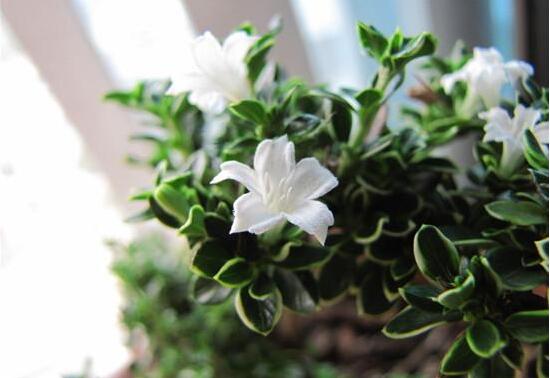
When watering Serissa japonica, it's simple for experienced growers who follow the requirements of Serissa japonica cultivation methods; but for beginners, the amount and frequency of watering are hard to gauge, and overwatering often occurs. So how often should you water Serissa japonica? In my experience, depending on the pot diameter and soil conditions, watering once every 3-5 days is generally sufficient.
Note: Serissa japonica has strong adaptability, and since it likes a moist environment, many flower lovers water it whenever they think of it, or whenever the air is dry. This easily leads to water accumulation in the potting soil, causing symptoms of yellowing and leaf drop in Serissa japonica, seriously affecting the plant's ornamental value.
2. How to water a potted Serissa japonica: keep the potting soil moist
According to the growth habits of Serissa japonica, we know it likes a moist environment but dislikes water accumulation, so how to water a potted Serissa japonica is a question many flower lovers want to know. My advice is: don't water too much, just keep the potting soil moist. As for the watering method, it differs across the four seasons. Let's continue reading.
3. Four-season watering methods for Serissa japonica
1. Spring watering: once a day
In spring, temperatures rise, and under sufficient sunlight, water evaporates quickly. Since Serissa japonica likes moisture, we generally water it once a day in spring.
2. Summer watering: twice a day
In summer, the climate is hot and water evaporates very quickly. At this time, increase the watering frequency to twice a day. In addition, mist the area around the plant in the morning and evening - firstly to lower the temperature, and secondly to increase the ambient humidity.
3. Autumn watering: once every 2-3 days
In autumn, temperatures gradually drop and the weather turns cool, so watering should also be reduced appropriately - once every 2-3 days is sufficient. You can also water as in spring, but it depends on the actual situation. Overall, keep the potting soil moist.
4. Winter watering: once every 20-30 days
After winter arrives, temperatures drop sharply. When the temperature is 0-10°C, water Serissa japonica once every 20-30 days; when the temperature is 15°C, water once every 7-10 days.
Note: In northern winters, the weather is very dry, so we can shorten the watering interval. In addition, mist the plant surface and surrounding ground daily to maintain ambient humidity.
4. Precautions for watering Serissa japonica
How to water Serissa japonica has been described in detail above, and everyone can just follow it. However, one thing to note: when Serissa japonica is in full bloom, do not mist the plant surface - only mist the ground, otherwise the flowers will rot.
How to dwarf a potted Serissa japonica
Why potted Serissa japonica needs dwarfing
There are generally two reasons for dwarfing a potted Serissa japonica. One is improper management, which causes the branches of Serissa japonica to become thin and long with reduced flowering; dwarfing is needed for good blooming. The other is to create a better shape, which also requires dwarfing.
Dwarfing measures for potted Serissa japonica
In terms of daily management, the main things are controlling water and fertilizer and providing sufficient sunlight.
Generally, watering and fertilizing are meant to promote the growth of Serissa japonica, but excessive water and fertilizer will cause it to only grow stems and leaves with few flowers. Generally, water and fertilizer control should start from the growing season. In spring, reduce watering to prevent the stem nodes of Serissa japonica from elongating, and do not over-fertilize to avoid rampant growth. To enable Serissa japonica to bloom well, apply more phosphorus and potassium fertilizers.
In addition, Serissa japonica needs to maintain ventilation and light, placed in a sunny spot, which can promote dwarfing and result in abundant flowers and lush leaves.
In terms of maintenance operations, it means timely pruning, reasonable repotting, and spraying dwarfing agents.
Serissa japonica does not need repotting too frequently - once every 3-4 years. This can promote aging of the plant, thickening of the stems, and encourage dwarfing.
Pruning of Serissa japonica should begin right from the initial potting stage, continuously pinching the tips and pruning vigorously growing leggy branches, so that the branches are short and the trunk is low, with evenly distributed branches, forming a small bonsai with distinct layers, achieving the goal of dwarfing.
In addition, Serissa japonica can also be sprayed with growth inhibitors to suppress branch growth. Spraying several times can dwarf the Serissa japonica plant.
Methods for growing potted Serissa japonica at home
Serissa japonica gets its name because it blooms in late spring and early summer, with pure white flowers like snow. Also called "sky full of stars," the name matches its appearance. It belongs to the Rubiaceae family, an evergreen multi-branched dwarf shrub with small elliptical leaves, opposite or clustered. The white flowers of Serissa japonica cluster in several blooms at the branch tips or leaf axils, mostly single-petaled, with some double-petaled varieties. Some varieties have white-edged leaves and slightly red flowers, which are coarse varieties. Generally, cuttings are best taken in June or July, as they root easily and are quite popular.
It likes partial shade, fears water accumulation, dreads scorching sun, and has strong resistance. Potted specimens must use soft mountain soil, and they can also grow normally indoors. It has the characteristics of fine leaves, dense branches, thick trunks, and exposed roots, making it one of the best materials for bonsai. The branches of Serissa japonica are soft and pliable, able to withstand wiring and shaping, and can be styled into straight-trunk, twisted, and cascade forms. If the pot is tall, it can be grown into a cascade style. Cascade style is further divided into semi-cascade, full cascade, and small cascade depending on the degree of tilt. So-called semi-cascade means the trunk basically extends horizontally out of the pot rim. Full cascade means the trunk hangs down 45 degrees below the pot rim. Small cascade generally means the trunk hangs down about 30 to 40 degrees. A natural style with slight trimming is also possible.
Serissa japonica is usually grown mainly as bonsai, but many are also cultivated as potted flowering plants. The 6-year-old Serissa japonica at my home is one example. The basic tasks for its care are watering and fertilizing. The principle of watering: don't water if not dry, and never overwater. If the pot surface stays wet for a long time, the roots will have difficulty breathing and are prone to rotting and death. Fertilizing should be frequent but light, using decomposed liquid fertilizer. Do not fertilize in summer, and do not fertilize during the flowering period, to avoid excessive growth that distorts the shape. Tip pinching should be done from May to June, and new buds in July should be removed.
Potted plants should be kept in a fixed position and not moved around, as Serissa japonica is particular about phototropism. In summer, provide shade above under the scorching sun, maintain ventilation, and mist the leaves 1 to 2 times a day to maintain air humidity. In severe cold, wrap it lightly with straw (at around -10°C) to prevent it from freezing to death.
The main pest and disease of Serissa japonica is generally scale insects. Spray 40% omethoate at 1000 to 1500 times dilution or 25% phosmet at 1000 to 1500 times dilution for control.