Does Saxifraga stolonifera die after blooming? After flowering, reduce watering and stop fertilizing
Recently, quite a few readers shared photos of Saxifraga stolonifera in bloom with us. From these photos, you can see that the flowers of Saxifraga stolonifera are very pretty with their alternating yellow and white, but many people worry that Saxifraga stolonifera will gradually die after blooming. So does Saxifraga stolonifera die after blooming? How should it be cared for after blooming? How do you grow Saxifraga stolonifera so that it blooms? Below, the editor tells you the answers.
Does Saxifraga stolonifera die after blooming?
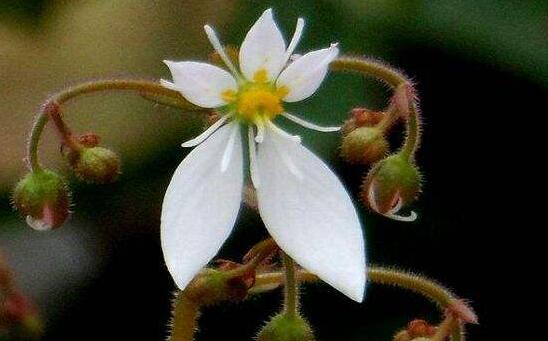
Saxifraga stolonifera does not die after blooming. It is a perennial plant. Its flowers are bilaterally symmetrical, with sepals spreading to recurved during the flowering period. It usually has 5 petals, 3 shorter and 2 longer. From photos of Saxifraga stolonifera in bloom, the flowers look very pretty, just like birds with wings.
How to care for Saxifraga stolonifera after blooming
1. Reduce watering
In the two weeks after Saxifraga stolonifera blooms, the frequency and amount of watering should be reduced, because at this time the plant enters a dormant period and has a lower demand for water. You only need to make sure the potting soil does not dry out completely and harden; there is no need to water too much. Wait until spring arrives and Saxifraga stolonifera resumes growth, then resume normal watering.
2. Stop fertilizing
Fertilizing should also stop after blooming, for the same reason as reducing watering. After growth resumes, you can fertilize once every 20 days, mainly with nitrogen fertilizer. If Saxifraga stolonifera is grown properly, it can keep growing and reproducing for a long time.
How to grow Saxifraga stolonifera so that it blooms
1. Choose suitable soil
To make Saxifraga stolonifera bloom, you first need to ensure it gets enough nutrients during the growing period, and the choice of soil is very important. Sandy soil is a good choice, and you can also use leaf mold mixed with sand. Before planting, be sure to apply enough base fertilizer at the bottom of the pot.
2. Light should be moderate
If the light is too strong, the leaves of Saxifraga stolonifera will develop scorched edges or turn yellow; if it is too dark, the leaves will become dull and it will also affect blooming. Therefore, the light must be moderate: do not keep it in dim light, and do not let it be exposed to scorching sun.
3. Watering cannot be skimped on
Some people's Saxifraga stolonifera blooms every year, while others do not see it bloom for several years. A careful comparison shows that many people rarely water their Saxifraga stolonifera at ordinary times, and this is not good for blooming, because Saxifraga stolonifera prefers a moist environment.
4. Keep the environment ventilated
Ventilation in the environment is very helpful for Saxifraga stolonifera to bloom. A closed environment hinders air circulation, causing the air to become dry and even stuffy and hot, while good ventilation can promote the growth and blooming of Saxifraga stolonifera.
Summary: Saxifraga stolonifera will not die after blooming. Its flowers will wither, but the plant itself can live for many years. If cared for properly afterward, it will bloom again. To help it bloom smoothly, light, soil and watering are the main factors. Try to create an environment favorable for Saxifraga stolonifera to bloom, and only then will you finally see its beautiful flowers.
How to grow Saxifraga stolonifera: cultivation methods and precautions for potted Saxifraga stolonifera / cool environment
Because Saxifraga stolonifera has many effects and benefits, more and more people plan to grow it, but some people do not know how to grow Saxifraga stolonifera, nor do they know its living habits and so on. Today, the editor will introduce the cultivation methods and precautions for potted Saxifraga stolonifera. After reading this, you will know that growing Saxifraga stolonifera is not that difficult.
How to grow Saxifraga stolonifera
Saxifraga stolonifera is a plant with very strong adaptability. It first appeared at an altitude of 400-4000 m under forests and in shady, moist rock crevices. It prefers a cool and humid environment and has fairly high cold tolerance. These are things you must know before learning how to grow Saxifraga stolonifera.
Cultivation methods and precautions for potted Saxifraga stolonifera
Saxifraga stolonifera was originally a wild plant and later developed into an ornamental plant that can be grown in pots. Below we will learn about the cultivation methods and precautions for potted Saxifraga stolonifera from several aspects, including soil, light, temperature, watering and fertilizing.
1. Choice of soil
Saxifraga stolonifera has ordinary soil requirements, but if it is potted, try to choose soil with good drainage and air permeability. For example, sandy soil rich in organic matter is best. You can also take soil from dense, moist forest floors and cool, damp cliff walls.
Precautions: Before potting, disinfect the soil. You can spread the soil in the sun to dry it, which can help avoid the appearance of pests and diseases.
2. Light requirements
The light requirements of Saxifraga stolonifera are: no direct sunlight, but a certain amount of light is needed. If there is not enough light, the leaf color will become dull, but if the light is too strong, the leaves may turn yellow, so special care is needed in summer and winter.
Precautions: In summer, move Saxifraga stolonifera to a cool place. If it cannot be moved, provide shade for it. In winter, place it in a spot with plenty of sunlight.
3. Temperature control
The most suitable temperature for the growth of Saxifraga stolonifera is 15-25 degrees, but its cold tolerance is fairly high, and it can survive in a 5-10 degree environment. However, try not to keep it in a low-temperature environment for a long time.
Precautions: Some varieties of Saxifraga stolonifera are not cold tolerant, such as the tricolor Saxifraga stolonifera, which may die below 15 degrees. Therefore, pay attention to which variety you are growing.
4. Water frequently
In the cultivation methods and precautions for potted Saxifraga stolonifera, watering is very particular. During the growing period, water once a day to keep the soil moist; after blooming, reduce the amount of watering.
Precautions: Saxifraga stolonifera likes a moist environment. If the soil is too dry, the leaves are likely to turn yellow and fall off, so be sure to water frequently. But remember not to water too much at one time, and do not let water accumulate in the pot.
5. Fertilizer management
Saxifraga stolonifera does not have a high demand for fertilizer, but during the growing period and before blooming, it should be fertilized once every 20 days. In winter, fertilizing can be stopped.
Precautions: When fertilizing, apply the fertilizer from the roots. Never let the fertilizer come into contact with the leaf surface, as this may affect the growth of the Saxifraga stolonifera plant.
Summary: The climate and environment differ from place to place, so when growing Saxifraga stolonifera, the cultivation methods and precautions for potted Saxifraga stolonifera are very important references. Only by caring for it attentively can you ensure that Saxifraga stolonifera grows vigorously and displays its greatest ornamental value.
How to grow Saxifraga stolonifera; Is Saxifraga stolonifera easy to grow?
How to grow Saxifraga stolonifera
1. The propagation method of Saxifraga stolonifera is very simple, mainly division propagation. When the Saxifraga stolonifera plant grows to a certain size, small plantlets grow at the ends of its stolons. In spring, cut off the small plantlets, transplant them into a large flower pot, and then cover them with plastic film. Be careful to maintain a relatively high temperature. Once the root system has grown well, they can be divided and planted into small flower pots, and placed in a shady, moist place for about two weeks to resume growth.
2. For potted Saxifraga stolonifera, the best soil choice is sandy soil rich in organic matter, and it must also have good drainage. You can make your own by mixing potting soil with river sand. Aside from needing a small amount of decomposed base fertilizer when planting, Saxifraga stolonifera can be fertilized once every two weeks during the growing season with dilute liquid fertilizer. If the concentration is too high, it can cause the plant to die.
3. Saxifraga stolonifera likes a warm environment, and the most suitable growing temperature is between 15 and 25 degrees. Saxifraga stolonifera is also fairly cold tolerant and can overwinter at a low temperature of 5 degrees, but the variegated tricolor Saxifraga stolonifera is not cold tolerant, and its overwintering temperature is 15 degrees. If it is below this temperature, it will die, so keeping warm in winter is also essential.
4. Saxifraga stolonifera likes a moist environment and needs relatively high humidity during the growing season, so the potting soil should be kept moist often, but water must not accumulate. In summer, in addition to appropriate watering, also spray water to increase the humidity in the air and on the leaf surface. After blooming in spring and summer, Saxifraga stolonifera has a dormant period. At this time, you can water less and just keep the pot from drying out. Every spring, you should also repot it or refresh it after blooming.
5. Saxifraga stolonifera should be grown in a semi-shady environment. It is very difficult for it to survive in a place with direct sunlight all day. Because too strong light will scorch the leaves, while too weak light will make the leaf color less vivid. Therefore, in spring, summer and autumn, shade treatment should be carried out, using brighter scattered light for lighting.