Does Monstera deliciosa bloom? Failure to bloom is heavily influenced by environment and flowering period
There is a saying circulating among people in China: "When the Monstera deliciosa blooms, it is as hard to see as the cycad tree," meaning that wanting to see a Monstera deliciosa bloom is as difficult as seeing a cycad bloom, which shows that its flowering is relatively rare. So, does Monstera deliciosa bloom? The answer is yes.
Does Monstera deliciosa bloom?
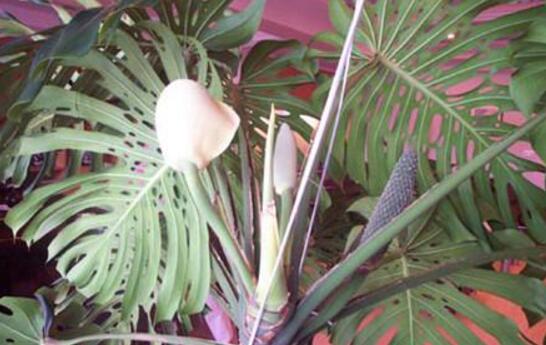
Monstera deliciosa originates from tropical regions. We know that the properties and effects of Monstera deliciosa are that its leaves can be used for ornamental purposes. Although it is extremely difficult for it to bloom, if the planting method is appropriate and the environment is suitable, it can bloom, and more and more Monstera deliciosa blooms are appearing in various places.
Monstera deliciosa flowering period
The flowering period of Monstera deliciosa is from August to September each year. The appearance of the flower is spathe-shaped, looking like a desk lamp. The peduncle of the inflorescence is 15-30 cm long, the staminal filaments are linear, and the pollen is yellow-white. The pistil is top-shaped, and the flower is yellow-white, looking very soft and elegant.
One rather strange point is that the fruit of Monstera deliciosa takes a long time to mature. It does not ripen until after the flowering period ends in the second year. From the appearance of the fruit to final maturity is generally 15 months. The fruit is a pale yellow berry, which can be eaten raw or used as an ingredient.
Why does Monstera deliciosa not bloom?
Botanists believe that the reasons Monstera deliciosa does not bloom are related to the environment, flowering period and flower buds, among which the environment is the main factor. In the north, Monstera deliciosa blooming is rarely seen because the average temperature there is lower.
1. Caused by environmental factors
The most suitable temperature for Monstera deliciosa growth is 15-20 degrees. The climate in many places does not fall within this range, and even where such a climate exists, it occurs only for a very short time each year. Temperature is the main factor affecting whether Monstera deliciosa blooms. Once the temperature is unsuitable, flowering is relatively rare.
2. The flowering period is relatively long
Compared with other plants, the flowering period of Monstera deliciosa appears relatively long. Sometimes it takes several years or even ten years of cultivation to see it bloom. This is a normal phenomenon. If the flowering period has not arrived, it naturally cannot bloom.
3. Flower buds are damaged
If division is used when propagating Monstera deliciosa, and the flower buds are accidentally damaged during division, the result is that Monstera deliciosa finds it difficult to bloom. Therefore, to avoid this situation, you must pay attention to whether the propagation method for Monstera deliciosa is correct.
Summary: Theoretically, the flowering period of Monstera deliciosa is from August to September each year, but due to the influence of the environment and other factors, Monstera deliciosa flowering is relatively rare. Sometimes it takes several years to see it bloom, and the flowers are not eye-catching or brightly colored, so they are often easily overlooked. However, scientific research shows that Monstera deliciosa can bloom.
Does Monstera deliciosa bloom? Why does Monstera deliciosa not bloom?
Monstera deliciosa is a sun-loving plant native to Mexico. It originally grew in Mexico's tropical rainforests, is evergreen year-round, and is often used as a large potted foliage plant. So, does Monstera deliciosa bloom? Why does Monstera deliciosa not bloom?
Whether Monstera deliciosa will bloom:
Monstera deliciosa will bloom. Its flowering period is August-September. The inflorescence stalk is 15-30 cm long, the spathe is thick and leathery, the spadix is nearly cylindrical, the staminal filaments are linear, the pollen is yellow-white, and the pistil is yellow and top-shaped. The fruit matures after the flowering period in a different year. It is pale yellow, with blue-purple spots around the stigma, 1 cm long and 7.5 mm thick.
Reasons why Monstera deliciosa does not bloom:
1. Environment: For Monstera deliciosa, environmental factors such as indoor temperature and humidity in the home generally make it difficult to meet the basic conditions for blooming, so it rarely blooms in northern regions. There is also a folk saying: "When the Monstera deliciosa blooms, it is as hard to see as the cycad tree."
2. Flower buds: In home cultivation, Monstera deliciosa is mostly propagated by asexual division from the mother plant. During division, the flower buds of Monstera deliciosa can be affected or damaged. This is also one of the reasons it is difficult to see Monstera deliciosa bloom at home.
3. Flowering period: The flowering period of Monstera deliciosa is relatively long, and blooming once is not very easy. Some take several years, or even more than ten years, to bloom. However, if you want it to bloom, try to maintain temperature and humidity conditions as suitable as those in its place of origin.
How to grow Monstera deliciosa:
1. Light: Monstera deliciosa likes warm and humid environments, dislikes drought, and fears direct sunlight, otherwise it can easily cause leaves to wither. In summer, Monstera deliciosa should be placed indoors or under a shade awning. It must not be placed on a balcony with overly strong sunlight for exposure, as this can very easily cause death. When the winter temperature drops to 6°C, Monstera deliciosa should be moved indoors to keep warm.
2. Watering: Monstera deliciosa needs sufficient water, and the potting soil must be kept moist frequently. During the summer growing period, water once in the morning and once in the evening, and also sprinkle water on the leaves from time to time to keep the leaves bright and the air humid. In winter, water evaporates slowly, so water once every 3-4 days; for routine watering, once a day is enough.
3. Fertilizing: Monstera deliciosa is a plant that relatively likes fertilizer, so attention should be paid to fertilizing it appropriately. During the growing period of Monstera deliciosa, apply diluted cake fertilizer water once every half month. With sufficient and appropriate fertilizing, Monstera deliciosa will grow with pleasing leaf color.
4. Pests and diseases: Monstera deliciosa is extremely susceptible to scale insect damage, and the stems and leaves are most vulnerable to scale insects. They can be cleaned with an old toothbrush and then sprayed with a 1000-fold dilution of 40% omethoate. Common diseases of Monstera deliciosa include leaf spot, gray spot and stem blight, and timely prevention and control should be carried out.
5. Repotting: Potted Monstera deliciosa needs to be repotted once a year, and the best time for repotting is between March and April. When repotting, remove the old soil, cut off the dead roots of Monstera deliciosa, and then add decomposed organic fertilizer or phosphorus and potassium fertilizer to the pot as a base fertilizer.
Does Monstera deliciosa bloom, and when does Monstera deliciosa bloom?
A few days ago, a friend asked me: does Monstera deliciosa bloom? When does Monstera deliciosa bloom? Why has he never seen Monstera deliciosa bloom? I think many flower lovers also have the same confusion as my friend. Below, the editor will explore this with everyone.
Does Monstera deliciosa bloom?
Of course Monstera deliciosa blooms. Its flower is spathe-shaped and pale yellow, and the fruit is edible. In cultivation there is also a variegated-leaf variety, whose green leaves carry irregular white spots and are very beautiful. Monstera deliciosa often grows epiphytically on tall banyan trees. Its pinnate parallel leaf veins are clearly prominent and its shape resembles a banana plant, so it is called "Penglaijiao". In Latin, Monstera deliciosa means "green wilderness monster". Its flowering is very peculiar, with a boat-bottom-like bud that is yellow-white, flowers as large as a palm, hiding a spadix inside, and it can bear fruit, which is a berry. After the fruit matures, it can be used in cooking. It has a sweet taste, and its fragrance is like pineapple or banana. But note that the fruit cannot be eaten when unripe because it is strongly irritating. In its place of origin, residents call this fruit "the beautiful fruit given by the immortals."
When does Monstera deliciosa bloom?
In fact, Monstera deliciosa is not at all easy to bloom. Generally speaking, as long as you understand the growth habits of Monstera deliciosa and meet its growth requirements, a small Monstera deliciosa can bloom in about 5-6 years, and the flowering period is in summer and autumn.
The flower language of Monstera deliciosa
The flower language of Monstera deliciosa is health and longevity, suitable for giving to friends, colleagues, the elderly, elders, and family members.
With this introduction, I believe everyone has some understanding of whether Monstera deliciosa blooms and when Monstera deliciosa blooms. In fact, it is very difficult for Monstera deliciosa to bloom. Besides understanding its growth habits, it should also be carefully cared for. Only then will Monstera deliciosa produce a flower rarely seen in ten years. You must believe that effort brings rewards. The same principle applies to whether Monstera deliciosa blooms.