How do you prevent and treat bacterial soft rot in irises?
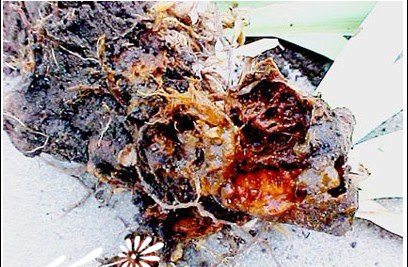
The pathogens of iris soft rot are bacteria, and 2 species are currently known, namely Erwinia carotovora pv. carotovora and Erwinia aroideae, both belonging to the order Eubacteriales and the genus Erwinia. Besides irises, they also harm many ornamental plants such as cyclamen, hyacinth, lily and tulip.
The pattern of occurrence is generally that the bacteria overwinter in the soil and on crop residues. They can survive in the soil for several months, and if inside diseased plant residues, they can survive for a long time. When the temperature is high and humidity is great, they survive more easily. Therefore, the disease generally occurs more when the soil is moist, and occurs more in places with overly dense planting and heavy shade cover.
If this disease has already occurred, the method that should be adopted immediately is: choose streptomycin or a mixed solution of streptomycin plus oxytetracycline (10:1) to spray the plants and the ground, spraying 2-3 times in succession, with very good results. After the disease occurs, agricultural streptomycin solution can also be sprayed once a month, which can likewise control the spread of the disease.
Prevention and treatment techniques for iris bacterial soft rot
Distribution and damage
Bacterial soft rot is a common disease of irises, distributed in the United States, Canada and Japan. In our country it occurs in Shanghai, Hangzhou, Hefei and Qingdao, among other cities. The host range of this pathogen is very broad. Besides irises, it also harms many ornamental plants such as cyclamen, hyacinth, lily and tulip.
Symptoms
After bulbous irises are affected, the tips of new leaves turn yellow first, and soon the outer leaves also turn yellow, and the whole plant dies standing. The root crown area of the diseased plant develops water-soaked soft rot, the aboveground part is easy to pull up, the bulb decays to a mushy consistency, and there is a foul odor. When the disease occurs on irises, the root crown area of the diseased plant develops water-soaked soft rot, the bulb decays to a mushy consistency, and a foul odor is produced. After other irises are affected, the disease spreads from the underground stem to the leaves and rhizome. The leaves begin as water-soaked soft rot, dying standing from dirty white to dark green, and the aboveground plant is easy to pull up. The root crown is soft-rotted, with a foul odor. When the bulb is diseased before planting, there are water-soaked spots resembling frost injury, the lower part turns tea-brown, with a foul odor and dirty white sticky exudate. After lightly diseased bulbs are planted, water-soaked brown lesions appear at the leaf tips, leaf unfolding stops, and soon the whole leaf turns yellow and dies, and the entire bulb rots.
Pathogen
The pathogen is bacteria, caused by Erwinia carotovora pv. carotovora (Jones) Bergey and Erwinia aroideae (Townsend) Holl, both belonging to the order Eubacteriales and the genus Erwinia. The bacteria are short rod-shaped and move by peritrichous flagella. They are Gram-negative. Erwinia carotovora pv. carotovora (Jones) Bergey measures 0.7×2μm. Erwinia aroideae measures 1.2-3.0μm×0.5-1.0μm. The optimum growth temperature for both is 27-30°C, and the maximum temperature range is 32-40°C. They can ferment glucose, and are oxidase-negative.
Prevention and treatment techniques for iris bacterial soft rot
[Distribution] Bacterial soft rot is a common disease of irises. It can occur on either bulbous irises or rhizomatous irises, and is distributed in the United States, Canada and Japan. In our country it occurs in Shanghai, Hangzhou, Hefei and Qingdao, among other cities.[Symptoms] When the disease occurs on bulbous irises, the root crown area of the diseased plant develops water-soaked soft rot, the bulb decays to a mushy consistency, and a foul odor is produced. As the underground part of the disease develops, the front end of the new aboveground leaves turns yellow, and soon the outer leaves also turn yellow. The aboveground part is easy to pull up, and the whole plant turns yellow and withers; when other categories of irises are diseased, the disease spreads from the underground stem to the leaves and rhizome. The leaves begin as water-soaked soft rot, dying standing from dirty white to dark green, the aboveground plant is easy to pull up, and the root crown is soft-rotted, with a foul odor. When the bulb is diseased before planting, there are frost-injury-like water-soaked spots, the lower part turns tea-brown, with a foul odor and dirty white mucus. After lightly diseased bulbs are planted, there are water-soaked brown lesions at the leaf tips, leaf unfolding stops, and soon the whole leaf turns yellow and dies, and the entire bulb rots.
[Pathogen] The pathogen is bacteria. There are 2 known pathogens of iris soft rot, namely Erwinia carotovora pv. carotovora (Jones) Bergey and Erwinia aroideae (Townsend) Holl., both belonging to the order Eubacteriales and the genus Erwinia. The bacteria are short rod-shaped and move by peritrichous flagella; they are Gram-negative. The former measures 0.7×2μm; Erwinia aroideae measures 1.2-3.0μm×0.5-1.0μm. The optimum growth temperature for both is 27-30°C, and the maximum temperature range is 32-40°C. They can ferment glucose, and are oxidase-negative. The host range of the bacteria is very broad. Besides irises, they also harm many ornamental plants such as cyclamen, hyacinth, lily and tulip.
[Pattern of occurrence] The bacteria overwinter in the soil and on crop residues. They can survive in the soil for several months, and can survive year-round in diseased plant residues in the soil. The bacteria spread by water flow, insects, contact between diseased and healthy leaves, or tools used in operations, and invade through insect wounds, wounds from division of clumps, injuries during transplanting and other wounds. In particular, the wounds made on young leaves by the larvae of the iris borers, or the wounds made by dividing roots for transplanting, all open the door for bacterial invasion; the disease spreads through rainwater, irrigation water and insects, and under natural conditions the disease occurs from June to September. When the temperature is high and humidity is great, especially when humidity is great, the disease is severe, and it occurs more especially when the soil is moist; in places with overly dense planting and heavy shade cover, bulbs are prone to the disease; in continuously cropped land the disease is severe. Iris germanica and Iris austriaca are commonly affected.
[Prevention and treatment methods]
1. Choose disease-free bulbs; avoid causing wounds when digging; do not use diseased root clumps when propagating by division; when growing in a greenhouse, replace with new soil, promptly prune diseased leaves or pull up diseased plants and destroy them; thoroughly dig out rotted bulbs, and promptly remove diseased bulbs found during storage. Soil with severe disease can be disinfected with 0.5%-1% formalin at 10g/sq m before planting, or replaced with new soil before planting; contaminated tools should be disinfected by soaking in boiling water or 70% alcohol, or 1% copper sulfate solution before reuse. For cut-flower tools, disinfect with 0.5% potassium permanganate.
2. In the early stage of the disease, choose 100-150×0.000001 streptomycin or a mixed solution of streptomycin plus oxytetracycline (10:1) for spraying, spraying 2-3 times in succession, with relatively good results. After the disease occurs, spray agricultural streptomycin 1000-fold solution once a month, which can control the spread of the disease. Spraying insecticides to control the damage of iris borers can reduce the occurrence of the disease.
3. When harvesting bulbs, avoid causing wounds; in autumn, remove withered diseased leaves from the nursery to prevent pests from laying eggs on them.
4. Choose healthy bulbs for planting; the nursery site should have good drainage; when planting, it is better to plant shallowly rather than deeply; during management, avoid overhead sprinkling when watering.
5. During the growing season, pay attention to controlling the iris borers that cause wounds on irises. You can use 50% malathion emulsifiable concentrate 1000-2000-fold solution or 2.5% deltamethrin emulsifiable concentrate 2000-3000-fold solution for control.