How to Grow Peperomia caperata? Detailed Guide to Growing Methods and Precautions
It adapts well to the environment; even if the soil and water quality are poor, it can still grow well, making it suitable for planting in the background. Because its roots, which take hold in the bottom sand, spread out, it needs a considerable amount of space to grow. It propagates through new shoots sent out from older parts. In the domestic horticultural world, propagation and cultivation are often carried out by cuttings, division, or leaf cuttings, with a very high success rate, but a moist environment must be maintained; adding some rooting hormone makes it even easier to promote successful rooting.
Root rot, stem rot
It is mainly caused by excessive watering, which leaves the growing medium wet for too long; it can be prevented by controlling the amount of watering. You can also use 1000 times diluted Root Rot Ling, applying it once every half month.
Anthracnose
It is mainly caused by high air humidity, where moisture on the leaves cannot dry off for a long time, making the disease likely to occur. In production, do a good job of ventilation management, try to choose morning watering, and use fungicides such as thiophanate-methyl, chlorothalonil, and thiram once every half month for regular prevention and control.
Potting soil for Peperomia caperata
Peperomia caperata is actually not very picky about soil. Generally speaking, well-drained leaf mold is enough. Gardeners can also make their own nutrient soil suitable for Peperomia caperata, for example, a loose growing mix made by blending garden soil, leaf mold, river sand, and so on, with a small amount of cake fertilizer added as a base fertilizer.
Fertilizing Peperomia caperata
Another thing that cannot be ignored during the growth period of Peperomia caperata is fertilizing it. Generally speaking, fertilizing once a month during the growing season is enough for Peperomia caperata. As for the choice of fertilizer, gardeners can use fully decomposed cake fertilizer water, diluted liquid fertilizer mainly based on nitrogen fertilizer, and so on. When fertilizing, be sure to avoid contact with the leaf surface.
Watering Peperomia caperata
Peperomia caperata is a mesophytic flower, so it is best to keep the growing environment moist day and night. Watering should be done so that the potting soil is moist, which is ideal, but even though it should be moist, you must also note that water must not accumulate; once water accumulates, root rot is very likely to occur.
In summer, when temperatures are high, Peperomia caperata grows vigorously, so it is best to water once every 2 to 3 days, but winter is dry and Peperomia caperata grows slowly, so it is best to control the amount of water.
Light for Peperomia caperata
Peperomia caperata is actually a semi-shade flower, so it is best to place potted Peperomia caperata in a semi-shaded spot to receive diffused light. If the light is too strong, the leaves turn yellow; if the light is too weak, the leaves easily lose their luster. In winter, it can be placed in a spot with ample sunlight.
Pruning Peperomia caperata
The growth of Peperomia caperata does not always go according to our wishes, and sometimes it grows in a very messy, disorderly way. At this point, we should prune Peperomia caperata. The purpose of pruning is to make the Peperomia caperata plant full and its branches and leaves dense.
You can pinch off the growing tips in early summer for pruning. Pinching means pruning the tender leaves growing from the top center of the plant, which can inhibit the plant's growth and let new leaves grow out from below.
Repotting Peperomia caperata
For potted Peperomia caperata, it is best to repot once every 2 years, so for lazy people, don't you think it's great that you don't have to repot every spring?
Growing Methods for Peperomia caperata and Propagation Methods for Peperomia caperata
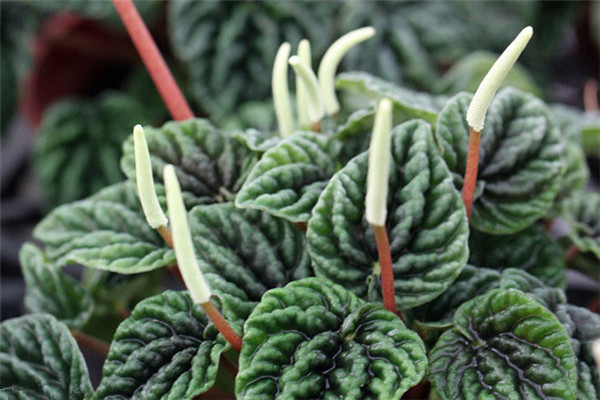
Peperomia caperata is a clump-forming plant, about 20 cm tall, with a short stem, and heart-shaped leaves growing in clusters at the top of the short stem. Today we will tell you about the growing methods for Peperomia caperata and the propagation methods for Peperomia caperata.
Growing methods for Peperomia caperata:
1. Nutrient solution: For hydroponic Peperomia caperata, in spring and summer, add foliage plant nutrient solution once every half month; do not directly use dissolved agricultural fertilizer. If algae is found in the hydroponic Peperomia caperata bottle, remove it promptly. You can wash the container each time you change the water. Algae in the container compete for oxygen around the roots of Peperomia caperata, causing root rot in Peperomia caperata.
2. Temperature: The suitable growing temperature for Peperomia caperata is 16°C to 24°C from April to September, and 13°C to 18°C from September to April of the following year. The minimum winter temperature should be kept above 10°C. If room temperature exceeds 30°C or falls below 10°C, Peperomia caperata grows slowly.
3. Light: Peperomia caperata can grow fairly well when placed in a semi-shaded environment. In summer, avoid direct sunlight; in spring, autumn, and winter, Peperomia caperata can be given somewhat more sunlight. If the light is too strong, it easily causes the leaf margins and leaf tips of Peperomia caperata to scorch. If the light is too weak for a long time, it easily causes Peperomia caperata to lose its luster.
Propagation methods for Peperomia caperata:
The commonly used propagation methods for Peperomia caperata are division or leaf cuttings. The division method for Peperomia caperata can be carried out in early spring. For the leaf cutting method for Peperomia caperata, select robust, sturdy Peperomia caperata leaves with 1.5-2.5 cm long petioles, and after the cut surface dries slightly, insert them obliquely into a pot with river sand as the growing medium. After inserting, water appropriately; if the sand bed is too wet, it easily causes rot. At a temperature of about 19°C, roots can develop in about half a month, and when the seedlings grow to 3.5-4.5 cm, they can be transplanted.
More information