A Detailed Guide to Clover Planting Techniques and Management Methods
Clover has strong cold resistance. When the temperature drops to 0°C, some old leaves turn yellow and withered, and the small leaves on the main root press close to the ground and stop growing, but they remain green. Therefore, the green period is very long. It is not demanding on soil and can adapt to various soil types, growing well in slightly acidic soil.
Clover prefers warm, sunny conditions and well-drained environmental conditions. Under drought conditions it grows slowly, and in hot seasons some plants may die off. It tolerates pruning and trampling, and has strong regeneration ability; within 10 days after pruning, new small leaves can grow. After high-intensity trampling or rolling, it can recover in 3 to 5 days. Under strong shading it tends to grow leggy, resulting in poor growth. It has strong resistance to harmful gas pollution and to pests and diseases.
Clover seeds are tiny, so the soil must be carefully prepared before sowing. First, deep plowing is required to remove tree stumps, construction waste, grass roots and other debris. Lawn establishment in courtyards is often carried out after construction is completed. Therefore, the site contains cement, sand and gravel, mortar, bricks, tiles, decorative material waste and other debris, all of which must be removed and backfilled with garden soil. Second, soil treatment must be carried out to eliminate weeds. After deep plowing and clearing, most grass roots and vegetative propagules have been removed, but weed seeds and some vegetative bodies are still in the soil; when conditions are suitable, the weed seeds will germinate again and harm the lawn. Therefore, the seedbed must undergo soil treatment. If the schedule is not tight, water the soil and wait for weeds to grow, then carry out eradication. If the schedule is tight, soil fumigation combined with soil disinfection can be used to treat weed seeds. White clover grows slowly at the seedling stage and is easily harmed by weeds, so soil treatment is very important. Third, shallow plowing should be carried out, and organic fertilizer or compound fertilizer should be applied together with shallow plowing. Fourth, harrowing and raking should be carried out to finely prepare the soil, making the seedbed flat and smooth and creating conditions for sowing.
Clover seeds are tiny, so the soil must be carefully prepared before sowing. First, deep plowing is required to remove tree stumps, construction waste, grass roots and other debris. Lawn establishment in courtyards is often carried out after construction is completed. Therefore, the site contains cement, sand and gravel, mortar, bricks, tiles, decorative material waste and other debris, all of which must be removed and backfilled with garden soil. Second, soil treatment must be carried out to eliminate weeds. After deep plowing and clearing, most grass roots and vegetative propagules have been removed, but weed seeds and some vegetative bodies are still in the soil; when conditions are suitable, the weeds
seeds will germinate again and harm the lawn. Therefore, the seedbed must undergo soil treatment. If the schedule is not tight, water the soil and wait for weeds to grow, then carry out eradication. If the schedule is tight, soil fumigation combined with soil disinfection can be used to treat weed seeds. White clover grows slowly at the seedling stage and is easily harmed by weeds, so soil treatment is very important. Third, shallow plowing should be carried out, and organic fertilizer or compound fertilizer should be applied together with shallow plowing. Fourth, harrowing and raking should be carried out to finely prepare the soil, making the seedbed flat and smooth and creating conditions for sowing.
An Introduction to Clover Planting Methods
There are many kinds of plants in nature, and clover is just one of them. Everyone must be familiar with clover; it is one of the most common plant types around us. So how much do you know about clover? What does clover symbolize? What are the ecological habits of clover? And what are the cultivation methods for clover? Below, the editor will introduce them to you, hoping to be of some help.
An Introduction to the Meanings of Clover
An Introduction to CloverClover is a short-lived perennial herb with a growth period of up to 5 years. Its main root is short, and its lateral roots and fibrous roots are well developed. The stems are creeping and trailing, slightly ascending at the upper part, rooting at the nodes, and the whole plant is hairless. It has a taproot system, and the roots have the characteristic of symbiosis with rhizobia; the root's tillering ability and regeneration ability are both strong.
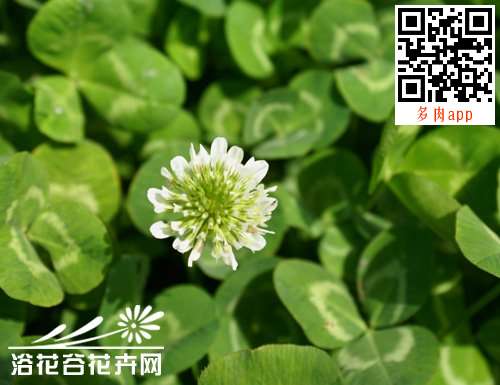
It has many branches, and the creeping stems grow along the ground; where the internodes touch the ground they root and sprout new buds. The leaves are compound with three leaflets; the leaflets are obovate or obcordate, wedge-shaped at the base, blunt or slightly notched at the tip, with fine serrations along the edges, and a "V"-shaped white mark in the center of the leaf surface; the stipules are oval and clasp the stem. It blooms in summer and autumn, with a head-like raceme, spherical, with a long peduncle, and white flowers, occasionally light red. It flowers and sets seed continuously, and the seeds mature at different times; the seeds are tiny.
The Meanings of Clover
In regions such as Australia and Canada, clover plants are all classified as weeds and must be cut away. In China, different numbers of clover leaves carry different flower meanings; for example, three leaves represent hope, and so on.
Clover (one leaf): represents supplication.
Clover (two leaves): represents hope.
Clover (three leaves): represents love.
Clover (four leaves): represents happiness and sincere love.
The Ecological Habits of Clover
Clover has strong cold resistance. When the temperature drops to 0°C, some old leaves turn yellow and withered, and the small leaves on the main root press close to the ground and stop growing, but they remain green. Therefore, the green period is very long. It is not demanding on soil and can adapt to various soil types, growing well in slightly acidic soil. It prefers warm, sunny conditions and well-drained environmental conditions. Under drought conditions it grows slowly, and in hot seasons some plants may die off. It tolerates pruning and trampling, and has strong regeneration ability; within 10 days after pruning, new small leaves can grow. After high-intensity trampling or rolling, it can recover in 3 to 5 days. It has strong resistance to harmful gas pollution and to pests and diseases.
Clover Planting Methods
Clover Planting MethodsSoil: Clover seeds are tiny, the seedlings are slender and weak in emerging from the soil, and growth at the seedling stage is extremely slow. Before planting, the soil must be deep-plowed and turned, the ground leveled, and soil clods broken up finely, so that the sowing layer is loose, flat and even.
Sowing: The best time to sow clover is in spring and autumn. For spring sowing, it can be done from the end of March to the end of April, and sowing can begin once the temperature stabilizes above 15°C. Autumn sowing generally starts from mid-to-late September. Before sowing clover, the seeds need to be soaked: for every 1 kg of seeds, add 1.5 kg of water, plus 1 g of ammonium molybdate, and soak for 12 hours; then mix evenly with 5-10 kg of calcium magnesium phosphate fertilizer plus 5-10 kg of fine soil or yellow sand before sowing.
Fertilizing: Clover belongs to the legume family and has its own nitrogen-fixing ability, but at the seedling stage the rhizobia have not yet formed, so a small amount of nitrogen fertilizer should be supplemented to help strengthen the seedlings; adding phosphorus and potassium fertilizer has a very good yield-increasing effect. Once clover has grown larger, only phosphorus and potassium fertilizer need to be supplemented.
Maintenance: For clover lawns that have grown for more than 2 years, the soil layer is compacted and poor in aeration. Before turning green in spring and autumn, and before regrowth after grazing or mowing, harrowing and loosening of the soil should be carried out, and topdressing should be combined with soil loosening to facilitate the growth and development of new buds and new roots. Clover has relatively high requirements for soil moisture; where irrigation conditions are available, irrigate when the soil is dry or in combination with topdressing.
Pests and diseases: Clover has few diseases, but if harvesting is not timely, brown patch and powdery mildew sometimes occur; it can be cut and used first, then controlled with Bordeaux mixture, lime sulfur mixture, carbendazim or similar.