How to grow Ariocarpus fissuratus? Detailed guide to cultivation methods and precautions
Propagation of Ariocarpus fissuratus is very difficult. It can be done by sowing seeds or by removing offsets for grafting. Because the fruit takes a very long time to mature and germination is very difficult, the germination rate is extremely low, and seedlings grow very slowly. It is the species in the genus Ariocarpus whose growth rate is second only to Ariocarpus agavoides; for grafting, Trichocereus (three-ribbed cactus) can be used as rootstock to speed up growth and bring flowering forward, but grafted plants have a very short lifespan, tend to age, and are not easy to cultivate. Moreover, plants of the genus Ariocarpus are very difficult to root after being removed from the rootstock, do not easily form roots, and have a very high mortality rate.
Temperature: It likes warmth and can tolerate low temperatures of 5°C. When water is withheld in winter, it can tolerate temperatures below 0°C.
Light: It likes ample but soft sunlight. In summer it needs appropriate shading, in a bright spot indoors.
Water: Water thoroughly during the growing season, but avoid continuous waterlogging in the pot.
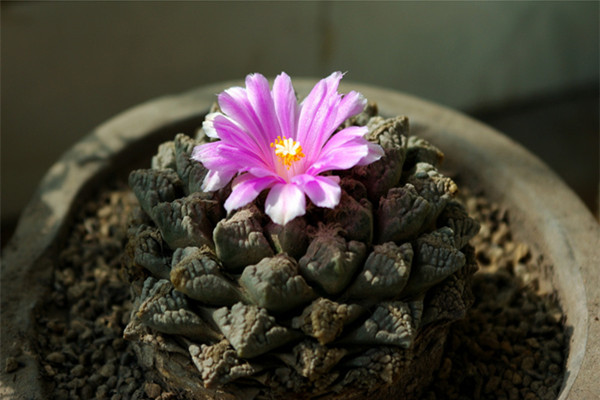
Cultivation methods for Ariocarpus fissuratus
Temperature
Ariocarpus fissuratus likes warmth and can tolerate low temperatures of 5°C. When water is withheld in winter, placed in a bright spot indoors, it can tolerate temperatures below 0°C.
Light
It likes ample but soft sunlight and needs appropriate shading in summer. If the light is too strong, it will not only easily scorch the body but also grow slowly. Normally it should be placed in a bright spot indoors.
Water
Water thoroughly during the growing season, but avoid continuous waterlogging in the pot.
Fertilizer
Apply a compound liquid fertilizer low in nitrogen and high in phosphorus and potassium about once every 15 days.
Soil
All plants of the genus Ariocarpus grow in calcareous soil, and Ariocarpus fissuratus is no exception.
The growing medium for Ariocarpus fissuratus is best a sandy soil with good drainage and aeration, containing an appropriate amount of calcareous material.
Precautions for growing Ariocarpus fissuratus
Maintain air humidity
The growing environment for Ariocarpus fissuratus should maintain air circulation and a certain level of air humidity.
Use a tall pot
Because this species of Ariocarpus fissuratus has a thick taproot, it is best to grow it in a relatively deep pot.
During cultivation, repot once every year to promote lush plant growth.
How to grow Ariocarpus fissuratus? Cultivation methods and precautions for Ariocarpus fissuratus
Ariocarpus fissuratus
[Common question] How to grow Ariocarpus fissuratus? What are the cultivation methods and precautions for Ariocarpus fissuratus?
[Expert answer] Ariocarpus fissuratus is a rare and endangered species, known as the "giant panda among plants" and also called the living rock. It blooms profusely with delicate, beautiful flowers and is a very beautiful small indoor potted plant. Below, the editor of First Agricultural Economics introduces the cultivation methods and precautions for Ariocarpus fissuratus:
1. Soil:In the wild, all plants of the genus Ariocarpus grow in calcareous soil. In most cases, the main component of calcareous material is calcium carbonate. However, while a certain amount of A. kotschoubeyanus grows on limestone, a large number of this species also grows in gypsiferous soil (whose main component is calcium sulfate). Limestone fragments are usually mixed with hard sandy clay, large amounts of minerals, and soil with low moisture. In its native habitat, large numbers of plants of this genus often appear in areas with well-drained, fragile, porous limestone. Therefore, it can be inferred that soluble calcium and other minerals are essential nutrients for plants of the genus Ariocarpus.
2. Temperature:It likes warmth and can tolerate low temperatures of 5°C. When water is withheld in winter, it can tolerate temperatures below 0°C.
3. Light:It likes ample but soft sunlight and needs appropriate shading in summer, in a bright spot indoors.
4. Water:Water thoroughly during the growing season, but avoid continuous waterlogging in the pot.
5. Air humidity:The cultivation site requires air circulation and a certain level of air humidity.
6. Fertilizer:Apply a compound liquid fertilizer low in nitrogen and high in phosphorus and potassium about once every 15 days.
7. Propagation:It can be propagated by sowing seeds or by removing offsets for grafting.
8. Repotting:During cultivation, Ariocarpus fissuratus should be repotted once every year to promote lush plant growth. The potting soil should be a sandy soil with good drainage and aeration, containing an appropriate amount of calcareous material. Because this species has a thick taproot, it is suitable for growing in a relatively deep pot.
[Editor's conclusion] Potted Ariocarpus fissuratus should be placed in a spot with soft, ample sunlight, and the air should circulate. For specifics, you can follow the care instructions introduced above by the editor of First Agricultural Economics. With careful care, Ariocarpus fissuratus can be made to bloom more.