Sunflower Planting Methods and Precautions
1. Rational crop rotation, choose a good previous crop. Sunflowers should not be planted continuously, nor should they be planted in low-lying, waterlogged plots. The choice of previous crop is not strict; apart from sugar beet and deep-rooted forage grasses, any other crop can serve as the previous crop for sunflowers. Sunflowers have strong adaptability and are best planted in sandy loam or loamy soil with deep soil layers, high humus content, and a pH of 6—8.
2. Select excellent seeds and treat them. Choose excellent varieties with high yield, good quality, excellent characteristics, good marketability, resistance to leaf spot disease, tolerance to sclerotinia, low empty grain rate, high germination rate, and strong germination vigor, and carry out seed treatment, giving full play to the role of "making the best use of seeds and making the best use of land."
3. Apply sufficient base fertilizer and lay a solid foundation. Sunflowers are a crop with high fertilizer demand. According to surveys, for every 100 kg of seed produced, 6 kg of nitrogen, 26 kg of phosphorus, and 86 kg of potassium need to be absorbed from the soil. Apply sufficient base fertilizer before sowing, and combine organic and inorganic fertilizers. Apply 30 to 40 cubic meters of decomposed and fermented organic fertilizer per hectare (preferably ash-manure), 150—200 kg of diammonium phosphate, and 100—150 kg of urea. Applying sufficient base fertilizer is the foundation for solid sunflower growth and development.
4. Seize the early start and sow early at the right time. Timely early sowing can prevent or reduce the occurrence of leaf spot disease and sclerotinia, and has a great impact on the yield and quality of sunflowers. The growth period of sunflowers is relatively short, and there is a relatively wide range of choices for sowing time. Sowing in early to mid-May, therefore oil-type varieties should be sown appropriately later; edible-type varieties should be sown appropriately earlier to prevent excessive late growth and reduced yield.
5. Rational close planting is beneficial for ventilation. Sunflowers have tall stalks and thick stems, so rational close planting is beneficial for ventilation and light penetration and improves photosynthesis. The principle is that tall-stalked, large-seeded varieties should be sparser; short-stalked and small-seeded varieties should be denser; oil-type varieties should retain 25000—30000 plants per hectare, and edible-type varieties 18000—20000 plants.
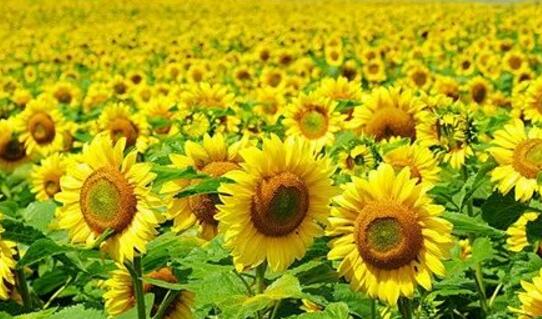
Because sunflower flowers are very popular, they have a strong market. Some people specialize in growing this herbaceous plant of the Asteraceae family, but most people grow it for ornamental purposes. Therefore, today we mainly introduce how to grow potted sunflowers, mainly covering temperature, water, light, soil, and other aspects of sunflower cultivation methods and precautions.
1. Potting
Usually, when the sown sunflower grows 4-5 tender leaves or the seedling has already taken root, it needs to be transplanted into a flower pot. This involves the propagation method of sunflowers, so for beginners it is not recommended to start from this step; you can directly buy sunflowers already potted from the market for planting.
2. Light
Although sunflowers sound very dependent on light, in the cultivation methods and precautions for sunflowers, we do not need to give them special light treatment for them to bloom normally, because as a short-day plant, it is not particularly sensitive to light.
Although sunflowers are not sensitive to light, this does not mean sunflowers do not like sufficient sunlight. Seedlings, leaves, and flower discs all have strong phototropism, so if you want them to grow healthily and robustly, sufficient light is very necessary and can promote the growth of the plant, stems, and leaves.
3. Temperature
Sunflowers have very strong adaptability to temperature. They can grow in high-temperature environments and also resist a certain degree of cold. Seeds have strong low-temperature survival ability; at 2 degrees the seeds can begin to germinate. The best temperature for germination is 31-37 degrees, and the maximum can be between 38-40 degrees.
However, it should be noted that in the cultivation methods and precautions for sunflowers, the most suitable growth temperature for sunflowers is 18-30 degrees, and the minimum temperature should not be lower than 10 degrees, otherwise its growth will be inhibited. Generally, the higher the temperature, the faster the development, but it is not recommended to keep it in a high-temperature environment for a long time.
4. Soil
Sunflowers can grow in various types of soil. They can even be planted in dry land and saline-alkali land because they have strong drought tolerance, salt tolerance, and waterlogging tolerance. Even when the water content is as low as 8.8%, they can still grow normally, so they are very easy plants to keep alive.
5. Watering
Although sunflowers have extremely strong drought tolerance, we still need to water them appropriately, because as light intensity increases, water evaporation also becomes faster. Especially in the flowering season, water supply is even more necessary, so water needs to be replenished in time. Generally, just follow the principle of alternating dry and wet.
6. Fertilizing
In order to let sunflowers grow more healthily and have fuller and more beautiful flowers, necessary fertilizing is very important. During the growing period, fertilize once every 7-10 days or so. During the seedling stage, mainly use nitrogen fertilizer, and after budding, use phosphorus and potassium fertilizer to promote the development of flower buds.
7. Pruning or transplanting
People appreciate sunflowers mainly for their yellow flowers, so during the growth process, excess side buds should be pruned, which can make them bloom more. 20 days after sunflower germination, spraying 89 solution can inhibit its growth height. If the plant is too tall, stakes can be used for support.
How to Grow Sunflowers, Sunflower Cultivation Methods and Precautions
Sunflowers are very beautiful flowers. They not only bloom but also produce sunflower seeds for people to eat. I believe many people feel joy at first sight of a sunflower. Sunflowers have huge, brightly colored flowers and dense branches and leaves, and are also novel ornamental potted plants. So do you know how to grow sunflowers? Let's take a look with the editor of Huayu.com at how sunflowers should be planted!
Sunflower Cultivation Methods and Precautions
1. Choose a suitable time for planting
Because the latitude difference between northern and southern China is very large, the temperatures in northern cities and southern cities are very different. The best temperature for seed germination is 24-28 degrees and must not exceed 30 degrees. Otherwise, if it is too hot, the seeds cannot handle it. So how do you grow sunflowers?
The growth period of sunflowers is 2-3 months. The temperature during the growth period should be above 28 degrees. If this cannot be reached, it is not suitable for planting. For example, even if the temperature in autumn is enough for seed germination, after germination it is already late autumn, so its growth needs cannot be met.
2. Sowing
The time for how to grow sunflowers was introduced above, so how do you sow sunflowers? Because they are sown from seeds. To ensure the success rate of germination, it is recommended to do this: tear half a paper napkin and soak it wet. Then put the seeds inside the napkin and cover them.
Loosen the soil in the small flower pot prepared in advance, then put the moistened seeds in. Remember that the soil must not cover too much; it can only be a thin layer, otherwise it will not have enough strength to sprout. Then adjust the nozzle of the spray bottle to the finest setting and sprinkle water evenly.
Another method can also be used: first wet all the soil in the small flower pot prepared for sowing (this method is an informal method used by lazy people like me; the previous one is what the book says), then similarly moisten the seeds in a wet napkin, and insert the sunflower seeds into the soil with the broad end up and the pointed end down. Then use a toothpick to push a little soil to cover the broad end of the seeds. Then spray a little water with the watering bottle.
3. Wait for germination
How do you grow sunflowers? Generally, after sowing sunflowers, you just wait for germination. Sunflowers sprout early or late. After sowing sunflowers, the days are spent waiting for germination. The germination time is about one week to 15 days. The time varies, depending on water, temperature, sunlight, soil, and the vitality of the seeds, roughly like this.
During this period, in order to ensure sufficient water, after spraying water on the sunflower sprouts every day, give the flowers one hour of light, and then cover them with plastic wrap or a glass sheet, leaving only a small gap for ventilation.
4. Moving to a pot
When the sunflower sprouts reach 1-2 cm and grow cotyledons and true leaves, or in other words after 2 or 3 leaves have grown, you should consider moving them to a pot. Transfer from the small pot used for germinating seeds to a larger pot. Of course, if you have enough flower pots at home, I think not moving them is also fine. That way you avoid accidentally damaging the roots.
5. Sufficient light and fertilizer
I believe everyone has some understanding of how to grow them, so what follows is much easier. You should boldly give it enough light and put it under the sun. Water it every morning when the sun has not yet risen, and remember to fertilize regularly. If it lacks sunlight, it will grow thin and long. A healthy sunflower should be thick, strong, and vigorous.
Continue growing leaves and basking in the sun until one day (probably after 1.5-2 months), you will find flower buds growing between the leaves of the sunflower. Remember to still insist on fertilizing. The lowest leaves of the sunflower slowly turn yellow and wither, while the flower buds above grow bigger and bigger, finally blooming into a beautiful sunflower, very pretty, golden yellow.
More related knowledge about sunflowers for flower lovers' reference: