How to propagate night-blooming jasmine (Cestrum nocturnum) by cuttings? Detailed methods and steps
The main propagation methods for night-blooming jasmine include cutting propagation, layering propagation, division propagation and seed sowing, among which cutting propagation is the most commonly used. Apart from winter, cutting propagation can be carried out at any time; keep it in a suitably warm and humid climate, and cultivate it in fertile soil, preferably sandy loam, because night-blooming jasmine has strong vitality, and new branches will gradually grow into a new young plant.
The cutting steps for night-blooming jasmine are as follows:
1. Choose the cuttings. Select branches that grow vigorously or are free of pests and diseases; on the same plant, choose sunny branches from the middle and upper parts of the current year's growth, requiring shorter internodes, thick and strong branches and leaves, and plump buds. Do not use branches that are about to flower or leggy growth.
2. Choose the substrate. Mix peat soil, leaf mold and sand in a ratio of 3:3:4 respectively; the bed soil prepared this way has the characteristics of raising bed temperature, retaining water, allowing aeration, being fertile and slightly acidic, and is suitable for the branches to take root and sprout.
3. Treat the cuttings. Before cutting, treat the cuttings with agents such as ABT rooting powder, which has the effect of promoting rooting. Cut the cuttings into segments of 8 cm to 12 cm, each bearing 2 to 3 buds; the lower cut of the cutting should preferably be 0.5 cm below a node, the cut should be smooth, remove the lower leaves, keeping only 2 to 3 leaves at the top, and the insertion depth is generally about 3 cm.
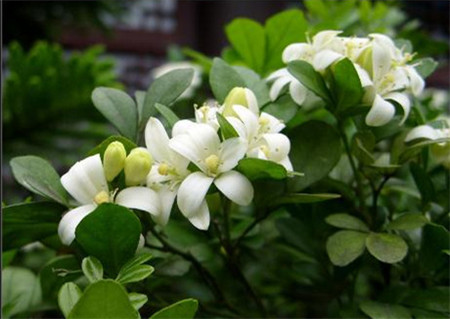
4. Create the conditions for rooting. The suitable rooting temperature is 20°C to 24°C; generally, soil temperature being 3°C to 5°C higher than air temperature is favorable for rooting. The relative air humidity of the cutting bed is 80% to 90%, which is favorable for rooting, and the light requirement is about 30%. Moisture should be appropriate: slightly more water in the early stage of cutting, and slightly drier later. The suitable period for open-field cutting locally is from early May to mid-June, when the climate is relatively good and can better meet the temperature and humidity conditions required for the cuttings to root.
5. Strengthen post-cutting management. After cutting, water thoroughly, cover with plastic film, and place in a relatively shady spot, or scatter loose grass on the film to prevent direct sunlight, and increase light at night to help the cuttings survive. Ventilate 1 to 2 times a day to replenish the needed oxygen and prevent disease. Spray water frequently to keep the cutting bed moderately moist, but do not spray excessively, otherwise the cutting bed will be too wet, which often affects the cuttings' healing and rooting. When the new roots of the cuttings grow to 2 cm to 3 cm, they can be transplanted into pots at the appropriate time. After flowering, in the Nanjing area, they should be moved indoors for maintenance in winter.
How to grow night-blooming jasmine: the latest detailed guide to growing night-blooming jasmine indoors
Introduction: night-blooming jasmine, as its name suggests, has a fresh fragrance, and especially at night its scent is even more fragrant. It is a vine-like shrub with weak branchlets, opposite leaves that are broadly ovate, heart-shaped to oblong-ovate, umbel-like cymes borne in the leaf axils, with as many as 30 flowers; the corolla has 5 lobes, oblong, yellow-green. Below let us learn about how to grow night-blooming jasmine indoors.
It likes a warm, humid, sunny, well-ventilated environment with loose, fertile soil; it is drought-tolerant and barren-tolerant, not waterlogging-tolerant, and not cold-tolerant. Therefore, growing night-blooming jasmine requires well-ventilated environmental conditions. From early May to the end of September, it is suitable to place it in a sunny part of the yard or on a balcony for maintenance. Although it likes sufficient sunlight, it should avoid scorching sun at noon in summer.
Summer is the peak growing season. In addition to applying sufficient fertilizer, the potting soil must be kept constantly moist, and if necessary, water twice a day. If it is a seedling, spray water on the leaf surface 1 to 2 times a day. Every year in mid-to-late October, it should be moved into a shed or indoor room, and the shed or room temperature should be kept at 8°C to 12°C; if the temperature is below 5°C, the leaves will turn yellow and fall off until the plant dies.
This truly lives up to its name night-blooming jasmine can give off a sweet fragrance, and it is mysterious, because it blooms at midnight and few people can see it in full bloom. Placing plants such as night-blooming jasmine that can give off a fresh fragrance in the bedroom can create a quiet and comfortable atmosphere for the bedroom, letting people fall asleep calmly and soundly amid the natural fragrance.
Everything has two sides, good and bad; if used inappropriately, it can also lead to bad consequences. Although night-blooming jasmine gives off a fresh fragrance at night, letting people fall asleep accompanied by its scent, not everyone can tolerate it. In the rooms of patients with high blood pressure and heart disease, it is not suitable to plant night-blooming jasmine flowers.
How to grow night-blooming jasmine
Night-blooming jasmine, also known as night fragrant flower, night orchid fragrance, night clove, foreign clove, foreign jasmine, etc. Solanaceae evergreen vine-like shrub. Native to South America and South China.
1. Morphological characteristics: leaves opposite, long ovate, base heart-shaped. Young branches green, old stems gray-white. Flowers small and clustered in the leaf axils of new branches, each inflorescence bearing 4〜5 yellow-green salverform corollas. Blooms at night, with a strong fragrance. Night-blooming jasmine gets its name from this.
2. Growth habits: likes a sunny, well-ventilated environment. Not cold-tolerant, afraid of frost, suitable for loose, breathable, well-drained fertile sandy loam.
3. Propagation and cultivation: propagation methods such as sowing, cutting and layering can be used. Cutting propagation is commonly used. Softwood cuttings can be taken in both spring and autumn. Cuttings should be selected from semi-lignified strong branches, 10〜15 cm long, strip the basal leaves, keep the upper two leaves, cut off 1/3〜 1/2 of the leaf tips, insert densely into a sand bed (pot) or rice husk ash, with a depth of 2/3 of the cutting length, water thoroughly, and except in the morning and evening, add a 5 cm〜70“ shade net every day, and spray water on the leaves at any time, note that the medium must not be too wet, otherwise it easily causes the stem part in the substrate to rot and die. After 15〜20 days, roots can form. Night-blooming jasmine can also be water-propagated; as long as there is a certain amount of light and clean water quality, it also roots and survives easily.
Night-blooming jasmine is generally used as a potted plant. The growing soil can be garden soil with an appropriate amount of peat soil and about 1 cm of decomposed organic fertilizer. Post-planting care and management are relatively extensive; just water in time, apply a relatively concentrated organic liquid fertilizer once in early spring or bury some cake fertilizer, and often apply some liquid fertilizer during the growing season. Because night-blooming jasmine grows vigorously and easily sprouts leggy branches from the root zone, a pruning combining renewal and shaping should be carried out after each full bloom, and at the same time cut off all redundant branches and dead branches, so that it sends out new branches, which is beneficial to vigorous growth and a large number of flowers. In winter, it should be kept above rc and the potting soil should not be watered too much.
Pest and disease control: night-blooming jasmine rarely suffers from pests and diseases. If they occur, promptly cut off diseased leaves or diseased branches and let it have ventilation and light. Pests can be caught manually.
Horticultural uses: night-blooming jasmine is often used as a family potted flower display. Its strong fragrance also has a certain mosquito-repellent effect.
The flowers of night-blooming jasmine can also be eaten, and are often used to make tea or as a seasoning for dishes. The flowers and roots are used as medicine, and have the effect of calming the liver and improving eyesight.