A Guide to Autumn Sowing of Herbaceous Flowers: Which Varieties Are Suitable for Planting in Autumn
True flower lovers mostly enjoy sowing seeds themselves. When you give flowers you have grown with your own hands to relatives and friends, what rises from the bottom of your heart is a kind of pride. Among herbaceous flowers, biennials and many perennial herbaceous plants are often propagated by autumn sowing to produce flower seedlings. Here is a collection of some herbaceous flowers suitable for sowing and growing on family balconies and in courtyards, with good flowering results.
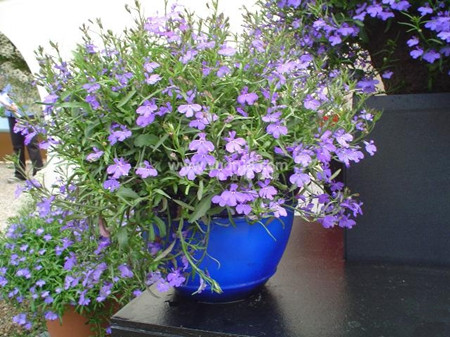
Trailing lobelia, also known as trailing six-times-lucky, is native to South Africa. It has flower meanings such as "pitiful" and "sympathy." Its natural flowering period is from summer to autumn. From sowing to flowering takes 14-16 weeks. Sowing requirements: cold-hardy varieties are sown in autumn from September to October. The sowing soil is a mixed substrate of leaf mold, potting soil and fine sand. Each gram contains 24,000 seeds; the seeds are tiny and light-loving, so there is no need to cover them with soil after sowing. The optimum germination temperature is 18°C-21°C, and germination occurs 2-3 weeks after sowing. Seedling management: transplant once when the seedlings have 2-3 true leaves, and plant out or pot up when they have 6-7 leaves. Use 8 cm-10 cm pots for pot culture, and 10 cm-15 cm pots for hanging basket culture, planting 3 seedlings per pot. Use a mixed soil of fertile garden soil and peat soil for the pots. During the growing period, keep the pot soil moist, preventing both excessive moisture and dehydration. Fertilize once every half month.
Columbine, also known as columbine flower, has its original species native to Europe. It has flower meanings such as "frankness," "worry" and "victory." Its natural flowering period is from late spring to midsummer. From sowing to flowering takes 5-6 months. Sowing requirements: sow in autumn from September to October, or sow immediately after the seeds mature. The optimum germination temperature is 18°C-21°C, and germination occurs 5-4 days after sowing; germination is uneven, and it will not germinate if the temperature is too high. Seedlings sown from seed bloom in the second year. Seedling management: after 1 transplant, when the seedlings are 8 cm-10 cm tall, pot them into 15 cm-18 cm pots. Use a mixed soil of leaf mold, potting soil and coarse sand for the pots. It is sensitive to water; during the growing period, keep the soil moist and the air humidity relatively high, and shade it in summer. Fertilize once a month during the growing period.
Snapdragon, also known as dragon's-head flower, originates from the Mediterranean region. The ones currently sold on the market are all hybrid-bred cultivars. Its natural flowering period is from summer to autumn. From sowing to flowering takes 21-22 weeks. Sowing requirements: in areas south of the Yangtze River, sow from September to October. The sowing soil is a mixed substrate of leaf mold, potting soil and fine sand; it is light-loving, so broadcast sow, do not cover after sowing. The optimum germination temperature is 21°C, and germination occurs 1 week after sowing. Seedling management: the optimum growing temperature for the seedlings is 10°C-16°C; after 6 weeks, plant into 10 cm pots. Use a mixed soil of fertile garden soil, peat soil and sand for the pots. Fertilize once every half month during the growing period.
What flowers are better to sow in autumn
Autumn has quietly come to us. Sowing in autumn, with seedlings overwintering, then flowering and setting seed in the following spring and summer, and dying afterward, is why they are also called autumn-sown flowers. Many flower lovers ask what flowers are better to sow in this season. Below, Zuihua Web answers this question for everyone. Such as snapdragon, pansy, wallflower, ornamental kale, pot marigold, daisy, campanula, sweet william, creeping baby's breath, cornflower, evening primrose, freesia, nasturtium, lisianthus, and so on.Snapdragon (aliases: dragon's-head flower, lion flower, dragon-mouth flower, foreign colorful sparrow), snapdragon is a perennial herbaceous plant, often cultivated as an annual or biennial flower. The plant height is 20-70 cm, and the leaves are oblong-lanceolate. It has a raceme, the corolla is tubular and lipped, swollen into a pouch shape at the base, the upper lip upright and 2-lobed, the lower lip 3-lobed, spreading and curved outward, in colors such as white, pale red, deep red, flesh color, deep yellow, light yellow, and yellow-orange.
Pansy (aliases: human-face flower, cat-face flower, sun butterfly flower, butterfly flower, ghost-face flower), relatively cold-hardy, likes coolness, and develops well under conditions of a daytime temperature of 15-25°C and a nighttime temperature of 3-5°C. If the daytime temperature stays above 30°C continuously, the flower buds disappear or petals do not form. Day length has a greater effect on flowering than light intensity; poor sunlight results in poor flowering. It likes fertile, well-drained neutral loam or clay loam rich in organic matter. It is a perennial flower, often cultivated as a biennial.
Lisianthus (Chinese aliases: Turkish bellflower, beauty bowl flower, Texas bluebell), cultivated in fertile loam rich in organic matter. Propagation method: by sowing, sown in autumn or early winter.
Freesia (freesia, aliases fragrant snow orchid, small iris orchid, foreign tuberose, wheat orchid, etc., a bulbous flower of the Iridaceae family.)
Perennial herbaceous plant. The corm is conical. The leaves are linear, alternately arranged in two rows, and the spiral-shell-shaped inflorescence is inclined, with narrow funnel-shaped flowers. The main cultivars include the light purple "Blue Sister," the bright yellow "Cream Cup," the red "Fast Red," the white "Graceful" and the orange "Spring Day," etc.
Nasturtium (aliases: nasturtium lotus, cold lotus, golden lotus flower, nasturtium flower, money lotus, cold golden lotus, large red sparrow), nasturtium is also known as golden lotus flower and nasturtium lotus, and is a perennial succulent herbaceous flower of the Tropaeolaceae family. It originates from South America, likes warmth and humidity, avoids the high heat of summer, is not tolerant of waterlogging, and is extremely easy to cultivate. In southern China it can be grown as a perennial; in North China it is mostly sown in autumn and grown indoors in pots, as a spring-welcoming flower, made to bloom during New Year's Day and the Spring Festival.
Cornflower, at first I felt it was hard to grow, but unexpectedly, after sowing the seeds, the germination rate was actually quite high. However, leaf miners really like to eat its leaves. As soon as you find leaf miners, you must eliminate them immediately, otherwise they will spread. The flowers are very beautiful, right?
Autumn is the season when chrysanthemums bloom in profusion, and many parks and public places hold chrysanthemum exhibitions. In fact, growing them in flower pots is also very beautiful. They are very easy to grow and keep alive. I don't know if the symbolic meaning is not so good. But just appreciating them is enough.
Cypress vine has small, black seeds, but it sprouts very quickly. It is suitable for beginners just getting into growing flowers. When I was little, I also called cypress vine star flower. Once grown, it climbs many vines and blooms lots and lots of small flowers. Beautiful, with a fresh scent.
Zinnia: if you sow this, the germination rate is very high. Basically all of mine sprouted, and if the flower pot is relatively large and the soil is fairly fertile, it can grow into a big plant, blooming from late summer into autumn. You'll know once you've grown it.
The part below the amaryllis is like garlic or an onion bulb, with just a few leaves that are both thick and large. After growing for a long time, small ones grow out beside it. When it blooms it looks like a single showpiece, but the colors are very bright and beautiful.
Red swamp lily, this one is very easy to grow. I put it on the terrace, and it stayed fine even at summer temperatures close to 40°C, and it didn't freeze to death when it snowed in winter. It quickly filled a whole pot, blooming with pink flowers, clean and beautiful.
Moss rose is generally sown in spring, but actually it can be grown in autumn too. You can sow it with seeds, or just casually break off a branch, stick it into the soil, water it regularly, and it will live. If the soil is fertile, it can grow a whole pot full.
Through the introduction in this article, flower lovers who want to sow seeds can refer to it. If you want to learn more home gardening knowledge, please continue to follow Zuihua Web!
How to grow herbaceous flowers
Herbaceous flowers have the characteristics of a high cultivation coefficient, fast growth, and brilliant flower colors, and are important materials for arranging flower beds. The herbaceous flowers commonly used in "May 1st" flower beds in the Fangshan area of Beijing include salvia, marigold, petunia, cold chrysanthemum, corn poppy, etc. From September 2009 to May 2010, the author conducted cultivation using different growing and seedling-raising methods for the marigold and petunia used in "May 1st" flower beds at the flower base of the Fangshan Landscape Institute.
Materials and methods for growing herbaceous flowers
Materials
The petunia seeds were self-collected by the base in autumn 2008, and the marigold seeds were purchased domestic F1 generation seeds. The cuttings used for petunia were tender shoots of the current year.
Methods
In this garden, open-field cultivation combined with greenhouse cultivation was used, with observation and recording, comparing seedling growth and plant flowering, and comparing the seedling-raising effects of applying different growing materials and seedling-raising techniques.
Marigold sowing trial by stages
Marigold was sown 3 times at different times. The first was November 15, 2009, the second was December 1, 2009, and the third was December 15, 2009.
The sowing method was pot sowing in all cases
The soil was old pot soil, sifted and filled into shallow seedling pots, the surface soil smoothed, then the seeds scattered evenly, covered with soil about 3 mm thick, watered by the bottom-watering method of soaking the pot, covered with glass and placed in a slightly shaded place to wait for germination.
After the seeds germinate, when the seedlings grow one pair of true leaves, thin them out and transplant into seedling containers, with a plant and row spacing of 5 cm × 5 cm. When the seedlings grow larger, pot them up for final planting, with pot specifications of 15 cm × 10 cm, and the pot soil made by mixing old pot soil and cow dung at a ratio of 2:1. During the seedling stage, control watering, just water when dry and let dry when wet, to prevent leggy growth. Apply liquid fertilizer once every 15 days, turn the pots once a week, and weed and spray pesticides in time. To promote more branching and more flower buds, pinch the plants in time. After the flower buds appear, to control the flowering period, remove the flower buds that appear too early.
Petunia sowing and cutting comparison trial. Pot-sown on November 4, 2009. The flower seeds were collected in the garden in autumn 2008. The soil was old pot soil, sifted and filled into shallow seedling pots, the surface soil smoothed, then the seeds were mixed evenly with soil and broadcast sown, without covering with soil, watered by the bottom-watering method of soaking the pot, covered with glass and placed in a slightly shaded place to wait for germination.
When the seedlings grow two cotyledons but the true leaves have not yet unfolded, begin thinning. When 1 true leaf has grown, transplant into plastic seedling containers, with a plant and row spacing of 2 cm × 2 cm. On February 19, 2010, the transplanted petunias were potted for the first time, with pot specifications of 10 cm × 6 cm, and the pot soil made by mixing garden soil, leaf mold and cow dung at a ratio of 4:2:1. More than a month later, they were potted a second time, that is, repotted, with pot specifications of 15 cm × 10 cm, and the pot soil made by mixing garden soil, leaf mold and cow dung at a ratio of 4:2:1.
Cuttings taken on November 4, 2009. Tender shoots were cut from flowers of the current year as cuttings, with a cutting length of 2.5 cm. The last node was inserted into vermiculite, pressed firm by hand, sprayed with water thoroughly and placed in a relatively shaded place. After rooting, they were potted on January 8, 2010, with pot specifications of 10 cm × 6 cm. They were repotted on March 20, with pot specifications of 15 cm × 10 cm. The soil used for both pottings was made by mixing garden soil, leaf mold and cow dung at a ratio of 4:2:1.
The daily care and management of the two methods were similar, that is, keeping them moist, but not watering too much, so as to avoid leggy growth of stems and leaves. Apply more phosphorus and potassium fertilizer and less nitrogen fertilizer. During the seedling stage, spray potassium dihydrogen phosphate on the leaves twice; after final planting and care, water with fertilizer once every half month. Pinch twice in total: the first on February 22, 2010, and the second on March 11.
Results and analysis of herbaceous flower growing
Marigold trial results. To shorten the marigold seedling-raising cycle, observations were made of the time to seedling maturity for different sowing dates. The data show that sowing at 3 different times all produced plants that flowered on schedule before the holiday, and when the flowers were in full bloom, the plant height, crown width, flower color and flower quantity differed little. Plants sown later were taller than those sown earlier, possibly related to the higher indoor temperature, causing leggy growth. Therefore, when growing, the room temperature should be well controlled so that the plants are more robust.
The results show that the marigold sowing time can be postponed to mid-December, and it can still be guaranteed to bloom before Labor Day of the following year, with good growth.
Petunia trial results. The seeds germinated one week after sowing, germinated uniformly, with a germination rate of 90%; after potting, flower buds first appeared in mid-to-late March 2010, and they bloomed in full on April 28, with a bicolor flower color. The cuttings began to form callus 10 days after insertion, and rooted successively after 15 days, with a rooting rate of 96%; flower buds appeared on March 15, 2010, and they bloomed in full on April 25, with a bicolor flower color.
Petunia sowing and cutting were carried out on the same day. Although the full-bloom periods differed, with cuttings being two or three days earlier than sowing, the seedlings produced by both methods could open on schedule before the holiday. For seedlings raised by sowing and by cutting, when in full bloom, the plant height, crown width, flower color and number of flowers differed little. The petunia seedlings from sowing were short and small, grew slowly during the seedling stage, and from germination to the first potting was more than two months, with a plant height of only 2.1 cm; the petunias from cuttings rooted slowly, but the rooting rate was high. The petunias from cuttings went from cutting to the first potting in more than a month, and the plants were relatively larger, easy to manage, and in the later growth stage water and fertilizer had to be controlled to prevent leggy growth. Therefore, in production it is better to use the cutting method to raise petunias.
Summary. From the above trials it can be seen that under the current cultivation conditions in Fangshan, Beijing, petunias raised by the cutting method have good results, with the characteristics of simple material sourcing, a high rooting rate, and a shortened cultivation cycle. Marigold sown from mid-November to mid-December can all produce seedlings for the holiday, with little difference in quality.