Staghorn Fern Growing Methods and Precautions
[Division time]: It is best to do this in early spring (February or March) after the soil has thawed.
[Division method]: Take the mother plant out of the flower pot, shake off excess potting soil, separate the root system that has become tangled together as much as possible, and cut it apart with a sharp knife into two or more plants. Each divided plant must have a substantial root system, and its leaves should be pruned appropriately to help it survive.
[Potting and disinfection]: Soak the divided small plants in a 1500-fold solution of chlorothalonil for five minutes, then take them out and let them dry before potting. You can also drench the roots with chlorothalonil immediately after potting.
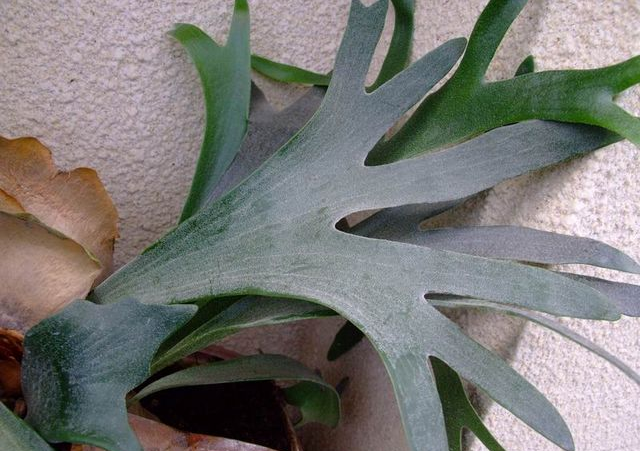
[Management after division]: After dividing and potting, drench the roots or water thoroughly once. Because its root system is severely damaged and its water-absorbing capacity is very weak, it takes about 3 to 4 weeks to recover and sprout new roots. Therefore, within 3 to 4 weeks after division, watering should be controlled to avoid root rot. However, transpiration from its leaves is not affected. To maintain the water balance of the leaves, spray the leaf surface 1 to 3 times a day (spray more when the temperature is high, and spray less or not at all when the temperature is low). Do not apply fertilizer during this period. After division, also be careful of overly strong sunlight and keep it in a shade shed for care.
[Potting]: When potting small seedlings, first place coarse-grained substrate or ceramsite 2 to 2 cm thick at the bottom of the pot as a drainage layer, sprinkle a layer of fully decomposed organic fertilizer on top as a base fertilizer about 1 to 2 cm thick, then cover with a layer of substrate about 1 to 2 cm thick, and then place the plant in so that the fertilizer is separated from the roots to avoid burning the roots.
The substrate used for potting can be one of the following. Garden soil: cinder = 3:1; or garden soil: medium-coarse river sand: sawdust (mushroom residue) = 4:1:2; or one of paddy soil, pond mud, or leaf mold. Or peat + perlite + ceramsite = 2 parts + 2 parts + 1 part; garden soil + cinder = 3 parts + 1 part; peat + cinder + ceramsite = 2 parts + 2 parts + 1 part; sawdust + vermiculite + medium-coarse river sand = 2 parts + 2 parts + 1 part. After potting, water thoroughly once and keep it in a shaded environment for care.
[Humidity management]: It likes a moist climate environment and requires the relative air humidity of the growing environment to be 60 to 75%.
[Temperature management]: The optimum growing temperature is 18°C to 30°C. It is averse to cold and frost, and the overwintering temperature needs to be kept above 10°C. In winter, when the temperature drops below 4°C, it enters a dormant state. If the ambient temperature approaches 0°C, it will die from frost injury.
Staghorn Fern Growing Methods and Precautions
Chinese scientific name: Staghorn FernLatin scientific name: Platycerium wallichii Hook.Binomial name: Platycerium wallichiiKingdom: PlantaePhylum: PteridophytaClass: PolypodiopsidaOrder: PolypodialesFamily: PlatyceriaceaeGenus: PlatyceriumDistribution area: tropical regions of eastern Australia, New Guinea Island, the Lesser Sunda Islands and Java, and Yunnan, ChinaEnglish name: Staghorn fernStaghorn fern (scientific name: Platycerium wallichii Hook.), also known as elk horn fern, bat fern, and staghorn fern, is a plant of the genus Platycerium in the family Polypodiaceae. It is native to tropical regions such as eastern Australia and Polynesia, and is an epiphytic ornamental fern. Its spore-bearing leaves are very distinctive, shaped like sika deer antlers.1. Morphological characteristics
Epiphytic plant. Rhizome fleshy, short and prostrate, densely covered with scales; scales light brown or grayish white, dark brown in the middle, hard, linear, 10 mm long, 4 mm wide. Leaves in 2 rows, dimorphic; basal sterile leaves (humus leaves) persistent, thickly leathery, fleshy in the lower part, up to 1 cm thick, thin in the upper part, upright, sessile, appressed to tree trunks, up to 40 cm long, length and width nearly equal, apex truncate, irregular, 3-5 times forked, lobes nearly equal in length, rounded-obtuse or pointed, entire, main vein raised on both sides, veins indistinct, both sides sparsely covered with stellate hairs, green at first, soon withering, brown. Normal fertile leaves often grow in pairs, pendulous, grayish green, 25-70 cm long. Divided into 3 main lobes of unequal size, base cuneate, decurrent, nearly sessile, the inner lobe largest, repeatedly forked into narrow lobes, the middle lobe smaller, both fertile, the outer lobe smallest, sterile, lobes entire, the whole body covered with grayish white stellate hairs, veins thick and prominent. Sori scattered below the first fork notch of the main lobe, not reaching the base, green at first, later turning yellow; paraphyses grayish white, stellate hairs. Spores green.2. Growth habits
Staghorn fern, also known as staghorn fern, likes warm, shady, and humid environments and fears direct strong light, preferring scattered light. In winter, the temperature should not be lower than 5°C, and the soil should preferably be loose leaf mold. It exhibits alternation of generations, with the sporophyte and gametophyte both living independently.The distribution area has a tropical monsoon climate, hot and rainy. The annual average temperature is 22.6°C, the January average temperature is 15-17°C, the extreme minimum temperature is not lower than 5°C, and the extreme maximum temperature is 39.5°C; annual precipitation is about 2000 mm, and relative humidity is not lower than 80%. It often grows epiphytically on the trunks and branches of monsoon forest trees dominated by Chukrasia tabularis var. velutina (Wall.) King, Albizia chinensis (Osb.) Merr., Ficus benjamina L., etc., and can also grow epiphytically on tree trunks or dead standing trees at forest edges and in open forests. Staghorn fern uses humus leaves to accumulate fallen leaves, dust, and other materials as nutrients. When the rainy season begins, new humus leaves and fertile leaves, 2 of each, grow at the top of the short stem. The humus leaves of the previous year wither and rot in the current year, while the fertile leaves gradually dry up and fall off only in the spring of the following year.
Growing Methods and Precautions for the Long-Leaf Staghorn Fern
Chinese scientific name: Long-leaf staghorn fernKingdom: PlantaePhylum: PteridophytaClass: PolypodiopsidaOrder: PolypodialesFamily: PlatyceriaceaeGenus: PlatyceriumAlso known as the Java staghorn fern, a large epiphytic fern. The rhizome of the long-leaf staghorn fern is creeping, and the appearance of the scales varies greatly, with serrated edges. The leaves are dimorphic; the basal leaves are round-kidney-shaped, closely appressed to the attachment, initially green, later turning brown, entire or wavy-margined, and are humus-collecting leaves that can collect nearby insect corpses, fallen leaves, rainwater, etc., to serve as nutrients for itself. The other leaves are shaped like sika deer antlers; when they first emerge they are upright, and after growing a little they droop, reaching up to 100 cm long; the leaves are divided several times in a dichotomous fork, and the leaf underside is very hairy. The sori grow on the back of the leaf apex, forming cushions, and have no indusium.