How to Grow Cobra Lily (Darlingtonia californica)? A Complete Guide to Cultivation Essentials
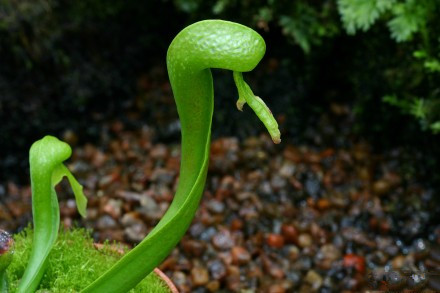
Cobra lily (Darlingtonia californica) is one of the genera in the pitcher plant family (Sarraceniaceae) and is a carnivorous plant, mainly distributed in northern California and Oregon in the United States. The cobra lily is a very well-known carnivorous plant species, named for its resemblance to a cobra, and is a prized collector's target for many enthusiasts. The left and right sides of their pitcher lid are fused, forming a bulbous top that makes the entire trap almost sealed. At the junction between the bulbous lid and the pitcher body there is a sunken gap. The lid and pitcher body bear many white markings that lack chlorophyll, and sunlight can shine through these white patches into the trap. Insects (mostly ants) can enter the trap through the narrow slit. Once inside, they are confused by these white patches, mistakenly believing the white patches are the exit, lose their way inside the trap, and finally fall into the digestive fluid and are digested.
Substrate
Peat, sand, sphagnum moss, peat, perlite, coconut husk, etc.
Watering
It needs to be watered with soft water, such as rainwater, distilled water, reverse osmosis deionized water, etc. Tap water in some areas contains large amounts of minerals (especially calcium salts). These calcium salts will precipitate out and thereby kill the plant. This is because most carnivorous plants have adapted to poor, acidic soil, so they are extremely calcifuge plants, and therefore they are very sensitive to nutrients in the soil.
Temperature
It tolerates cold but fears heat; especially the roots must be kept icy cold, and there should be a large temperature difference between day and night; it can survive between -10 degrees and 30 degrees, and 15 to 27 degrees is the temperature most suitable for its growth. It likes strong light, and when the temperature is not too high, it can accept direct sunlight, and the top of the plant will show a red network pattern, which is very beautiful.
Pests and Diseases
It is susceptible to damage from aphids or mealybugs. Smaller infestations should be removed by hand, while larger infestations should be treated with insecticides as appropriate. Isopropyl alcohol is an effective insecticide against scale insects. Diazinon is also a broad-spectrum insecticide tolerated by most carnivorous plants. Malathion and acephate are likewise suitable for carnivorous plants.
Although pests are a problem, the biggest problem is gray mold. It develops in warm, humid environments and becomes a serious problem in winter. Placing it in a cool, well-ventilated environment and promptly removing diseased branches can, to a certain extent, inhibit the development of gray mold. If that fails, fungicides should be used as appropriate.
Cultivation Essentials for Cobra Lily
Cobra lily (Darlingtonia californica) is a very famous carnivorous plant, named because its appearance closely resembles a cobra, and it is also a prized collector's target for many plant enthusiasts. So how should cobra lily be grown?
Cobra Lily
Cobra lily is one of the more difficult carnivorous plants to cultivate. It requires relatively high daytime temperatures and relatively low nighttime temperatures. Its native habitat is swamps or riverbanks where cold mountain springs flow in year-round, so the roots can remain at a relatively low temperature at all times. Therefore, the best simulation method in cultivation is to grow it with cool, pure water. When the weather is hot, ice cubes can be placed on the soil surface to lower the temperature. In a high-humidity, warm environment, the plant can be given plenty of sunlight; if the humidity is low or fluctuates greatly, it needs slight shading.
Growing cobra lily from seedlings is very difficult and slow, so it is usually propagated in late winter or spring from its stolons. Usually from the spring equinox to late spring, many small buds will grow on the nodes of the stolons. Cut the stolons into several sections, each with some roots. Then place these stem sections on cool, moist crushed sphagnum moss and maintain a bright, high-humidity environment. After a few weeks, the buds can be seen developing.
Like other carnivorous plants that grow in temperate regions, cobra lily requires winter dormancy to survive long-term. The plant stops growing for 3 to 5 months in winter. Until close to spring, mature plants will produce a single flower, and several weeks later grow several large traps. Throughout summer it will continuously grow traps, but their size is far smaller than the spring traps.
Many growers have successfully cultivated cobra lily and have found three forms: all-green, all-red, and red-green. Wild cobra lily is all-green under ordinary light intensity, and shows red-green under strong light.
Cultivation Essentials for Cobra Lily
Cobra lily (Darlingtonia californica) is one of the genera in the pitcher plant family (Sarraceniaceae) and is a carnivorous plant, mainly distributed in northern California and Oregon in the United States. The cobra lily is a very well-known carnivorous plant species, named for its resemblance to a cobra, and is a prized collector's target for many enthusiasts. The left and right sides of their pitcher lid are fused, forming a bulbous top that makes the entire trap almost sealed. At the junction between the bulbous lid and the pitcher body there is a sunken gap. The lid and pitcher body bear many white markings that lack chlorophyll, and sunlight can shine through these white patches into the trap. Insects (mostly ants) can enter the trap through the narrow slit. Once inside, they are confused by these white patches, mistakenly believing the white patches are the exit, lose their way inside the trap, and finally fall into the digestive fluid and are digested.
Substrate
Peat, sand, sphagnum moss, peat, perlite, coconut husk, etc.
Watering
It needs to be watered with soft water, such as rainwater, distilled water, reverse osmosis deionized water, etc. Tap water in some areas contains large amounts of minerals (especially calcium salts). These calcium salts will precipitate out and thereby kill the plant. This is because most carnivorous plants have adapted to poor, acidic soil, so they are extremely calcifuge plants, and therefore they are very sensitive to nutrients in the soil.
Temperature
It tolerates cold but fears heat; especially the roots must be kept icy cold, and there should be a large temperature difference between day and night; it can survive between -10 degrees and 30 degrees, and 15 to 27 degrees is the temperature most suitable for its growth. It likes strong light, and when the temperature is not too high, it can accept direct sunlight, and the top of the plant will show a red network pattern, which is very beautiful.
Pests and Diseases
It is susceptible to damage from aphids or mealybugs. Smaller infestations should be removed by hand, while larger infestations should be treated with insecticides as appropriate. Isopropyl alcohol is an effective insecticide against scale insects. Diazinon is also a broad-spectrum insecticide tolerated by most carnivorous plants. Malathion and acephate are likewise suitable for carnivorous plants.
Although pests are a problem, the biggest problem is gray mold. It develops in warm, humid environments and becomes a serious problem in winter. Placing it in a cool, well-ventilated environment and promptly removing diseased branches can, to a certain extent, inhibit the development of gray mold. If that fails, fungicides should be used as appropriate.