Which is easier to grow, camellia sasanqua or camellia? Camellia sasanqua is more expensive because it has stronger disease and cold resistance
Camellia is surely familiar to everyone; it is one of China's top ten famous flowers. As for camellia sasanqua, many people surely know it too. It gets its name because its form and flower shape combine the beauty of camellia and the elegance of plum blossom, making it a precious flower. Regarding camellia sasanqua and camellia, many flower lovers are puzzled: which is easier to grow, camellia sasanqua or camellia? Why is camellia sasanqua more expensive than camellia? Here, the editor will answer these questions for you.
I. Differences between camellia sasanqua and camellia
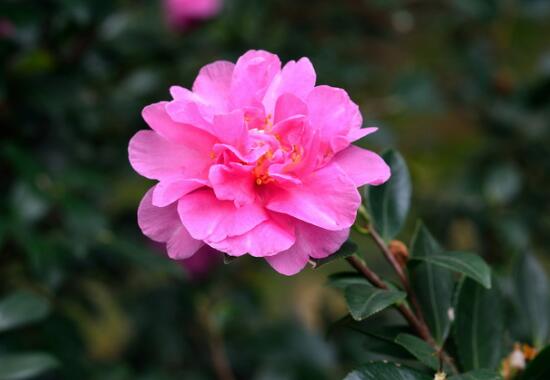
In daily life, many beginners cannot tell camellia sasanqua and camellia apart when buying potted plants, so to answer which is easier to grow, camellia sasanqua or camellia, we need to know the differences between them. Here, the editor will briefly distinguish them by flower shape, fragrance, flower drop, and flowering period, as follows:
1. Flower shape: Camellia flowers are trumpet-shaped, while camellia sasanqua flowers are saucer-shaped. As long as you observe carefully, you can tell them apart.
2. Fragrance: It is said that camellia flowers have no fragrance, while camellia sasanqua flowers inherit the characteristics of plum blossoms and carry a faint floral scent.
3. Flower drop: Camellia flowers fade in a very distinctive way; their petals scatter one by one. Camellia sasanqua is different: when its flowers fade, the whole flower falls off.
4. Flowering period: Camellia blooms from February to April, while camellia sasanqua blooms from November to January of the following year, so camellia blooms later than camellia sasanqua.
II. Which is easier to grow, camellia sasanqua or camellia? Camellia sasanqua
Now that we know the differences between camellia sasanqua and camellia, let us return to the question itself: which is easier to grow, camellia sasanqua or camellia? According to the editor, the vast majority of flower lovers who have grown both believe camellia sasanqua is a bit easier to grow, because its resistance to disease, sun and cold is a little stronger than camellia's, and it does not get sick easily. Besides stronger resistance, we can also observe from their growth habits:
Camellia growth habits: It likes semi-shade and avoids blazing sun; it likes a warm climate and is slightly cold-tolerant; ordinary varieties can withstand low temperatures of -10°C and are heat-tolerant. It is suitable for fertile, loose, well-drained acidic sandy soil. Overall, the keys to growing camellia well are: suitable potting soil, frequent fertilizing, proper watering, and appropriate shading.
Camellia sasanqua growth habits: It likes shady and moist conditions, with half shade and half sun being most suitable, but it avoids direct strong light. Camellia sasanqua likes a warm, humid climate and is suitable for fertile, loose, well-drained acidic sandy soil. Overall, the keys to growing camellia sasanqua well are: suitable potting soil, light fertilizing, proper watering, and appropriate shading. By comparison, as to which is easier to grow, camellia sasanqua or camellia, camellia sasanqua is clearly a bit easier to grow.
III. Why camellia sasanqua is more expensive than camellia
This question arises because camellia sasanqua's form and flower shape combine the beauty of camellia and the elegance of plum blossom. But saying camellia sasanqua is more expensive than camellia is wrong, because camellia is more expensive. In flower shops, there are many camellias priced over 500, but for camellia sasanqua, it seems I have never heard of any priced over 500. Of course, prices differ by region, and everyone should judge according to the actual situation.
In general, camellia sasanqua and camellia are both very beautiful flowers, and both are easy to keep alive, so friends who want to grow them can get started. As for what to grow, if you have no time or are rather lazy, then grow camellia sasanqua; it does not get sick easily and is easier to grow. If you do not know how to grow it, you can also look at the cultivation methods for camellia sasanqua, which will help you~
Begonia Begonia evansiana Andr. Begonia illustrated guide: how to grow begonia / how to propagate begonia
Begonia profileBegonia Begonia evansiana Andr.
Begonia cultivation methods and precautions, introduction to begonia
Begonia was anciently called "August spring" and is also known as acacia grass, heartbreak flower, acacia grass, and heartbreak grass. It belongs to the family Begoniaceae and the genus Begonia. It is a famous ornamental flower, with brilliant flower colors, varied flower shapes, and delicate, charming, verdant leaves. Begonia is native to China and is a perennial evergreen herbaceous flowering plant. The flowers are red, pink, and white, and the flowering period is from April to November. Not only are the flowers attractive, but the leaves are also rich in color, including light green, dark green, light brown, dark brown, and purplish red. There are more than 20 varieties, such as wax begonia, cane begonia, hairy-leaf begonia, rex begonia, spotted begonia, and variegated-leaf begonia. It is said that Emperor Xuanzong of Tang once used "begonia not yet fully awake from sleep" to describe Yang Guifei's appearance when drunk and not yet awake, with a hazy, languid look after dressing.
Morphological characteristics of begonia
Stem erect and smooth; ovate leaves, base obliquely heart-shaped, red beneath; pale red flowers in autumn, monoecious and cross-flowered; capsule with three large wings. Begonias are perennial herbaceous or woody plants. The stem is green, erect, smooth, 60-100 cm tall, usually 80 cm. There is a spherical tuber underground. The stem is erect and stout, much branched, smooth, and swollen at the nodes. Bulbils grow in the leaf axils; leaves alternate, petioles 5-12 cm long; stipules lanceolate; leaf blades obliquely ovate, 8-20 cm long, 6-18 cm wide, apex pointed, base oblique. Both surfaces bear fine bristles, the lower surface of the leaf and the petiole are purplish red, and the margin has fine pointed teeth. Flowers unisexual, pink, 2.5-3.5 cm in diameter; monoecious, forming axillary forked cymes; male perianth segments 4, the outer 2 round and larger, stamens numerous, gathered into a head, filaments united into 1 common stalk, anthers yellow; female perianth segments 5, the inner ones smaller, pistil 1, differentiated from 3 carpels, ovary inferior, styles 3-forked, stigma twisted. Capsule 1.5-3 cm long, with 3 wings, one of which is usually larger. Flowering period July-August, fruiting period October-November.
Nodes swollen and succulent. Some have rhizomes, some have tuberous stems. Leaves alternate, round or obliquely heart-shaped with unequal sides; some leaf blades resemble elephant ears, red or green, or with white markings, red beneath, and some leaves have protrusions. Flowers terminal or axillary, in cymes, with white, pink, red and other colors. There are more than 400 species of begonia, and nearly a thousand horticultural varieties. They are divided into three major groups: tuberous begonias, rhizomatous begonias, and fibrous-rooted begonias. Mostly cultivated in gardens. Distributed throughout the country.
Tuber irregularly flattened-globose. Leaves irregularly heart-shaped, apex sharply pointed, base oblique, green, margin with coarse teeth and cilia. Axillary cymes, flowers large and beautiful. There are very many varieties, including single, semi-double, double, and ruffled-petal forms. Flower colors include red, white, pink, and bicolor. Rhizome nearly spherical, 8-20 mm in diameter, with dense and interwoven slender fibrous roots. Stem erect, branched, 40-60 cm tall, with longitudinal ridges, nearly hairless. Basal leaves not seen. Cauline leaves alternate, with long petioles; leaf blades unequal on both sides, outline broadly ovate to ovate, 10-18 cm long, 7-14 cm wide, apex acuminate to long acuminate, base heart-shaped, oblique, narrow side 1.6-4 cm wide, broad side extending downward as long as 3-6.5 cm, 4-8 cm wide, margin with unequal triangular shallow teeth, tooth tips with short awns, and often wavy or broadly triangular very shallow teeth, appearing more on the broad side, upper surface brownish green, often with a red halo, sparsely bearing bristles when young, gradually falling off, nearly hairless when old, lower surface lighter, with a red halo or purplish red, sparsely bristly or nearly hairless along the veins, palmately 7 (-9) veined, purplish red, narrow side often 2 (-3) veins, broad side 3-4 (-5) veins, branched near the middle, pinnate; petiole 4-13.5 cm long, ridged, nearly hairless; stipules membranous, oblong to lanceolate, about 10 mm long, about 2-4 mm wide, apex acuminate, early deciduous. Flowering stem 7.1-9 cm tall, with longitudinal ridges, hairless; flowers pink, rather numerous, (2-)3-4 times dichasial, peduncle 4.5-7 cm long, usually with 1 small leaf at the base, secondary branches 2-3.5 cm long, tertiary branches 1.2-2 cm long, with longitudinal ridges, all hairless; bracts oblong, 5-6 mm long, 2-3 mm wide, apex obtuse, early deciduous; male flowers: pedicel about 8 mm long, hairless, perianth segments 4, the outer 2 broadly ovate or nearly round, 1.1-1.3 cm long, 7-10 mm wide, apex rounded, the inner 2 obovate to obovate-oblong, 7-9 mm long, 3-5 mm wide, apex rounded or obtuse, base wedge-shaped, hairless; stamens numerous, united at the base for as long as (1-)2-3 mm, the whole forming a sphere, anthers obovoid, about 0.9 mm long, apex slightly concave.
Female flowers: pedicel about 2.5 cm long, hairless, perianth segments 3, the outer 2 nearly round or flatly round, about 12 mm long, width and length almost equal, apex rounded, the inner 1 obovate, about 8 mm long, about 6 mm wide, apex rounded, ovary oblong, about 10 mm long, about 5 mm in diameter, hairless, 3-locular, axile placentation, each locule placenta with 2 lobes, with unequal 3 wings or 2 short wings reduced to an eaves shape, styles 3, 1/2 united or slightly united or free, stigma often 2-lobed or capitate or kidney-shaped, externally enlarged and spirally twisted, or U-shaped and with spiny papillae. Capsule drooping, fruit stalk 3.5 cm long, slender, hairless; outline oblong, 10-12 mm long, about 7 mm in diameter, hairless, with unequal 3 wings, the large one obliquely oblong or triangular-oblong, about 1.8 cm long, upper edge flat, lower edge slanting from bottom to top, the other 2 wings extremely narrow, narrowly triangular, 3-5 mm long, upper edge flat, lower edge slanting, or the 2 narrow wings narrowly eaves-shaped or completely absent, all hairless or nearly hairless; seeds extremely numerous, small, oblong, light brown, smooth. Flowering begins in July, fruiting begins in August.
Ecological habits of begonia
Most begonias are native to tropical and subtropical regions, and in nature they mostly grow under forest, by ditches, by streams, or on moist rocks in warm areas. They like warm, slightly shady and humid environments and moist soil, are not cold-tolerant, and fear dryness and waterlogging. The optimal growth temperature is around 10-30°C; below 10°C growth is slow. At suitable temperatures, they can bloom in all four seasons, with a long flowering period and strong continuous flowering, and they have the characteristic of growing while flowering, with succulent leaves. When the temperature is too high, growth is poor and leaves may be scorched and withered. They easily climb tall and become leggy and are prone to diseases. They are suitable for environments with relatively high air humidity and moist soil, are not tolerant of dryness, and also avoid waterlogging. They like a growth environment with ample light and good ventilation, but direct strong sunlight will burn the leaves and flowers, so cultivation in summer requires 40-50% shading. Wax begonia is a long-day to intermediate-day plant; when night temperatures are below 21°C, it flowers only under long days, but day length does not have as decisive an influence on flowering as it does for chrysanthemum or poinsettia. In terms of stress tolerance, the green-leaf series is stronger than the copper-leaf series. No pinching is needed, and growth regulators should be avoided.
A horticultural hybrid bred from various wild parents native to the mountain areas of South America, it is a perennial bulbous flower. It likes a warm, humid, semi-shady environment. It is not tolerant of high temperatures; above 32°C, the stems and leaves wither and fall off, and even the tubers may die. The optimal growth temperature is 6-21°C, and the relative humidity is 70%-80%. It is also not cold-tolerant in winter.
Wax begonia likes warm, humid, and semi-shady environments; it fears both dryness and waterlogging; it avoids both high temperatures and cold. It requires humus-rich, loose, well-drained, slightly acidic sandy loam. Potted plants should be repotted in spring and autumn; as the plant grows, when 5-6 true leaves appear, pinching is required to promote branching. Wax begonia has a well-developed root system and vigorous growth, and needs more water during the growing period; it grows best in a semi-shady, warm environment with relative air humidity above 80%. Because of this, cultivation.
Variety classification of begonia
There are about 2,000 species in the genus Begonia, with numerous horticultural varieties. In horticulture,according to the characteristics of the rhizome, they are roughly divided into four categories:
1. Perennial-root type
Such as wax begonia (also known as glass emerald, clam-meat begonia).
2. Fibrous-root type
Also called shrub type, including succulent herbs, subshrubs, and shrubs, evergreen, growing tall, with many branches; the main flowering period is summer and autumn, and in winter they enter semi-dormancy but can still be used for foliage. Examples include silver-spotted begonia (B. argenteo-guttata), cane begonia (B. President-carnot), and wax begonia (B. semperflorens).
3. Rhizome type
The stem creeps on the ground, thick and succulent, with extremely short nodes; leaves and flower stems emerge from the leaf axils of the rhizome, and the petioles are stout. The flowering period is between winter and spring, and the leaves mostly have beautiful markings, such as rex begonia (B. rex), maple-leaf begonia (B. digyna), and thick-beaked begonia (B. crassirostris), etc.
4. Tuberous type
The underground part has tubers or corms. They are greenhouse spring-planted bulbs; after flowering in autumn, the aboveground parts gradually die, and the bulbs lie dormant in winter, such as round-leaf begonia (B. cyclophylla) and palm-leaf begonia (B. hemsleyana), etc.
Main varieties
Camellia begonia
Wax begonia
Origin and habits: Native to Brazil, it is a perennial herbaceous plant. It likes warm, humid, and semi-shady environments, fears dryness and waterlogging, and the optimal growth temperature is 18-20°C; below 10°C growth is slow, and it requires an environment with high air humidity.
Morphological characteristics: It belongs to the fibrous-rooted begonias, with an erect, much-branched stem. Leaves alternate, glossy, ovate, with serrated margins. Flowers pale red, axillary, in clusters of several. There are many horticultural varieties; plant types range from tall to short; flowers may be single or double; flower colors include red, white, pink, and intermediate colors; leaf colors include green, purplish red, and dark brown.
Propagation and cultivation: Propagated by sowing, cuttings, and division. Sowing can be done in spring and autumn. Division is mostly done in spring together with repotting.
Rex begonia
Origin and habits: Native to Brazil and the eastern part of Peru, it is a perennial herbaceous plant. It likes warmth, is not cold-tolerant, and is suitable for shady, humid environments and moist soil; it avoids direct sunlight in summer.
Morphological characteristics: No aboveground stem; the underground rhizome grows prostrate. Leaves basal, oblique on one side, dark green, with silvery white markings. Flowers pale red, with a relatively long flowering period.
Propagation and cultivation: Propagated by cuttings and sowing. During the growing season, apply a dilute fertilizer about once every 10 days, and pay attention to timely pinching. In summer, if ventilation is poor, it is susceptible to whitefly damage.
Iron cross begonia
Origin and habits: It is a perennial herbaceous plant. It likes warmth and humidity, and in winter the humidity must not be lower than 10°C. In summer it requires a cool, semi-shady environment with high air humidity; the suitable temperature is 22-25°C. It is not tolerant of high temperatures; above 32°C growth is slow, and it fears direct strong light. Air humidity should be around 80%. It likes loose, well-drained loam rich in humus.
Morphological characteristics: Rhizome prostrate, succulent. The petiole bears long downy hairs, and the petiole grows directly from the rhizome. Leaves nearly heart-shaped, 16-20 cm long, with protrusions and bristles, light green. In the middle there is a purplish-brown marking resembling a cross. Flowers small, yellow-green.
Propagation and cultivation: Propagated by division or leaf cuttings. Divide when repotting. Leaf cuttings are generally done by division in summer; keep the bed surface moist, and the air humidity should not be too high, otherwise it easily rots. In about 30-some days, small plants can grow. Once small leaves have grown, they can be transplanted.
Silver-spotted begonia
Origin and habits: Native to Brazil, it is a perennial small shrub. In summer the optimal growth temperature is around 25°C; it is relatively cold-tolerant and fears direct sunlight. In winter the optimal growth temperature is 15°C, and it needs ample sunlight and should have water properly controlled.
Morphological characteristics: It belongs to the fibrous-rooted begonias, with an erect stem. It has branches. Leaves obliquely ovate, upper surface green with dense silvery white spots interspersed, lower surface purplish red. Flowers pale red.
Propagation and cultivation: Propagated by cuttings, which can be done in all four seasons. Leaf cuttings can also be used, but adventitious buds are relatively difficult to produce. Repot and prune every spring.
Tuberous begonias
(1) Tuberous hybrid begonia group, planted outdoors, with large and colorful flowers, flowering from early summer until the first frost.
(2) Greenhouse begonia group, flowering in winter. The greenhouse begonia group can be further divided into the Christmas begonia group (Cheimantha group), a hybrid of B. socotrana and B. dregei; and the Rieger begonia group (Elatior group), a hybrid of B. socotrana and several tuberous Andean begonias.
The tuberous hybrid group is divided into the following types according to flower characteristics or growth habits: 1. Single-flowered type; 2. Ruffled type, perianth ruffled; 3. Crested type, perianth with crest-like protrusions; 4. Narcissus-flowered type; 5. Camellia-flowered type; 6. Wave-edged camellia-flowered type; 7. Rosebud type, with a raised center, resembling a rose bud; 8. Fringed-flowered type, flowers resembling carnation; 9. Red-edged yellow-flowered type, camellia-shaped, petals yellow with red edges; 10. Picotee type, perianth edges differing in color from the rest; 11. Marbled type, camellia-shaped, rose-colored with white spots; 12. Hanging type, for hanging baskets; 13. Multiflora type, densely clustered.
Most species in this genus are relatively tender, not tolerant of drought, and unsuitable for strong light.
The genus name is taken from the Governor of Santo Domingo, Michel Begon (1638-1710), who was a patron of plants.
Begonia is a famous ornamental flower, with brilliant flower colors, varied flower shapes, and delicate, charming, verdant leaves. Begonia is native to China and is a perennial evergreen herbaceous flowering plant. The flowers are red, pink, and white, and the flowering period is from April to November. Not only are the flowers attractive, but the leaves are also rich in color, including light green, dark green, light brown, dark brown, and purplish red. There are more than 20 varieties, such as wax begonia, cane begonia, hairy-leaf begonia, rex begonia, spotted begonia, and variegated-leaf begonia. The producing areas are the Qinling Mountains in Shaanxi, Henan, Shandong, Hebei, Liaoning, Jiangsu, Sichuan, Yunnan, etc. The flowers, leaves, stems, and roots of begonia can all be used as medicine. Edible effects: It has the effects of clearing heat and reducing swelling, invigorating blood and dispersing stasis, cooling blood and stopping bleeding, and regulating menstruation and relieving pain. It is often used to treat traumatic injuries, sore throat, carbuncles and toxic swellings, vomiting blood, coughing blood, nosebleeds, irregular menstruation, and gastric ulcers and other conditions.
The general term for plants in the genus Begonia of the family Begoniaceae, about 1,000 species, mostly succulent plants. Many species have brightly colored flowers or leaves and are used as indoor potted plants or garden plants. Native to the tropics and subtropics. A prominent feature is usually 4 colored petal-like perianth segments (petals and sepals together), two large and two small, and the ovary of the female flower has 3 wings. Flower colors are pink, red, yellow, or white, the ovary is inferior, and the color is the same as the flower. Leaves alternate, leaf shape asymmetrical on both sides, and leaf shape and color vary by species.
There are extremely many cultivated varieties of begonia (most from hybridization), with more than 10,000 recorded, and the floral arrangements are dazzling. Most varieties can be grouped into 3 major categories: fibrous-rooted, rhizomatous, or tuberous.
The fibrous-rooted type can be further divided into wax (or bedding) begonias (wax begonia group), including the lines of wax begonia (B. semperflorens), which are the most common bedding plants in summer; cane-type begonias (also called angel-wing begonias), characterized by tall stems; and hairy begonias, with felted leaves.
Rhizomatous begonias include the rex begonia group, including the collateral lines of rex begonia (B. rex) and some closely related species, valued for their brilliantly colored and patterned leaves.
Distribution area of begonia
Abroad, it is distributed in India, Java, Malaysia, Japan, and other places. It grows in areas at altitudes of 100 m to 1,100 m, often on moist stone walls in valleys, on dense forests beside valley streams, on rocks by mountain gullies, and in valley thickets.
Origin and habitat
Begonia is native to China and distributed in the provinces and regions south of the Yangtze River. It is produced in Hebei, Henan, Shandong, Shaanxi, Sichuan, Guizhou, Guangxi, Hunan, Hubei, Anhui, Jiangxi, Zhejiang, Fujian, Liaoning, Jiangsu, Sichuan, Yunnan, etc. It is cultivated in Kunming. It grows on moist stone walls in valleys, on stones in dense forests beside valley streams, on rocks by mountain gullies, and in valley thickets, at altitudes of 100-1,100 m.
Landscape uses of begonia
Dwarf, floriferous flowering begonias are used to arrange summer and autumn flower beds and lawn edges. Potted begonias are often used to decorate living rooms, display windows, or home windowsills, balconies, and tea tables. Begonias are often placed in shady wall corners and along steps.
Wax begonia has a long flowering period, many flower colors, and rich variation; it is a flower with both beautiful flowers and leaves. It is suitable not only for outdoor cultivation in gardens and flower beds, but is also an excellent choice for indoor decoration on home desks, tea tables, counters, and shop windows.
Wax begonia, also known as begonia, melon-seed begonia, etc., is native to Brazil and is now cultivated throughout China. It belongs to the Begoniaceae family, fibrous-rooted type, a perennial herbaceous flower. As a potted ornamental, it is small and exquisite, with graceful posture, delicate and glossy leaf color, and clustered flowers that bloom in all four seasons, with a unique and endearing elegance.
Medicinal or dietary therapeutic value of begonia
The medical information and healthy dietary information on Huahua.com are for reference only and cannot be used as a basis for diagnosis or medical treatment. For any health problem, consult professional medical personnel, and for the treatment of any disease, please follow medical advice.
Ultimate flower-protecting mission: To love yourself, start from reality and strictly follow medical advice. For illness, do not be careless, do not delay, do not give up hope, face it bravely, warm the silent world with love, and care for the flower field in your heart with your heart.
The medical content on Huahua.com is for reference only and cannot be regarded as professional advice. For any health problem, consult professional medical personnel. Basic information on Chinese herbal medicine
The flowers, leaves, stems, and roots of begonia can all be used as medicine.
[Alias] Yan Wanzi
[Source] The plant Begonia evansiana Andr. of the genus Begonia in the family Begoniaceae, with tubers and fruits used as medicine. Tubers are collected in summer and autumn; fruits are collected in early winter, sun-dried or used fresh.
[Nature, flavor, and meridians] Sour, astringent, cool.
[Functions and indications] Cool blood and stop bleeding, disperse stasis, regulate menstruation. Used for vomiting blood, nosebleeds, coughing blood, uterine bleeding, leukorrhea, irregular menstruation, and dysentery; externally used to treat traumatic injuries.
[Usage and dosage] 1-3 qian. For external use, an appropriate amount, ground into powder and applied to the affected area.
Chinese medicinal material 1
[Source] "Gangmu Shiyi"
[Pinyin name] Qiū Hǎi Tánɡ
[Source] The flowers of the Begoniaceae plant begonia.
[Original form] Begonia, also known as: August spring, heartbreak flower ("Qunfang Pu"), acacia grass ("Zhangzhou Fu Zhi"), heartbreak grass ("Daguan Lu").
Perennial herb, with tubers underground. Stem erect, smooth, about 60 cm tall. Leaves obliquely ovate, apex pointed, margin finely serrated, base obliquely heart-shaped, upper surface with fine bristles, lower surface and petiole purplish red, small bulbils growing in the leaf axils and producing new seedlings when they fall to the ground. Flowers pink, monoecious; male flowers with perianth 4, the outer 2 round and large, stamens numerous, filaments united into one common stalk, anthers yellow; female flowers with perianth 5 or fewer, the inner ones smaller, ovary inferior, styles 3-forked, stigma twisted. Capsule with unequal 3 wings, dehiscing loculicidally. Flowering period August-September.
[Habitat and distribution] Mostly cultivated in gardens. Distributed throughout the country.
[Chemical constituents] The whole plant contains oxalic acid.
[Nature and flavor] "Yaoxing Kao": sour in taste, cold in nature, non-toxic.
[Functions and indications] "Baicao Jing": rub for ringworm and kill insects.
Chinese medicinal material 2
[Pinyin name] Qiū Hǎi Tánɡ
[Alias] Yan Wanzi
[Source] The plant Begonia evansiana Andr. of the genus Begonia in the family Begoniaceae, with tubers and fruits used as medicine. Tubers are collected in summer and autumn; fruits are collected in early winter, sun-dried or used fresh.
[Nature and flavor] Sour, astringent, cool.
[Functions and indications] Cool blood and stop bleeding, disperse stasis, regulate menstruation. Used for vomiting blood, nosebleeds, coughing blood, uterine bleeding, leukorrhea, irregular menstruation, and dysentery; externally used to treat traumatic injuries.
[Usage and dosage] 1-3 qian. For external use, an appropriate amount, ground into powder and applied to the affected area.
[Excerpt] "National Compendium of Chinese Herbal Medicines"
The plant Begonia evansiana Andr. of the genus Begonia in the family Begoniaceae, with tubers and fruits used as medicine. Tubers are collected in summer and autumn; fruits are collected in early winter, sun-dried or used fresh.
Pharmacological effects
1. "Fenlei Caoyaoxing": Treats vomiting blood and traumatic injuries.
2. "Guizhou Minjian Fangyaoji": Stops vomiting blood, coughing blood, and bleeding from cuts.
3. "Shaanxi Chinese Herbal Medicine": Invigorates blood and disperses stasis, clears heat, stops bleeding and relieves pain. Treats traumatic injuries, vomiting blood, nosebleeds, gastric ulcers, dysentery, lung abscess, uterine bleeding, leukorrhea, and irregular menstruation.
4. "Guizhou Herbal Medicine": Invigorates blood and transforms stasis, cools blood and stops bleeding.
5. Jiangxi "Herbal Manual": Moves qi and blood, reduces swelling and relieves pain, relieves spasms, and treats scrofula.
Begonia has won people's affection not only with its flowers that bloom continuously through the four seasons, are alluring and luxuriant, and its colorful, variously embroidered leaves, but its stems and leaves also have good medicinal and edible value.
For example:
(1) Both wax begonia and cane begonia can be used as medicine as whole plants; they taste slightly bitter and are cool in nature, clearing heat and promoting diuresis, with the effects of treating colds and reducing swelling and relieving pain. External use can treat traumatic swelling and pain and sores and boils. Brazilians in South America often use begonia as a antipyretic and diuretic medicine.
(2) Europeans, such as the French, use begonia leaves as soup stock, or cook them with fish, and the taste is delicious.
(3) Purple-backed begonia (also known as Tiankui begonia), the whole plant is used as medicine. In Dinghu Mountain, Zhaoqing City, Guangdong Province, it is a famous medicinal plant, with the effects of clearing heat and detoxifying, invigorating blood and relieving cough, reducing inflammation and relieving pain, aiding digestion, strengthening the stomach, and sobering up. It is deeply loved by people.
References
"Guizhou Herbal Medicine": Compiled by the Guizhou Provincial Institute of Traditional Chinese Medicine
Jiangxi Medicinal Herb Handbook: Compiled by the Revolutionary Committee of Jiangxi Pharmaceutical School
Cai Lan Magazine: Li Jiqi, Wanwei Mountain Hall
Supplement to the Compendium of Materia Medica: 1765 AD, the 30th year of the Qianlong reign of the Qing Dynasty, compiled by Zhao Xuemin
Pharmacopoeia of the People's Republic of China: 2005
Sheng Hui Fang: The 3rd year of the Taiping Xingguo reign of Emperor Taizong of Song, an officially compiled formulary in one hundred volumes
Bencao Huiyan: Compiled by Ni Zhumo, 1624 AD
Compilation of Common Folk Medicinal Herbs: Compiled by the Chengdu Municipal Health Bureau, 1965
Kaibao Bencao: 973-974 AD, the 6th-7th year of the Kaibao reign of Song. Compiled by Liu Han, Ma Zhi and others
Diannan Bencao: Written by Lan Mao, 2004
Bencao Tongxuan: Written by Li Zhongzi of the Ming Dynasty
Compendium of Materia Medica: Written by Li Shizhen of the Ming Dynasty
Toxicity
Slightly toxic; it can cause skin itching, vomiting, diarrhea, sore throat, difficulty breathing and other symptoms.
Propagation Methods of Begonia
Begonias are commonly propagated by three methods: sowing, cuttings and division.
Commonly propagated by cuttings and division of tubers, and also by sowing. During the growing season, water can be given frequently, but the potting soil should not be too wet, otherwise it will cause root rot; dry air will cause flower drop. Watering should be gradually reduced in the later growth stage. During the growing season and flowering period, fertilize once every half month.
Propagation by Sowing
Because the seeds are tiny, they are often mixed with fine sand and broadcast when sowing, so that seedlings emerge more evenly. There is now a type of coated seed sold on the market, which gives better results when sown. When sowing, lightly press the seeds with a wooden board so that they make close contact with the substrate, but do not cover with soil at first; instead, absorb water from the bottom of the pot. After the substrate is moistened, cover the pot with translucent plastic film and place it in a semi-shaded spot at about 20°C. When the substrate dries, moisten it appropriately with a spray of water. Seedlings generally emerge in about half a month. For most begonias, from seedling emergence to flowering, under suitable management, it takes about 5 months.
Propagation by Cuttings
The pots used for cuttings should be clean and the potting soil should be sterilized, which can reduce the occurrence of disease. The sowing substrate is commonly peat soil mixed with 1/2 to 1/4 vermiculite, or a mix of potting soil with some leaf mold and sand. Cuttings can be done by three methods: stem cuttings, leaf cuttings and rhizome cuttings. Cutting is the most common and most important method of propagating begonias. Different types of begonias, because of their different forms and rooting characteristics, require different cutting methods; there are two aspects: stem cuttings and leaf cuttings. Usually, fibrous-rooted begonias, such as cane begonia (B. presiclent-carnot), silver-spotted begonia (B. argenteo-guttata), fuzzy-leafed begonia (B. cathyana) and plane-leaf begonia (B. platanifolia), because they have obvious above-ground stems and can grow adventitious roots on the stems, are suitable for stem cuttings. Rhizomatous begonias, such as B. massoniana, painted-leaf begonia (B. rex-cultorum cv. Colourful), B. boweri and king begonia (B. rex), because they do not have upright above-ground stems and their leaves have the ability to regenerate adventitious roots and sprout adventitious buds, are better suited to leaf cuttings. The cutting substrate must be loose, well aerated and well drained, and free of any pathogens, such as vermiculite or fine sand, so that the cuttings or leaves will not rot from waterlogging in the cutting bed (pot) or fail to root due to infection by pathogens.
Stem cuttings can be done year-round in the greenhouse, but spring cuttings give the best results. At this time, combined with pruning and shaping, select robust-growing stems and cut them into about 10 cm lengths as cuttings, leaving 3-4 leaves on top. The base of the cutting should be cut at an angle at the leaf axil, because the meristematic cells here divide vigorously, making rooting very easy. Then insert the cutting into the substrate to 1/3 to 1/2 of its length. Water thoroughly once; healing and rooting occur in 10-25 days, and after one month they can be potted separately.
The cut veins of begonia leaves can also send out roots and buds; using this characteristic, leaves can be used for propagation. Leaf cuttings are generally done in late spring and summer-autumn. Choose fully developed two-year-old leaves; if the leaves are too tender, they rot easily after insertion, and if too old, they root slowly and sprout with difficulty. After selecting the leaves, they can be inserted flat or upright. So-called flat insertion means first cutting off most of the petiole (leaving about 0.5 cm), using a sharp knife to cut through the main veins on the leaf, making 3-5 cuts per leaf, then laying the leaf flat on the surface of the cutting bed (pot) and pressing it down so that the leaf fully contacts the cutting substrate, spraying water until the substrate is moist; after about one month, roots will form at the base of the petiole and at the vein cuts. At this time, water every 7-10 days with a soilless culture nutrient solution, or a 1:1000 urea solution, which can promote the sprouting of adventitious buds. In 2-3 months it can become a new young plant. Upright insertion means cutting off the petiole and the thin tissue around the edge of the leaf, cutting the base of the petiole into a wedge shape, then inserting it upright into the substrate to 1/2 of its length, keeping the substrate moist; in 40-60 days it will root and grow adventitious buds.
Whether stem cuttings or leaf cuttings, after insertion it is necessary to maintain high air humidity around the cutting bed and ensure sufficient light (shade in summer) in order to increase the survival rate. After the cuttings have taken root, transferring the young plants directly to soilless culture can greatly accelerate their growth rate.
For rhizomatous begonias, a rhizome about 4 cm long can be cut and inserted obliquely into clean sand or vermiculite; in a little over half a month it will also root and gradually sprout.
Propagation by Division
Division is the simplest and easiest method; rhizomatous (foliage) begonias are usually propagated this way. Tuberous begonias can also be propagated by dividing the tubers. Cut a sprouted tuber lengthwise into sections, each with 1 to 2 buds; after the cut surface has dried, they can be potted. If using the two asexual propagation methods of cuttings and division, attention must be paid to maintaining relatively high ambient humidity and a temperature of 20°C to 25°C to achieve better results.
If you want to propagate on a large scale, cloning techniques can also be used; for example, using 1 leaf or one stem segment, a large number of uniform young plants can be rapidly propagated in a short time. This method is very quick for production applications.
Propagation methods differ according to type, including sowing, cuttings, tuber division and rhizome division. Most prefer shade and moisture; they dislike high temperatures in summer, and growth is poor when the temperature is above 32°C. Before flowering, top-dressing should be applied and water gradually increased, while after flowering watering should be reduced. Among them, the fibrous-rooted wax begonia should be pruned after flowering to promote reblooming. Brief history of cultivation and flower culture: the wax begonia originated in Brazil, South America; in 1821, the Berlin Botanical Garden discovered the original species of wax begonia in the soil of plants introduced from Brazil. In 1828 it spread to various parts of Europe, and in 1878 breeders succeeded in interspecific hybridization, forming the characteristics of the modern wax begonia. Thus the wax begonia became a multi-source hybrid. The genus Begonia is distributed from the tropics to the subtropics worldwide, except in Australia.
[Sowing method]: In East China, it is generally most suitable in spring from April to May and in autumn from August to September. The seeds should be evenly broadcast on the fine soil in the pot (no need to cover with soil). Then absorb enough water through the bottom of the sowing pot, cover with a piece of glass and place in a semi-shaded spot; they will sprout after 10 days. Seedlings sown in spring can bloom in autumn of the same year.
[Cutting method]: Can be done year-round, but after the plants mature they branch less; except for double-petaled varieties, this method is generally not used for propagation.
Wax begonias can be propagated by sowing, cuttings and division.
[Sowing method] Sowing is generally done in early spring or autumn when the temperature is not too high. Because the seeds are tiny, sowing requires careful work. Before sowing, sterilize the potting soil at high temperature, then evenly scatter the seeds in, press flat, then immerse the pot in water and let water seep up from the bottom to moisten the soil. They sprout in about 7-10 days at a temperature of 20°C. When 2 true leaves appear, thin the seedlings in time; when 4 true leaves appear, transplant the multiple seedlings separately into pots with a diameter of 6 cm. Those sown in spring can bloom in winter, and those sown in autumn bloom in March-April of the following year.
[Cutting method] This method is most suitable for propagating superior double-petaled varieties of wax begonia. It can be done in all four seasons, but spring and autumn are best. Because summer is hot and humid, the cuttings rot easily and the survival rate is low. The cuttings should be tender tips of robust-growing branches at the base, about 8-10 cm long. When cutting, remove most of the leaves, insert into a clean sand pot, keep moist, and pay attention to shading; they root in 15-20 days. After rooting, they can be given sunlight in the morning and evening; when the roots have grown to 2-3 cm long, they can be potted for cultivation. Alternatively, in spring or autumn when the temperature is not too high, cut tender branches 8-10 cm long, soak the base in clean water to root, and after rooting plant them in pots for care.
[Division method] Division propagation is best done when repotting in spring. Divide the roots of one plant into several portions, coat the cut surfaces with plant ash (to prevent the wounds from rotting), then plant them separately in pots with sufficient base fertilizer. After division, do not water too much.
Cultivation Techniques of Begonia: Key Cultivation Points
Because begonia stems and leaves are tender and sappy, they should not be placed in too shady a spot for too long. If there is prolonged cloudy and rainy weather or excessive watering, waterlogging in the potting soil will often cause the plant to rot and die. If fertilizer is applied too much or too concentrated, death can also occur, so attention should be paid in management. Begonias like warm and humid environments. In autumn and winter, water once in the morning and once in the evening to keep the soil moist; before low temperatures or cold waves arrive, measures should be taken in time to prevent cold wave damage.
Begonias branch a lot; to achieve the desired perfect shape, appropriate pruning can be done at any time.
Cultivation and Care
Water and fertilizer management is the key to growing wax begonias well. The requirement for watering is "two more, two less," namely: spring and autumn are the growth and flowering periods, so water should be appropriately greater and the potting soil slightly moist; summer and winter are the semi-dormant or dormant periods for wax begonias, so water can be less and the potting soil slightly dry, especially in winter when watering should be reduced even more, and the potting soil should always be kept slightly dry. The time of watering should also be noted in different seasons: in winter, water around noon in the sunlight; in summer, water in the morning or evening, so that the temperature difference between the air and the potting soil is smaller, which benefits plant growth. The principle of watering is "do not water if not dry; when dry, water thoroughly."
During the growing period, apply once every 10-15 days a fully fermented 20% soybean cake water, rapeseed cake water, chicken or pigeon manure water, or human waste liquid fertilizer. When fertilizing, grasp the principle of "light fertilizer, frequent application." If the fertilizer liquid is too concentrated or unfermented raw fertilizer is applied, it will cause fertilizer damage; in mild cases the leaves scorch, and in severe cases the plant dies. After fertilizing, spray water on the plant with a watering can to prevent the fertilizer liquid from sticking to the leaves and causing yellow leaves. In summer and winter when growth is slow, apply less or stop fertilizing, which can avoid rotting diseases caused by tender stems and leaves and weakened heat and cold resistance.
Another characteristic of wax begonia care is pinching. Like jasmine, Chinese rose and other flowers, after the flowers fade, the spent flowers must be pruned and the tips pinched in time to promote more branching and more flowering. If pinching and pruning are neglected, the plant tends to grow lanky, the plant shape is not very attractive, and it flowers less.
After Qingming, potted plants can be moved outdoors under a shade frame for care. In East China, from April to October they should be cared for under all-day shade, but it is best to let them see a little sunlight in the morning and evening; if the leaves are found to curl and develop scorched spots, this is a symptom of sunburn. After Frost's Descent, they should be moved indoors to prevent freezing and keep warm, otherwise they will freeze to death from frost; indoor placement should be in a sunny spot. If the room temperature remains above 15°C and top-dressing is applied, it can continue to bloom.
The key points for caring for wax begonia are:It is necessary to maintain relatively high air humidity, but the potting soil must not be constantly too wet; relatively high humidity should be maintained, and water can often be sprayed on the leaves and around the pot, while watering should keep the potting soil alternating between dry and wet. Special attention must be paid not to let the potting soil become waterlogged; if the potting soil is too wet for a long time, it will cause root rot and even the death of the whole plant. The pots of wax begonia can usually be placed on a balcony or in a courtyard in semi-shade for care, and attention should be paid to shading; strong direct light must not be allowed. In the hot, high-temperature days of midsummer, the plant is in a dormant state, so watering should be controlled and it should be placed in a well-ventilated, cool and shady spot. About half a month after potting, wax begonia can be given one application of decomposed fertilizer water; thereafter, during the growing period, apply a light fertilizer water once every 20-30 days. After the first flowers appear, reduce nitrogen fertilizer and increase phosphorus and potassium fertilizers. After flowering, except for plants kept for seed, the tops should be pinched to control the plant shape and promote branching. At the same time, water, and apply top-dressing again after new branches grow. In winter, move indoors and place in a spot with sufficient sunlight to overwinter; the minimum temperature must not be lower than 10°C.
Planting
Greenhouse cultivation mostly uses pots. When the seedlings have grown 3-4 true leaves, transplant them into pots. The time for planting into pots should not be later than 90-120 days before the date on which you want them to bloom. Use a potting soil mix of leaf mold, garden soil and river sand, adding an appropriate amount of decomposed cake fertilizer, bone meal or 1% superphosphate. When transplanting, keep the soil ball, do not damage the leaves and fine roots, and do not plant too deep.
Shaping and Pruning
When the young seedlings are 6 cm tall, pinch the tips to promote branching and increase the ornamental value of the whole plant. About 45 days before flowering, lightly prune to promote branching and early flowering. After the plant has taken shape, pinching can delay the flowering period. After flowering, promptly cut off the spent flowers and the section of tender stem connected to them, to promote the sprouting of axillary buds on the lower branches; about 10 days after pruning, the tender branches will bud and bloom.
① Fertilizer. During the spring and autumn growing periods, grasp the principle of light fertilizer applied frequently, mainly applying decomposed odorless organic dilute fertilizer water or soaked inorganic fertilizer liquid. During the seedling establishment stage, apply more nitrogen fertilizer to promote the growth of branches and leaves; during the bud and flowering stage, apply more phosphorus fertilizer to promote more flower bud formation and more vivid flowers. If fertilizer is lacking, the plant will wither and even die.
② Water. During the vigorous spring and autumn growing period, the soil needs to contain more water; water promptly and keep it moist.
③ Summer and winter management. In summer and winter, affected by temperature, growth is slow, so fertilizer and water management need to be strengthened. In the hot midsummer season, take measures to avoid strong direct light and lower the temperature, creating a small environment below 30°C for care, keeping the potting soil appropriately dry and wet; too wet easily causes root rot, too dry causes leaves to wilt, and slight moisture is enough; if too much fertilizer is applied during this period, it will cause tender stems and leaves or rotting disease. In winter, as long as the temperature is kept above 10°C, it can overwinter safely. In summer and winter management, if the temperature can be controlled below 30°C and above 10°C, watering is appropriately dry and wet, and fertilization is moderate, the plant will certainly be robust and can bloom continuously through all four seasons.
Disease Control of Begonia
During the growing period, when it is hot and humid, stem rot and root rot often occur; room temperature and watering should be controlled, and spray with 25% carbendazim wettable powder at 300 times dilution. In environments with high room temperature and poor ventilation, it is very easily harmed by scale insects and aphids, as well as tortricid larvae and thrips. Scale insects and aphids gather on petioles, flower buds and new shoots to suck nutrients; tortricid larvae bite and eat flowers and leaves; thrips suck nutrients on the undersides of leaves. Affected plants completely lose their ornamental value. For scale insects, spray with 40% omethoate emulsifiable concentrate at 1000 times dilution. For aphids, thrips and tortricids, spray with 10% pyrethrin emulsifiable concentrate and rotenone at 2000 times dilution.
The common pest of wax begonia is the tortricid. This pest's larvae eat tender leaves and flowers, directly affecting plant growth and flowering. When few occur, catch them by hand; when severe, spray with diluted dimethoate for control.
Begonia powdery mildew is a worldwide disease that seriously affects plant growth and reduces its ornamental value. The disease mainly infects the leaves, stems, petioles and flowers of the plant. Affected parts form grayish-white or light brown lesions, and the lesions are covered with a white powdery mold layer. When the disease is severe, the affected tissue gradually necroses.
Control Measures
1. Strengthen management. When introducing new materials, whether plants or seedlings purchased from other places or from nearby markets, they must be strictly inspected to eliminate the introduction of diseased plants as much as possible; when collecting wild plants in the field, choose healthy, disease-free plants. Maintain cleanliness and sanitation of the cultivation environment, frequently and promptly remove diseased branches and old leaves from plants and fallen spent flowers and leaves, eliminating hidden sources of disease. Ventilate the shed; in case of continuous rain, open doors and windows more. Appropriately increase the application of organic fertilizer, compound fertilizer and potassium fertilizer, etc., and do not over-apply nitrogen fertilizer, so as to improve plant disease resistance.
2. Fertilize reasonably, avoid dense planting, improve ventilation conditions, and remove diseased leaves.
3. At the early stage of disease, promptly spray 15% triadimefon (Bayleton) wettable powder at 1000-1500 times dilution, or 20% triadimefon emulsifiable concentrate at 2000 times dilution, or 36% thiophanate-methyl suspension at 500-600 times dilution, 50% sulfur suspension at 300 times dilution, or spray 20% triadimefon at 4000 times dilution.
Poor Growth Conditions
What poor growth and developmental conditions are wax begonias prone to?
Wax begonia is one of the flowers commonly cultivated by people. During cultivation, the following physiological diseases often appear due to poor management:
1. The plant grows short and small, and the leaves turn red. This is mainly caused by severe fertilizer deficiency. Apply a decomposed dilute liquid fertilizer or compound chemical fertilizer once every 7-10 days.
2. Leaf drop and stem withering. In the high-temperature summer season, wax begonia is in a slow-growing or semi-dormant state; at this time the potting soil should be somewhat dry rather than too wet, otherwise it easily causes leaf drop and stem withering, and even causes root or stem rot, resulting in the death of the whole plant; but the potting soil must not be too dry either, as too dry causes leaves to wilt or scorch. Therefore, watering should be appropriately dry and wet.
3. The plant grows weak and slender, and the flower and leaf colors turn pale. This is mainly caused by insufficient light during the growing season; therefore, appropriate light should be given to make the flower colors vivid, but it must not be exposed to direct sunlight, otherwise the leaves will curl and easily develop scorched spots.
Cultural Background of Begonia: Folk Legends
By the East China Sea there was an ancient town, a lively port for waterway trade. Sea ships came and went, and merchants gathered; it was bustling indeed.
In this ancient town, every household liked to grow flowers and enjoy them. The rich had gardens; the poor also planted some flowers in front of and behind their houses. Some people made flower growing their profession, and some merchants liked to take the flowers of the ancient town overseas to trade.
In this ancient town there was a man named Gui Tang, who had a wife, a child and an old mother, and the family lived in poverty. Besides helping grow flowers, his wife could also cut flower patterns to sell. Whatever flower she had seen, she could cut it, and once cut it looked just like the real thing; the neighbors all praised her skillful hands. One day, while she was selling flower patterns on the street, a merchant who had come from overseas said to her: "Madam, the flowers you cut are good, but it is a pity they are flat. If you could make flowers from colored paper and colored silk, I could take them overseas to sell and give you a good price."
Hearing the merchant's words, Gui Tang's wife said happily: "Sir! Let me try making them. If they are good, then you buy them."
Gui Tang's wife went home and began day and night to make paper flowers and silk flowers. She made and made, and made a basket of all kinds of beautiful paper flowers and silk flowers, in all colors, exquisite beyond compare. One day, Gui Tang's wife carried the basket of flowers and found that merchant. As soon as he saw the paper flowers and silk flowers, he clapped his hands in delight and bought the whole basket on the spot, paying the money.
Gui Tang's wife counted on her fingers and reckoned that making flowers earned more money than growing them, so from then on she made paper flowers and silk flowers to sell. Others also learned to do it, and besides being famous for growing flowers, the people of the ancient town also became famous for making paper flowers and silk flowers.
However, although Gui Tang and his wife could grow flowers and make flowers, supporting a family of four was still very difficult. One day Gui Tang said to his wife: "Wife, I hear that the paper flowers and silk flowers you make sell for good money overseas. I want to take them overseas myself to sell, so that our life can be a little better!"
His wife's eyes reddened; she could not bear to let her husband go overseas to do business, but for the sake of their future life she had no choice but to nod and agree.
Gui Tang's wife made a batch of paper flowers and silk flowers. When the chrysanthemums bloomed, Gui Tang took a passing ship and went to sea.
The plum blossoms of the first month and the apricot blossoms of the second month had both bloomed; the cockscomb of the seventh month and the osmanthus of the eighth month had also bloomed! Gui Tang had gone when the chrysanthemums bloomed last year, and now when the chrysanthemums bloomed this year he still had not returned! Was he ill and unable to come back, or was he penniless and unable to return home? Dead or alive, who could know?
She waited and waited, and at last news came: Gui Tang, poor and ill overseas, had long since died. Gui Tang's wife was still half-believing and half-doubting, hoping her husband could come back alive. Every day she leaned blankly on the sill of the north window, gazing toward the sea. Sorrowful and grief-stricken, dazed and confused. She gazed until her eyes were worn out, yet her husband did not return; she shed all her tears and wept until her heart broke.
The Flower Goddess took pity on Gui Tang's wife and transformed the tears she had shed on the soil beneath the north window into a plant: the leaves green on the front and red on the back. The small flowers it bore were like drops of tears, and also like the vivid, rich silk flowers made by Gui Tang's wife, both rare and beautiful. This was the Flower Goddess letting Gui Tang's wife grow this strange flower to sell so as to make a living, and also letting Gui Tang's wife look at this flower every day to express her mourning for her husband!
Later, this flower flourished in a large patch. People said Gui Tang had died pitifully; he had gone to sea in autumn, and this flower also bloomed in autumn, so they called it "Autumn Begonia" to commemorate him. They also said the flower was wept into being by Gui Tang's wife for Gui Tang, so it was also called "Heartbreak Flower."
Cultural Heritage
The genus Begonia is distributed from the tropics to the subtropics worldwide, except in Australia, and some legends and allusions about begonias also circulate among the Chinese people.
Cai Lan Magazine records: In ancient times there was a woman who missed her sweetheart but could never meet him, and often wept beneath a wall. Her tears dripped into the soil, and where the tears fell a plant grew, with charming and moving flowers, the flower color like a woman's face, and small leaves green on the front and red on the back, blooming in autumn, named "Heartbreak Herb."
Supplement to the Compendium of Materia Medica also records: "It is said that formerly a person, because of longing, spat blood at the foot of the steps, and this herb then grew, hence it is also called 'Lovesickness Herb.'" People love begonias; the beauty of begonias is indeed pleasing to the eye. Begonias can be potted for indoor viewing, or planted in warm regions in flower beds or in large patches to form a lush ground cover. Some are grown for their leaves, some for their flowers; on close appreciation, their charm is endless.
Legends and Allusions
(1) Cai Lan Magazine records: "Formerly there was a woman who, thinking of her lover and unable to see him, would weep, always shedding tears beneath the north wall. Later, where the tears fell, grass grew; its flowers were very charming, the color like the woman's face, its leaves green on the front and red on the back, blooming in autumn, named Heartbreak Flower, also called August Spring, which is today's autumn begonia." In ancient times there was a woman who missed her sweetheart but could never meet him, and often wept beneath a wall. Her tears dripped into the soil, and where the tears fell a plant grew, with charming and moving flowers, the flower color like a woman's face, and small leaves green on the front and red on the back, blooming in autumn, named "Heartbreak Herb." Supplement to the Compendium of Materia Medica also records: "It is said that formerly a person, because of longing, spat blood at the foot of the steps, and this herb then grew, hence it is also called 'Lovesickness Herb.'" People love begonias; the beauty of begonias is indeed pleasing to the eye. Begonias can be potted for indoor viewing, or planted in warm regions in flower beds or in large patches to form a lush ground cover. Some are grown for their leaves, some for their flowers; on close appreciation, their charm is endless.
The Southern Song patriotic poet Lu You loved Tang Wan bitterly all his life. Tang Wan was a talented woman who was well-read and reasonable, quiet and elegant, but because her family was poor, she was ultimately not tolerated by Lu You's mother, and Lu You could not go against his mother's wishes, so the two lovers could never become husband and wife.
Lu You was depressed all day and drank to drown his sorrows. To make Lu You forever break free from his love for Tang Wan, Lu You's mother asked someone to seek an official career for him in a distant place, and Lu You had no choice but to obey and go. At parting, Tang Wan gave Lu You a pot of begonia and told him it was the "Heartbreak Flower." Hearing this, Lu You was even more heartbroken and said this flower should be called the "Lovesickness Flower." Because he would be living away from home and it would be inconvenient to care for it, he hoped Tang Wan would cultivate it herself, so that seeing this flower every day would be like seeing Lu You. The two lingered sorrowfully and parted in tears.
Tang Wan keenly felt the fickleness of the world and was utterly despondent, and was forced to marry Zhao Shicheng, whom she greatly disliked. Time passed like water, and ten years later Lu You returned to his hometown. One day, while visiting Shaoxing, he arrived at Shen Garden and saw a pot of unforgettable begonia, and the pot looked very much like the one Tang Wan had given him, so he asked the gardener what flower it was. The gardener answered that it was the "Lovesickness Flower." Lu You was very surprised to hear this, and then the gardener told him that this pot of flowers had been entrusted to him for care by the young mistress of the Zhao family. Facing this flower, Lu You was filled with mixed feelings and could not bear to leave for a long time. He then wrote a poem titled "Autumn Begonia": "Spread across the brocade railings outside, all the red clouds gathered into the cup. Greedy to look, I do not mind holding a night candle; leaning wildly, I would almost monopolize the spring wind."
By coincidence, one day Tang Wan and her husband were crossing a small bridge and happened to meet Lu You. The person she had longed for day and night was right before her eyes, and they truly wanted to tell each other their innermost feelings together. But with Zhao beside her, even with ten thousand tender feelings, she could only silently watch him go. Lu You sat down dejectedly and said to himself: "The autumn begonia is not only the flower of lovesickness, but even more the flower of heartbreak!" After a moment, Tang Wan sent a young servant to bring a pot of wine and told Lu You that Tang Wan had sent it to him. Surprised and delighted, Lu You drank it all in one go, and immediately took up his brush and wrote a ci poem, "Phoenix Hairpin," on the wall of Shen Garden:
Red delicate hands, yellow teng wine, the city full of spring colors and palace-wall willows. The east wind is cruel, joy is thin, a bosom full of sorrow, separated for several years. Wrong, wrong, wrong. Spring is as of old, the person has grown thin in vain, tear stains redden and soak through the silk kerchief. Peach blossoms fall, idle pond and pavilion, though the mountain vow remains, brocade letters are hard to send. No, no, no.
(Earlier critics commented on Lu You's ci poem "Phoenix Hairpin," saying "not a single word is not heaven-made." What is called "heaven-made" means naturally expressed without the slightest affectation. Lu You himself said: "Articles are heaven-made; a skillful hand happens to obtain them." It is precisely because the poet personally experienced this heartbreak of the ages that he produced this peerless ci poem. This bitter past became a lifelong hidden pain for Lu You; even in his later years he repeatedly came to Shen Garden to shed tears in memory of this confidante of his life, writing the poems of "Shen Garden.")
Poetry
"Autumn Begonia" Period: Modern Author: Qiu Jin
Planted with deep grace, sharing the same rain and dew, one clump pale, one clump deep.
All its life it does not borrow the power of spring light; how many times has it bloomed to fight the evening wind?
"Inscription on Autumn Begonia" Period: Modern Author: Ji Yun
The haggard secluded flower is most pitiable, in a courtyard of slanting sunlight in late autumn.
The poet, grown old, has less romantic feeling, yet still faces the fading flower with a sense of melancholy.
Jin Tang Chun - Autumn Begonia, Qing Dynasty, Nalan Xingde
Outside the curtain a wisp of pale smoke, in the shade of the wall a few clusters of low flowers. Last night in fine rain and west wind, powerless, letting themselves lean askew. As if a person had just risen from sleep, blushing without makeup. In cold weather the green sleeves add desolation; sorrow draws near, wanting to perch like crows.
Other Knowledge
Autumn begonia originally refers to the plant Begonia of the genus Begonia in the family Begoniaceae; its tubers and fruit can be used as medicine. Later, many things were named after it, such as: in Taiwan, China, "autumn begonia" refers to the "autumn begonia map," namely a map of Greater China including Outer Mongolia; the "Mandarin Duck and Butterfly School" writer Qin Shouou also wrote a novel in the 1920s titled "Autumn Begonia," which was once called "the first romance novel of the Republic of China"; afterward this novel was adapted to the stage and television in the forms of drama, film and TV series.
The Flower Language of Autumn Begonia
1. Cordiality, sincerity, unrequited love, bitter love, heartbreak.
2. Care
3. Warm friendship
Flower motto: Self-confidence is the first condition for success; only by believing in yourself can you break through difficulties.
Autumn Begonia Pictures
Practical Guide to Home Flower Growing (Middle Volume)
31.What Are the Benefits of Foliar Fertilization??
Foliar fertilization, also called leaf-surface fertilization, is a fertilization method in which a dilute solution of chemical fertilizer or trace elements is sprayed on the leaf surface and absorbed and utilized by the plant through the leaf stomata. The main advantages of foliar fertilization are: small dosage, remarkable and rapid fertilizer effect, not fixed by the soil, and not affected by the absorption function of the root system.
32.Why Can't Unfermented Fertilizer Be Applied??
Some flower lovers often bury rotten eggs, the internal organs of chickens, ducks and fish, meat skins, raw horse manure, cake fertilizer, etc. into the potting soil, thinking that this can increase nutrients and make the flowers bloom profusely and grow lush leaves, but the result is contrary to their wishes and instead harms the flowers. Why is this? Because the growth and development of flowers rely on absorbing nitrogen, phosphorus, potassium, magnesium, iron... and various nutrient elements in the soil that have been fermented and dissolved in water. The above-mentioned spoiled foods, if buried directly into the pot without fermentation, will ferment upon contact with water and generate high temperatures, directly scalding the flower roots; in addition, microbial activity causes soil oxygen deficiency, leading to the death of the flowers. At the same time, unfermented fertilizer produces a foul odor during fermentation, attracting flies to lay eggs; maggots can also bite the root system, harming flower growth, and the odor can also pollute the environment. Therefore, when growing flowers, one must pay attention to applying fully decomposed fertilizer to ensure good flower growth.
33.What Harm Does Applying Concentrated Fertilizer Do??
Applying liquid fertilizer at too high a concentration often causes flower branches and leaves to wither and yellow, and even the whole plant to die. Why is this? Because under normal conditions, the concentration of the cell sap in the plant's root hairs is greater than that of the soil solution, so the osmotic pressures of the two differ; at this time the soil solution can continuously seep into the root hair cells, and the root hairs can absorb water and nutrients from the soil to supply the growth and development of the flowers. If the concentration of the liquid fertilizer applied is too high (its concentration greater than the cell sap concentration), a reverse phenomenon occurs, namely the cell sap instead seeps out into the soil solution, causing the root cells to lose water and resulting in plasmolysis, and in severe cases causing the plant to wither and die. The principle is similar to pickling vegetables at home: put salt and vegetables into a water vat, and before long the salt water becomes diluted and the vegetables become wilted. This phenomenon mostly occurs when too much chemical fertilizer is applied; a similar phenomenon also occurs if decomposed liquid fertilizer is applied too concentrated. Therefore, the concentration of chemical fertilizer liquid applied to potted flowers must not be too high; generally about 0.1% is suitable. When applying decomposed liquid fertilizer, it should also be diluted 5-10 times.
Practical Guide to Home Flower Growing (Middle Volume)
34.Why Are Eggshells and Tea Leaves Harmful to Flowers??
In daily life, some people like to place eggshells in flower pots or water flowers with leftover tea, thinking this benefits flower growth, but in fact it often does the opposite. Because when eggshells are placed in flower pots, the residual egg white inside the shells flows into the surface layer of the potting soil and, after fermentation, generates heat that directly burns the plant roots. At the same time, after the egg white ferments it produces a foul odor, attracting flies to breed maggots, which bite the roots and further easily induce pests and diseases, affecting flower growth. Tea contains theophylline, caffeine and other alkaloids, which have a relatively destructive effect on the organic nutrients in the soil. At the same time, leftover tea covering the pot surface will, over time, gradually ferment and rot, hindering the aeration of the potting soil, causing oxygen deficiency in the pot and affecting root respiration, which is unfavorable to flower growth. However, decomposed eggshells, using the supernatant liquid as top-dressing, or drying and crushing the eggshells and applying them into the potting soil, are beneficial to flower growth and development. Applying decomposed tea leaves as base fertilizer is also beneficial for soil improvement. The flower-growing proverb "seven parts depend on management, three parts depend on pruning" is an important piece of flower-growing experience. Through pruning, not only can the flower branches be evenly distributed, nutrients saved, plant vigor regulated and excessive growth controlled, thus making the flower plant shape neat and graceful, but more importantly it helps produce more flowers. The flowers of most flowers bloom on new branches; only by constantly pruning old branches can new branches be promoted, producing more flowers and more fruit.35.What Effect Does Air Humidity Have on the Growth of Foliage Plants??
The water needed by foliage plants is easily solved in the process of watering; what is difficult is their special requirement for air humidity. Because most of them originated in tropical rainforests and require air humidity of at least about 60%. Therefore, air humidity is an important factor in keeping the plant's leaves green. In northern homes, the relative humidity is mostly below 60%; under general conditions, as long as it is not below 50%, most varieties can still grow normally. On the contrary, if the humidity is less than 40%, the plant's leaves will develop scorched edges and wither and yellow. At this time, water should be sprayed frequently, or a plastic cover added, or measures such as the deep-pot evaporation method used to increase air humidity. If foliage plants are kept in a dry environment for a long time, not only will the leaves lose their luster, but the growth vigor of the whole plant will also weaken, growing slowly or stagnating, until it withers and dies. Foliage plants bought home from flower shops often grow poorly, mostly because they cannot adapt to the dry air in the home. Therefore, controlling humidity well is another key to the care and management of foliage plants.36.Why should air humidity be increased when growing flowers on a balcony?
All physiological activities of flowers require water to take place. Without water, the metabolic functions of flowers will stop, leading to death. Flowers absorb water through two pathways: soil moisture and air humidity. In hot seasons, high air humidity correspondingly lowers the temperature, which benefits flower growth. Some flowers that prefer shade and moisture can only survive in relatively high air humidity. For example, orchids, Monstera deliciosa, ferns and begonias require relative humidity between 80%--85% in summer, and no lower than 65%--75% in winter; evergreen ornamental flowers such as Chinese hibiscus, white orchid, Lantana camara, jasmine, rubber tree and poinsettia require relative humidity no lower than 70% in summer and no lower than 60% in winter; even drought-loving cacti or succulent flowers must have relative humidity above 60% during the peak growing season in summer to grow well. Balconies are located high up in buildings, and in hot seasons the intense sunlight causes the balcony floor, railings, walls and other surfaces to absorb much heat and release it slowly, thus raising the balcony temperature and lowering air humidity; ordinarily, because buildings are high and winds are strong, air humidity is also not high. When balcony air humidity remains low for a long time, flower plants appear dull and lusterless, lacking vitality, and even new buds dry at the tips and leaves develop scorched edges and scorched spots, seriously affecting the growth, development, flowering and fruiting of flowers. Therefore, growing flowers on a balcony requires increasing air humidity.The Complete Practical Guide to Home Flower Growing (Part Two)
37.What soils are commonly used for potted flowers?
Various flowers and their different growth and development stages have different soil requirements. The commonly used potting soil materials are roughly the following: Plain surface sand soil This is a fine surface sand soil, pure in texture, with little clay content and good drainage. This soil is often used for sowing general flowers, or for cuttings of stems and buds of herbaceous flowers and softwood cuttings of woody flowers, and is also a main material for mixing culture soil. Peat soil Also called turf soil, it is collected from peat bogs. It is formed by the continuous accumulation of organic matter under waterlogged and anaerobic conditions. Its organic matter content varies, with some reaching as high as 80%--90% or more, and it contains large amounts of fiber and humic acid. It is loose and soft, with strong fertilizer adsorption and water retention capacity, and good water and air permeability. Peat soil is acidic or neutral, contains organic matter, and is suitable for use as cutting soil for slow-rooting evergreen flowering shrubs, or mixed half-and-half with plain surface sand soil for sowing and cutting of general flowers. It can also be used to mix culture soil. Garden soil The matured loam of the garden surface layer can be used as flowerbed soil or to mix culture soil. Furnace ash soil Furnace ash soil has strong drainage and air permeability and can be used to mix culture soil. Sieved furnace ash residue can be placed at the bottom of pots as a drainage layer. Mountain forest humus soil It is formed by the natural accumulation and fermentation-decomposition of fallen branches and leaves, moss and windblown sand in mountain forests. Humus soil can be made into culture soil with slight mixing. River mud It is the sediment soil of fish ponds and lotus ponds, containing large amounts of organic matter. After being dug out in autumn or winter, dried and weathered through the winter, and mixed half-and-half with yellow clay, it can be used as cultivation soil for aquatic flowers such as lotus and water lilies. River mud can be dried in the sun, turned and broken up repeatedly, and after one year can be used to prepare culture soil. Mountain soil This soil is commonly called orchid soil. It is natural humus soil produced in the mountainous areas of Zhejiang, formed by the rotting of fallen leaves accumulated over many years. It is light in texture, both air-permeable and drainage-friendly, and also water- and fertilizer-retentive. It is a good potting soil, tending to be acidic, suitable for cultivating acid-loving orchids, rhododendrons, camellias, etc., and can be used as cultivation soil for bonsai. Guangdong pond mud It is fertile pond mud lumps from South China, the surface soil deposited at the bottom of fish ponds over many years. It is gray-black in color, contains the decomposing remains and excrement of aquatic animals, is rich in organic matter, has sufficient nutrients and drains well. It is dug up in winter when the pond is dry, dried in the sun, broken up, and sieved for later use. Large particles can be placed at the bottom of pots; because they are not easy to crumble, there is absolutely no risk of water stagnation. It is neutral or slightly acidic.
38.What are acidic soil and alkaline soil?
Soil acidity and alkalinity is a term for measuring how much acid and alkali are contained in soil. pH value is the symbol indicating the degree of acidity and alkalinity. Its correspondence with acidity and alkalinity is shown below: pH value 3-4 5 6 7 8 9 10-11 Indicates strongly acidic acidic weakly acidic neutral weakly alkaline alkaline strongly alkaline Soil with a pH value less than 7 is acidic soil, and soil with a pH value greater than 7 is alkaline soil. Table of how various flowers and trees adapt to soil acidity and alkalinity: Acid-tolerant flowers and trees (pH4--5) Rhododendron, cyclamen, gardenia, Coleus, Tradescantia pallida, ferns, orchids, etc. Flowers and trees suitable for weakly acidic soil (pH5--6) Cyclamen, begonia, amaryllis, primrose, camellia, jasmine, Aglaia odorata, five-needle pine, lily, gladiolus, palms, white orchid, gloxinia, etc. Flowers and trees adapted to neutral to slightly acidic soil (pH6--7) Chrysanthemum, asparagus fern, Chinese rose, narcissus, hyacinth, osmanthus, four-season primrose, asparagus, poinsettia, fuchsia, taro, clivia, purple magnolia, Chaenomeles speciosa, etc. Flowers and trees suitable for neutral to slightly alkaline soil (pH7-8) Rose, dianthus, geranium, cacti, winter jasmine, boxwood, nandina, sweet pea, Prunus triloba, sabina, etc.
39.How can the acidity and alkalinity of potting soil be measured with a simple method?
The simplest method for measuring pH value is to buy some pH test paper, litmus paper and a standard color chart from a chemical reagent store. When testing, take one small spoonful of potting soil and place it in the bottom of a clean bowl. Add a small amount of distilled water until it just covers the test soil, never too much. Then stir evenly and let it settle; this is the soil extract. Dip a bamboo stick with a little soil extract onto a small piece of test paper. If it turns red it is acidic, and if it turns yellow it is alkaline. The color shown on the test paper can be compared with the standard color chart, and the color chart number closest in color is the pH value of the tested potting soil.
The Complete Practical Guide to Home Flower Growing (Part Two)
40.What roles do the three major fertilizer elements play for potted flowers?
Among the various mineral elements required for plant growth and development, the most needed and most important are nitrogen, phosphorus and potassium. Therefore nitrogen, phosphorus and potassium are called the three major fertilizer elements. Their roles are:Nitrogen fertilizer is also called leaf fertilizer.
It can make plants grow rapidly, with luxuriant branches and leaves and dark green leaf color. At the seedling stage and for foliage flowers, nitrogen fertilizer should be applied mainly. In the early stage of plant growth, that is, the vegetative growth stage, nitrogen must not be lacking. It is generally applied mostly from spring to early summer. If nitrogen fertilizer continues to be applied when plant growth and development have stopped (after summer), it will cause excessive growth of stems and leaves, making it difficult for the plant to finally mature and seriously affecting flowering and fruiting. Moreover, the stems and leaves are weak and tender, making them susceptible to pests and diseases. Therefore, before the plant enters the reproductive growth stage (flower bud differentiation stage), nitrogen fertilizer should be stopped. Human excrement and urine, bean cake, ammonium sulfate and urea are all nitrogen fertilizers.
Phosphorus fertilizer is also called fruit fertilizer.
It can promote flower bud differentiation and bud formation, make flowers brightly colored and strongly fragrant, make fruits large and of good quality, and also promote robust plant growth. It is most effective when applied in the later stage of plant growth and development (reproductive growth stage). Therefore, before flowering and after fruit set, more phosphorus fertilizer can be applied. Plants have the ability to store phosphorus fertilizer in their bodies and can regulate its use according to growth needs, so it can be applied all at once in the base fertilizer. Plants have a certain limit to their ability to absorb phosphorus fertilizer. Calcium phosphate, potassium dihydrogen phosphate and phosphate rock powder are all phosphorus fertilizers.
Potassium fertilizer is also called root fertilizer.
It can make stems and root systems grow robustly, making them less prone to lodging, and enhance resistance to pests, diseases and cold. It is indispensable in the early stage of plant development. During the seedling stage, shoot emergence stage and after transplanting seedlings, more potassium fertilizer can be applied. In the later stage of plant development, potassium fertilizer helps complete photosynthesis and plays an important role in the production of carbohydrates, especially for bulbous flowers that can store large amounts of carbohydrates, where its effect is even more significant. Therefore, throughout the entire growth process of plants, potassium fertilizer is indispensable. For potted flowers kept indoors for a long time, because insufficient light weakens photosynthesis, a large amount of potassium fertilizer can be applied. Potassium fertilizer will also not cause fertilizer damage due to excessive application. Plant ash, potassium chloride and potassium sulfate are all potassium fertilizers.
41.What adverse phenomena in plant growth occur when potting soil lacks fertilizer?
When potting soil lacks fertilizer, plants are short and weak, with few branches and abnormal leaves, showing poor robust growth. Because different fertilizer elements are lacking, the adverse growth phenomena are also different: when potting soil lacks nitrogen, the leaves are small, the leaf color is pale yellow, the lower leaves yellow first, and then gradually the whole plant loses its green color, with the lower leaves even paler yellow than the upper leaves; when potting soil lacks phosphorus, the leaves curl, the leaf color is dark green, the lower leaves yellow between the veins and take on a bronze color, flowering is sparse, the root system is underdeveloped, and young buds sprout slowly; when potting soil lacks potassium, the lower leaves show brown edges, and from the leaf tip downward the leaf edges and center lose green and turn white, with various colored spots appearing between the veins; when potting soil lacks iron, scorched brown spots and drying appear on both sides of the veins, inside the leaf margins and at the leaf tips, sometimes expanding to form large areas of drying, with only the larger veins remaining greenThe Complete Practical Guide to Home Flower Growing (Part Two)
42. There are three methods of fertilizing potted flowers:
(1) Applying base fertilizerApplying base fertilizer to potted flowers is very important. Sufficient base fertilizer can reduce the need for supplemental fertilizer, and chemical fertilizer alone can even be used as supplemental fertilizer, because repotting is needed after 1--2 years and it will not affect the quality of the potting soil.
Organic fertilizer made from fully fermented dried human excrement, barnyard manure and household waste such as crushed bones, fish and poultry offal, and rotten vegetables is suitable as base fertilizer for potted flowers. The method is to mix 10% to 30% into the culture soil, keep it moist, turn it often, so that the fertilizer and soil fully blend, and use it after one winter or 2--3 months in a high-temperature season. According to different compositions, it can be used separately for potting, repotting or soil changing of different flowers. Hooves, horns and poultry feathers used as base fertilizer can be placed directly at the bottom of the pot when potting flowers. Oil meal fertilizers such as sesame paste residue and bean cake and bone meal used as base fertilizer are used in the same way as manure fertilizer, with an amount of 3%--5% mixed into the culture soil.
For flowers and trees not repotted that year, during dormancy a ring-shaped trench can be opened along the pot edge, or short trenches symmetrically opened, and some of the above fermented organic fertilizer applied, then covered with new culture soil; this can also replace applying base fertilizer.
Inorganic fertilizers (chemical fertilizers), for example phosphorus fertilizer can use 0.5% superphosphate and phosphate rock powder, nitrogen fertilizer can use 0.2% ammonium sulfate or 0.1% urea, and potassium fertilizer can use 0.1% potassium sulfate and potassium chloride, mixed into the culture soil two weeks in advance as base fertilizer.
(2) Applying supplemental fertilizer
During the growing season of flowers and trees, applying dilute liquid fertilizer to make up for the insufficiency of base fertilizer is called applying supplemental fertilizer. For fermented urine, bean cake water, fish intestine water, rice washing water and other liquids, use 1 part liquid mixed with 10--20 times water, or use urea or potassium dihydrogen phosphate to make a 0.1%--0.2% aqueous solution, and apply 1-2 times per week, then once every half month after the Start of Autumn.
When applying supplemental fertilizer, grasp the following: apply more nitrogen and potassium fertilizer during vegetative growth, and more phosphorus fertilizer during flower bud formation; loosen the soil the day before fertilizing, and water the next morning after fertilizing; apply after the beginning of spring, not after the Autumn Equinox; apply when buds appear, not when buds split; apply before rain and on sunny days, not after rain; apply in dry climates, not in the moldy rainy season; apply when the potting soil is dry, not when the potting soil is wet; apply more when the climate is suitable and growth is vigorous, not when the climate is hot and growth stagnates; do not apply when newly planted, leggy or dormant; apply thin fertilizer frequently, do not apply concentrated fertilizer; for fertilizer-loving chrysanthemums and jasmine, apply more from dilute to concentrated; for barren-tolerant five-needle pine and other conifers, rather dilute than concentrated and apply less; apply before and after flowering, not during full bloom; apply in the morning and evening, not at noon; apply more to strong seedlings and less to weak seedlings; do not let them go too hungry, and do not let them be too full; do not apply unfermented or undiluted fertilizer.
(3) Foliar feeding
Spraying a chemical fertilizer solution on the upper and lower surfaces of leaves to make up for the insufficiency of root fertilization is called foliar feeding. Because the fertilizer nutrients increase, plants grow robustly, with many branches and green leaves, abundant and brilliant flowers, and enhanced disease resistance, but it cannot replace soil fertilization. Only water-soluble inorganic fertilizers such as urea, ammonium sulfate, potassium chloride, superphosphate and potassium dihydrogen phosphate can be used, and they should be applied in the morning and evening in weather with low temperature and high humidity. In high temperatures they dry easily and cannot be absorbed. A concentration of 0.1%--0.2% is unsuitable; too dilute gives low fertilizer efficiency, and too concentrated is difficult to absorb.
43.What issues should be noted when fertilizing potted flowers?
There is a flower proverb: "Whether it lives or not depends on water; whether it grows or not depends on fertilizer." Reasonable fertilization is one of the key issues in the care of potted flowers. With proper fertilization, seedlings are strong and leaves luxuriant, flowers are brilliant and fruits large; with improper fertilization, branches and leaves wither, the plant languishes, and it may even die. Home potted flower fertilization should note the following points:(1) Fertilize according to different flowers and trees and different growth stages. There is a flower proverb: "Clear orchid, rich jasmine." This means orchids prefer light fertilizer, while jasmine prefers rich fertilizer. Most flowers and trees prefer dilute fertilizer, and few prefer rich fertilizer. Although jasmine prefers rich fertilizer, this is only in the dog days, and only with the coordination of full sun and abundant water can heavy fertilizer be used. If rich fertilizer is applied as soon as it is brought out of the room, that would be disastrous. Although chrysanthemums like heavy fertilizer, in the early growth stage too much nitrogen fertilizer causes leggy growth and makes it difficult to form flower buds; only during the process of flower bud formation can the amount and concentration of fertilizer be gradually increased. Acid-loving flowers and trees such as gardenia, rhododendron, camellia and jasmine cannot be given alkaline fertilizers such as ammonia water or sodium nitrate. Bulbous flowers and flowers and trees that need heavy pruning every year should be given more phosphorus and potassium fertilizer. Half a month before frost, overwintering fertilizer should be applied to improve cold resistance; before sprouting in early spring, sprouting-promoting fertilizer should be applied to make buds plump and sprout quickly; when spring shoots are about to mature, flower-promoting fertilizer should be applied to promote flower bud differentiation and plump buds; after flowering, apply dilute nutritional fertilizer to restore tree vigor for another flowering or fruiting. During full bloom and early fruit set, fertilizer and water should be controlled, otherwise flowers and fruits easily drop. At the seedling stage growth is rapid, so apply more nitrogen and potassium fertilizer. Before flowering and when buds appear, apply more phosphorus fertilizer.
(2) Loosen the soil before fertilizing, so that fertilizer water penetrates quickly and is easily absorbed. Also take care not to let fertilizer water fall on leaves and buds, which would affect growth. Acidic fertilizers such as human excrement and urine, superphosphate and ammonium carbonate cannot be mixed with alkaline fertilizers such as plant ash and ammonia water, otherwise they will neutralize and lose fertilizer efficiency. Alkaline potting soil should use acidic fertilizer, and acidic potting soil should use alkaline fertilizer. Never use a single fertilizer; applying nitrogen fertilizer together with phosphorus and potassium can improve fertilizer efficiency; applying inorganic fertilizer together with organic fertilizer can prolong fertilizer efficiency and also prevent potting soil from compacting, improving the potting soil's properties of air permeability, water seepage, water retention and fertilizer retention.
(3) When fertilizing on a balcony, pay attention to environmental hygiene, and at the same time take care not to dirty clothes hanging to dry on the balcony below, which would affect neighborly relations.
The Complete Practical Guide to Home Flower Growing (Part Two)44.How to pot flower seedlings?
Potting refers to the beginning of cultivating flowers in pots, also called planting in pots. Large seedlings of woody flowers are generally potted from early December to the end of March, when the flowers and trees are dormant or just sprouting; otherwise normal growth and development will be affected, tree vigor will weaken, and it will then take a longer time to recover. For centralized cutting propagation, after rooting and leafing, the seedlings should be divided and potted in time. Newly sown seedlings should preferably be potted when they become mature plants. For most perennial flowers, potting should be done when the young buds just begin to sprout.
When potting bare-root seedlings (seedling roots without soil), delicate seedlings or those with large root damage should first be planted in plain surface sand soil for a period. In spring, take care to protect them from wind; in summer, shade them when necessary; after the root system is strong, repot them with culture soil for final planting. For robust bare-root seedlings or those with soil around the roots, as well as perennial flowers, potting can be done with culture soil according to the seedling's growth vigor and habits, with an appropriate amount of base fertilizer added.
Before potting, choose a suitable flower pot according to the size and growth speed of the seedling, and take care not to put a small seedling into a large pot. New pots should first be soaked thoroughly with water; old pots often have water stains and debris and should be scrubbed clean. Cover the drainage hole with a potsherd or block it with weeds. For flowers afraid of waterlogging, according to the size of the pot, place 1--4 cm thick residue sifted from culture soil or coarser sand and stones at the bottom of the pot as a drainage layer. Ceramic and porcelain flower pots need broken potsherds as a drainage layer, and it should be thicker than in clay pots. On top of the drainage layer, spread a layer of bottom soil, whose thickness depends on the depth of the pot and the size of the plant. Generally when potting, fill soil to the original planting depth of the plant. Those with robust stems and fibrous roots can be planted deep; those with fleshy stems and roots must not be planted too deep. Leave a watering space at the upper part of the pot; the depth of the watering space should be such that a normal full watering can penetrate to the bottom of the pot.
When potting bare-root seedlings, pile the bottom soil into a small mound in the center of the pot, hold the seedling upright and straight with one hand, spread the fibrous roots evenly, and fill soil with the other hand, gently lifting the seedling as you fill, so that the fibrous roots extend downward at a 45°C angle. For flowers with longer fibrous roots, when potting, the seedling can be rotated so that the long roots coil evenly in the pot. After any flower is potted, the soil must be firmed down, and the potting soil must not be hollow below and solid above or contain cavities. Pressing firmly by hand easily injures the roots. The soil used for potting should be moist, that is, it forms a lump when squeezed and crumbles when rubbed. After potting, it is best to place it in a wind-sheltered, shady and humid place and not water it for the time being. In dry weather, spray water at any time to keep the seedling alive. Generally after 4--48 hours, water thoroughly. This can not only prevent the fibrous roots from rotting and shrinking, but also promote rapid growth and recovery of new roots. After placing it in a shady place for about 7 days, then according to the habits of the flower seedling, move it to a sunny place or under a shade shed and transfer to normal care.
In conjunction with potting, the plant should be pruned: overly long fibrous roots, diseased and dead branches, overly dense branches and leaves should all be cut off. For overly weak plants and flowers and trees that bloom on current-year branches, they can be cut back 10 cm from the stem base to promote the growth and development of robust sprouting branches.
45. Why do potted flowers need repotting? How to repot and change pots?
After 1--3 years of cultivation, the root mass of potted flowers and trees fills the pot, the potting soil nutrients are exhausted, and because of long-term watering the potting soil becomes alkalized, the soil compacts, air permeability is poor, and it does not retain water. Even if supplemental fertilizer is often applied, the flowers and trees will not grow well. At the same time, as the flowers and trees grow larger, the original pot no longer suits their growth and development, so repotting and changing pots are necessary.Repotting and changing pots are routine work in flower growing. If potted flowers are not repotted or changed for many years, they will not grow well. Through repotting and changing pots, the pot size can match the seedling and nutritional conditions can be improved.
Repotting generally means moving a flower seedling that has grown for some time after potting into a pot one size larger, or moving a flower seedling originally potted bare-root in plain surface sand soil into culture soil for planting. When repotting, the original soil ball is not disturbed, so there is no damage to the roots or the aboveground part; therefore the time of repotting is generally not restricted by season.
When repotting, the original potting soil must not be too wet or too dry. When removing the plant from the pot, hold the base of the plant between the index finger and middle finger of one hand with the palm pressed tightly against the soil surface; with the other hand support the bottom of the pot and turn it over, gently tap the pot edge with the palm, and the whole ball can be removed. Then immediately remove the drainage layer at the bottom of the soil ball, slightly loosen the outer fibrous roots, and plant it in the larger pot.
Changing pots refers to potted flowers that have already been cultivated into shape, carried out before spring sprouting in combination with operations such as shaping and pruning, in order to maintain a beautiful plant shape and long-lasting vigorous growth. Changing pots is generally done before spring germination. For wintersweet, camellia, plum blossom, winter jasmine and others that bloom in early spring, the pots can be changed after flowering. For potted flowers that grow quickly and bloom abundantly, such as jasmine, Chinese rose, Chinese hibiscus and pomegranate, the pots should be changed every year; for potted flowers that grow slowly, such as camellia, rhododendron, citrus and conifers, the pots can be changed once every 2--3 years. Do not water for a few days before changing pots, so that the potting soil separates from the pot wall. Cut away 1/3 of the old soil from the original soil ball, and prune some circling roots and old roots. For potted flowers already fixed in shape, the same plant can be changed into the same pot; generally use a pot one size larger. After removing from the pot, cut off tangled fibrous roots and rotten roots, remove part of the original soil, and replace with culture soil. Some flowers can also be divided when changing pots.
The Complete Practical Guide to Home Flower Growing (Part Two)46. What should be done if the plant root system fills the pot?
To what state should potted foliage plants grow before they should be repotted? Observe whether the surface soil in the pot has bulged up, or whether roots have emerged from the bottom hole of the pot. This indicates that the root system in the pot is already full, and at this time the pot should be turned and the soil changed in time; otherwise the plant will weaken due to malnutrition or poor air permeability and other reasons.
First, remove the plant from the flower pot, cut off old roots and rotten roots, and also shake off some of the old soil attached to the root system. Find a flower pot one size larger, place a few small stones at the bottom of the pot, first fill in a small amount of new soil, put the plant into the pot, then gradually add new soil until it is filled and firmed.
If you only want to change the soil and do not change the size of the flower pot, shake off 1/3 of the old soil from the root system, and also cut off 1/3 of the old leaves, so that the water absorbed by the roots and the water evaporated by the leaves can maintain balance.
47.Why are some herbaceous flowers unsuitable for transplanting?
Herbaceous flowers unsuitable for transplanting are taproot-type flowers, whose main root extends straight down and has very few lateral roots. When transplanting, after the main root is cut off, lateral roots grow poorly and the ability to absorb nutrients decreases, so transplanting mostly does not easily survive or growth and development are poor. Morning glory, corn poppy, California poppy and the like belong to this category. Such herbaceous flowers are best cultivated by direct sowing. If transplanting is needed, they can be moved into small pots for cultivation soon after germination, and after the seedlings grow, removed from the pots for transplanting, taking care not to damage the main root.Some herbaceous flowers cannot tolerate transplanting, such as stock and wallflower, which cannot be transplanted multiple times or bare-root transplanted. When transplanting, take as large a soil ball as possible and do not let the soil ball break apart.
48.Why do some flowers and plants need several rounds of seedling transplanting?
Cultivating herbaceous flowers usually involves raising seedlings in batches, used to beautify the environment or arrange flowerbeds, requiring neatness and beauty. But often some herbaceous flowers planted into flowerbeds have a low survival rate or grow very weakly, failing to achieve the ideal beautifying effect. The main reason is that during seedling raising, the measures of transplanting and hardening off are inadequate. Some herbaceous flowers, such as garden balsam, China aster, zinnia and marigold, easily grow tall and lodge. To cultivate short, sturdy, neat, drought-resistant and waterlogging-tolerant flower seedlings, they should go through several rounds of transplanting and hardening off during cultivation. When sown seedlings grow 2 true leaves, they should be divided bare-root in time, with a plant and row spacing of 10 cm. Water after planting, water again 2--3 days later to help them recover, and then when the surface soil is no longer sticky, loosen the soil in time to harden the seedlings. The hardening time depends on the weather, generally about 1 week. When the seedlings show wilting at noon, begin watering, and combine with fertilizing. After fertilizing, the seedlings visibly grow, then water once more. When the plants and leaves have begun to touch each other, transplant and divide again. When transplanting, cut off the main root to promote proliferation of lateral roots, cut a soil ball 8--10 cm in diameter, and after planting water twice in the same way to help recovery. Thereafter, loosen the soil promptly after each watering, and combine watering with fertilizing. From sowing to final planting in the flowerbed, herbaceous flowers that have gone through 2--3 rounds of transplanting grow robustly, do not wilt after final planting, and are neat and uniform. Herbaceous flowers grown at home should also not be planted too densely, and during the seedling growth stage there should also be a hardening process, with frequent loosening of soil and fertilizing, so they can be robust. Cuttings-propagated scarlet sage, chrysanthemum and others must also be cultivated in this way to produce ideal flower seedlings.The Complete Practical Guide to Home Flower Growing (Part Two)
49.What tasks does the pruning of flowers and trees include?
Pruning is one of the important means of growing flowers and trees well. If all flowers and trees are allowed to grow naturally, they will lose their proper ornamental value. Pruning can not only create a good plant shape, but also regulate the reasonable distribution and supply of nutrients within the plant, prevent excessive growth of branches and leaves, help flower bud differentiation and bud formation, and create good ventilation and light conditions, reducing the occurrence of pests and diseases.
50.How to prune and shape foliage plants?
Some large foliage plants, such as rubber tree, bamboo palm, coconut palm, Monstera deliciosa and Schefflera, have relatively large bodies. If pruned frequently, plant growth can be promoted, making them strong and beautiful. Topping can make the plant's leaves dense and the plant shape well-balanced, preventing leggy growth; removing excess lateral buds can make the plant upright and straight.
Some smaller plants, such as Pilea, Peperomia and aloe, need pruning to look beautiful and lush. Therefore, before new buds begin to grow, poor branches must be cut off to maintain a graceful shape.
To prevent foliage plants from growing leggy at will, a certain height should be determined, so the terminal buds of stems or branches should often be cut off to inhibit growth and make them dwarfed or clustered. This is different from the pruning principles for ordinary outdoor plants.
51.Does keeping flowers indoors for a long time affect health?
Some people worry that keeping plants indoors for a long time may affect human health, but this is actually unfounded anxiety. During the day plants carry out photosynthesis, releasing far more oxygen than they need for their own respiration; at night, although photosynthesis stops, their respiration is also extremely weak. Especially foliage plants, whose respiration is even weaker than that of flowering plants (flowering plants have the greatest respiration during the bud and flowering stages), need even less oxygen.
Someone once did such an experiment: through respiration, 1 molecule of oxygen can produce 1 molecule of carbon dioxide, while the amount of oxygen needed to light 2 matches is equivalent to the nighttime respiration of two or three indoor plants. It can be seen that the carbon dioxide exhaled by ornamental plants is negligible. From this it appears that indoor plants have no effect on human health. On the contrary, many indoor ornamental plants are also beneficial to people. For example, begonia, asparagus fern and asparagus can not only absorb carbon dioxide gas, but also secrete bactericidal substances, helping prevent colds, typhoid, laryngitis and other diseases. In addition, plants can also reduce indoor dust, clean the air, and increase negative oxygen ions, allowing people to live in a fresh and healthy environment.
The Complete Practical Guide to Home Flower Growing (Part Two)
52.Why are most modern indoor ornamental plants mainly foliage plants?
People cannot be separated from nature. In today's world, in cities full of high-rise buildings, people cannot own courtyard green space and can only rely on indoor plants to bring the freshness of nature into their homes, and it is precisely foliage plants that occupy an absolute advantage among indoor plants. In a bedroom, study or reception room, placing a few pots of ornamental plants not only adds color to the home, but also, after work or in a break from "writing," glancing at the emerald, graceful green "artworks" one has cultivated oneself makes fatigue vanish and the heart feel refreshed.
Foliage plants have leaves of different forms and splendid variety and can remain evergreen through all four seasons; therefore they can be enjoyed all year round without seasonal restriction, especially for appreciating the posture and color of their leaves. Second, foliage plants are relatively shade-tolerant and prefer warm, humid environments, and their requirements for light and nutrients are much lower than those of flowering and fruiting plants.
Some flowering plants also have the characteristics of foliage plants, for example: oleander, orchid, clivia, anthurium, bird of paradise, dwarf gloxinia and so on.
Foliage plants are mostly ideal materials for indoor greening and decoration. In our country, foliage plants are still in a rising stage. Although they have already occupied major hotels and restaurants, they have not yet become widespread in family homes. It is believed that in the not-too-distant future, foliage plants will enter thousands of households.
53.Which foliage plants are suitable for home cultivation?
Some plants are outstanding not for their flowers but for their leaves. Their greatest feature is that they are not limited by the blooming and fading of flowers and can be enjoyed at any time throughout the year. Among them are those appreciated for form, such as Monstera deliciosa, Fatsia japonica, Rhapis excelsa, asparagus fern and sword fern. There are also those appreciated for color, such as redwood, red maple, Excoecaria cochinchinensis and Tradescantia pallida. There are also those with both form and color, such as Coleus, purple velvet plant and Dieffenbachia. There are also clivia, Chloranthus, four-season Epiphyllum and others that are enjoyed both for flowers and leaves. In a family home, placing a few pots adds a uniquely graceful and novel pleasure. Several easy-to-cultivate species suitable for the home are introduced below:
54.Which flowers are suitable for hanging basket cultivation?
Hanging basket flowers are decorations for beautifying balconies and interiors. They can make full use of space and are most suitable for environments with small balcony and room area. With flower pots suspended indoors, outside the balcony or at windows, branches and leaves sway in the wind, offering a unique charm. Hanging basket devices must be firm. The height of the hanging pot should in principle not hinder daily life. As for the hanging rope, besides nylon rope, using the chains for hanging lamps is even more beautiful. For the care of hanging basket flowers, in addition to referring to the care of potted flowers, the direction of the hanging pot should also be changed frequently so that different parts can receive sunlight. Sun-loving types cannot be hung indoors for a long time. Flowers suitable for hanging basket cultivation must have soft, drooping branches or flower scapes. For example: Tradescantia pallida, Sedum sarmentosum, Tradescantia zebrina and Saxifraga stolonifera are all easy-to-cultivate species. The last three are introduced below:
The Complete Practical Guide to Home Flower Growing (Part Two)
55.What characteristics do climbing plants have? Are they suitable for home cultivation?
In the wonderful natural world, plant shapes are infinitely varied. Some plants have soft stems that cannot stand upright and need to twine around or attach to other objects to grow upward, so they are called climbing plants. All kinds of climbing plants can be divided by their climbing method into:
(1) Twining climbers, such as morning glory, cypress vine, Polygonum multiflorum, honeysuckle and wisteria, which can twine around other objects and climb upward.
(2) Attaching climbers, such as grapes and loofah that climb by tendrils; Boston ivy and Virginia creeper that climb by suckers; trumpet creeper and ivy that climb by aerial roots.
56.How to select and buy foliage plants?
When selecting and buying foliage plants, decide according to the actual conditions and requirements of the exhibition room, hall or living room, such as the size of the room, light, temperature and the desired decorative effect. When first starting to grow them, buy easy-to-cultivate varieties, and after accumulating rich experience, choose those that are more difficult to grow. For example, Pilea and red-edged Cordyline can quickly adapt to the environment and are easy to grow well; while Philodendron and Maranta plants require extra care.
When selecting at the market, choose plants with bright, glossy leaves and no yellow leaves or disease spots. Also turn over and look at the bottom hole of the pot, and choose one where no roots have grown out through the bottom hole. In addition, one with a neat and beautiful plant shape, vigorous growth and no leggy branches is even better.
On the way home, cover the newly purchased plant with a plastic bag to prevent wind damage or injury. Because the road is bumpy, the shaking of the plant will loosen the fibrous roots. After returning home, place the plant in a humid area without strong light and with good ventilation, keep the potting soil moist to encourage rooting, and after a few days place it in its intended display position. This is called the seedling recovery treatment. After the seedling recovery treatment, the plant can adapt to the indoor growing environment and begin to grow.
57.How to choose flower pots?
For potted flowers and trees, the material and volume of the flower pot greatly affect growth, so reasonable selection of flower pots is very important. An ideal flower pot should have: light material for easy carrying; durability and resistance to breaking; colors, shapes, thickness and sizes that can meet the needs of flower and tree growth, with multiple specifications and models; and low price.
The Complete Practical Guide to Home Flower Growing (Part Two) 58.What safety issues should be noted when installing balcony flower racks?Balcony flower racks are generally installed on balcony railings. In order to use space, they also extend outward beyond the balcony, so only the side resting on the balcony railing is a load-bearing point, while the other side extending outside the balcony bears force through wire suspension. For safety, it is best to add supports below the part of the flower rack extending outside the balcony; this is more solid, safe and reliable.
On the three sides of the flower rack extending outside the balcony, use steel bars or wooden boards to make a barrier about 15 cm high to prevent flower pots from falling. Some balcony flower racks do not have this barrier. When drying clothes or doing other household activities on the balcony, flower pots may accidentally be knocked off, and cases of injury have been heard of. Balcony flower growers must pay attention to this point.
59.How to set up a shade shed when growing flowers on a balcony?
Flower growing also requires the arrangement of a shade shed. The balcony area is small. If only a small number of strongly sun-loving flowers are grown, such as crape myrtle, jasmine, peach blossom, citrus, succulents and annual or biennial herbaceous flowers, a shade shed may not be set up. If some shade-loving flowers are also to be grown, then a shade shed is needed; moreover, in the scorching summer, some sun-loving flowers such as wintersweet, osmanthus, gardenia and Chinese hibiscus also need appropriate shading; and some sun-loving flowers such as Chinese rose and fine varieties of cacti also need shading at noon.The shade shed can be installed at the window side near the balcony. Installing a flower rack below the window, although it holds few potted flowers, makes planting and care operations very convenient, and the shade shed can also act as a sun-shading curtain, cooling the interior in summer. If a shade shed is set up on the balcony flower rack, it will hinder drying clothes and bedding on the balcony and also affect doing other household activities on the balcony. For this reason, it is better to install the shade shed at the window beside the balcony. In this way, sun-loving flowers are grown specifically on the balcony flower rack and shade-loving flowers specifically under the window shade shed, without interfering with each other.
The shade shed does not need special materials such as bamboo or reed poles to build; it can also be made using the rack for planting climbing flowers and trees, thus both serving as a shade shed and beautifying the balcony and window. A balcony shade shed must not be too high. Apart from the shade shed on the window, which must be installed according to window height, the shade shed on the flower rack should preferably be below 1.2 m. Balcony potted flowers are all controlled at about 80 cm; too high blocks wind and is not easy to install, while too low makes care operations inconvenient. Besides shading the top of the shade shed, the west-facing side must also be shaded, but ventilation must also be considered. In the shade shed, it is better to plant small vines and climbing plants with smaller leaves, because the shade shed area is not large; thus honeysuckle and woodbine are most ideal. Although trumpet creeper is a large vine, its leaves are relatively small, and the gaps through which sunlight enters are also small, so its shading effect is better than that of large-leaved grapes. If a higher degree of shade is desired, some herbaceous climbing plants can also be planted, such as cypress vine, morning glory and hyacinth bean, producing an even better beautifying effect.
60.Where is a good position indoors for large foliage plants?
Those growing above 1.2 m are generally called large foliage plants, and most of them are woody types.Common large foliage plants include: sago palm, Norfolk Island pine, rubber tree, Monstera deliciosa, nandina, croton, Fatsia japonica, oleander, Rhapis excelsa, Cordyline, dragon blood tree, pothos made into a totem pole, ivy and so on. These plants have graceful plant shapes, are full of grandeur, and cover a large decorative range, suitable for placement in relatively large rooms. Small rooms are not suitable for arranging large plants, because in that way the plant not only takes up a lot of space, but also fails to produce a decorative effect, making the room appear even more crowded.
Large foliage plants are placed on the ground, or beside a writing desk, or in a certain corner, or at the bend of a corner sofa. When placing them, it is best to put a relatively beautiful pot over the outside of the clay pot, such as a porcelain pot, ceramic pot or plastic pot, or even a fiberglass-reinforced plastic pot. The color of the outer pot should harmonize with the indoor furniture.
Of course, when placing these foliage plants, be sure to satisfy their ecological conditions. If the indoor conditions are not suitable for plant growth, but for the sake of some happy event or entertaining guests it is necessary to create atmosphere and produce an elegant, peaceful and comfortable environment, then it is best to place these large plants for only one or two days, and then remove them. Many flower business units have rental display services; they rent out flowers, which for many customers is both economical and practical.
Recommended reading:The Complete Practical Guide to Home Flower Growing (Part One)