What to Do When Philodendron Leaves Turn Yellow? Identify the Cause of Temperature, Fertilizer, and Watering Problems and Treat Accordingly
Native to South America, Philodendron bipinnatifidum is loved for its huge, heart-shaped leaves, but some flower growers may encounter yellowing leaves, which is deeply distressing. So what should you do if the leaves of your Philodendron turn yellow? Besides mastering the correct cultivation methods and precautions for Philodendron, we also need to find the cause and treat it accordingly.
What to Do When Philodendron Leaves Turn Yellow
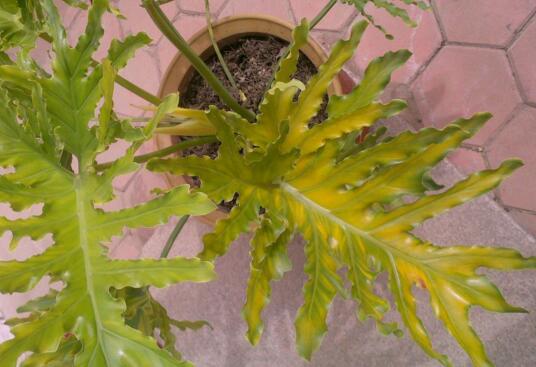
There are many causes of yellowing leaves in Philodendron, and the most common ones are temperature problems, improper watering, fertilizer problems, soil problems, light problems, and so on. Therefore, to solve the problem of yellowing Philodendron leaves, corresponding measures must be taken according to the actual situation.
I. Temperature Problems
Philodendron has relatively poor cold tolerance. When the temperature drops below 10°C, it stops growing, and being below 5°C for a long time has a huge impact on it, causing some leaves to turn yellow and gradually drop off. Dry air also hinders its photosynthesis, and the lack of chlorophyll leads to yellowing.
Solution: Move it to a place with plenty of sunlight while providing shade, which can raise the ambient temperature around the Philodendron without exposing it to direct sunlight.
II. Improper Watering
1. Overwatering causes water-yellowing
We know that when growing plants, watering is a task that must be done, but some people water frequently out of worry that the plant lacks water, resulting in waterlogging in the potting soil and, in severe cases, root rot.
Solution: Reduce the amount and frequency of watering, loosen the soil to let excess water drain out. If root rot occurs, transplant it and replace the soil.
2. Underwatering causes drought-yellowing
Although Philodendron does not have high water requirements, it should not be left in a dehydrated state for a long time. If the lower leaves start to turn yellow from the bottom up while the new leaves are unaffected, it is generally caused by too little watering. So what should you do when Philodendron leaves turn yellow? The specific methods are as follows.
Solution: Increase the frequency and amount of watering, about 1-2 times per week, watering thoroughly each time. Never wait until the potting soil is completely dry before watering.
III. Fertilizer Problems
1. Overfertilizing causes fertilizer-yellowing
Some people fertilize frequently to make the Philodendron grow faster, and the fertilizer concentration is also very high, resulting in old branches and leaves turning yellow and dropping off, while new leaves are thick and fat but lack luster.
Solution: Place some radish seeds around the plant; they can absorb some of the fertilizer in the potting soil, thereby reducing the fertilizer content. Water as usual, and it will generally return to normal after two weeks.
2. Lack of fertilizer causes yellowing leaves
The opposite extreme of fertilizer-yellowing is not fertilizing the Philodendron for a long time, resulting in small and pale yellow leaves, and in severe cases, dry and scorched brown spots.
Solution: Fertilize the Philodendron. When fertilizing, be sure that the nutrients in the fertilizer are balanced and contain the elements necessary for Philodendron growth, such as nitrogen, phosphorus, potassium, magnesium, and so on.
IV. Soil Problems
Philodendron prefers acidic soil, but in the north, because the water quality is alkaline, watering the Philodendron gradually turns the soil neutral to alkaline, causing the leaves to fade, turn yellow, and then drop off.
Solution: Loosen the soil of the Philodendron regularly, and repot once every 2 years. Repotting is best done in spring, which can improve the yellowing of leaves caused by soil problems.
V. Light Problems
Philodendron can grow in low-light environments, but that does not mean it does not need light at all. If its growing environment is too enclosed and dark, some old leaves will turn yellow faster. So what should you do when Philodendron leaves turn yellow? Adjusting the light can solve it.
Solution: Move it to a place with slightly stronger light, avoid exposing it to strong light, and also keep its environment ventilated. Air circulation is also very important for its respiration.
Summary: Philodendron is an evergreen plant. If the leaves turn yellow, in most cases it is abnormal, and the cause must be found and measures taken in time to prevent other leaves from continuing to turn yellow.
What to Do When Philodendron Leaves Turn Yellow What to Do When Philodendron Leaves Rot
Yellowing, dropping, and rotting of leaves are all common problems during plant cultivation. Generally speaking, such problems mainly come from some part of the plant's growing environment, so we need to eliminate and confirm the causes one by one, so as to solve the problem in a targeted way.
What to Do When Philodendron Leaves Turn Yellow
1. Water-yellowing: mainly caused by improper water and fertilizer. Too much watering leads to poor soil aeration and further causes root rot of the Philodendron. In this case, reduce watering, loosen the soil, and enhance soil aeration.
2. Fertilizer-yellowing: mainly caused by too much fertilizer. Old leaves turn yellow and drop off while new leaves are thick and do not spread out. In this case, you can scatter a layer of cabbage or radish seeds on the plant, and after they sprout, pull them out to consume the excess nutrients.
3. Drought-yellowing: caused by long-term lack of watering or dehydration of the plant, making the lower leaves dry and yellow or drop off and age. In this case, appropriately increase watering and spray more water to meet the plant's water needs and keep the environment moist, or appropriately spray suitable agents to replenish the necessary water for the plant.
4. Alkaline-yellowing: because Philodendron prefers acidic soil while the water quality and soil in the north are both alkaline, the leaves fade, turn yellow, and drop off. In this case, water with fermented rice-washing water or rainwater.
What to Do When Philodendron Leaves Rot
If rot has already occurred and it is not serious, you can prune accordingly. If it is due to too much water or improper fertilizing, you need to change the soil and replant.
Before planting, be sure to choose soil with good water permeability and aeration, so that even if you occasionally overwater once, it will drain out easily.
When watering daily, do not pour it all at once; pour it in slowly. When watering, you can also gauge the amount of water by seeing how much water is poured in before the drainage holes at the bottom start to release water, then make a record, so that future watering has a comparison. When the temperature drops to 15°C, be sure to control watering; at this time the plant's water demand gradually weakens.
When fertilizing normally, be sure to pay attention to the fertilizer concentration, dilute stronger fertilizers, and apply them slowly along the edge of the pot.
Try to choose a place with good air circulation for care.
What to Do When Philodendron Has Pests and Diseases
1. Categories of Philodendron pests and diseases
Generally speaking, plant pests and diseases are divided into diseases and insect pests.
Common diseases of Philodendron include leaf spot and anthracnose. Relatively speaking, leaf spot is more common than anthracnose. Philodendron ring-pattern leaf spot mainly appears as nearly circular leaf spots, brown to reddish-brown, with dark brown edges, a yellow halo on the outside, faint reddish-brown concentric rings on the spot surface, and needle-head-sized spots clustered on the lesions.
Common insect pests of Philodendron include red spider mites and scale insects. Relatively speaking, scale insects are more common than red spider mites. The appearance of red spider mites is very likely due to low air humidity, and the appearance of scale insects is very likely due to poor ventilation.
2. Treatment methods for Philodendron pests and diseases
For diseases such as Philodendron leaf spot and anthracnose, wettable powders such as carbendazim, thiophanate-methyl, and zineb can be used for control. Leaf spot is more common than anthracnose. Specifically, leaf spot needs to be controlled by spraying with a 1000-fold dilution of 50% carbendazim.
For insect pests such as Philodendron red spider mites and scale insects, targeted insecticides can be sprayed for control. Specifically, scale insects need to be controlled by spraying with a 1000-fold dilution of 50% omethoate emulsifiable concentrate. In addition, when preventing red spider mites, air humidity needs to be increased, while scale insects can be prevented by strengthening ventilation.
In addition, if the leaves become yellow, withered, or scorched, prune them in time.
Philodendron Cutting Propagation Method
For sandy soil, Philodendron is often propagated by cuttings. The best propagation season is from May to September. Simply put, cut 2-3 nodes of robust stems and insert them into sphagnum moss or coarse sand to root, keeping the soil moist; they generally root in 20 days. Alternatively, cut off the upper part of the Philodendron for cuttings, and the old lower plant will sprout many young shoots, which can also be used for propagation.
Besides yellowing leaves, there is also leaf rot. During Philodendron cultivation, pests and diseases are also an issue that requires great attention. Usually, after one plant becomes diseased, it will infect other surrounding plants, and if not controlled properly, it may threaten all the plants, so we must carry out timely prevention, control, and management.
Where in the Home Should Philodendron Be Placed (Feng Shui) What to Do When Philodendron Leaves Turn Yellow
Growing flowers indoors is a common method used by many modern families to decorate the home environment, but many plants have a certain relationship with feng shui. Good home feng shui can bring good luck to the family and change feng shui fortunes. Philodendron is a green plant with a tall plant shape and mainly ornamental foliage. Generally, this kind of green plant with large, thick leaves is very suitable for indoor cultivation. What are the placement requirements for Philodendron in feng shui?
Where in the Home Should Philodendron Be Placed (Feng Shui)
1. Indoors
Alocasia macrorrhizos is an indoor foliage plant. Foliage plants have relatively large leaves and therefore relatively strong transpiration. With high transpiration, more water is released into the air. Dry weather leaves everything in a state of water shortage, so keeping a pot of Alocasia macrorrhizos at home in this season lets you breathe moist air when you come home.
It also has the effect of purifying the air and absorbing dust, making it an excellent indoor shade-tolerant foliage plant.
2. Living room
Its appearance is very festive, its leaves are very green, its flowers are very bright, and it is very large and very beautiful. If you place it in the living room, it can gather blessings. When guests come to the home, the leaves move with the wind, as if greeting them, very enthusiastic, making the home feel more lively, and the host will also feel proud. The living room is indeed a very suitable place.
Philodendron Repotting Methods and Precautions
I. Repotting Time
It is best to repot once about every two years in spring. Of course, the specifics also depend on the plant's growth, but the general repotting time is as described.
II. Repotting Method
To ensure comprehensive absorption of water and nutrients, when repotting, it is necessary to cut off old roots, diseased roots, dead roots, weak roots, rotten roots, and overly long roots. Poorly growing or curled roots can also be pruned appropriately, which helps new roots sprout.
When disinfecting, it is best to use medical eye ointment or sulfonamide ointment to effectively prevent bacterial infection. In addition, Philodendron is afraid of waterlogging, so when repotting, some broken tiles or crushed stones should be placed at the bottom of the pot.
III. Repotting Management
1. Light
After repotting, first place the pot in a cool place to reduce evaporation from the leaf surface, then gradually give light after a few days, and after it fully adapts, place it in a place with plenty of sunlight.
2. Water
After repotting, be sure to maintain an adequate water supply so that the soil comes into close contact with the roots, but afterward do not water too much, because many roots are damaged during repotting and their ability to absorb water decreases. If there is too much water, the injured parts of the roots may rot. Once new roots grow out, you can gradually increase watering.
IV. Combining Repotting with Pruning
When repotting Philodendron, appropriate pruning can be done at the same time. Cut off diseased branches, weak branches, and excess branches to promote the sprouting of new, robust branches.
How to Care for Philodendron in Winter
1. Control of room temperature
To be safe, 8°C and above allows it to safely pass the winter, and at the lowest it is best not to go below 0°C.
2. Control of water
We may all have heard that Philodendron originates in hot and humid places, so it has a relatively large demand for water. Although it begins to go dormant in winter and its water needs decrease accordingly, you still cannot forget to water. Water promptly when the potting soil becomes dry and cracked, but do not let it sit in water. In addition, you can also care for it by sprinkling water on the leaves and spraying water into the surrounding environment.
3. Control of light
If it is placed in a dark place for a long time, its leaves may gradually turn yellow, and the beautiful green will gradually disappear. Therefore, let it see light regularly. However, it also does not like long-term light. So choose a semi-shaded environment, or let it sunbathe for a while and then promptly move it back.
4. Control of fertilizer
From late autumn onward, pay attention to the amount used. In winter it enters dormancy and hardly needs nutrients, so fertilizing should be suspended.
What to Do When Philodendron Leaves Turn Yellow
1. Water-yellowing
Mainly caused by improper water and fertilizer. Too much watering leads to poor soil aeration and further causes root rot of the Philodendron. In this case, reduce watering, loosen the soil, and enhance soil aeration.
2. Fertilizer-yellowing
Mainly caused by too much fertilizer. Old leaves turn yellow and drop off while new leaves are thick and do not spread out. In this case, you can scatter a layer of cabbage or radish seeds on the plant, and after they sprout, pull them out to consume the excess nutrients.
3. Drought-yellowing
Caused by long-term lack of watering or dehydration of the plant, making the lower leaves dry and yellow or drop off and age. In this case, appropriately increase watering and spray more water to meet the plant's water needs and keep the environment moist, or appropriately spray suitable agents to replenish the necessary water for the plant.
4. Alkaline-yellowing
Because Philodendron prefers acidic soil while the water quality and soil in the north are both alkaline, the leaves fade, turn yellow, and drop off. In this case, water with fermented rice-washing water or rainwater.
Philodendron Introduction
1. Alternative names
Philodendron, also called Philodendron selloum and split-leaf Philodendron, is a relatively popular indoor foliage plant.
2. Growth habits
Philodendron likes a hot and humid growing environment, has low light requirements, and has strong shade tolerance. Philodendron is relatively intolerant of cold. The suitable growth temperature is between 18°C-25°C, and the winter overwintering temperature should not be lower than 5°C. Philodendron likes loose, fertile, and well-drained sandy soil.
3. Uses
It can be grown in pots to decorate indoor spaces. Placing it in a hall, office, living room, study, and so on is very suitable.
Placing Philodendron indoors has a very good effect, and it does not have high environmental requirements and is very adaptable. So if needed, you might as well grow one at home. When you are busy with work and come home, one look at it can effectively relieve stress.