How do you get a Monstera deliciosa to develop leaf splits? Simply water it regularly, fertilize more, and increase light, and the problem is solved.
The leaves of the Monstera deliciosa are its most distinctive feature and one of the main reasons people love it. What makes the leaves so unusual is that they naturally develop splits once the plant reaches a certain stage of growth. However, some growers find that their Monstera deliciosa shows no sign of splitting for a long time. What exactly is the reason? How do you get a Monstera deliciosa to develop leaf splits? Let us find out together.
How do you get a Monstera deliciosa to develop leaf splits?
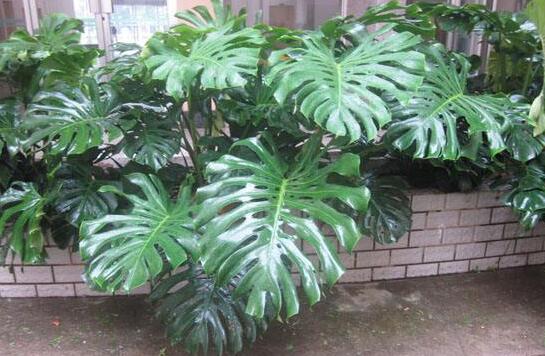
If we use the right cultivation methods for Monstera deliciosa and the growing environment is fairly suitable, it will normally develop leaf splits naturally at around 10 months. So getting a Monstera deliciosa to develop splits requires no human intervention. If splitting does not occur, there are generally three reasons: not enough light, too little watering, and insufficient fertilizing. Therefore, identify the cause and address it specifically.
Reasons Monstera deliciosa leaves do not split and how to solve them
1. Not enough watering
During the vigorous growth period, Monstera deliciosa needs a certain amount of water, and its water requirements are even higher in summer. Newly purchased seedlings should be watered regularly, taking care to keep the soil moist, and the leaves should be misted frequently to maintain the humidity of the surrounding air, which can encourage it to develop splits as early as possible.
Solution: Water it 1-2 times a week, with the principle of keeping the soil moist. In summer, mist it once in the morning and once in the evening, which both helps cool it down and raises the air humidity.
2. Not enough light
Insufficient light can lead to a situation where some leaves of the Monstera deliciosa have split while other leaves show no sign of splitting, especially the leaves at the back or close to the plant body. At this point, how do you get a Monstera deliciosa to develop leaf splits? The answer is to increase light.
Solution: The reason some leaves have split while others have not is that the split leaves received a certain amount of light, while the unsplit leaves lacked light. Move the Monstera deliciosa to a spot with good light, but be sure not to let it bake in direct sun.
3. Too little fertilizing
Monstera deliciosa is a plant that loves fertilizer, and its demand for fertilizer is very high, especially during the growing season. Fertilize according to the size of the plant to ensure its normal growth rate.
Solution: Top-dress the Monstera deliciosa every 10-15 days, mainly with nitrogen fertilizer, which promotes the growth of stems and leaves and speeds up leaf splitting. Note, however, not to overdo it, or fertilizer burn (yellowing) may occur.
Summary: When the leaves of a Monstera deliciosa do not split, we should calmly analyze the reasons. Besides the main reasons mentioned above, there is one point people easily overlook: splitting takes time. Do not fertilize and water frequently in pursuit of earlier splitting; trying to hurry a plant along is not a good approach.
How to grow Monstera deliciosa, and what to do when its leaves turn yellow
Monstera deliciosa is a sun-loving plant native to Mexico, originally growing in Mexican tropical rainforests. It is evergreen year-round and blooms, with the flowering time in November each year. Monstera deliciosa is generally grown for ornamental purposes, because its leaf shape is unique and it stays green year-round, making it deeply loved by many people. It has the ability to absorb carbon dioxide at night, so growing a Monstera deliciosa is not only attractive but also purifies the indoor air environment.
How to grow Monstera deliciosa
Monstera deliciosa is a plant that loves sun and moisture. Its growth requires plenty of light, but note that plenty of light does not mean frequently moving it outside to bake in the sun. Although Monstera deliciosa likes sunlight, prolonged exposure to direct sun will cause the leaves to wither. Therefore, in summer, place the Monstera deliciosa indoors or in a fairly shady spot, and do not put it where sunlight shines directly. The suitable temperature for a growing Monstera deliciosa is above 6°C; when the temperature drops to this level in winter, move it into a warm room.
The environment Monstera deliciosa likes is warm and humid, so growing it requires ensuring plenty of water. Never let the Monstera deliciosa lack water or let the soil dry out. So when watering Monstera deliciosa, be sure to remember: generally water once in the morning and once in the evening in summer; in winter, water loss is slower, so watering once every three or four days is fine.
Monstera deliciosa likes fertile soil, and fertilizing it to keep the soil fertile is very important. Generally, fertilize Monstera deliciosa once every two months, using a dilute liquid fertilizer. Pests are something many potted plants encounter. When insects begin to appear on the leaves, start paying attention to control. To control pests on Monstera deliciosa, you can use an old toothbrush to clean the leaf surface, dipped in diluted omethoate. Growing Monstera deliciosa also requires repotting it every year; when repotting, you can trim away some of the old vine roots and add organic fertilizer and so on to the bottom of the new pot.
Monstera deliciosa leaves turning yellow
There are many reasons that cause Monstera deliciosa leaves to turn yellow. If you find yellowing leaves, you can cut off the yellow leaves and then place it in a ventilated spot. Common reasons for Monstera deliciosa leaves turning yellow include: iron deficiency, sunburn, cold damage, insufficient ventilation, and soil that is too wet. You can solve the problem according to the different causes.
The above is my introduction to Monstera deliciosa cultivation methods. I hope it brings you useful help with growing Monstera deliciosa.
Monstera deliciosa Monstera deliciosa illustrated guide: how to grow Monstera deliciosa / how to propagate Monstera deliciosa
Monstera deliciosa profileMonstera deliciosa Monstera deliciosa
Monstera deliciosa cultivation methods and precautions, an introduction to Monstera deliciosa
Monstera deliciosa is an evergreen vine with thick stems. The young leaves are heart-shaped with no holes; when mature they become broadly ovate with deep pinnate lobes, with oval perforations between the veins, and the leaves have long stalks and are dark green. The spadix inflorescence has a boat-shaped spathe, blooms in November, and is pale yellow. Monstera deliciosa is also known as "Penglaibanana" and "wire grass". It is an evergreen climbing foliage plant of the Araceae family. Brown aerial roots grow on the stem, shaped like wires, hence the name "wire grass". The leaves are ovate-round, with many oblong holes and deep lobes scattered between the pinnate veins in a turtle-shell pattern; their shape resembles a turtle-shell pattern, and the stem has nodes like a bamboo culm, hence the name "turtle-back bamboo" (Monstera deliciosa). The spadix inflorescence looks like a "desk lamp," with a lampshade and a bulb. It is native to Mexican tropical rainforests, likes warm, humid environments, dislikes direct sunlight, and is not cold-tolerant. In northern China it is grown as an indoor potted plant.
Monstera deliciosa, also known as Penglaibanana, wire orchid, turtle-back taro, and turtle-back leaf, is a plant of the genus Monstera in the Araceae family. The leaf shape is unusual, with holes and splits, closely resembling a turtle's back. The stem nodes are thick and resemble bamboo, with dark brown aerial roots crisscrossing like wires. Its leaves are emerald green year-round and it is extremely shade-tolerant, making it a famous large indoor potted foliage plant. In Europe, America, and Japan, Monstera deliciosa is commonly used for potted display, decorating living rooms and windowsills, and is fairly widespread. In South American countries such as Brazil and Argentina and in Mexico in Central America, besides potting, it is often planted beside pergolas or buildings, letting Monstera deliciosa trail over the trellis or cling to walls, making an excellent vertical greening material.
Since the early 1980s, China has introduced large quantities of Monstera deliciosa from the United States, and the sown potted seedlings were deeply loved by the public, once creating a "Monstera deliciosa craze." To this day, large potted Monstera deliciosa has become a major staple material for hotel lobbies. In the south, potted Monstera deliciosa produced with snake-wood pole support sells well all over the country and has become one of the flagship products among Guangdong's foliage plants. Monstera deliciosa has entered thousands of households.
Morphological characteristics of Monstera deliciosa
Monstera deliciosa is semi-vining, with thick stems and many nodes like bamboo, hence the name Monstera deliciosa; long, drooping brown aerial roots grow on the stems, which can cling to other objects and grow upward. The leaves are thick and leathery, alternate, dark green or green; the young leaves are heart-shaped with no perforations, and when mature the leaves become oblong with irregular deep pinnate lobes, with holes and splits from the leaf margin to near the midvein, like a turtle-shell pattern; the leaf stalk is 30-50 cm long, dark green, with leaf scars; at the leaf scars there are bracts, leathery, yellow-white. The flower is shaped like a spathe, pale yellow. The fruit is edible. In cultivation there is also a variegated variety, with large irregular white patches on the deep green leaves, very beautiful.
Ecological habits of Monstera deliciosa
Monstera deliciosa often grows epiphytically on tall trees in tropical rainforests. It likes warm, humid environments and must avoid strong direct sun and dryness. The suitable growing temperature is 20-25°C. In winter, the nighttime temperature for seedlings should not be below 10°C; mature plants can briefly tolerate 5°C, and below 5°C they are prone to cold damage. When the temperature rises above 32°C, growth stops. In summer it needs frequent misting to maintain fairly high air humidity, and the leaves should be kept clean regularly to aid photosynthesis.
During the growing period, the plant grows rapidly, and the cultivation space must be spacious, otherwise the extension of stems and leaves will be affected and the beauty of the leaf shape will not be shown. The potting soil should be fertile, loose, highly water-absorbent, and moisture-retentive slightly acidic loam, with leaf mold or peat soil being best.
Monstera deliciosa, also known as Penglaibanana, is native to Mexico. It likes warm, humid environments and must avoid strong direct sun and dryness. It is shade-tolerant, and leaf mold is the best soil. In summer it needs frequent misting, and in winter the temperature should not be below 5°C. It is mainly propagated by cuttings. From April to May, cut cuttings from the tip of the stem node, each segment with 2-3 stem nodes, remove some aerial roots, and insert them with leaves or without leaves into a sand bed; they generally root in 4-6 weeks and can grow new shoots in about 10 weeks. In summer it should be kept in semi-shade; it fears strong direct sun and dryness, and besides watering every day, it needs frequent misting. During the growing period, fertilize once every half month. When first planted, a support frame should be set up; after the shape is set, pay attention to trimming and renewing the whole plant, striving for a natural and beautiful look. Mealybugs are the most common pest of Monstera deliciosa; common diseases include leaf spot, gray spot, and stem blight. Monstera deliciosa has an unusual leaf shape and a graceful plant form, and scattered planting beside ponds, streams, and in rock crevices is also very natural and elegant. Its same-genus variety includes variegated Monstera deliciosa. The leaf form is unusual, with holes and splits, closely resembling a turtle's back, and it is a famous foliage plant. It is shade-tolerant and suitable for potting, and is a widely cultivated indoor ornamental plant. In the south, it can also be scattered beside ponds and streams. It has a high commercial rate. Evergreen vine. The stem is green, thick, and bears dark brown aerial roots, long and drooping. The leaves are thick and leathery, heart-shaped when young with no holes, and when mature broadly ovate with irregular deep pinnate lobes, with oval perforations between the veins, closely resembling a turtle's back, with long stalks. The spathe inflorescence blooms from August to September and is pale yellow. The variety includes variegated Monstera deliciosa, whose leaves bear irregular yellow-white markings, extremely beautiful. It is native to South American tropical rainforests, most abundantly in Mexico, and often grows epiphytically on tall banyan trees. It likes warm, humid environments and must avoid strong direct sun and dryness. Leaf mold is the best soil. In summer it needs frequent misting. In winter keep the temperature above 5°C. The plant grows rapidly, and the cultivation space must be spacious, otherwise the extension of stems and leaves will be affected. It is commonly propagated by layering and cuttings. For layering, do it from May to August. After about 3 months it can be cut away from the mother plant to become a new plant. For cuttings, do it from April to May. Cut cuttings from the tip of the base node, each segment with 2-3 base nodes, remove the aerial roots, and insert them with leaves or without leaves into a sand bed, maintaining a certain temperature and humidity, and move them to pots after rooting. You can also in spring or autumn split off the side branches of Monstera deliciosa whole, with some aerial roots, and plant them directly in a wooden tub or water vat; the survival rate is high and the shape forms quickly. When planting, a support pole needs to be set in the pot for it to cling to. The bamboo is semi-vining. The leaves are thick, 50 cm long. In cultivation there is also a variegated variety, with large irregular white patches on the deep green leaves, very beautiful. Leaf mold is the best soil, and it can also be grown in sphagnum moss. Overwintering in a greenhouse requires a temperature above 5°C. In summer move it outdoors, in semi-shade, avoiding direct sunlight. During the summer growing period, water twice a day and mist the leaves frequently to maintain fairly high air humidity. During the growing period, apply dilute cake fertilizer water once every half month.
Variety classification of Monstera deliciosa
Commonly cultivated forms of Monstera deliciosa include Mini Monstera (var. minima), whose leaves are only 8 cm long; Marble Monstera (Marmorata), with pale green leaves and yellow-green markings on the leaf surface; White-variegated Monstera (Albo-Variegata), with dark green leaves and milky white markings on the leaf surface; and Climbing Monstera (var. borsigiana), whose stems and leaves have a particularly strong vining habit.
Common ornamental species in the same genus include Monstera friedrichsthalii, with long ovate, dark green leaves and oval window holes between the midrib and leaf margin, with the spacing from the outer edge of the window holes to the leaf margin being somewhat wider. Monstera epipremnoides, a large species, with leaves thick like a tree vine, 70-80 cm long, dark green. Monstera standleyana, with ovate-round leaves 15-20 cm long, a bluntly rounded leaf base, bright green leaf surface, and a broad flat stalk with wings, 10-30 cm long. Monstera standleyana cv. Variegata, with a dark green leaf surface and milky white spots or markings. Monstera obliqua, with long elliptic leaves and a bluntly asymmetrical leaf base. Monstera obliqua var. expilfa, with long ovate leaves, a bluntly asymmetrical leaf base, and many window holes with a large window-hole area. There are also Monstera punctulata and Monstera adansonii.
Embryo of monocotyledonous plant seeds: has 1 terminal cotyledon; vascular bundles in the stem: scattered arrangement, with no cambium or secondary tissue, only primary tissue.
Leaf veins: parallel or arcuate veins; flowers: the base number is often 3; roots: the taproot is not well developed, often a fibrous root system.
Distribution area of Monstera deliciosa
Monstera deliciosa is native to Mexico, and in Europe, America, and Japan it is commonly used for potted display. Since the early 1980s, China has introduced large quantities of Monstera deliciosa from the United States, and the sown potted seedlings were deeply loved by the public, once creating a "Monstera deliciosa craze."
Uses and purposes of Monstera deliciosa
Monstera deliciosa has a graceful plant form, unusually shaped leaves, and deep green, glossy leaf color, giving a good overall ornamental effect. It has been widely introduced and cultivated in China. The beautiful, unusual, and varied Monstera deliciosa is a famous indoor potted foliage plant and is much loved. It has the unusual ability to absorb carbon dioxide at night. It contains many organic acids, and these organic acids can react chemically with the carbon dioxide absorbed at night, turning into another kind of organic acid that is retained. During the day, this changed organic acid is reduced back to the original organic acid, releasing the carbon dioxide for photosynthesis. Therefore, keeping a Monstera deliciosa at home has a certain air-purifying effect. It is commonly grown in small and medium pots and placed in indoor living rooms, bedrooms, and studies; it can also be grown in large pots and placed in hotels, restaurants, lobbies, and indoors, or beside garden ponds and under large trees, giving a rather tropical look. The leaves can also be used as cut-flower foliage.
Monstera deliciosa's air-purifying function is somewhat weaker; unlike spider plants and aloe, it is not an all-rounder at purifying air. But Monstera deliciosa is fairly effective at removing formaldehyde from the air. In addition, Monstera deliciosa has the effect of absorbing carbon dioxide at night. It is very helpful for improving indoor air quality and raising oxygen content. Combined with the fact that Monstera deliciosa generally has a larger plant size, an elegant shape, and fairly airy, beautiful leaves, it is a very ideal indoor plant. The fruit of Monstera deliciosa can be used in cooking after it ripens. Its fragrance is like pineapple or banana.
Monstera deliciosa is famous for being shade-tolerant and is suitable for display and accent in indoor living rooms and hallways. In the south it is often scattered in courtyards, beside park ponds, streams, rocks, and in rock crevices. The holes and notches on the leaves of Monstera deliciosa have both empty and solid parts, novel and interesting, and the aerial roots hanging at the pot mouth are rustic and elegant.
Shaped like a spathe, pale yellow, and the fruit is edible. In cultivation there is also a variegated variety, with irregular white patches on the green leaves, very beautiful. Monstera deliciosa often grows epiphytically on tall banyan trees. Its pinnate parallel veins are clearly prominent, shaped like a banana, hence it is called "Penglaibanana." In Latin, Monstera deliciosa means "green wilderness monster." Its flowering is very unusual, like a boat-bottom spathe, yellow-white, with flowers as large as a palm, concealing a spadix, and it can bear fruit, and the fruit is a berry. After the fruit ripens it can be used in cooking and has a sweet taste, with a fragrance like pineapple or banana. But note that the fruit cannot be eaten when unripe, because it is quite irritating. In its place of origin, residents call this fruit the "beautiful fruit given by the gods."
Landscape use: mainly used for indoor potted display, and can be used as a purifying material; the leaves can be used as fresh cut-flower foliage, and their unusual leaf shape makes them suitable as an accent material in flower arrangements.
Cultivation techniques for Monstera deliciosa
Use loose, well-draining, well-aerated imported peat of the Klasmann 5-40 mm grade. Break up the peat, add water and mix well (standard for adding water: after mixing with water, squeeze a handful of peat tightly and water seeps out between the fingers). Then pot it up for planting.
Monstera deliciosa potting usually uses an equal mix of leaf mold, garden soil, and river sand as the substrate. When planting, add a small amount of bone meal and dried cow manure as base fertilizer. It likes moisture, and during the growing period it needs plenty of water, and the potting soil must be kept moist regularly; when the weather is dry, the leaves must also be misted to keep the air humid, so as to favor the growth of stems and leaves and keep the leaves vivid. In autumn and winter, gradually reduce the amount of watering. Monstera deliciosa is a flower that fairly likes fertilizer. To make it grow vigorously, apply dilute liquid fertilizer twice a month from April to September; with sufficient fertilizer the leaf color becomes pleasing. During the growing season, pay attention to shading and avoid strong direct sunlight; especially in midsummer it must not be placed in direct sun, otherwise the leaves are easily scorched and burned, affecting ornamental value. The leaves of Monstera deliciosa can sometimes develop brown spot disease, and it must be promptly sprayed with thiophanate or carbendazim and the like for control, to prevent the disease from spreading.
Monstera deliciosa is easy to cultivate. To shorten the growth cycle and improve the ornamental effect, the following points should be noted in care:
It fears strong direct sun. Monstera deliciosa is a typical shade-tolerant plant, and large-scale production requires shade facilities, and 50% shade netting can be used. Especially for sown seedlings and newly rooted cuttings, direct sunlight must be avoided to prevent leaf burn. Mature plants should also be shaded during midsummer, otherwise the leaves age, lack natural luster, and their ornamental value is affected.
It fears dry air. Monstera deliciosa grows naturally in tropical rainforests and likes moisture, but waterlogged potting soil will also cause root rot, making the plant stop growing, the leaves droop, lose luster, and become uneven. Watering should follow the principle of keeping it moist rather than dry, keeping the potting soil moist regularly but not waterlogged. In spring and autumn, water once every 2-3 days. In midsummer, besides watering every day, mist several times to keep the leaves fresh; for hanging cultivation, mist even more frequently. In winter, leaf transpiration weakens, so the amount of watering should be reduced.
Apply light fertilizer frequently. Monstera deliciosa is a fairly fertilizer-tolerant foliage plant. To make it produce more new leaves and keep the leaf color emerald green with a natural luster, fertilize once every half month during the growing period, and when fertilizing take care not to let the fertilizer liquid stain the leaf surface. At the same time, the roots of Monstera deliciosa are fairly tender and must not be given raw fertilizer or concentrated fertilizer, to avoid burning the roots. It is best to use "Huiyou" 20-8-20 four-season high potassium nitrate fertilizer and 20-20-20 general fertilizer, which are more beneficial to the growth of Monstera deliciosa.
It needs tying and shaping. Monstera deliciosa is a large foliage plant with thick stems and large leaves. Especially when dividing adult plants, a frame must be set up and tied to prevent lodging and deformation. After the shape is set, remove the support frame. At the same time, after the shape is set, when the stem-node leaves grow too densely and the branches and vines grow too long, pay attention to trimming the whole plant, striving for a natural and beautiful look.
Propagation in the north
Monstera deliciosa is native to tropical rainforests and is a perennial evergreen vine flower. In the north it is very difficult for it to bloom and set seed, so it can only be propagated by the stem-cutting method. For stem-cutting propagation, choose plants that are growing well and have more than 5 leaves.
Time for stem cutting
Because Monstera deliciosa is a flower that likes moisture and high temperatures, July-August is its peak growing season. Carrying out stem-cutting propagation during this period gives the highest survival rate. However, plants propagated by stem cutting during this period can only grow 1-2 leaves after developing before growth stops due to the arrival of autumn, and cannot be offered for display that year. Therefore, when stem-cutting skills are proficient, it can also be advanced to late May.
Stem-cutting operation
Watering should be stopped one or two days before stem cutting; slightly dry potting soil is helpful for the operation. When cutting, first knock the Monstera deliciosa out of the pot, then gently remove the root soil by hand, and clean up the tangled root system one by one neatly. At this point, the number of stem-cutting segments and the position of the cuts can be determined according to the development of the main vine and the strength of the root system. Generally speaking, the mother plant after stem cutting should retain at least 3 leaves, otherwise it is not easy for its vigor to recover. If the main vine is about 4 cm in diameter, it can be cut into single nodes; weaker plants can be cut into segments of 2-3 nodes joined together. Also note that each node of the Monstera deliciosa main vine has only one bud eye. The bud eye is characterized by a slight bulge on the surface of the vine stem. If the cut accidentally falls at the position of the bud eye, that segment of vine stem will never sprout again. After considering all the above factors thoroughly, first cut off the old leaves on the vine stem to be removed, so as to induce new buds more quickly, then use a sharp knife to cut the main vine horizontally. The cut should avoid the root system and bud eyes and be close to the leaf stalk. The cut short stems can be placed in pre-prepared pots; the size of the pot should be determined by the amount of root system, and it should not be too large or too small.
The bottom of the flower pot should first have a layer of coarse sand to aid drainage, then add leaf mold or ordinary garden soil; no base fertilizer is needed. Then lay the cut short stems horizontally in the pot, and fill with soil to completely bury the root system, just exposing the short stems. Press the soil lightly and firmly by hand, water thoroughly, and place in a spot with medium light. Water an appropriate amount every few days. After about one month, a split will appear at the position of the bud eye and new buds will gradually grow.
Potted management
For potting, mix 3 parts leaf mold, 3 parts compost soil, and 4 parts river sand into a growing medium. When repotting and changing soil each spring, add decomposed organic fertilizer or phosphorus and potassium fertilizer to the pot as base fertilizer. During the growing season, water regularly, following the principle of keeping it moist rather than dry, and keep the potting soil moist. In summer, mist the leaves frequently to maintain fairly high air humidity. In winter the temperature must not be below 10°C, and cold wind must be prevented, otherwise the leaves easily turn yellow and fall off. In winter the potting soil should be on the dry side, slightly moist; too wet easily causes root rot and leaf withering. Every 3-5 days, spray the branches and leaves once with water at the same or similar temperature as the room, to remove indoor dust pollution and keep the plant fresh and vivid regularly. From May to September, apply dilute liquid fertilizer once every 2 weeks or so, and apply a foliar fertilizer once at the peak growth period; a 0.1% urea water solution or a 0.2% potassium dihydrogen phosphate water solution is better. During overwintering, fertilize less or not at all.
For a long period, water must be sufficient, and the growing medium must be kept moist regularly, watering once every 2-3 days; when the weather is dry, the leaves should also be misted to keep the air humid. Follow the watering principle of keeping it moist rather than dry, so as to favor the growth of stems and leaves and keep the leaves vivid. In autumn and winter, gradually reduce the amount of watering. Excessive watering causes root rot, but the air should still be kept fairly humid, misting the leaves every 7-10 days to keep the plant and leaves fresh and evergreen. Monstera deliciosa fairly likes fertilizer. To make it grow vigorously, apply dilute liquid fertilizer twice a month from April to September. During the growing season, pay attention to shading, with semi-shade being best, and avoid strong direct sunlight; especially in midsummer it must not be placed in direct sun, otherwise the leaves are easily scorched and burned, affecting ornamental value. After 2-3 years of growing Monstera deliciosa, the stem may become too tall, reaching over 1.5 m, but it cannot stand upright, so a bamboo pole can be inserted for support to prevent lodging. For large pots, use 1 wooden stick 1.3-1.5 m long, insert it in the pot, and plant the Monstera deliciosa on it: first to prevent lodging, second so it grows luxuriantly clinging to the pole. Or cut the overly tall stem for propagation, letting the mother plant sprout new stems and new leaves again. In winter it needs to be kept indoors above 10°C, but at minimum keep the temperature above 5°C, otherwise the leaves will freeze and scorch, and the potting soil should be on the dry side. During the growing period, Monstera deliciosa often develops brown spot disease and anthracnose, which can be promptly controlled by spraying 50% thiophanate and 75% chlorothalonil 1000x solution, or 50% carbendazim 800-****x solution. When ventilation is poor in summer and winter, mealybugs and noctuid larvae often occur on the back of the stem, sucking sap and eating tender leaves; you can catch the insects by hand or brush them off, and it is best to spray and kill them with 40% omethoate emulsifiable concentrate 1500x solution, or 40% isocarbophos emulsifiable oil 2000x solution, or 40% profenofos emulsifiable concentrate 1500x solution.
Summer and autumn care
In autumn and the two seasons when sunlight is strong and the weather is dry and hot, potted Monstera deliciosa should be placed in a cool, ventilated spot. While shading reasonably, mist the leaves more to increase humidity and lower temperature, and keep the leaf surface clean and bright, adding a touch of coolness to the room. Because of frequent watering and misting in summer, the potting soil easily becomes compacted and its acidity decreases. To prevent physiological yellowing of Monstera deliciosa, which leads to iron-deficiency chlorosis, add a small amount of ferrous sulfate while watering, at a concentration of about 0.5-1.0%, to raise the acidity of the potting soil and supplement the plant's iron nutrition. In late autumn, to help Monstera deliciosa overwinter safely, apply a small amount of potassium chloride or potassium carbonate to raise the plant's cell sap concentration, enhance its cold resistance, and let it pass through the severe winter safely. The way to inhibit its growth is to control watering and fertilizing, changing watering to misting the leaves; you can use a clean, hygienic metal awl to pierce through the base stem nodes of the Monstera deliciosa, destroying part of its conducting tissue and blocking the transport of some nutrients, making the plant form neat and compact, with a short stem, dense nodes, short stalks, and beautiful leaves.
Propagation methods for Monstera deliciosa
Monstera deliciosa is easy to propagate and can be done by cuttings and sowing.
Propagation by sowing
Monstera deliciosa blooms in summer. To increase the seed-setting rate, manual pollination is needed; pollinating twice, at 9-10 a.m. and 3-4 p.m., is best, with a high pollination success rate. From pollination to seed maturity takes 15 months. During the seed development stage, pay attention to ventilation and fertilizer and water management to promote full, plump seeds. Before sowing, first soak the seeds in 40°C warm water for 10 hours, and the sowing soil should be sterilized at high temperature. Monstera deliciosa seeds are fairly large, so spot sowing can be used. After sowing, keep the room temperature at 20-25°C, cover the box mouth with plastic film, and maintain humidity above 80%. After sowing, they generally germinate in 20-25 days. If the room temperature is too low during sowing, it not only affects emergence but may even cause the seeds to become water-soaked and rot.
Propagation by cuttings
Stem-node cuttings can be used in both spring and autumn, with cuttings in spring from April to May and in autumn from September to October giving the best results. Monstera deliciosa cuttings work well because the temperature during these periods is suitable for the stem-node cuts to heal and root, and they survive quickly. For the cuttings, choose current-year side branches with solid stem tissue and robust growth; the cuttings are 20-25 cm long, and the basal leaves are cut off. Keep the small leaves at the upper end, cut off the long aerial roots, and keep the short aerial roots to absorb water and favor rooting. The cutting bed uses a mixed substrate of coarse sand and peat or leaf mold. After inserting, maintain 25-27°C and fairly high air humidity; rooting only begins about 1 month after insertion. After the cuttings root, the axillary buds on the stem nodes also begin to stir and unfold leaves. To speed up seedling growth, keep the room temperature above 10°C and strengthen fertilizer and water management; in the second year after insertion the seedlings take shape and can be sold as merchandise. If hanging decoration is needed, a wooden frame or iron frame container can be prepared, filled with palm fiber, and fertile leaf mold placed on top, and the rooted, surviving Monstera deliciosa planted on it, as a hanging basket product.
Propagation by division
Carried out in summer and autumn, split off the side branches of a large Monstera deliciosa as whole segments, with some aerial roots, and plant them directly in a wooden tub or pot; not only is the survival rate high, but the shape also forms quickly.
In 1980, Denmark used the stem tips and axillary buds of Monstera deliciosa as explants for tissue-culture propagation. Using MS medium plus 10 mg/L 6-benzylaminopurine and 2 mg/L indoleacetic acid, at 30°C, callus and adventitious buds began to grow after 6 weeks. Then the adventitious buds were transferred to conical flasks with MS medium plus 2 mg/L indoleacetic acid, and rooting was induced in 4-6 weeks.
Disease control for Monstera deliciosa
Mealybugs are the most common pest of Monstera deliciosa. When few, they can be cleaned off with an old toothbrush and then sprayed and killed with 40% omethoate emulsifiable concentrate 1000x solution. Common diseases include leaf spot, gray spot, and stem blight, which can be sprayed with 65% zineb wettable powder 600x solution.
Monstera deliciosa gray spot disease
It mostly starts from damaged spots at the leaf margin. It is more severe after low temperature, smoke, or pest damage. After infection, the lesions are initially black spots, and after expanding they become oval or irregular. The edge is dark brown and the inside is gray-brown.
Control methods: 1. Strengthen plant care, remove pests promptly, and cut off some diseased leaves. 2. When the disease occurs, spray with 70% thiophanate 1000x solution or 0.5 equal-strength Bordeaux mixture.
The flower language of Monstera deliciosa
Monstera deliciosa has a graceful plant form, unusually shaped leaves, and deep green, glossy leaf color, giving a good overall ornamental effect. In addition, it has the unusual ability to absorb carbon dioxide at night, and keeping it in a room has a certain effect of purifying indoor air. It is often grown in small and medium pots and placed in a corner of an indoor living room, bedroom, or study; it can also be grown in large pots and placed in hotel and restaurant lobbies and beside ponds and under large trees in indoor gardens, giving a rather tropical look. It is a famous large indoor potted foliage plant. It is suitable for display and arrangement indoors, in exhibition halls, and in subways. In southern courtyards, scattered planting beside ponds, along streams, and in rock crevices is very natural and elegant.
The flower language and symbolic meaning of Monstera deliciosa: health and longevity.
Because the leaf shape of Monstera deliciosa closely resembles a turtle shell, and it is a fairly long-lived indoor item, and at the same time it has the unusual ability to absorb carbon dioxide, which benefits people's health, its flower language is health and longevity.
Monstera deliciosa pictures