How do you grow forget-me-nots? Growing methods and precautions, light must be sufficient
Forget-me-not is a light blue flowering plant with high ornamental value. It is grown in many regions of our country, and this plant can also be kept at home, where it serves a decorative purpose indoors. As for how to grow forget-me-nots, what are the growing methods and precautions for forget-me-nots? Below, the editor will walk everyone through it.
I. How to grow forget-me-nots / light must be sufficient
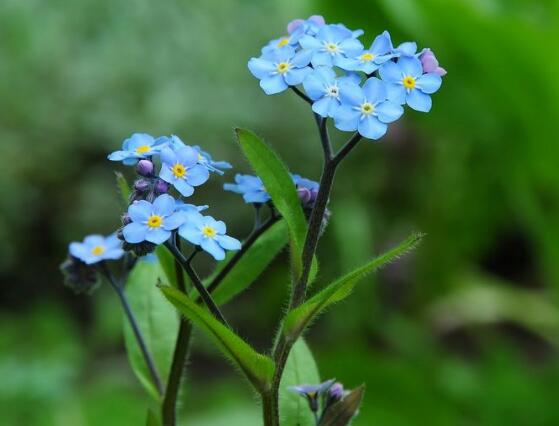
Regarding the question of how to grow forget-me-nots, there are many aspects that need attention, such as light, watering, soil and so on, among which light is especially important. This is a light-loving plant, and it is very difficult for it to survive without light.
II. Growing methods and precautions for forget-me-nots
1. Fertilization requirements
In the process of growing plants, fertilization is an essential step, and forget-me-nots are no exception. However, the fertilizer requirements of forget-me-nots are much lower than those of other plants; generally, fertilizing once a quarter is enough.
2. Environmental requirements
Forget-me-nots still have relatively high environmental requirements. An environment of around 22-28°C is most suitable for the growth of forget-me-nots. Generally, temperatures that are too low or too high will affect their growth. Also, the growing environment must be well ventilated, otherwise some diseases are very likely to appear.
3. Light requirements
Among the growing methods and precautions for forget-me-nots, light is a relatively important part. Forget-me-nots are naturally light-loving, so it is best to let them grow in an environment with sufficient light. However, when the summer sunlight is too strong, shade should still be provided, otherwise the leaves may turn yellow.
4. Watering requirements
This plant, the forget-me-not, is relatively fond of water, but it is afraid of waterlogging, so when watering, generally keeping the soil moist is enough. Remember never to water too much. If water accumulates, it will cause root rot in forget-me-nots. Everyone should remember this point.
5. Pest and disease control
Everyone must pay attention to methods when growing forget-me-nots. Improper cultivation can easily lead to pests and diseases. If pests or diseases appear, they must be dealt with as soon as they are discovered. If the matter drags on, it will be very difficult to cure completely. For control methods, everyone can read the article on pest and disease control for forget-me-nots. The editor will not introduce too much here.
As for the question of how to grow forget-me-nots, I believe everyone has gained some understanding after reading the above. As long as everyone grows them according to the above methods, your forget-me-nots will surely grow vigorously. The editor will introduce the growing methods and precautions for forget-me-nots here, hoping to be of some help to everyone.
How to grow forget-me-nots, growing methods and precautions for forget-me-nots
Whether at home or abroad, forget-me-nots have received enthusiastic welcome from people and have a large market. So how do you grow a pot of forget-me-nots well, and what are the growing methods and precautions for forget-me-nots? Today the editor has put together a summary to share with everyone.
Growing methods for forget-me-nots
Forget-me-nots like a warm and humid growing environment. At a temperature of 15-20 degrees, this is the best growing temperature for forget-me-nots; forget-me-nots are suitable for planting in fertile, loose soil, mostly in open-field cultivation. For plots with poor soil conditions, base fertilizer should be applied once, mainly choosing decomposed organic fertilizer and compound fertilizer. When planting, pay attention to the row spacing so that the roots can also receive sunlight, which is relatively beneficial to the growth of the plant.
Forget-me-nots have relatively high watering requirements. They must not be waterlogged, nor drought-stricken. Pay attention to combining water and fertilizer. Before the flowering period arrives, apply a round of fertilizer water once, which can lead to more flowers and beautiful colors.
If forget-me-nots are not managed properly, diseases such as gray mold, powdery mildew and viral disease can occur. For gray mold, 800-**** chlorothalonil or thiophanate-methyl can be sprayed continuously 3-4 times for control. For powdery mildew, fenarimol and the like can be sprayed for control. For viral disease, the main measures include promptly pulling out diseased plants and burning them, and spraying insecticides to prevent insects from transmitting the disease. Scale insects are the most common pest of Monstera deliciosa; when there are only a few, they can be cleaned with an old toothbrush and then sprayed with a 1000-fold solution of 40% omethoate emulsifiable concentrate to kill them.
Precautions for forget-me-nots
Forget-me-nots are generally planted in spring and summer. Long periods of sufficient light help the growth of forget-me-nots. Because forget-me-nots need long-distance transport, storing cut flowers is a problem. A certain amount of gibberellin and silver nitrate can be used, spraying the cut flower buds until they bloom, then moving them into an environment below 4°C, and placing them in a vase with preservative solution, which is beneficial for the long-distance transport of forget-me-nots.
The above are the growing methods and precautions for forget-me-nots. For more flower-growing information, please continue to follow the planting encyclopedia of China Agrochemical Investment Network.
Extended reading:
Forget-me-not fertilization techniques, pest and disease control, how to grow? Growing methods and precautions
How to grow forget-me-nots? Growing methods and precautions for forget-me-nots
[Common questions] How do you plant forget-me-nots, and how do you care for them?
[Expert answers]
1. Sowing: Sowing is generally from September to January of the following year. The seeds are photophobic, so after broadcasting the seeds, cover them with a little soil and maintain humidity. Under suitable temperature conditions of 15-°20℃, they germinate after 10-15 days. When sowing, be careful that the temperature does not exceed 25℃. After the sprouts emerge, ventilation is needed. When the seedlings have more than 5 true leaves, transplant them. For tissue-cultured seedlings propagated by tissue culture technology, transplant them when they have 4-6 leaves.
2. Soil: Suitable for growing in loose, fertile, well-drained slightly alkaline soil, and it likes deep soil layers.
3. Field planting:
(1) Ground planting: Decomposed organic fertilizer and slow-release compound fertilizer can be evenly turned into the soil; the planting spacing is 30 cm × 40 cm, and the planting depth should be such that the substrate is slightly higher than the root crown.
(2) Pot planting: One month after emergence, they can be field planted or potted. When transplanting, carry as much soil as possible and damage the root system as little as possible. Reduce watering appropriately, but do not let the medium dry out; keep it moist. During the seedling stage, the plant should fully receive sunlight to prevent the seedlings from growing leggy.
4. Watering: Forget-me-nots like a dry environment with good drainage, and avoid waterlogging. During the entire growth period, the amount of watering should be properly controlled, otherwise the flowering quality and yield will decline.
5. Light: Forget-me-nots like sunlight, but avoid high temperature and high humidity. They tolerate partial shade, but sufficient light can make the plant grow better. Long-day conditions are beneficial for their flowering.
6. Temperature: Forget-me-nots like light and tolerate drought. The suitable growing temperature is 20℃-25℃. After planting forget-me-nots, there should be 2 months during which the temperature is kept below 15℃, so that the plant can pass through the vernalization stage, which is beneficial for normal growth and flowering.
7. Fertilization: For the total amount of fertilizer applied during the growth period, 70% of the nitrogen and potassium etc. is applied as base fertilizer, and 30% as topdressing. All phosphorus fertilizer is applied as base fertilizer. Topdressing is generally once per season. Applying potassium fertilizer and boron fertilizer during the flowering period is beneficial for improving the quality and yield of cut flowers. During growth, apply a light fertilizer once every 10 days. Fertilization at the seedling stage should mainly be nitrogen, and before and after budding, attention should be paid to increasing the application of phosphorus and potassium fertilizers.
8. Pest and disease control: The diseases of forget-me-nots include gray mold, powdery mildew, viral disease and so on. For gray mold, 800-1000 chlorothalonil or thiophanate-methyl can be sprayed continuously 3-4 times for control. For powdery mildew, fenarimol and the like can be sprayed for control. For viral disease, the main measures include promptly pulling out diseased plants and burning them, and spraying insecticides to prevent insects from transmitting the disease. Scale insects are the most common pest of Monstera deliciosa; when there are only a few, they can be cleaned with an old toothbrush and then sprayed with a 1000-fold solution of 40% omethoate emulsifiable concentrate to kill them.
[Editor's comments] In flower shops we can often buy a kind of cut flower called “forget-me-not”. In fact, its scientific name is sea lavender, and it is simply sold under the name “forget-me-not”. So, do you know how to plant forget-me-not (sea lavender) and how to care for and manage it? The editor of First Agricultural Economics above introduced the growing methods and precautions for forget-me-nots, hoping to be of help to you.