How to Grow Brunfelsia pauciflora? Detailed Guide to Cultivation Methods and Precautions
Seed propagation
Seed selection: Before sowing, the seeds must first be selected. Whether the seeds are well chosen directly determines whether sowing will succeed. 1. It is best to use seeds harvested in the current year. The longer the seeds are stored, the lower their germination rate.
2. Choose plump seeds with no damage or deformities.
3. Choose seeds free of pests and diseases.
Disinfection: Disinfection includes two concepts - one refers to disinfecting the seeds, and the other refers to disinfecting the sowing substrate. For household seed disinfection, it is common to soak the seeds in hot water at about 60°C for a quarter of an hour, then use warm water to promote germination for 12-24 hours. For disinfecting the sowing substrate, the best method is to put it in a pot and heat it while stirring; any pests and diseases will be killed by the heat.
Germination promotion: Soak the seeds in warm water (at a temperature similar to face-washing water) for 12-24 hours, until the seeds absorb water and swell. For very common seeds that germinate easily, this step can be skipped.
Sowing: For tiny seeds that are difficult to pick up with your hands or other tools, you can moisten one end of a toothpick with water and stick the seeds one by one onto the surface of the substrate, then cover with substrate 1 cm thick. After that, place the sowing pot into water, with the water depth at 1/2-2/3 of the pot's height, and let the water slowly soak upward (this method is called the “pot soaking method”);
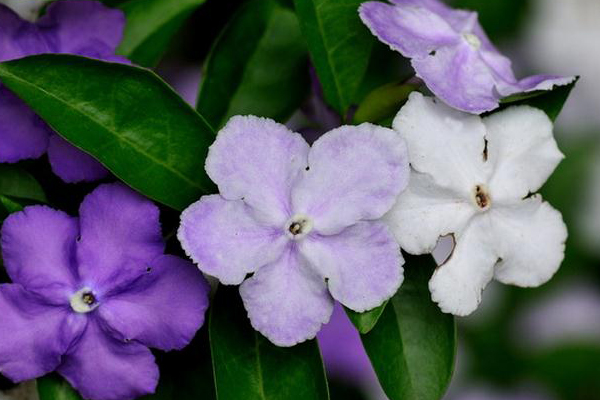
Cultivation Methods for Brunfelsia pauciflora
Soil requirements
Brunfelsia pauciflora is generally cultivated in East China and North China, and is suitable for slightly acidic soil with good drainage and aeration.
Light and temperature requirements
The suitable temperature for the growth of Brunfelsia pauciflora is 20-30°C. At this temperature, the branches and leaves are lush and growth is vigorous. When the temperature drops to 12°C, it becomes dormant. It is not cold-tolerant, so in winter, take care to move it indoors in time to avoid frost damage.
Brunfelsia pauciflora likes a sunny and humid environment, and avoids scorching sun exposure. In summer, appropriate shading is needed. With excessive exposure, the flowers and leaves tend to curl. The daily light duration must not be less than 4 hours, which ensures abundant flowering.
Watering method
Brunfelsia pauciflora likes humidity and fears waterlogging. Watering should follow the principle of watering when dry and stopping when wet. In summer, watering needs attention: not only should the plant's growth needs be met, but the air should also be kept humid, spraying clean water on the leaf surface 2-3 times a day. In winter, keep the potting soil dry to prevent frost damage.
Fertilizing method
During the growing season, apply alum fertilizer water in time. This not only prevents soil alkalization and avoids yellowing leaves, but also increases soil fertility and promotes plant growth.
After the flowers of Brunfelsia pauciflora fade, apply a dilute cake fertilizer water once. After 10 days, apply a liquid fertilizer mainly based on phosphorus and potassium fertilizer once, and combine it with watering by spraying a potassium dihydrogen phosphate solution on the leaf surface to promote flower bud differentiation.
Pruning
During routine care, promptly cut off yellowing and withered leaves to avoid affecting the overall ornamental value.
After the flowers fade, promptly cut off the spent flowers and cut back the branches by 1/3-1/2. At the end of autumn, cut off weak branches, inward-growing branches, and pest- or disease-damaged branches to ensure vigorous growth of Brunfelsia pauciflora the following year.
Precautions for Growing Brunfelsia pauciflora
Cold protection
Brunfelsia pauciflora has very poor cold tolerance. In winter, it must be kept indoors. Generally, it is moved indoors around November, with the room temperature kept above 0°C, watering controlled, and the potting soil kept dry so it can overwinter safely.
Preventing water accumulation
Brunfelsia pauciflora fears waterlogging. During the rainy season, reduce watering. Potted plants kept outdoors should be drained promptly to avoid root rot.
How to Grow Brunfelsia pauciflora: Cultivation Methods and Precautions for Brunfelsia pauciflora
Brunfelsia pauciflora is also called the yesterday-today-and-tomorrow plant. It is a type of plant in the Solanaceae family, native to tropical regions, and is one of the best-selling ornamental plants on the market today. Many people want to grow it at home, but do you know how to grow Brunfelsia pauciflora? Do you know what precautions there are for growing Brunfelsia pauciflora? If not, take a look at the detailed introduction to growing Brunfelsia pauciflora below. After reading it, everyone will know how Brunfelsia pauciflora should be grown.
How to Grow Brunfelsia paucifloraThis plant, Brunfelsia pauciflora, can be propagated by cuttings. Between April and August each year, cut 8-10 cm one-year-old branches. They need to be cultivated in soil, and after one month they can take root. After rooting, transplant them directly into flower pots, place them in a shady environment to recover, and after about a week they will survive. At that point, move them into the sunlight and place them there.
Cultivation methodsIn short, for Brunfelsia pauciflora, attention must be paid to temperature regulation. It most likes to grow in an environment of 18-30°C, and when cultivated indoors, it must receive 4 hours of sufficient sunlight every day, otherwise its flowering period will be directly affected. When the outside temperature reaches 12°C, it will enter a dormant state. When growing Brunfelsia pauciflora normally, moisture regulation is also very important. In hot summer weather, it should be watered once every two days, and water should also be sprayed on its leaves. After entering autumn and winter, reduce the water supply, and watering once every ten days is enough.
Brunfelsia pauciflora is an ornamental plant that likes a warm and humid climate, and its cold tolerance is particularly poor. When growing Brunfelsia pauciflora normally, be sure to pay attention to this point, and when winter arrives, move it to a warm indoor place. In addition, when growing Brunfelsia pauciflora, note that it should be repotted once a year. Repotting can be done in spring. When repotting, prune and shape the plant and remove its old roots and dead roots, so that Brunfelsia pauciflora can grow more vigorously in the new year.