How to grow Osmanthus fragrans var. semperflorens? Cultivation methods and precautions explained in one article
Osmanthus fragrans var. semperflorens is a precious flower in China, not only widely admired by viewers but also of high economic value, deeply loved by people. However, growing Osmanthus fragrans var. semperflorens well is not so easy. How to cultivate it should start from the following five aspects.
1. Choose good potting soil
Osmanthus prefers slightly acidic, well-drained, fertile sandy loam. Osmanthus grows slowly in strongly acidic soil, with yellowed and withered leaves and few branches; in soil with a pH of 3-4, grafted two-year-old seedlings produce only 2-3 branches in that year, with branch lengths of only 6 cm, which is 2 times fewer branches and 1-2 times shorter than in soil with a pH of 6. In alkaline soil, leaf withering appears within two to three months, and the plant gradually dies.
2. Vigorous flowering depends on fertilizer; Osmanthus likes pig manure. It can be mixed into the potting soil, or applied at the bottom of the pot after being composted and dried. The amount of fertilizer applied should be based on 1/4 of the pot height. A layer of soil about 1 cun-2 cun thick should be covered over the fertilizer, then Osmanthus fragrans var. semperflorens should be planted, and no further fertilizing is needed within a year. In cities where pig manure is unavailable, donkey, horse or mule hooves can be composted into liquid; water once when sprouts appear in spring, then before August, water once every 7-10 days. Alternatively, sauce residue, fried soybeans, or fried raw peanuts can be ground into powder and buried in the potting soil in holes dug around the roots. According to observation: with sufficient fertilizer, the flowers are vigorous and fragrant, with 2-3 times more flowers. With insufficient fertilizer, there are fewer branches, fewer flowers, and the flowers are not fragrant.
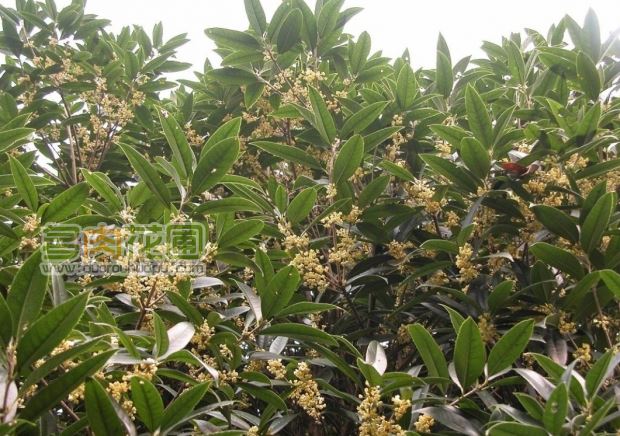
1. Morphological characteristics
Evergreen small tree or shrub-like, up to 12 m tall, bark dark brown. Branchlets cylindrical, with longitudinal fine stripes, young parts slightly pubescent or nearly glabrous. Leaves alternate, oblong or oblong-lanceolate, 5.5-12 cm long, 1.8-3.2 cm wide, apex acute or acuminate, base cuneate, margin finely wavy, leathery, dark green above, slightly lighter below, glabrous on both surfaces, pinnate veins, midrib and lateral veins raised on both surfaces, lateral veins 10-12 per side, ends curved and connected near the leaf margin, veinlets reticulate, more or less obvious on both surfaces, honeycomb-like; petiole 0.7-1 cm long, purplish red when fresh, slightly pubescent or nearly glabrous, grooved on the upper side.Flowers dioecious. Umbels axillary, 1-3 clustered or in short racemose arrangement, enclosed before flowering by 4 decussate involucral bracts, spherical; involucral bracts nearly circular, glabrous outside, sericeous inside, peduncle up to 7 mm, slightly pubescent or nearly glabrous. Male flowers: each umbel has 5 flowers; flowers small, yellow-green, pedicels about 2 mm, sparsely pubescent, perianth tube short, densely sparsely pubescent outside, perianth lobes 4, broadly obovate or nearly circular, appressed pubescent on both surfaces; fertile stamens usually 12, arranged in three whorls, filaments of the first whorl without glands, filaments of the second and third whorls with a pair of sessile kidney-shaped glands at the middle, anthers elliptical, 2-celled, introrse; ovary sterile. Female flowers: usually with 4 staminodes, alternating with perianth lobes, filament apex with paired sessile glands, with a lanceolate ligulate body extending between them; ovary 1-celled, style short, stigma slightly enlarged, obtusely triangular. Fruit ovoid, dark purple when ripe. Flowering period March-May, fruiting period June-September.
Evergreen shrub, flowers yellow-white or pale white, blooming several times a year, but still mainly in autumn. The plant is relatively small, mainly shrubby.
2. Distribution range
Native to the Mediterranean region, introduced and cultivated in China's Zhejiang, Jiangsu, Fujian, Taiwan, China, Sichuan and Yunnan provinces. Northern subtropical deciduous and evergreen broad-leaved mixed forest region: (main cities: Nanjing, Yangzhou, Zhenjiang, Nantong, Changzhou, Wuxi, Suzhou, Hefei, Wuhu, Anqing, Huainan, Xiangyang, Shiyan)Central subtropical evergreen and deciduous broad-leaved forest region: (main cities: Wuhan, Shashi, Huangshi, Yichang, Nanchang, Jingdezhen, Jiujiang, Ji'an, Jinggangshan, Ganzhou, Shanghai, Changsha, Zhuzhou, Yueyang, Huaihua, Jishou, Changde, Xiangtan, Hengyang, Shaoyang, Guilin, Wenzhou, Jinhua, Ningbo, Chongqing, Chengdu, Dujiangyan, Mianyang, Neijiang, Leshan, Zigong, Panzhihua, Guiyang, Zunyi, Liupanshui, Anshun, Kunming, Dali)
Southern subtropical evergreen broad-leaved forest region: (main cities: Fuzhou, Xiamen, Quanzhou, Zhangzhou, Guangzhou, Foshan, Shunde, Dongguan, Huizhou, Shantou, Taipei, China, Liuzhou, Guiping, Gejiu)
3. Main varieties
18 varieties of Osmanthus fragrans var. semperflorens: Changgeng Suhua, Danzhuang Yuegui, Ai Huang, Daye Fodingzhu, Xiaoye Fodingzhu, Tianxiang Taige, Tianxiang Zhouye Sijigui, Tiannü Sanhua Sijigui, Xiaoye Sijigui, Rixiang Gui, Daye Sijigui, Wuban Jin, Dongxiang Hong, Huang Jin, Jinye Tianxiang
4. Growth habits
Osmanthus fragrans var. semperflorens is suitable for growing in warm, humid places with ample sunlight. The soil used should be fertile, loose, slightly acidic and well-drained and irrigated. Osmanthus fragrans var. semperflorens is relatively drought-tolerant and cold-tolerant; its optimum growth temperature is 20-30°C. In winter, if there is no particularly severe cold wave, it can generally overwinter outdoors.5. Propagation methods
Cuttings
Select excellent mother plants with superior varieties, vigorous growth and no pests or diseases for collecting cuttings, and cut current-year semi-lignified young shoots from the upper outer part of the canopy as cuttings. When processing the cuttings, cut them into 2-3 cm, retaining 1-2 leaves at the top. Cut the upper end of the shoot into a flat opening, and cut the base into a slanted surface; the slanted surface should be smooth to facilitate cutting and healing and rooting. Soak the shoots in 0.1% thiophanate-methyl or carbendazim for 10 min for disinfection. Then dip the base into a 50 mg naphthaleneacetic acid or 100 mg ABT rooting powder No. 1 solution, remove after 1 h and insert for cuttings, or soak in 200 mg naphthaleneacetic acid for 10 min before inserting.
After cutting is completed, water promptly and cover with plastic film and a sunshade net or straw curtain. If no water droplets are found inside the film and the bed surface is dry and the topsoil is grayish white, spray water promptly to maintain moisture. Water thoroughly, but not excessively, otherwise it easily causes soil compaction, breeds bacteria, and causes cuttings to rot. After insertion, uncover the film every 5-6 d to replenish water, and combine with spraying 0.1% thiophanate-methyl or carbendazim. Spray 2000-fold carbendazim solution once every 7 d to prevent cuttings from being infected by bacteria and causing cortex rot. Always maintain the permeability of the nursery site to prevent young roots of cuttings from rotting due to lack of oxygen; loosen the soil promptly after rain to ensure the soil is loose and breathable, which is good for rooting, but be careful not to touch the cuttings. Spray 0.2% urea or potassium dihydrogen phosphate solution once every 10 d to promote root and new shoot growth of the cuttings.
Air layering
For one- or two-year-old branches, make a notch or ring-bark, then wrap the notched area with split bamboo tubes, flower pots, thick paper tubes or plastic film, and fill the gaps inside with rice husk ash, moss, potting soil, perlite and other materials. Keep it moist frequently, but water should not be excessive. After rooting, it can be cut away from the mother plant. The inner diameter of the high-pressure bag made of plastic film is generally 4-5 cm, and the length is 8-10 cm. The notching and ring-barking site is below the node, where rooting is easy. The width of the removed phloem is 1-2 cm.Air layering is mostly carried out before spring sprouting, and can also be carried out during summer growth. Carrying it out during the plum rain season also has very good results. According to experiments, wintersweet roots in 40-50 days, and Chinese rose roots in 20-30 days. During air layering propagation, the rooting time is generally longer, about 3 to 4 months. After cutting away from the mother plant, it must be placed in a cool place and maintained for a period before transplanting.
It should be noted that the soil used for layering must be loose, moist and rich in organic matter, and must be pressed firmly against the layer. After layering, keep it moist frequently; the soil must not lack water or dry out, otherwise it will affect survival and rooting. In severe cold winter areas, it must be wrapped with straw, cotton wadding, etc. for cold protection, and the layer must not be frozen.
Grafting method
The rootstocks mainly used for grafting Osmanthus fragrans var. semperflorens include privet, ash, lilac, and fringetree. The disadvantage of using privet as a rootstock is that its root system is too developed, making it unsuitable for pot cultivation, and it flowers late. The disadvantage of using ash as a rootstock is its short lifespan, and it easily sheds leaves in winter and blooms less. When lilac is used as a rootstock, the trunk is thick at the top and thin at the bottom, making the tree shape top-heavy. Fringetree as a rootstock has good compatibility, drought and cold resistance, strong adaptability, and a long lifespan, with tree age reaching over a hundred years. Therefore, the most suitable rootstock for potted Osmanthus grafting propagation is fringetree.Grafting techniques
- Bud grafting. This method is especially suitable when the rootstock is thick and both the rootstock and scion are not easy to peel. Branch grafting can be carried out during the dormant period, but is usually carried out in spring and autumn, mostly using cut grafting and cleft grafting.
Branch grafting. This method is especially suitable when the rootstock is thick and both the rootstock and scion are not easy to peel. Branch grafting can be carried out during the dormant period, but is usually carried out in spring and autumn, mostly using cut grafting and cleft grafting.
Approach grafting. Bring the main trunk of the rootstock close to a suitable Osmanthus branch for grafting, and cut a smooth cut surface of about 3 cm on each of the suitable parts of the two, with a depth of about 1/3 of the diameter. Place the two cut surfaces against each other, with at least one side of the cambium aligned, and bind firmly with plastic film strips. This method is suitable for the peak growth season, generally from June to July. About 30 days after grafting, it can heal, but it is best to separate it from the mother body after the flower buds are plump.
Cultivation methods and precautions for Osmanthus fragrans var. semperflorens, pictures of Osmanthus fragrans var. semperflorens
Flower Bonsai Network introduction: Today, Flower Bonsai Network brings you an article about the cultivation methods and precautions for Osmanthus fragrans var. semperflorens. Let's take a look together.
· Osmanthus fragrans var. semperflorens is a variant of Osmanthus (Osmanthus fragrans var. semperflorens): Osmanthus fragrans var. semperflorens is also called Yueyue Gui. The flower color is slightly white, or pale yellow, the fragrance is relatively light, and the leaves are thin. It blooms all year round.
Osmanthus fragrans var. semperflorens is a precious flower in China, not only widely admired by viewers but also of high economic value, deeply loved by people. However, growing Osmanthus fragrans var. semperflorens well is not so easy. How to cultivate it should start from the following five aspects.
Cultivation methods for Osmanthus fragrans var. semperflorens: Choose good potting soil
Osmanthus prefers slightly acidic, well-drained, fertile sandy loam. Osmanthus grows slowly in strongly acidic soil, with yellowed and withered leaves and few branches; in soil with a pH of 3-4, grafted two-year-old seedlings produce only 2-3 branches in that year, with branch lengths of only 6 cm, which is 2 times fewer branches and 1-2 times shorter than in soil with a pH of 6.
In alkaline soil, leaf withering appears within two to three months, and the plant gradually dies.
Cultivation methods for Osmanthus fragrans var. semperflorens: Vigorous flowering depends on fertilizer
Osmanthus likes pig manure. It can be mixed into the potting soil, or applied at the bottom of the pot after being composted and dried. The amount of fertilizer applied should be based on 1/4 of the pot height. A layer of soil about 1 cun-2 cun thick should be covered over the fertilizer, then Osmanthus fragrans var. semperflorens should be planted, and no further fertilizing is needed within a year.
In cities where pig manure is unavailable, donkey, horse or mule hooves can be composted into liquid; water once when sprouts appear in spring, then before August, water once every 7-10 days. Alternatively, sauce residue, fried soybeans, or fried raw peanuts can be ground into powder and buried in the potting soil in holes dug around the roots. According to observation: with sufficient fertilizer, the flowers are vigorous and fragrant, with 2-3 times more flowers. With insufficient fertilizer, there are fewer branches, fewer flowers, and the flowers are not fragrant.
Cultivation methods for Osmanthus fragrans var. semperflorens: Watering should be appropriate
Watering Osmanthus should grasp the principle of two less and one more: water less for plants repotted before new shoots appear, water less on cloudy and rainy days, and water more on dry days in summer and autumn. After repotting and watering thoroughly, maintain a water content of about 50% regularly; during the dog days (July-September), the soil water content should be about 60%. Identification method: pinch the potting soil with your hand; it can form a ball, and when released it disperses. On cloudy and rainy days, pay attention to drainage to prevent waterlogging and root rot. Practice has shown that with more than 90% soil waterlogging, Osmanthus is prone to dying.
At the same time, air humidity should also be maintained. Place Osmanthus in a shady place, and spray water on the leaf surface once each morning and evening every day. Or place a water-filled fish tank or small basin nearby, and place Osmanthus in the open air to receive night dew and increase humidity to keep the leaves fresh.
Cultivation and care
Osmanthus fragrans var. semperflorens is an excellent variety among Osmanthus, and unlike other Osmanthus, it blooms in all four seasons. The flowers are pale yellow when they first open, then turn white, and when fully bloomed they are refreshingly fragrant. Each inflorescence consists of 12 to 20 small flowers, and the flowering period is 5 to 7 days. Osmanthus fragrans var. semperflorens plants are short, with large evergreen leaves, and are relatively suitable for home cultivation. The following points should be noted during care.
1. Soil preparation: Osmanthus fragrans var. semperflorens is suitable for growing in loose, fertile, well-drained acidic soil. Generally, 60% broad-leaved humus soil, 25% coniferous humus soil, 10% river sand or fine furnace ash, and 5% fermented pig manure or chicken manure can be mixed and prepared.
2. Light: Osmanthus fragrans var. semperflorens likes light. For indoor cultivation, it should be placed in a sunny and ventilated place, with daily light maintained at 8 to 12 hours.
3. Temperature: Osmanthus fragrans var. semperflorens likes warmth. It generally grows well at 18°C to 25°C, with many flowers and a clear fragrance. If below 15°C, it enters a semi-dormant state and blooms less. It can overwinter at 3°C to 5°C, but cannot bloom.
4. Humidity: When cultivating Osmanthus fragrans var. semperflorens, it is necessary both to keep the potting soil moist and not to let it become waterlogged. When watering, follow the principle of dry-wet alternation, and never allow waterlogging, so as to avoid root rot or leaf drop. Especially when flowering, water should not be too much, so as to avoid bud drop and affect flowering.
5. Fertilizing: Osmanthus fragrans var. semperflorens likes fertilizer. During sprouting and bud formation, more diluted fertilizer water containing phosphorus and potassium should be applied to make branches and flower buds grow robustly. Especially a few days before flowering, applying some diluted fertilizer water will make the flowers larger, more colorful, and more fragrant.
6. Pest control: The main pests of Osmanthus fragrans var. semperflorens are red spider mites and mulberry white scale insects, and pesticides can be selected for spraying.
7. Pruning: The canopy must be pruned to varying degrees to ensure the balance of water metabolism.
Balcony cultivation
For balcony cultivation, it is most suitable to choose young plants. For young plants 30-50 cm tall, first spread a layer of 4 cm thick crushed stone where the flower pot is placed, then drill several small holes in the bottom of the flower pot (to facilitate drainage), and then place the flower pot on top of the crushed stone. Then fill the flower pot with fine soil, that is, plant the Osmanthus seedlings. After planting, cover the seedling roots with fine soil to a thickness of 4-5 cm, and pat the soil firm. Finally, (with clean water) pour enough settling water to soak the flower pot soil thoroughly. When the seedlings survive and reveal new buds, pry open the soil at the roots and apply 100 g of fermented oil cake per plant. After 3 months, apply 100 g of ammonium bicarbonate with 500 g of manure water per plant once, and afterward apply less but frequently.
Cultivation methods for Osmanthus fragrans var. semperflorens: Flowering control
The formation and differentiation of flower buds in Osmanthus fragrans var. semperflorens through to flowering requires a high temperature-low temperature-high temperature process. Differentiation begins at a high temperature of about 30°C, and flower buds form in 25-31 days. After 3-5 days of low-temperature dormancy at about 15°C, the flower buds begin to sprout. After the flower buds sprout, at a high temperature above 25°C, they bloom quickly.
Cultivation methods for Osmanthus fragrans var. semperflorens: Shaping
Osmanthus is mainly valued for its leaves, shape, and flowers. The flowers are small but fragrant, and it is mainly the beauty of the leaves and shape. The shaping should express an air of prosperity and wealth, solemnity, and elegant innocence. Privet can be chosen as the rootstock. First move large-leaved privet to a flower pot. From the summer solstice to the autumn equinox, approach grafting can be used throughout this period, that is, approach-graft Osmanthus branches onto privet branches and remove the privet branch tips.
After survival, cut the Osmanthus from the mother body to form a new Osmanthus plant. The general survival rate can reach 100%. Some privet rootstocks are not beautiful in form, so they can be shaped first, such as curved bow, twisted, etc., shaped according to personal preference and then approach-grafted. Where large-leaved privet is unavailable, small-leaved privet can be used as the rootstock. After Osmanthus approach grafting, watering cannot be neglected, and management should be the same as normal.