How to grow peppermint? A detailed guide to cultivation methods and precautions
Peppermint is a perennial herbaceous plant with a creeping root system, aromatic and cooling in flavor. It has creeping rhizomes with nodes, each node bearing two opposite buds and bud scales. The stems are four-angled, upright, covered with fine hairs on the upper part and only a few fine hairs along the angles on the lower part. The leaves are opposite, oblong-lanceolate to elliptic, 8-10 cm long and 3-5 cm wide, with sharp-pointed tips, relatively flat leaf surfaces, leaf color from bright green to dark green, sunken reticulate veins, deep and sharp serrated leaf margins, and petioles 1-2 cm long covered with fine hairs. The verticillate cymes are axillary, with tubular bell-shaped calyxes. This mint was first discovered and named by Carl Linnaeus when he collected samples in Britain; Linnaeus considered this plant to be a new species, but the academic community has reached a consensus to classify peppermint as a hybrid plant.
Cultivation: Full sunlight, good ventilation, and well-drained sandy loam or deep loamy soil are best. Sow seeds evenly on peat soil, cover lightly with soil and keep moist. Germination is faster at 20-25°c. After germination, let the seedlings receive light as soon as possible to prevent leggy growth. The planting soil must be fertile, moist, alkaline and well-drained. If there is enough light, it can be grown indoors.
Lavender flowers have the richest essential oil content; when using them, the flowers or inflorescences are the main part. For ease of harvest, in the early stages of cultivation some small inflorescences may as well be trimmed flat with large scissors, so that the newly grown inflorescences are uniform in height, which is helpful for harvesting in one go. Some varieties can reach 90 cm in height; this method is also used to keep plants short, encourage more branching and flowering, and increase harvest yield.
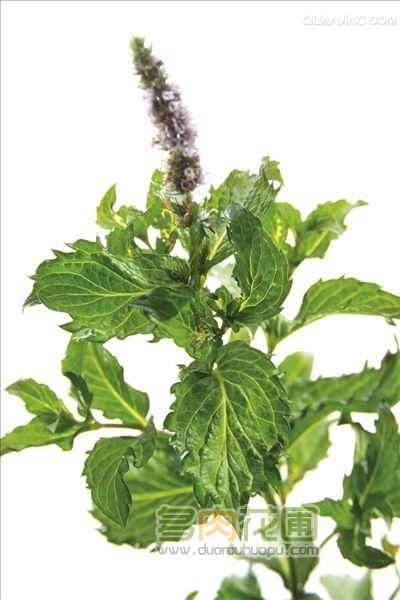
1. Morphological characteristics
Perennial herbaceous plant with a creeping root system, aromatic and cooling in flavor. It has creeping rhizomes with nodes, each node bearing two opposite buds and bud scales. The stems are four-angled, upright, covered with fine hairs on the upper part and only a few fine hairs along the angles on the lower part. The leaves are opposite, oblong-lanceolate to elliptic, 8-10 cm long and 3-5 cm wide, with sharp-pointed tips, relatively flat leaf surfaces, leaf color from bright green to dark green, sunken reticulate veins, deep and sharp serrated leaf margins, and petioles 1-2 cm long covered with fine hairs. The verticillate cymes are axillary, with tubular bell-shaped calyxes. This mint was first discovered and named by Carl Linnaeus when he collected samples in Britain; Linnaeus considered this plant to be a new species, but the academic community has reached a consensus to classify peppermint as a hybrid plant.2. Species distribution
Native to Europe, introduced to the United States in the 19th century, and later spread to Australia, India, China, Japan, Korea, and elsewhere3. Growth habits
It likes warm, humid environments and generally tolerates high temperatures of 40°C during the growing period. The above-ground parts of mature plants gradually wither after heavy frost, while the underground parts can tolerate low temperatures of about -20°C. During the seedling stage, exposure to -6°C only turns the leaf surface dark red without serious damage. Spearmint tastes sweet and mild with a slight coolness, and has a slight grassy aroma and a bitter-pungent taste.4. Main components
The whole plant contains volatile oil, whose main components are menthol, menthone, glucosides and various free amino acids.5. Classification
Green-stem typePurple-stem type
6. Varieties
There are two varieties in production: the green-stem type and the purple-stem type. They are cultivated in the United States, the Soviet Union, Bulgaria, Italy, Morocco, India and other countries, with the United States producing the most.
7. Ornamental and practical applications
A major economic mint, its leaves can be used as a vegetable, eaten cold-tossed or stir-fried, and it is commonly used in Europe to make tea. It can also be used in sauces, beverages, cold dishes, and in cooking sword beans, potatoes, or fish, and is also used in making pastries. In industry it can also be used as a fragrance for soap, and the extracted essential oil is an important flavoring oil in candies, pharmaceuticals and toothpaste. It is also used extensively in chewing gum production. When used medicinally in the tropics, the leaf juice is used together with onion to suppress vomiting, and the essential oil can be used as a deodorant and carminative.Peppermint essential oil skin benefits: increases skin elasticity, anti-aging, soothes sensitivity, fades scars and stretch marks, and can clear toxic congestion in the body, thereby improving eczema, ringworm, scabies and itching. It is cooling, relieves itching, inflammation and burns, and can also soften the skin. It can instantly suppress fever and promote sweating, with excellent effects on colds. Psychological benefits: it can soothe anger, hysteria and fear. It can be used as a sauce, vinegar, vegetable, dessert or made into candy; peppermint oil has a cooling and refreshing effect. It can also be used to flavor beverages, cigarettes, toothpaste and medicines. Its essential oil can treat vomiting, and mint itself is stimulating, aiding digestion and reducing gastrointestinal gas.
Cultivation: Full sunlight, good ventilation, and well-drained sandy loam or deep loamy soil are best. Sow seeds evenly on peat soil, cover lightly with soil and keep moist. Germination is faster at 20-25°C. After germination, let the seedlings receive light as soon as possible to prevent leggy growth. The planting soil must be fertile, moist, alkaline and well-drained. If there is enough light, it can be grown indoors.
How to grow peppermint? An introduction to peppermint cultivation methods and precautions
Peppermint is an annual herbaceous plant of the Lamiaceae family, a widely cultivated hybrid mint native to Europe that can be used as a food seasoning. This mint variety is a hybrid of spearmint and watermint.
Peppermint likes warm, humid environments and generally tolerates high temperatures of 40°C during the growing period. The above-ground parts of mature plants gradually wither after heavy frost, while the underground parts can tolerate low temperatures of about -20°C. During the seedling stage, exposure to -6°C only turns the leaf surface dark red without serious damage. Spearmint tastes sweet and mild with a slight coolness, and has a slight grassy aroma and a bitter-pungent taste.
Cultivation:Full sunlight, good ventilation, and well-drained sandy loam or deep loamy soil are best. Sow seeds evenly on peat soil, cover lightly with soil and keep moist. Germination is faster at 20-25°C. After germination, let the seedlings receive light as soon as possible to prevent leggy growth. The planting soil must be fertile, moist, alkaline and well-drained. If there is enough light, it can be grown indoors.
Propagation:Propagation can be done by seeds, cuttings, seedlings and rhizomes. In production, rhizome and seedling propagation are often used. Rhizome propagation: from late October to early November, dig up rhizomes from the seed plot, select white, thick, short-noded ones, cut them into 10 cm segments, and immediately plant them in pre-dug 10 cm deep furrows. Row spacing 25 cm-30 cm, plant spacing 15 cm. After planting, cover with fine soil. Generally, about 100 kg of white tender new rhizomes are used per mu. Seedling propagation: choose a field with robust plants, uniform growth and no pests or diseases as the seed plot. After the autumn harvest, immediately do one cultivation, weeding and topdressing. In early April of the following year, when the seedlings are 15 cm tall, pull them up and transplant. Dig holes in the transplanting site at a row spacing of 20 cm and plant spacing of 15 cm, planting 2 seedlings per hole. After planting, cover with soil and press firm, then water with dilute manure water to settle the roots.
Summary: The above is an introduction to peppermint care methods. We hope it is helpful to everyone.