Detailed Guide to Growing and Caring for Asparagus Fern
Asparagus fern, also known as asparagus grass. It is a perennial semi-vining green herbaceous plant of the Liliaceae family. It has spindle-shaped fleshy tuberous roots. The leaf-like branches are linear and clustered, the flowers are white or pale pink, and the berries are bright red.
It prefers a warm, humid environment and sunlight, tolerates partial shade, and fears direct strong light. It is suited to loose, fertile, well-drained sandy loam. In northern regions, asparagus fern is usually repotted in mid-to-late April. When repotting, cut away some of the old roots and add a growing medium mixed evenly from 4 parts leaf mold, 4 parts garden soil, and 2 parts river sand.
In spring, water thoroughly once every 2-3 days. If the air is dry at this time, spray water on the plant every day and sprinkle water on the ground around the growing area; in summer, spray water every day and water once every 2-3 days to increase air humidity. Asparagus fern has fleshy roots and fears waterlogging, so it should not be watered too much at ordinary times; in summer, water thoroughly once a day.
From May to September is its vigorous growth period, and it can be given a once every 15-20 days application of decomposed cake fertilizer water. If indoor light is insufficient, it is best to place it outdoors for a period of care in spring and autumn; in winter, place it in a bright indoor spot, keep the room temperature above 5°C, water once every 10-15 days, and spray-wash the branches and leaves once every 3-5 days.
1. Morphological Characteristics
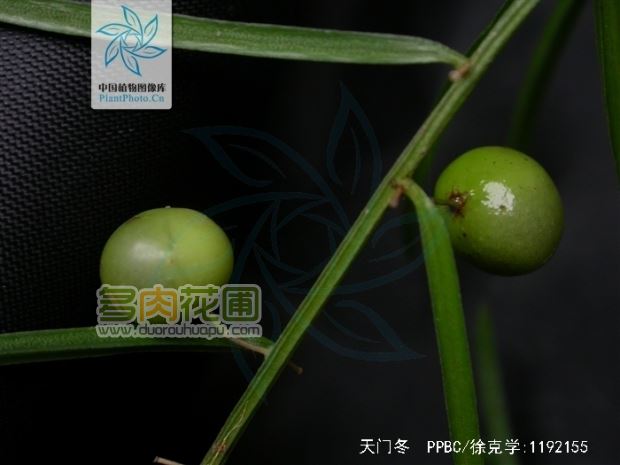
A climbing plant. The roots become spindle-shaped and swollen in the middle or near the ends, with the swollen part 3-5 cm long and 1-2 cm thick. The stem is smooth, often curved or twisted, up to 1-2 m long, and the branches are ridged or narrowly winged. The leaf-like branches are usually in clusters of 3, flat or slightly sharply triangular because of the keeled midrib, slightly sickle-shaped, 0.5-8 cm long and about 1-2 mm wide; the scale-like leaves on the stem extend at the base into hard spines 2.5-3.5 mm long, while the spines on the branches are shorter or inconspicuous. Flowers are usually in pairs in the leaf axils, pale green; pedicels 2-6 mm long; the joint is generally in the middle, sometimes variable in position; male flowers: perianth 2.5-3 mm long; filaments not adnate to the perianth segments; female flowers similar in size to male flowers. Berry 6-7 mm in diameter, red when ripe, with 1 seed. Flowering period May-June, fruiting period August-October.2. Growing Environment
It grows in shady, damp mountain areas. It grows in areas at an altitude of 1750 m, generally along roadsides, on hillsides, in valleys, under sparse forests, and on wasteland, and has not yet been introduced and cultivated artificially. Asparagus fern has strong adaptability, requires extensive management, is easy to cultivate, and is suitable for home care. Asparagus fern prefers fertile sandy soil and is suited to a humid climate and environment, but fears waterlogging and scorching sun. It prefers a warm, humid climate, is not tolerant of severe cold, and avoids drought and standing water. It is best to choose deep, fertile, humus-rich, well-drained loam or sandy loam for cultivation; it should not be planted in clay or poor soil or in places with poor drainage.3. Geographical Distribution
It is distributed from the southern parts of Hebei, Shanxi, Shaanxi, and Gansu provinces to the provinces and regions of East China, Central South China, and Southwest China. It grows on hillsides, roadsides, under sparse forests, in valleys, or on wasteland below an altitude of 1750 m. It is also found in Korea, Japan, Laos, and Vietnam.4. Cultivation Techniques
Planting Methods
Propagate by seed or division. Seed propagation, seedling and transplanting method: harvest in July-August when the fruit turns from green to yellow, rub off the flesh, wash clean, and select large, plump, dark, glossy seeds for sowing. Spring sowing is in March-April; autumn sowing is in August-September. In areas without frost or with a short frost period, autumn sowing gives a higher germination rate and stronger growth. For spring sowing, store the seeds over winter with 2-3 times their volume of moist sand; before sowing, choose a shaded spot under trees with 30% shade to make a seedbed, or build a shade frame. Open horizontal furrows on the seedbed surface, with row spacing 17-20 cm, sowing width 8-10 cm, and depth 3.5 cm; scatter the seeds evenly into the furrows, cover with fine soil or soil mixed with plant ash and farmyard manure, then cover with a thin layer of grass to retain moisture. Cultivate for 1-2 years, then transplant in October or before sprouting in spring, with row spacing and plant spacing of (30-40) cm x (20-25) cm. For division propagation, in March-April before the plants sprout, dig out the roots and divide them into 3-5 clumps, each with 1-2 buds; plant in holes, 1 clump per hole, with row spacing and plant spacing of 30 cm x (20-25) cm, keep moist, and seedlings emerge in 10-15 d.Field Management
Carry out intertillage and weeding 3 times each year: the 1st time in March-April; the 2nd time in June-July, with topdressing of human and livestock manure water, and appropriate application of ammonium sulfate and urea; the 3rd time in September-October, with application of farmyard manure. When the vines grow to about 50 cm, set up supports or stakes for them to twine around, to promote growth.Pest and Disease Control
For the short-whiskered mite, which damages the leaves in May-June, spray with 40% isocarbophos 1500-fold solution or 20% amitraz EC 1000-fold solution for control.Asparagus Fern Growing Methods and Precautions
Soil Requirements for Asparagus Fern
It prefers a warm, humid environment and sunlight, tolerates partial shade, and fears direct strong light. It is suited to loose, fertile, well-drained sandy loam. In northern regions, asparagus fern is usually repotted in mid-to-late April. When repotting, cut away some of the old roots and add a growing medium mixed evenly from 4 parts leaf mold, 4 parts garden soil, and 2 parts river sand.
Watering Methods for Asparagus Fern
In spring, water thoroughly once every 2-3 days. If the air is dry at this time, spray water on the plant every day and sprinkle water on the ground around the growing area; in summer, spray water every day and water once every 2-3 days to increase air humidity. Asparagus fern has fleshy roots and fears waterlogging, so it should not be watered too much at ordinary times; in summer, water thoroughly once a day.
Fertilizing Methods for Asparagus Fern
From May to September is its vigorous growth period, and it can be given a once every 15-20 days application of decomposed cake fertilizer water. If indoor light is insufficient, it is best to place it outdoors for a period of care in spring and autumn; in winter, place it in a bright indoor spot, keep the room temperature above 5°C, water once every 10-15 days, and spray-wash the branches and leaves once every 3-5 days.
Propagation Methods for Asparagus Fern
Asparagus fern is mostly propagated by division, which can be done together with repotting in spring. The mother plant should be a plant more than 3 years old. When dividing, take the mother plant out of the pot and, according to the size of the clump, divide it into several pots, water thoroughly, and place in partial shade for 10-15 days. The seeds mature at the end of December; after harvesting, soak them in water, rub off the fruit skin, and dry them in the sun. Sow in spring; the indoor temperature should not be lower than 15°C, and they will germinate in about one month. When the seedlings are about 4-5 cm long, divide and plant them, with several plants per pot.