How to grow thyme? A complete guide to cultivation methods and precautions
Plants of the genus Thymus are also known in China as dijiao, dihuajiao, shanjiao, shanhujiao, shexiangcao and so on. Thyme is a subshrub whose stems and leaves are fragrant. It is often planted in flower borders, flower beds, rock gardens and herb gardens, or used as ground cover in sunny spots. It is very suitable as a culinary seasoning and has high medicinal value.
The growing environment for thyme must have plenty of light, otherwise the plant will become leggy. It is not demanding about soil, but the soil must drain well; peat moss or potting soil mixed with perlite can be used. The most suitable growing temperature is 20°C to 25°C. Special attention should be paid to the high temperatures of summer; when temperatures are higher, the plant can be trimmed slightly to improve ventilation and placed in a cool spot to get through the summer.
For fertilizing, organic fertilizer can be used as a base fertilizer. During the vigorous growth periods of spring and autumn, dilute Huabao 1000 times and water it in once every 7-10 days. In summer the plant is weaker, so it is best not to fertilize. The branches and leaves can be cut for use at any time before flowering, otherwise the plant is liable to die after flowering and setting seed. If a larger quantity is harvested, it can also be dried for storage.
Thyme can be propagated by seed, cuttings, layering and division, and except for summer, all these methods are suitable. If propagating by seed, because the seeds are very small, broadcasting is better; first water the medium thoroughly, then scatter the seeds evenly on the surface. When the true leaves have grown to 4-6 leaves, the seedlings can first be moved to a smaller container (such as a plug tray), and when the root system has developed well, they can be moved into 3-inch pots for final planting; at planting time, 5-10% organic Dabutie can be added to the potting soil. For cuttings, the terminal bud can be taken as the cutting, preferably with 3-5 nodes, but be careful not to take already woody branches, as their rooting ability is poorer.
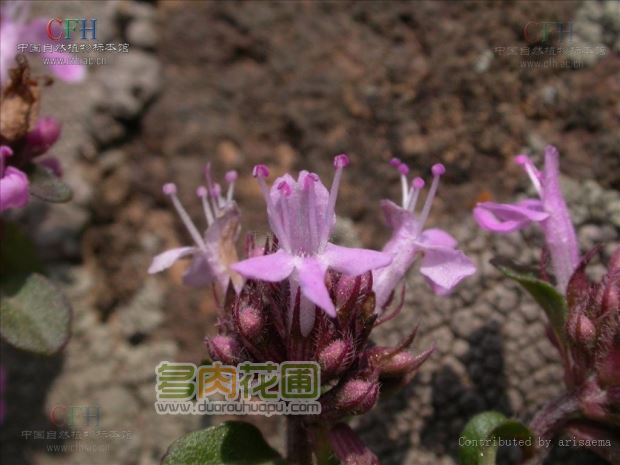
1. Morphological characteristics
Subshrub. Stems numerous, prostrate or ascending; sterile branches arising from the ends or base of the stems, prostrate or ascending, covered with short soft hairs; flowering stems (1.5)2-10 cm tall, densely covered below the inflorescence with spreading soft hairs that are curved downward or slightly spreading, the hairs on the lower part becoming shorter and sparser, with 2-4 pairs of leaves, and with fallen early leaves at the base. Leaves ovate, 4-10 mm long, 2-4.5 mm wide, apex obtuse or slightly acute, base cuneate or gradually narrowed, margin entire or rarely with 1-2 pairs of small serrations, both surfaces hairless, lateral veins 2-3 pairs, slightly raised beneath, glandular dots more or less obvious, petiole obvious, the petiole of the lower leaves about 1/2 as long as the blade, shorter in the upper part; bracts similar in shape to the leaves, with cilia on the lower 1/3 of the margin.Inflorescence capitate, many-flowered or few-flowered, flowers with short pedicels. Calyx tubular-campanulate or narrowly campanulate, 4-4.5 mm long, the lower part covered with soft hairs, the upper part nearly hairless, the lower lip longer than the upper lip or nearly equal to it, the teeth of the upper lip short, not exceeding 1/3 of the total length of the upper lip, triangular, ciliate or hairless. Corolla purplish red, purple or pale purple, pink, 6.5-8 mm long, covered with sparse short soft hairs, the corolla tube elongated, 4-5 mm long, slightly enlarged upward.
Nutlets nearly round or ovate, flattened, smooth. Flowering period July-August.
2. Geographical distribution
Produced in Gansu, Shaanxi, Qinghai, Shanxi, Hebei and Inner Mongolia; grows on stony mountains, slopes, valleys, ravines, roadsides and in thickets, at an altitude of 1100-3600 m. Isotype specimens were collected from the Taohe Basin in Gansu and from Qinghai.3. Growth habits
It likes warmth, light and a dry environment, is not demanding about soil, but grows well in well-drained calcareous soil. Loose, well-drained land, in a sunny spot.4. Cultivation techniques
Cultivation
The growing environment must have plenty of light, otherwise the plant will become leggy. It is not demanding about soil, but the soil must drain well; peat moss or potting soil mixed with perlite can be used. The most suitable growing temperature is 20-25°C. When cultivating in Taiwan, China, attention should be paid to the high temperatures of summer; the plant can be trimmed slightly to improve ventilation and placed in a cool spot to get through the summer.For fertilizing, organic Dabutie can be used as a base fertilizer. During the vigorous growth periods of spring and autumn, dilute Huabao 1000 times and water it in once every 7-10 days. In summer the plant is weaker, so it is best not to fertilize. The branches and leaves can be cut for use at any time before flowering, otherwise the plant is liable to die after flowering and setting seed. If a larger quantity is harvested, it can also be dried for storage.
Raising seedlings
It can be propagated by seed and by division.① Seed propagation method
Sow seeds and raise seedlings in spring from March to April. Because thyme seeds are small, the seedling bed must be carefully prepared, the soil must be fine, crumbly and level, then slightly compacted; after watering, broadcast the seeds, then cover with a thin layer of fine soil, and set up a small arched frame covered with plastic film to keep warm and moist. Seedlings emerge after 10-12 days; remove the film when the temperature is suitable. During the seedling stage, care should be taken to keep the soil moist and to remove weeds. When the seedlings are 10-15 cm tall, they can be planted directly in the field at row and plant spacings of (30-45) cm x (25-30) cm, and watered after planting.
② Division propagation method
Choose plants more than 3 years old; in late March or early April, before they sprout, dig out the mother plant with its roots, then divide it into 4-6 parts according to the size of the clump; each division should have 4-5 buds, and can then be planted. In addition, there is also the cluster division method. During the growing period, cut off the stolons and transplant them.
Field management
After planting, water immediately and take care to keep the soil moist until the seedlings recover. During the growing period, water once a month and loosen the soil by cultivating in time; in the rainy season, pay attention to drainage. Along with watering, topdress with urea 1-2 times according to growth conditions, using about 5 kg per mu each time. Before winter, after watering to overwinter, apply decomposed dry manure and earth up the soil to help it overwinter.5. Main value
Medicinal value
Improves the digestive system and gynecological diseases, promotes blood circulation, enhances immunity, relieves neuralgic pain, and is antibacterial. Helps wound healing and treats eczema and acne-prone skin. Activates brain cells, improves memory and attention, counters depression and soothes emotional trauma. It is very effective against dandruff and for inhibiting hair loss. Antibacterial, antispasmodic, anti-insect-venom, sterilizing, strengthening, and promotes scarring. Strengthens the nerves and prevents nightmares.The leaves can be combined with all kinds of meat, fish and shellfish dishes; brewed as tea it can help digestion, relieve flatulence and sober one up; an infusion with honey added can treat spasmodic cough, colds and sore throat. Bathing with it also has a soothing and nerve-calming effect; the essential oil extracted from it has a sterilizing effect and can be added to freckle creams, helping to remove freckles and improve aging skin, and it can also be used as a material for making soap and mouthwash.
Although thyme does not look very outstanding, its uses are very wide-ranging. Thyme helps digestion, sobers one up, preserves food and acts as a diuretic. Its fresh or dried branches and leaves are generally used in cooking or brewed as an herbal tea. Thyme tea can also relieve headaches caused by a hangover, but the total daily consumption of this kind of aromatic plant is best not to exceed 10 grams, so as not to be too stimulating to the human body. In addition, adding some branches and leaves to bath water also has an invigorating and refreshing effect. If you do not like strongly flavored aromatic plants, it is suggested that you choose thyme, which has a milder scent.
Edible value
Thyme is the whole plant of the Lamiaceae plant Thymus. The stems of thyme are prostrate, rooting at every node, much branched, woody in the lower part, reddish brown; the flowering stems are upright, 3-15 cm tall, with a strong fragrant aroma. Leaves opposite; small, long elliptic or ovate, up to 15 mm long and up to 7 mm wide, margin entire, apex obtuse, base with bristles, with a short petiole. Flowers small, purplish red, clustered at the ends of the branches, forming verticillate spikes: calyx green, calyx tube campanulate, apex 5-lobed, throat hairy; corolla bilabiate, lower lip 3-lobed; stamens 4, didynamous; pistil 1. Nutlets elliptic, located at the bottom of the persistent calyx. Flowering period June-July. It grows on dry, sandy mountain slopes. Distributed in Inner Mongolia, Gansu, Shaanxi, Northeast China and other places. Whenever spring and summer come, patches of thyme are green like a carpet, the small pink flowers are fragrant, sending out wave after wave of fresh scent with the wind. Harvested in June-July, dried in the shade or used fresh.Nutritional analysis:The whole plant contains volatile oil, with the highest content when the flowers are in full bloom. Its main components are various compounds such as thymol, carvacrol, linalool and p-cymene. It has antitussive, anti-inflammatory, preservative and other effects. Thyme contains flavonoid components such as baicalein, glucosides, luteolin-7-glucoside and apigenin, as well as volatile oil; in excess it is strongly irritating and can cause liver degeneration.
Nutrient content
Nutrient
Content
Nutrient
Content
Carbohydrates (g)
0.20
Phosphorus (mg)
42.00
Manganese (mg)
0.94
Calcium (mg)
218.00
Copper (mg)
1.08
Magnesium (mg)
104.00
Vitamin E (mg)
0.11
Zinc (mg)
0.72
Iron (mg)
27.90
Potassium (mg)
470.00
Carotene (mcg)
3510.00
Vitamin A (mcg)
585.00
Sodium (mg)
36.40
Fiber (g)
0.20
Vitamin C (mg)
0.00
Dietary therapeutic effects
Thyme is pungent in flavor and warm in nature; it has the effects of warming the middle and dispelling cold, and dispelling wind and relieving pain;
It mainly treats vomiting, abdominal pain, diarrhea, poor appetite with distension, cough due to wind-cold, swollen throat, toothache, body pain and skin itching.
Ornamental value
As early as 2000 years ago, in the agricultural poems of Roman poets, there are records of using thyme as a spice. When the ancient Greeks sacrificed brave warriors, they would light thyme on the altar, so in Greek thyme symbolizes nobility and courage. Thyme has long been famous as an aromatic herb; the cheese and wine made by the Romans both used it as a seasoning, and it was used as a spice in soups and canned goods. The essential oil extracted from thyme has obvious disinfecting and sterilizing effects, can treat chest infections and other diseases as well as stomach pain and diarrhea caused by catching cold, and has antispasmodic, antitussive, wound-healing and other effects. It can also be used as a flower bed plant.Thyme pictures: thyme cultivation methods and precautions
Thyme is an ornamental plant with a rich fragrance. It can beautify the environment, refresh the mind and wake one up, and can also be purified into essential oil for people to use. However, many people in daily life are not familiar with thyme and do not know what it looks like. In a moment I will sort out its pictures and share them with everyone, and at the same time I will also let everyone understand the methods of growing thyme, as well as what things need attention.
Cultivation methods1. The environment for growing thyme
This plant, thyme, likes a warm environment. Normally it should be placed in a mild environment of 20 to 25 degrees, and it cannot be grown in a hot, humid environment. During hot summer weather, indoor ventilation should be increased, and water should be sprayed on the thyme leaves in time to lower the temperature. In addition, thyme needs plenty of sunlight during its growth process. Normally it should be placed on a sunny balcony or in a sunny room; if there is insufficient sunlight, the plant will become leggy.
2. Fertilizer and water management for thyme
To grow thyme well, fertilizer and water management is especially important. The leaves of this plant are slightly succulent, its drought tolerance is relatively strong, and its tolerance of waterlogging is especially poor. Normally water should not be supplied too much; watering once a week is enough, and the potting soil must not be too wet, nor should water accumulate in the pot, otherwise its roots will rot. This plant, thyme, has relatively low fertilizer requirements, grows slowly, and normally does not need frequent fertilizing; it is enough to fertilize once every half month when thyme is growing vigorously in spring.
PrecautionsWhen growing thyme normally, be sure to pay attention to resting it. During its seedling stage, pinching should be carried out so as to promote branching and shaping. During its growth period, it should also be pruned at any time according to its growth so as to keep the plant looking good, and this is also good for its ventilation and healthy growth. In addition, when growing this plant, thyme, the pot should be changed once every two years, and the soil should be a neutral or alkaline soil with good drainage.